## Summary

This is just a small refactor to move workspace related structs and impl
out from `server.rs` where `Server` is defined and into a new
`workspace.rs`.
## Summary

This PR should help in
https://github.com/astral-sh/ruff-vscode/issues/676.

There are two issues that this is trying to fix all related to the way
shutdown should happen as per the protocol:
1. After the server handled the [shutdown
request](https://microsoft.github.io/language-server-protocol/specifications/lsp/3.17/specification/#shutdown)
and while waiting for the exit notification:

> If a server receives requests after a shutdown request those requests
should error with `InvalidRequest`.

But, we raised an error and exited. This PR fixes it by entering a loop
which responds to any request during this period with `InvalidRequest`

2. If the server received an [exit
notification](https://microsoft.github.io/language-server-protocol/specifications/lsp/3.17/specification/#exit)
but the shutdown request was never received, the server handled that by
logging and exiting with success but as per the spec:

> The server should exit with success code 0 if the shutdown request has
been received before; otherwise with error code 1.

    So, this PR fixes that as well by raising an error in this case.

## Test Plan

I'm not sure how to go about testing this without using a mock server.
## Summary

This PR updates the `ruff.printDebugInformation` command to return the
info as string in the response. Currently, we send a `window/logMessage`
request with the info but that has the disadvantage that it's not
visible to the user directly.

What `rust-analyzer` does with it's `rust-analyzer/status` request which
returns it as a string which then the client can just display it in a
separate window. This is what I'm thinking of doing as well.

Other editors can also benefit from it by directly opening a temporary
file with this information that the user can see directly.

There are couple of options here:
1. Keep using the command, keep the log request and return the string
2. Keep using the command, remove the log request and return the string
3. Create a new request similar to `rust-analyzer/status` which returns
a string

This PR implements (1) but I'd want to move towards (2) and remove the
log request completely. We haven't advertised it as such so this would
only require updating the VS Code extension to handle it by opening a
new document with the debug content.

## Test plan

For VS Code, refer to https://github.com/astral-sh/ruff-vscode/pull/694.

For Neovim, one could do:
```lua
local function execute_ruff_command(command)
  local client = vim.lsp.get_clients({
    bufnr = vim.api.nvim_get_current_buf(),
    name = name,
    method = 'workspace/executeCommand',
  })[1]
  if not client then
    return
  end
  client.request('workspace/executeCommand', {
    command = command,
    arguments = {
      { uri = vim.uri_from_bufnr(0) }
    },
    function(err, result)
      if err then
        -- log error
        return
      end
      vim.print(result)
      -- Or, open a new window with the `result` content
    end
  }
```
## Summary

Related to https://github.com/astral-sh/ruff-vscode/pull/686, this PR
ignores handling source code actions for notebooks which are not
prefixed with `notebook`.

The main motivation is that the native server does not actually handle
it well which results in gibberish code. There's some context about this
in
https://github.com/astral-sh/ruff-vscode/issues/680#issuecomment-2647490812
and the following comments.

closes: https://github.com/astral-sh/ruff-vscode/issues/680

## Test Plan

Running a notebook with the following does nothing except log the
message:
```json
  "notebook.codeActionsOnSave": {
    "source.organizeImports.ruff": "explicit",
  },
```

while, including the `notebook` code actions does make the edit (as
usual):
```json
  "notebook.codeActionsOnSave": {
    "notebook.source.organizeImports.ruff": "explicit"
  },
```
## Summary

fixes: #16041

## Test Plan

Using the [project](https://github.com/bwcc-clan/polebot) in the linked
issue:

Notice how the project "polebot" is in the "play" directory which is
included in the `exclude` setting as:

```toml
exclude = ["play"]
```

**Before this fix**

```
DEBUG ruff:worker:0 ruff_server::resolve: Ignored path via `exclude`: /private/tmp/ruff-test/play/polebot/src/utils/log_tools.py
```

**After this fix**

```
DEBUG ruff:worker:2 ruff_server::resolve: Included path via `include`: /private/tmp/ruff-test/play/polebot/src/utils/log_tools.py
```

I also updated the same project to remove the "play" directory from the
`exclude` setting and made sure that anything under the `polebot/play`
directory is included:

```
DEBUG  ruff:worker:4 ruff_server::resolve: Included path via `include`: /private/tmp/ruff-test/play/polebot/play/test.py
```

And, excluded when I add the directory back:

```
DEBUG  ruff:worker:2 ruff_server::resolve: Ignored path via `exclude`: /private/tmp/ruff-test/play/polebot/play/test.py
```
## Summary

This PR refactors the `RuffSettings` struct to directly include the
resolved `Settings` instead of including the specific fields from it.
The server utilizes a lot of it already, so it makes sense to just
include the entire struct for simplicity.

### `Deref`

I implemented `Deref` on `RuffSettings` to return the `Settings` because
`RuffSettings` is now basically a wrapper around it with the config path
as the other field. This path field is only used for debugging
("printDebugInformation" command).
## Summary

This PR fixes the `show_*_msg` macros to pass all the tokens instead of
just a single token. This allows for using various expressions right in
the macro similar to how it would be in `format_args!`.

## Test Plan

`cargo clippy`
## Summary

This PR creates separate functions to check whether the document path is
excluded for linting or formatting. The main motivation is to avoid the
double `Option` for the call sites and makes passing the correct
settings simpler.
## Summary

I noticed this while trying out
https://github.com/astral-sh/ruff-vscode/issues/665 that we use the
`Display` implementation to show the error which hides the context. This
PR changes it to use the `Debug` implementation and adds the message as
a context.

## Test Plan

**Before:**

```
   0.001228084s ERROR main ruff_server::session::index::ruff_settings: Unable to find editor-specified configuration file: Failed to parse /private/tmp/hatch-test/ruff.toml
```

**After:**

```
   0.002348750s ERROR main ruff_server::session::index::ruff_settings: Unable to load editor-specified configuration file

Caused by:
    0: Failed to parse /private/tmp/hatch-test/ruff.toml
    1: TOML parse error at line 2, column 18
         |
       2 | extend-select = ["ASYNC101"]
         |                  ^^^^^^^^^^
       Unknown rule selector: `ASYNC101`
```
## Summary

The cause of this bug is from
https://github.com/astral-sh/ruff/pull/12575 which was itself a bug fix
but the fix wasn't completely correct.

fixes: #14768
fixes: https://github.com/astral-sh/ruff-vscode/issues/644

## Test Plan

Consider the following three cells:

1.
```python
class Foo:
    def __init__(self):
        self.x = 1

    def __str__(self):
        return f"Foo({self.x})"
```

2.
```python
def hello():
    print("hello world")
```

3.
```python
y = 1
```

The test case is moving cell 2 to the top i.e., cell 2 goes to position
1 and cell 1 goes to position 2.

Before this fix, it can be seen that the cells were pushed at the end of
the vector:

```
  12.643269917s  INFO ruff:main ruff_server::edit:📓 Before update: [
    NotebookCell {
        document: TextDocument {
            contents: "class Foo:\n    def __init__(self):\n        self.x = 1\n\n    def __str__(self):\n        return f\"Foo({self.x})\"",
        },
    },
    NotebookCell {
        document: TextDocument {
            contents: "def hello():\n    print(\"hello world\")",
        },
    },
    NotebookCell {
        document: TextDocument {
            contents: "y = 1",
        },
    },
]
  12.643777667s  INFO ruff:main ruff_server::edit:📓 After update: [
    NotebookCell {
        document: TextDocument {
            contents: "y = 1",
        },
    },
    NotebookCell {
        document: TextDocument {
            contents: "class Foo:\n    def __init__(self):\n        self.x = 1\n\n    def __str__(self):\n        return f\"Foo({self.x})\"",
        },
    },
    NotebookCell {
        document: TextDocument {
            contents: "def hello():\n    print(\"hello world\")",
        },
    },
]
```

After the fix in this PR, it can be seen that the cells are being pushed
at the correct `start` index:

```
   6.520570917s  INFO ruff:main ruff_server::edit:📓 Before update: [
    NotebookCell {
        document: TextDocument {
            contents: "class Foo:\n    def __init__(self):\n        self.x = 1\n\n    def __str__(self):\n        return f\"Foo({self.x})\"",
        },
    },
    NotebookCell {
        document: TextDocument {
            contents: "def hello():\n    print(\"hello world\")",
        },
    },
    NotebookCell {
        document: TextDocument {
            contents: "y = 1",
        },
    },
]
   6.521084792s  INFO ruff:main ruff_server::edit:📓 After update: [
    NotebookCell {
        document: TextDocument {
            contents: "def hello():\n    print(\"hello world\")",
        },
    },
    NotebookCell {
        document: TextDocument {
            contents: "class Foo:\n    def __init__(self):\n        self.x = 1\n\n    def __str__(self):\n        return f\"Foo({self.x})\"",
        },
    },
    NotebookCell {
        document: TextDocument {
            contents: "y = 1",
        },
    },
]
```
## Summary

Refer to the VS Code PR
(https://github.com/astral-sh/ruff-vscode/pull/659) for details on the
change.

This PR changes the following:

1. Add tracing span for both request (request id and method name) and
notification (method name) handler
2. Remove the `RUFF_TRACE` environment variable. This was being used to
turn on / off logging for the server
3. Similarly, remove reading the `trace` value from the initialization
options
4. Remove handling the `$/setTrace` notification
5. Remove the specialized `TraceLogWriter` used for Zed and VS Code
(https://github.com/astral-sh/ruff/pull/12564)

Regarding the (5) for the Zed editor, the reason that was implemented
was because there was no way of looking at the stderr messages in the
editor which has been changed. Now, it captures the stderr as part of
the "Server Logs".
(82492d74a8/crates/language_tools/src/lsp_log.rs (L548-L552))

### Question

Regarding (1), I think having just a simple trace level message should
be good for now as the spans are not hierarchical. This could be tackled
with #12744. The difference between the two:

<details><summary>Using <code>tracing::trace</code></summary>
<p>

```
   0.019243416s DEBUG ThreadId(08) ruff_server::session::index::ruff_settings: Ignored path via `exclude`: /Users/dhruv/playground/ruff/.vscode
   0.026398750s  INFO main ruff_server::session::index: Registering workspace: /Users/dhruv/playground/ruff
   0.026802125s TRACE ruff:main ruff_server::server::api: Received notification "textDocument/didOpen"
   0.026930666s TRACE ruff:main ruff_server::server::api: Received notification "textDocument/didOpen"
   0.026962333s TRACE ruff:main ruff_server::server::api: Received request "textDocument/diagnostic" (1)
   0.027042875s TRACE ruff:main ruff_server::server::api: Received request "textDocument/diagnostic" (2)
   0.027097500s TRACE ruff:main ruff_server::server::api: Received request "textDocument/codeAction" (3)
   0.027107458s DEBUG ruff:worker:0 ruff_server::resolve: Included path via `include`: /Users/dhruv/playground/ruff/lsp/play.py
   0.027123541s DEBUG ruff:worker:3 ruff_server::resolve: Included path via `include`: /Users/dhruv/playground/ruff/lsp/organize_imports.py
   0.027514875s  INFO     ruff:main ruff_server::server: Configuration file watcher successfully registered
   0.285689833s TRACE     ruff:main ruff_server::server::api: Received request "textDocument/codeAction" (4)
  45.741101666s TRACE     ruff:main ruff_server::server::api: Received notification "textDocument/didClose"
  47.108745500s TRACE     ruff:main ruff_server::server::api: Received notification "textDocument/didOpen"
  47.109802041s TRACE     ruff:main ruff_server::server::api: Received request "textDocument/diagnostic" (5)
  47.109926958s TRACE     ruff:main ruff_server::server::api: Received request "textDocument/codeAction" (6)
  47.110027791s DEBUG ruff:worker:6 ruff_server::resolve: Included path via `include`: /Users/dhruv/playground/ruff/lsp/play.py
  51.863679125s TRACE     ruff:main ruff_server::server::api: Received request "textDocument/hover" (7)
```

</p>
</details>

<details><summary>Using <code>tracing::trace_span</code></summary>
<p>

Only logging the enter event:

```
   0.018638750s DEBUG ThreadId(11) ruff_server::session::index::ruff_settings: Ignored path via `exclude`: /Users/dhruv/playground/ruff/.vscode
   0.025895791s  INFO main ruff_server::session::index: Registering workspace: /Users/dhruv/playground/ruff
   0.026378791s TRACE ruff:main notification{method="textDocument/didOpen"}: ruff_server::server::api: enter
   0.026531208s TRACE ruff:main notification{method="textDocument/didOpen"}: ruff_server::server::api: enter
   0.026567583s TRACE ruff:main request{id=1 method="textDocument/diagnostic"}: ruff_server::server::api: enter
   0.026652541s TRACE ruff:main request{id=2 method="textDocument/diagnostic"}: ruff_server::server::api: enter
   0.026711041s DEBUG ruff:worker:2 ruff_server::resolve: Included path via `include`: /Users/dhruv/playground/ruff/lsp/organize_imports.py
   0.026729166s DEBUG ruff:worker:1 ruff_server::resolve: Included path via `include`: /Users/dhruv/playground/ruff/lsp/play.py
   0.027023083s  INFO     ruff:main ruff_server::server: Configuration file watcher successfully registered
   5.197554750s TRACE     ruff:main notification{method="textDocument/didClose"}: ruff_server::server::api: enter
   6.534458000s TRACE     ruff:main notification{method="textDocument/didOpen"}: ruff_server::server::api: enter
   6.535027958s TRACE     ruff:main request{id=3 method="textDocument/diagnostic"}: ruff_server::server::api: enter
   6.535271166s DEBUG ruff:worker:3 ruff_server::resolve: Included path via `include`: /Users/dhruv/playground/ruff/lsp/organize_imports.py
   6.544240583s TRACE     ruff:main request{id=4 method="textDocument/codeAction"}: ruff_server::server::api: enter
   7.049692458s TRACE     ruff:main request{id=5 method="textDocument/codeAction"}: ruff_server::server::api: enter
   7.508142541s TRACE     ruff:main request{id=6 method="textDocument/hover"}: ruff_server::server::api: enter
   7.872421958s TRACE     ruff:main request{id=7 method="textDocument/hover"}: ruff_server::server::api: enter
   8.024498583s TRACE     ruff:main request{id=8 method="textDocument/codeAction"}: ruff_server::server::api: enter
  13.895063666s TRACE     ruff:main request{id=9 method="textDocument/codeAction"}: ruff_server::server::api: enter
  14.774706083s TRACE     ruff:main request{id=10 method="textDocument/hover"}: ruff_server::server::api: enter
  16.058918958s TRACE     ruff:main notification{method="textDocument/didChange"}: ruff_server::server::api: enter
  16.060562208s TRACE     ruff:main request{id=11 method="textDocument/diagnostic"}: ruff_server::server::api: enter
  16.061109083s DEBUG ruff:worker:8 ruff_server::resolve: Included path via `include`: /Users/dhruv/playground/ruff/lsp/play.py
  21.561742875s TRACE     ruff:main notification{method="textDocument/didChange"}: ruff_server::server::api: enter
  21.563573791s TRACE     ruff:main request{id=12 method="textDocument/diagnostic"}: ruff_server::server::api: enter
  21.564206750s DEBUG ruff:worker:4 ruff_server::resolve: Included path via `include`: /Users/dhruv/playground/ruff/lsp/play.py
  21.826691375s TRACE     ruff:main request{id=13 method="textDocument/codeAction"}: ruff_server::server::api: enter
  22.091080125s TRACE     ruff:main request{id=14 method="textDocument/codeAction"}: ruff_server::server::api: enter
```

</p>
</details>


**Todo**

- [x] Update documentation (I'll be adding a troubleshooting section
under "Editors" as a follow-up which is for all editors)
- [x] Check for backwards compatibility. I don't think this should break
backwards compatibility as it's mainly targeted towards improving the
debugging experience.

~**Before I go on to updating the documentation, I'd appreciate initial
review on the chosen approach.**~

resolves: #14959

## Test Plan

Refer to the test plan in
https://github.com/astral-sh/ruff-vscode/pull/659.

Example logs at `debug` level:

```
   0.010770083s DEBUG ThreadId(15) ruff_server::session::index::ruff_settings: Ignored path via `exclude`: /Users/dhruv/playground/ruff/.vscode
   0.018101916s  INFO main ruff_server::session::index: Registering workspace: /Users/dhruv/playground/ruff
   0.018559916s DEBUG ruff:worker:4 ruff_server::resolve: Included path via `include`: /Users/dhruv/playground/ruff/lsp/play.py
   0.018992375s  INFO     ruff:main ruff_server::server: Configuration file watcher successfully registered
  23.408802375s DEBUG ruff:worker:11 ruff_server::resolve: Included path via `include`: /Users/dhruv/playground/ruff/lsp/play.py
  24.329127416s DEBUG  ruff:worker:6 ruff_server::resolve: Included path via `include`: /Users/dhruv/playground/ruff/lsp/play.py
```

Example logs at `trace` level:

```
   0.010296375s DEBUG ThreadId(13) ruff_server::session::index::ruff_settings: Ignored path via `exclude`: /Users/dhruv/playground/ruff/.vscode
   0.017422583s  INFO main ruff_server::session::index: Registering workspace: /Users/dhruv/playground/ruff
   0.018034458s TRACE ruff:main notification{method="textDocument/didOpen"}: ruff_server::server::api: enter
   0.018199708s TRACE ruff:worker:0 request{id=1 method="textDocument/diagnostic"}: ruff_server::server::api: enter
   0.018251167s DEBUG ruff:worker:0 request{id=1 method="textDocument/diagnostic"}: ruff_server::resolve: Included path via `include`: /Users/dhruv/playground/ruff/lsp/play.py
   0.018528708s  INFO     ruff:main ruff_server::server: Configuration file watcher successfully registered
   1.611798417s TRACE ruff:worker:1 request{id=2 method="textDocument/codeAction"}: ruff_server::server::api: enter
   1.861757542s TRACE ruff:worker:4 request{id=3 method="textDocument/codeAction"}: ruff_server::server::api: enter
   7.027361792s TRACE ruff:worker:2 request{id=4 method="textDocument/codeAction"}: ruff_server::server::api: enter
   7.851361500s TRACE ruff:worker:5 request{id=5 method="textDocument/codeAction"}: ruff_server::server::api: enter
   7.901690875s TRACE     ruff:main notification{method="textDocument/didChange"}: ruff_server::server::api: enter
   7.903063167s TRACE ruff:worker:10 request{id=6 method="textDocument/diagnostic"}: ruff_server::server::api: enter
   7.903183500s DEBUG ruff:worker:10 request{id=6 method="textDocument/diagnostic"}: ruff_server::resolve: Included path via `include`: /Users/dhruv/playground/ruff/lsp/play.py
   8.702385292s TRACE      ruff:main notification{method="textDocument/didChange"}: ruff_server::server::api: enter
   8.704106625s TRACE  ruff:worker:3 request{id=7 method="textDocument/diagnostic"}: ruff_server::server::api: enter
   8.704304875s DEBUG  ruff:worker:3 request{id=7 method="textDocument/diagnostic"}: ruff_server::resolve: Included path via `include`: /Users/dhruv/playground/ruff/lsp/play.py
   8.966853458s TRACE  ruff:worker:9 request{id=8 method="textDocument/codeAction"}: ruff_server::server::api: enter
   9.229622792s TRACE  ruff:worker:6 request{id=9 method="textDocument/codeAction"}: ruff_server::server::api: enter
  10.513111583s TRACE  ruff:worker:7 request{id=10 method="textDocument/codeAction"}: ruff_server::server::api: enter
```
## Summary

This PR fixes a bug in the Ruff language server where the
editor-specified configuration was resolved relative to the
configuration directory and not the current working directory.

The existing behavior is confusing given that this config file is
specified by the user and is not _discovered_ by Ruff itself. The
behavior of resolving this configuration file should be similar to that
of the `--config` flag on the command-line which uses the current
working directory:
3210f1a23b/crates/ruff/src/resolve.rs (L34-L48)

This creates problems where certain configuration options doesn't work
because the paths resolved in that case are relative to the
configuration directory and not the current working directory in which
the editor is expected to be in. For example, the
`lint.per-file-ignores` doesn't work as mentioned in the linked issue
along with `exclude`, `extend-exclude`, etc.

fixes: #14282

## Test Plan

Using the following directory tree structure:
```
.
├── .config
│   └── ruff.toml
└── src
    └── migrations
        └── versions
            └── a.py
```

where, the `ruff.toml` is:
```toml
# 1. Comment this out to test `per-file-ignores`
extend-exclude = ["**/versions/*.py"]

[lint]
select = ["D"]

# 2. Comment this out to test `extend-exclude`
[lint.per-file-ignores]
"**/versions/*.py" = ["D"]

# 3. Comment both `per-file-ignores` and `extend-exclude` to test selection works
```

And, the content of `a.py`:
```py
"""Test"""
```

And, the VS Code settings:
```jsonc
{
  "ruff.nativeServer": "on",
  "ruff.path": ["/Users/dhruv/work/astral/ruff/target/debug/ruff"],
  // For single-file mode where current working directory is `/`
  // "ruff.configuration": "/tmp/ruff-repro/.config/ruff.toml",
  // When a workspace is opened containing this path
  "ruff.configuration": "./.config/ruff.toml",
  "ruff.trace.server": "messages",
  "ruff.logLevel": "trace"
}
```

I also tested out just opening the file in single-file mode where the
current working directory is `/` in VS Code. Here, the
`ruff.configuration` needs to be updated to use absolute path as shown
in the above VS Code settings.
## Summary

The implicit namespace package rule currently fails to detect cases like
the following:

```text
foo/
├── __init__.py
└── bar/
    └── baz/
        └── __init__.py
```

The problem is that we detect a root at `foo`, and then an independent
root at `baz`. We _would_ detect that `bar` is an implicit namespace
package, but it doesn't contain any files! So we never check it, and
have no place to raise the diagnostic.

This PR adds detection for these kinds of nested packages, and augments
the `INP` rule to flag the `__init__.py` file above with a specialized
message. As a side effect, I've introduced a dedicated `PackageRoot`
struct which we can pass around in lieu of Yet Another `Path`.

For now, I'm only enabling this in preview (and the approach doesn't
affect any other rules). It's a bug fix, but it may end up expanding the
rule.

Closes https://github.com/astral-sh/ruff/issues/13519.
## Summary

This PR updates the language server to avoid indexing the workspace for
single-file mode.

**What's a single-file mode?**

When a user opens the file directly in an editor, and not the folder
that represents the workspace, the editor usually can't determine the
workspace root. This means that during initializing the server, the
`workspaceFolders` field will be empty / nil.

Now, in this case, the server defaults to using the current working
directory which is a reasonable default assuming that the directory
would point to the one where this open file is present. This would allow
the server to index the directory itself for any config file, if
present.

It turns out that in VS Code the current working directory in the above
scenario is the system root directory `/` and so the server will try to
index the entire root directory which would take a lot of time. This is
the issue as described in
https://github.com/astral-sh/ruff-vscode/issues/627. To reproduce, refer
https://github.com/astral-sh/ruff-vscode/issues/627#issuecomment-2401440767.

This PR updates the indexer to avoid traversing the workspace to read
any config file that might be present. The first commit
(8dd2a31eef)
refactors the initialization and introduces two structs `Workspaces` and
`Workspace`. The latter struct includes a field to determine whether
it's the default workspace. The second commit
(61fc39bdb6)
utilizes this field to avoid traversing.

Closes: #11366

## Editor behavior

This is to document the behavior as seen in different editors. The test
scenario used has the following directory tree structure:
```
.
├── nested
│   ├── nested.py
│   └── pyproject.toml
└── test.py
```

where, the contents of the files are:

**test.py**
```py
import os
```

**nested/nested.py**
```py
import os
import math
```

**nested/pyproject.toml**
```toml
[tool.ruff.lint]
select = ["I"]
```

Steps:
1. Open `test.py` directly in the editor
2. Validate that it raises the `F401` violation
3. Open `nested/nested.py` in the same editor instance
4. This file would raise only `I001` if the `nested/pyproject.toml` was
indexed

### VS Code

When (1) is done from above, the current working directory is `/` which
means the server will try to index the entire system to build up the
settings index. This will include the `nested/pyproject.toml` file as
well. This leads to bad user experience because the user would need to
wait for minutes for the server to finish indexing.

This PR avoids that by not traversing the workspace directory in
single-file mode. But, in VS Code, this means that per (4), the file
wouldn't raise `I001` but only raise two `F401` violations because the
`nested/pyproject.toml` was never resolved.

One solution here would be to fix this in the extension itself where we
would detect this scenario and pass in the workspace directory that is
the one containing this open file in (1) above.

### Neovim

**tl;dr** it works as expected because the client considers the presence
of certain files (depending on the server) as the root of the workspace.
For Ruff, they are `pyproject.toml`, `ruff.toml`, and `.ruff.toml`. This
means that the client notifies us as the user moves between single-file
mode and workspace mode.

https://github.com/astral-sh/ruff/pull/13770#issuecomment-2416608055

### Helix

Same as Neovim, additional context in
https://github.com/astral-sh/ruff/pull/13770#issuecomment-2417362097

### Sublime Text

**tl;dr** It works similar to VS Code except that the current working
directory of the current process is different and thus the config file
is never read. So, the behavior remains unchanged with this PR.

https://github.com/astral-sh/ruff/pull/13770#issuecomment-2417362097

### Zed

Zed seems to be starting a separate language server instance for each
file when the editor is running in a single-file mode even though all
files have been opened in a single editor instance.

(Separated the logs into sections separated by a single blank line
indicating 3 different server instances that the editor started for 3
files.)

```
   0.000053375s  INFO main ruff_server::server: No workspace settings found for file:///Users/dhruv/projects/ruff-temp, using default settings
   0.009448792s  INFO main ruff_server::session::index: Registering workspace: /Users/dhruv/projects/ruff-temp
   0.009906334s DEBUG ruff:main ruff_server::resolve: Included path via `include`: /Users/dhruv/projects/ruff-temp/test.py
   0.011775917s  INFO ruff:main ruff_server::server: Configuration file watcher successfully registered

   0.000060583s  INFO main ruff_server::server: No workspace settings found for file:///Users/dhruv/projects/ruff-temp/nested, using default settings
   0.010387125s  INFO main ruff_server::session::index: Registering workspace: /Users/dhruv/projects/ruff-temp/nested
   0.011061875s DEBUG ruff:main ruff_server::resolve: Included path via `include`: /Users/dhruv/projects/ruff-temp/nested/nested.py
   0.011545208s  INFO ruff:main ruff_server::server: Configuration file watcher successfully registered

   0.000059125s  INFO main ruff_server::server: No workspace settings found for file:///Users/dhruv/projects/ruff-temp/nested, using default settings
   0.010857583s  INFO main ruff_server::session::index: Registering workspace: /Users/dhruv/projects/ruff-temp/nested
   0.011428958s DEBUG ruff:main ruff_server::resolve: Included path via `include`: /Users/dhruv/projects/ruff-temp/nested/other.py
   0.011893792s  INFO ruff:main ruff_server::server: Configuration file watcher successfully registered
```

## Test Plan

When using the `ruff` server from this PR, we see that the server starts
quickly as seen in the logs. Next, when I switch to the release binary,
it starts indexing the root directory.

For more details, refer to the "Editor Behavior" section above.
## Summary

This PR adds support for VS Code specific cell metadata to consider when
collecting valid code cells.

For context, Ruff only runs on valid code cells. These are the code
cells that doesn't contain cell magics. Previously, Ruff only used the
notebook's metadata to determine whether it's a Python notebook. But, in
VS Code, a notebook's preferred language might be Python but it could
still contain code cells for other languages. This can be determined
with the `metadata.vscode.languageId` field.

### References:
* https://code.visualstudio.com/docs/languages/identifiers
* e6c009a3d4/extensions/ipynb/src/serializers.ts (L104-L107)
*
e6c009a3d4/extensions/ipynb/src/serializers.ts (L117-L122)

This brings us one step closer to fixing #12281.

## Test Plan

Add test cases for `is_valid_python_code_cell` and an integration test
case which showcase running it end to end. The test notebook contains a
JavaScript code cell and a Python code cell.
## Summary

Related to https://github.com/astral-sh/ruff-vscode/issues/571, this PR
updates the settings index builder to trace all the errors it
encountered. Without this, there's no way for user to know that
something failed and some of the capability might not work as expected.
For example, in the linked PR, the settings were invalid which means
notebooks weren't included and there were no log messages for it.

## Test Plan

Create an invalid `ruff.toml` file:
```toml
[tool.ruff]
extend-exclude = ["*.ipynb"]
```

Logs:
```
2024-08-12 18:33:09.873 [info] [Trace - 6:33:09 PM]   12.217043000s ERROR ruff:main ruff_server::session::index::ruff_settings: Failed to parse /Users/dhruv/playground/ruff/pyproject.toml
```

Notification Preview:

<img width="483" alt="Screenshot 2024-08-12 at 18 33 20"
src="https://github.com/user-attachments/assets/a4f303e5-f073-454f-bdcd-ba6af511e232">

Another way to trigger is to provide an invalid `cache-dir` value:
```toml
[tool.ruff]
cache-dir = "$UNKNOWN"
```

Same notification preview but different log message:
```
2024-08-12 18:41:37.571 [info] [Trace - 6:41:37 PM]   21.700112208s ERROR ThreadId(30) ruff_server::session::index::ruff_settings: Error while resolving settings from /Users/dhruv/playground/ruff/pyproject.toml: Invalid `cache-dir` value: error looking key 'UNKNOWN' up: environment variable not found
```

With multiple `pyproject.toml` file:
```
2024-08-12 18:41:15.887 [info] [Trace - 6:41:15 PM]    0.016636833s ERROR ThreadId(04) ruff_server::session::index::ruff_settings: Error while resolving settings from /Users/dhruv/playground/ruff/pyproject.toml: Invalid `cache-dir` value: error looking key 'UNKNOWN' up: environment variable not found

2024-08-12 18:41:15.888 [info] [Trace - 6:41:15 PM]    0.017378833s ERROR ThreadId(13) ruff_server::session::index::ruff_settings: Failed to parse /Users/dhruv/playground/ruff/tools/pyproject.toml
```
## Summary

Follow-up from https://github.com/astral-sh/ruff/pull/12725, this is
just a small refactor to use a wrapper struct instead of type alias for
workspace settings index. This avoids the need to have the
`register_workspace_settings` as a static method on `Index` and instead
is a method on the new struct itself.
## Summary

This PR updates the server to ignore non-file workspace URL.

This is to avoid crashing the server if the URL scheme is not "file".
We'd still raise an error if the URL to file path conversion fails.

Also, as per the docs of
[`to_file_path`](https://docs.rs/url/2.5.2/url/struct.Url.html#method.to_file_path):

> Note: This does not actually check the URL’s scheme, and may give
nonsensical results for other schemes. It is the user’s responsibility
to check the URL’s scheme before calling this.

resolves: #12660

## Test Plan

I'm not sure how to test this locally but the change is small enough to
validate on its own.
## Summary

This pull request adds support for logging via `$/logTrace` RPC
messages. It also enables that code path for when a client is Zed editor
or VS Code (as there's no way for us to generically tell whether a client prefers
`$/logTrace` over stderr.

Related to: #12523

## Test Plan

I've built Ruff from this branch and tested it manually with Zed.

---------

Co-authored-by: Dhruv Manilawala <dhruvmanila@gmail.com>
## Summary

When working on improving Ruff integration with Zed I noticed that it
errors out when we try to resolve a code action of a `QUICKFIX` kind;
apparently, per @dhruvmanila we shouldn't need to resolve it, as the
edit is provided in the initial response for the code action. However,
it's possible for the `resolve` call to fill out other fields (such as
`command`).
AFAICT Helix also tries to resolve the code actions unconditionally (as
in, when either `edit` or `command` is absent); so does VSC. They can
still apply the quickfixes though, as they do not error out on a failed
call to resolve code actions - Zed does. Following suit on Zed's side
does not cut it though, as we still get a log request from Ruff for that
failure (which is surfaced in the UI).
There are also other language servers (such as
[rust-analyzer](c1c9e10f72/crates/rust-analyzer/src/handlers/request.rs (L1257)))
that fill out both `command` and `edit` fields as a part of code action
resolution.

This PR makes the resolve calls for quickfix actions return the input
value.

## Test Plan

N/A
## Summary

This PR removes the requirement of `--preview` flag to run the `ruff
server` and instead considers it to be an indicator to turn on preview
mode for the linter and the formatter.

resolves: #12161

## Test Plan

Add test cases to assert the `preview` value is updated accordingly.

In an editor context, I used the local `ruff` executable in Neovim with
the `--preview` flag and verified that the preview-only violations are
being highlighted.

Running with:
```lua
require('lspconfig').ruff.setup({
  cmd = {
    '/Users/dhruv/work/astral/ruff/target/debug/ruff',
    'server',
    '--preview',
  },
})
```
The screenshot shows that `E502` is highlighted with the below config in
`pyproject.toml`:

<img width="877" alt="Screenshot 2024-07-17 at 16 43 09"
src="https://github.com/user-attachments/assets/c7016ef3-55b1-4a14-bbd3-a07b1bcdd323">
## Summary

This PR updates the settings index building logic in the language server
to consider the fallback settings for applying ignore filters in
`WalkBuilder` and the exclusion via `exclude` / `extend-exclude`.

This flow matches the one in the `ruff` CLI where the root settings is
built by (1) finding the workspace setting in the ancestor directory (2)
finding the user configuration if that's missing and (3) fallback to
using the default configuration.

Previously, the index building logic was being executed before (2) and
(3). This PR reverses the logic so that the exclusion /
`respect_gitignore` is being considered from the default settings if
there's no workspace / user settings. This has the benefit that the
server no longer enters the `.git` directory or any other excluded
directory when a user opens a file in the home directory.

Related to #11366

## Test plan

Opened a test file from the home directory and confirmed with the debug
trace (removed in #12360) that the server excludes the `.git` directory
when indexing.
## Summary

This PR updates the server to build the settings index in parallel using
similar logic as `python_files_in_path`.

This should help with https://github.com/astral-sh/ruff/issues/11366 but
ideally we would want to build it lazily.

## Test Plan

`cargo insta test`
## Summary

This PR fixes the bug where the server was not considering the
`cells.structure.didOpen` field to sync up the new content of the newly
added cells.

The parameters corresponding to this request provides two fields to get
the newly added cells:
1. `cells.structure.array.cells`: This is a list of `NotebookCell` which
doesn't contain any cell content. The only useful information from this
array is the cell kind and the cell document URI which we use to
initialize the new cell in the index.
2. `cells.structure.didOpen`: This is a list of `TextDocumentItem` which
corresponds to the newly added cells. This actually contains the text
content and the version.

This wasn't a problem before because we initialize the cell with an
empty string and this isn't a problem when someone just creates an empty
cell. But, when someone copy-pastes a cell, the cell needs to be
initialized with the content.

fixes: #12201

## Test Plan

First, let's see the panic in action:

1. Press <kbd>Esc</kbd> to allow using the keyboard to perform cell
actions (move around, copy, paste, etc.)
2. Copy the second cell with <kbd>c</kbd> key
3. Delete the second cell with <kbd>dd</kbd> key
4. Paste the copied cell with <kbd>p</kbd> key

You can see that the content isn't synced up because the `unused-import`
for `sys` is still being highlighted but it's being used in the second
cell. And, the hover isn't working either. Then, as I start editing the
second cell, it panics.


https://github.com/astral-sh/ruff/assets/67177269/fc58364c-c8fc-4c11-a917-71b6dd90c1ef

Now, here's the preview of the fixed version:


https://github.com/astral-sh/ruff/assets/67177269/207872dd-dca6-49ee-8b6e-80435c7ef22e
## Summary

This PR fixes various bugs for computing the replacement range between
the original and modified source for the language server.

1. When finding the end offset of the source and modified range, we
should apply `zip` on the reversed iterator. The bug was that it was
reversing the already zipped iterator. The problem here is that the
length of both slices aren't going to be the same unless the source
wasn't modified at all. Refer to the [Rust
playground](https://play.rust-lang.org/?version=stable&mode=debug&edition=2021&gist=44f860d31bd26456f3586b6ab530c22f)
where you can see this in action.
2. Skip the first line when computing the start offset because the first
line start value will always be 0 and the default value of the source /
modified range start is also 0. So, comparing 0 and 0 is not useful
which means we can skip the first value.
3. While iterating in the reverse direction, we should only stop if the
line start is strictly less than the source start i.e., we should use
`<` instead of `<=`.

fixes: #12128

## Test Plan

Add test cases where the text is being inserted, deleted, and replaced
between the original and new source code, validate the replacement
ranges.
## Summary

Follow-up to #11902

This PR simplifies the `LinterResult` struct by avoiding the generic and
not store the `ParseError`.

This is possible because the callers already have access to the
`ParseError` via the `Parsed` output. This also means that we can
simplify the return type of `check_path` and avoid the generic `T` on
`LinterResult`.

## Test Plan

`cargo insta test`
## Summary

This PR updates the way syntax errors are handled throughout the linter.

The main change is that it's now not considered as a rule which involves
the following changes:
* Update `Message` to be an enum with two variants - one for diagnostic
message and the other for syntax error message
* Provide methods on the new message enum to query information required
by downstream usages

This means that the syntax errors cannot be hidden / disabled via any
disablement methods. These are:
1. Configuration via `select`, `ignore`, `per-file-ignores`, and their
`extend-*` variants
	```console
$ cargo run -- check ~/playground/ruff/src/lsp.py --extend-select=E999
--no-preview --no-cache
	    Finished `dev` profile [unoptimized + debuginfo] target(s) in 0.10s
Running `target/debug/ruff check /Users/dhruv/playground/ruff/src/lsp.py
--extend-select=E999 --no-preview --no-cache`
warning: Rule `E999` is deprecated and will be removed in a future
release. Syntax errors will always be shown regardless of whether this
rule is selected or not.
/Users/dhruv/playground/ruff/src/lsp.py:1:8: F401 [*] `abc` imported but
unused
	  |
	1 | import abc
	  |        ^^^ F401
	2 | from pathlib import Path
	3 | import os
	  |
	  = help: Remove unused import: `abc`
	```
3. Command-line flags via `--select`, `--ignore`, `--per-file-ignores`,
and their `--extend-*` variants
	```console
$ cargo run -- check ~/playground/ruff/src/lsp.py --no-cache
--config=~/playground/ruff/pyproject.toml
	    Finished `dev` profile [unoptimized + debuginfo] target(s) in 0.11s
Running `target/debug/ruff check /Users/dhruv/playground/ruff/src/lsp.py
--no-cache --config=/Users/dhruv/playground/ruff/pyproject.toml`
warning: Rule `E999` is deprecated and will be removed in a future
release. Syntax errors will always be shown regardless of whether this
rule is selected or not.
/Users/dhruv/playground/ruff/src/lsp.py:1:8: F401 [*] `abc` imported but
unused
	  |
	1 | import abc
	  |        ^^^ F401
	2 | from pathlib import Path
	3 | import os
	  |
	  = help: Remove unused import: `abc`
	```

This also means that the **output format** needs to be updated:
1. The `code`, `noqa_row`, `url` fields in the JSON output is optional
(`null` for syntax errors)
2. Other formats are changed accordingly
For each format, a new test case specific to syntax errors have been
added. Please refer to the snapshot output for the exact format for
syntax error message.

The output of the `--statistics` flag will have a blank entry for syntax
errors:
```
315     F821    [ ] undefined-name
119             [ ] syntax-error
103     F811    [ ] redefined-while-unused
```

The **language server** is updated to consider the syntax errors by
convert them into LSP diagnostic format separately.

### Preview

There are no quick fixes provided to disable syntax errors. This will
automatically work for `ruff-lsp` because the `noqa_row` field will be
`null` in that case.
<img width="772" alt="Screenshot 2024-06-26 at 14 57 08"
src="https://github.com/astral-sh/ruff/assets/67177269/aaac827e-4777-4ac8-8c68-eaf9f2c36774">

Even with `noqa` comment, the syntax error is displayed:
<img width="763" alt="Screenshot 2024-06-26 at 14 59 51"
src="https://github.com/astral-sh/ruff/assets/67177269/ba1afb68-7eaf-4b44-91af-6d93246475e2">

Rule documentation page:
<img width="1371" alt="Screenshot 2024-06-26 at 16 48 07"
src="https://github.com/astral-sh/ruff/assets/67177269/524f01df-d91f-4ac0-86cc-40e76b318b24">


## Test Plan

- [x] Disablement methods via config shows a warning
	- [x] `select`, `extend-select`
	- [ ] ~`ignore`~ _doesn't show any message_
- [ ] ~`per-file-ignores`, `extend-per-file-ignores`~ _doesn't show any
message_
- [x] Disablement methods via command-line flag shows a warning
	- [x] `--select`, `--extend-select`
	- [ ] ~`--ignore`~ _doesn't show any message_
- [ ] ~`--per-file-ignores`, `--extend-per-file-ignores`~ _doesn't show
any message_
- [x] File with syntax errors should exit with code 1
- [x] Language server
	- [x] Should show diagnostics for syntax errors
	- [x] Should not recommend a quick fix edit for adding `noqa` comment
	- [x] Same for `ruff-lsp`

resolves: #8447
## Summary
Fixes#11651.
Fixes#11851.
We were double-closing a notebook document from the index, once in
`textDocument/didClose` and then in the `notebookDocument/didClose`
handler. The second time this happens, taking a snapshot fails.
I've rewritten how we handle snapshots for closing notebooks / notebook
cells so that any failure is simply logged instead of propagating
upwards. This implementation works consistently even if we don't receive
`textDocument/didClose` notifications for each specific cell, since they
get closed (and the diagnostics get cleared) in the notebook document
removal process.
## Test Plan
1. Open an untitled, unsaved notebook with the `Create: New Jupyter
Notebook` command from the VS Code command palette (`Ctrl/Cmd + Shift +
P`)
2. Without saving the document, close it.
3. No error popup should appear.
4. Run the debug command (`Ruff: print debug information`) to confirm
that there are no open documents
## Summary
Closes#11914.
This PR introduces a snapshot test that replays the LSP requests made
during a document formatting request, and confirms that the notebook
document is updated in the expected way.
## Summary
Fixes#11911.
`shellexpand` is now used on `logFile` to expand the file path, allowing
the usage of `~` and environment variables.
## Test Plan
1. Set `logFile` in either Neovim or Helix to a file path that needs
expansion, like `~/.config/helix/ruff_logs.txt`.
2. Ensure that `RUFF_TRACE` is set to `messages` or `verbose`
3. Open a Python file in Neovim/Helix
4. Confirm that a file at the path specified was created, with the
expected logs.
## Summary

Fixes https://github.com/astral-sh/ruff-vscode/issues/496.

Cells are no longer removed from the notebook index when a notebook gets
updated, but rather when `textDocument/didClose` is called for them.
This solves an issue where their premature removal from the notebook
cell index would cause their URL to be un-queryable in the
`textDocument/didClose` handler.

## Test Plan

Create and then delete a notebook cell in VS Code. No error should
appear.
## Summary

This PR updates the server capabilities to include the commands that
Ruff supports. This is similar to how there's a list of possible code
actions supported by the server.

I noticed this when I was trying to find whether Helix supported
workspace commands or not based on Jane's comment
(https://github.com/astral-sh/ruff/pull/11831#discussion_r1634984921)
and I found the `:lsp-workspace-command` in the editor but it didn't
show up anything in the picker.

So, I looked at the implementation in Helix
(9c479e6d2d/helix-term/src/commands/typed.rs (L1372-L1384))
which made me realize that Ruff doesn't provide this in its
capabilities. Currently, this does require `ruff` to be first in the
list of language servers in the user config but that should be resolved
by https://github.com/helix-editor/helix/pull/10176. So, the following
config should work:

```toml
[[language]]
name = "python"
# Ruff should come first until https://github.com/helix-editor/helix/pull/10176 is released
language-servers = ["ruff", "pyright"]
```

## Test Plan

1. Neovim's server capabilities output should include the supported
commands:

```
  executeCommandProvider = {
    commands = { "ruff.applyFormat", "ruff.applyAutofix", "ruff.applyOrganizeImports", "ruff.printDebugInformation" },
    workDoneProgress = false
  },
```

2. Helix should now display the commands to pick from when
`:lsp-workspace-command` is invoked:

<img width="832" alt="Screenshot 2024-06-13 at 08 47 14"
src="https://github.com/astral-sh/ruff/assets/67177269/09048ecd-c974-4e09-ab56-9482ff3d780b">
## Summary
Fixes#11744.
We now show a distinct popup message when we fail to get a document
snapshot during command execution. This message more clearly
communicates the issue to the user, instead of a generic "ruff
encountered an error" message.
## Test Plan
Try running `Fix all auto-fixable problems` on an incompatible file (for
example: `settings.json`). You should see the following popup message:
<img width="456" alt="Screenshot 2024-06-11 at 11 47 16 AM"
src="https://github.com/astral-sh/ruff/assets/19577865/3a28e3d7-3896-4dd0-b117-f87300dd3b68">
## Summary
Closes#11715.
Introduces a new command, `ruff.printDebugInformation`. This will print
useful information about the status of the server to `stderr`.
Right now, the information shown by this command includes:
* The path to the server executable
* The version of the executable
* The text encoding being used
* The number of open documents and workspaces
* A list of registered configuration files
* The capabilities of the client
## Test Plan
First, checkout and use [the corresponding `ruff-vscode`
PR](https://github.com/astral-sh/ruff-vscode/pull/495).
Running the `Print debug information` command in VS Code should show
something like the following in the Output channel:
<img width="991" alt="Screenshot 2024-06-11 at 11 41 46 AM"
src="https://github.com/astral-sh/ruff/assets/19577865/ab93c009-bb7b-4291-b057-d44fdc6f9f86">
## Summary
Fixes#10968.
Fixes#11545.
The server's tracing system has been rewritten from the ground up. The
server now has trace level and log level settings which restrict the
tracing events and spans that get logged.
* A `logLevel` setting has been added, which lets a user set the log
level. By default, it is set to `"info"`.
* A `logFile` setting has also been added, which lets the user supply an
optional file to send tracing output (it does not have to exist as a
file yet). By default, if this is unset, tracing output will be sent to
`stderr`.
* A `$/setTrace` handler has also been added, and we also set the trace
level from the initialization options. For editors without direct
support for tracing, the environment variable `RUFF_TRACE` can override
the trace level.
* Small changes have been made to how we display tracing output. We no
longer use `tracing-tree`, and instead use
`tracing_subscriber::fmt::Layer` to format output. Thread names are now
included in traces, and I've made some adjustment to thread worker names
to be more useful.
## Test Plan
In VS Code, with `ruff.trace.server` set to its default value, no logs
from Ruff should appear.
After changing `ruff.trace.server` to either `messages` or `verbose`,
you should see log messages at `info` level or higher appear in Ruff's
output:
<img width="1005" alt="Screenshot 2024-06-10 at 10 35 04 AM"
src="https://github.com/astral-sh/ruff/assets/19577865/6050d107-9815-4bd2-96d0-e86f096a57f5">
In Helix, by default, no logs from Ruff should appear.
To set the trace level in Helix, you'll need to modify your language
configuration as follows:
```toml
[language-server.ruff]
command = "/Users/jane/astral/ruff/target/debug/ruff"
args = ["server", "--preview"]
environment = { "RUFF_TRACE" = "messages" }
```
After doing this, logs of `info` level or higher should be visible in
Helix:
<img width="1216" alt="Screenshot 2024-06-10 at 10 39 26 AM"
src="https://github.com/astral-sh/ruff/assets/19577865/8ff88692-d3f7-4fd1-941e-86fb338fcdcc">
You can use `:log-open` to quickly open the Helix log file.
In Neovim, by default, no logs from Ruff should appear.
To set the trace level in Neovim, you'll need to modify your
configuration as follows:
```lua
require('lspconfig').ruff.setup {
cmd = {"/path/to/debug/executable", "server", "--preview"},
cmd_env = { RUFF_TRACE = "messages" }
}
```
You should see logs appear in `:LspLog` that look like the following:
<img width="1490" alt="Screenshot 2024-06-11 at 11 24 01 AM"
src="https://github.com/astral-sh/ruff/assets/19577865/576cd5fa-03cf-477a-b879-b29a9a1200ff">
You can adjust `logLevel` and `logFile` in `settings`:
```lua
require('lspconfig').ruff.setup {
cmd = {"/path/to/debug/executable", "server", "--preview"},
cmd_env = { RUFF_TRACE = "messages" },
settings = {
logLevel = "debug",
logFile = "your/log/file/path/log.txt"
}
}
```
The `logLevel` and `logFile` can also be set in Helix like so:
```toml
[language-server.ruff.config.settings]
logLevel = "debug"
logFile = "your/log/file/path/log.txt"
```
Even if this log file does not exist, it should now be created and
written to after running the server:
<img width="1148" alt="Screenshot 2024-06-10 at 10 43 44 AM"
src="https://github.com/astral-sh/ruff/assets/19577865/ab533cf7-d5ac-4178-97f1-e56da17450dd">
## Summary

This PR updates the parser to remove building the `CommentRanges` and
instead it'll be built by the linter and the formatter when it's
required.

For the linter, it'll be built and owned by the `Indexer` while for the
formatter it'll be built from the `Tokens` struct and passed as an
argument.

## Test Plan

`cargo insta test`
## Summary

As-is, we're using the URL path for all files, leading us to use paths
like:

```
/c%3A/Users/crmar/workspace/fastapi/tests/main.py
```

This doesn't match against per-file ignores and other patterns in Ruff
configuration.

This PR modifies the LSP to use the real file path if available, and the
virtual file path if not.

Closes https://github.com/astral-sh/ruff/issues/11751.

## Test Plan

Ran the LSP on Windows. In the FastAPI repo, added:

```toml
[tool.ruff.lint.per-file-ignores]
"tests/**/*.py" = ["F401"]
```

And verified that an unused import was ignored in `tests` after this
change, but not before.
## Summary

Fixes https://github.com/astral-sh/ruff-vscode/issues/482.

I've made adjustments to `format` and `format_range` that handle parsing
errors before they become server errors. We'll still log this as a
problem, but there will no longer be a visible popup.

## Test Plan

Instead of seeing a visible error when formatting a document with syntax
issues, you should see this warning in the LSP logs:

<img width="991" alt="Screenshot 2024-06-04 at 3 38 23 PM"
src="https://github.com/astral-sh/ruff/assets/19577865/9d68947d-6462-4ca6-ab5a-65e573c91db6">

Similarly, if you try to format a range with syntax issues, you should
see this warning in the LSP logs instead of a visible error popup:

<img width="1010" alt="Screenshot 2024-06-04 at 3 39 10 PM"
src="https://github.com/astral-sh/ruff/assets/19577865/99fff098-798d-406a-976e-81ead0da0352">

---------

Co-authored-by: Zanie Blue <contact@zanie.dev>
## Summary

This PR updates the entire parser stack in multiple ways:

### Make the lexer lazy

* https://github.com/astral-sh/ruff/pull/11244
* https://github.com/astral-sh/ruff/pull/11473

Previously, Ruff's lexer would act as an iterator. The parser would
collect all the tokens in a vector first and then process the tokens to
create the syntax tree.

The first task in this project is to update the entire parsing flow to
make the lexer lazy. This includes the `Lexer`, `TokenSource`, and
`Parser`. For context, the `TokenSource` is a wrapper around the `Lexer`
to filter out the trivia tokens[^1]. Now, the parser will ask the token
source to get the next token and only then the lexer will continue and
emit the token. This means that the lexer needs to be aware of the
"current" token. When the `next_token` is called, the current token will
be updated with the newly lexed token.

The main motivation to make the lexer lazy is to allow re-lexing a token
in a different context. This is going to be really useful to make the
parser error resilience. For example, currently the emitted tokens
remains the same even if the parser can recover from an unclosed
parenthesis. This is important because the lexer emits a
`NonLogicalNewline` in parenthesized context while a normal `Newline` in
non-parenthesized context. This different kinds of newline is also used
to emit the indentation tokens which is important for the parser as it's
used to determine the start and end of a block.

Additionally, this allows us to implement the following functionalities:
1. Checkpoint - rewind infrastructure: The idea here is to create a
checkpoint and continue lexing. At a later point, this checkpoint can be
used to rewind the lexer back to the provided checkpoint.
2. Remove the `SoftKeywordTransformer` and instead use lookahead or
speculative parsing to determine whether a soft keyword is a keyword or
an identifier
3. Remove the `Tok` enum. The `Tok` enum represents the tokens emitted
by the lexer but it contains owned data which makes it expensive to
clone. The new `TokenKind` enum just represents the type of token which
is very cheap.

This brings up a question as to how will the parser get the owned value
which was stored on `Tok`. This will be solved by introducing a new
`TokenValue` enum which only contains a subset of token kinds which has
the owned value. This is stored on the lexer and is requested by the
parser when it wants to process the data. For example:
8196720f80/crates/ruff_python_parser/src/parser/expression.rs (L1260-L1262)

[^1]: Trivia tokens are `NonLogicalNewline` and `Comment`

### Remove `SoftKeywordTransformer`

* https://github.com/astral-sh/ruff/pull/11441
* https://github.com/astral-sh/ruff/pull/11459
* https://github.com/astral-sh/ruff/pull/11442
* https://github.com/astral-sh/ruff/pull/11443
* https://github.com/astral-sh/ruff/pull/11474

For context,
https://github.com/RustPython/RustPython/pull/4519/files#diff-5de40045e78e794aa5ab0b8aacf531aa477daf826d31ca129467703855408220
added support for soft keywords in the parser which uses infinite
lookahead to classify a soft keyword as a keyword or an identifier. This
is a brilliant idea as it basically wraps the existing Lexer and works
on top of it which means that the logic for lexing and re-lexing a soft
keyword remains separate. The change here is to remove
`SoftKeywordTransformer` and let the parser determine this based on
context, lookahead and speculative parsing.

* **Context:** The transformer needs to know the position of the lexer
between it being at a statement position or a simple statement position.
This is because a `match` token starts a compound statement while a
`type` token starts a simple statement. **The parser already knows
this.**
* **Lookahead:** Now that the parser knows the context it can perform
lookahead of up to two tokens to classify the soft keyword. The logic
for this is mentioned in the PR implementing it for `type` and `match
soft keyword.
* **Speculative parsing:** This is where the checkpoint - rewind
infrastructure helps. For `match` soft keyword, there are certain cases
for which we can't classify based on lookahead. The idea here is to
create a checkpoint and keep parsing. Based on whether the parsing was
successful and what tokens are ahead we can classify the remaining
cases. Refer to #11443 for more details.

If the soft keyword is being parsed in an identifier context, it'll be
converted to an identifier and the emitted token will be updated as
well. Refer
8196720f80/crates/ruff_python_parser/src/parser/expression.rs (L487-L491).

The `case` soft keyword doesn't require any special handling because
it'll be a keyword only in the context of a match statement.

### Update the parser API

* https://github.com/astral-sh/ruff/pull/11494
* https://github.com/astral-sh/ruff/pull/11505

Now that the lexer is in sync with the parser, and the parser helps to
determine whether a soft keyword is a keyword or an identifier, the
lexer cannot be used on its own. The reason being that it's not
sensitive to the context (which is correct). This means that the parser
API needs to be updated to not allow any access to the lexer.

Previously, there were multiple ways to parse the source code:
1. Passing the source code itself
2. Or, passing the tokens

Now that the lexer and parser are working together, the API
corresponding to (2) cannot exists. The final API is mentioned in this
PR description: https://github.com/astral-sh/ruff/pull/11494.

### Refactor the downstream tools (linter and formatter)

* https://github.com/astral-sh/ruff/pull/11511
* https://github.com/astral-sh/ruff/pull/11515
* https://github.com/astral-sh/ruff/pull/11529
* https://github.com/astral-sh/ruff/pull/11562
* https://github.com/astral-sh/ruff/pull/11592

And, the final set of changes involves updating all references of the
lexer and `Tok` enum. This was done in two-parts:
1. Update all the references in a way that doesn't require any changes
from this PR i.e., it can be done independently
	* https://github.com/astral-sh/ruff/pull/11402
	* https://github.com/astral-sh/ruff/pull/11406
	* https://github.com/astral-sh/ruff/pull/11418
	* https://github.com/astral-sh/ruff/pull/11419
	* https://github.com/astral-sh/ruff/pull/11420
	* https://github.com/astral-sh/ruff/pull/11424
2. Update all the remaining references to use the changes made in this
PR

For (2), there were various strategies used:
1. Introduce a new `Tokens` struct which wraps the token vector and add
methods to query a certain subset of tokens. These includes:
	1. `up_to_first_unknown` which replaces the `tokenize` function
2. `in_range` and `after` which replaces the `lex_starts_at` function
where the former returns the tokens within the given range while the
latter returns all the tokens after the given offset
2. Introduce a new `TokenFlags` which is a set of flags to query certain
information from a token. Currently, this information is only limited to
any string type token but can be expanded to include other information
in the future as needed. https://github.com/astral-sh/ruff/pull/11578
3. Move the `CommentRanges` to the parsed output because this
information is common to both the linter and the formatter. This removes
the need for `tokens_and_ranges` function.

## Test Plan

- [x] Update and verify the test snapshots
- [x] Make sure the entire test suite is passing
- [x] Make sure there are no changes in the ecosystem checks
- [x] Run the fuzzer on the parser
- [x] Run this change on dozens of open-source projects

### Running this change on dozens of open-source projects

Refer to the PR description to get the list of open source projects used
for testing.

Now, the following tests were done between `main` and this branch:
1. Compare the output of `--select=E999` (syntax errors)
2. Compare the output of default rule selection
3. Compare the output of `--select=ALL`

**Conclusion: all output were same**

## What's next?

The next step is to introduce re-lexing logic and update the parser to
feed the recovery information to the lexer so that it can emit the
correct token. This moves us one step closer to having error resilience
in the parser and provides Ruff the possibility to lint even if the
source code contains syntax errors.
## Summary

Closes https://github.com/astral-sh/ruff/issues/11587.

## Test Plan

- Added a lint error to `test_server.py` in `vscode-ruff`.
- Validated that, prior to this change, diagnostics appeared in the
file.
- Validated that, with this change, no diagnostics were shown.
- Validated that, with this change, no diagnostics were fixed on-save.
## Summary

This PR fixes the bug to avoid flattening the global-only settings for
the new server.

This was added in https://github.com/astral-sh/ruff/pull/11497, possibly
to correctly de-serialize an empty value (`{}`). But, this lead to a bug
where the configuration under the `settings` key was not being read for
global-only variant.

By using #[serde(default)], we ensure that the settings field in the
`GlobalOnly` variant is optional and that an empty JSON object `{}` is
correctly deserialized into `GlobalOnly` with a default `ClientSettings`
instance.

fixes: #11507

## Test Plan

Update the snapshot and existing test case. Also, verify the following
settings in Neovim:

1. Nothing

```lua
ruff = {
  cmd = {
    '/Users/dhruv/work/astral/ruff/target/debug/ruff',
    'server',
    '--preview',
  },
}
```

2. Empty dictionary

```lua
ruff = {
  cmd = {
    '/Users/dhruv/work/astral/ruff/target/debug/ruff',
    'server',
    '--preview',
  },
  init_options = vim.empty_dict(),
}
```

3. Empty `settings`

```lua
ruff = {
  cmd = {
    '/Users/dhruv/work/astral/ruff/target/debug/ruff',
    'server',
    '--preview',
  },
  init_options = {
    settings = vim.empty_dict(),
  },
}
```

4. With some configuration:

```lua
ruff = {
  cmd = {
    '/Users/dhruv/work/astral/ruff/target/debug/ruff',
    'server',
    '--preview',
  },
  init_options = {
    settings = {
      configuration = '/tmp/ruff-repro/pyproject.toml',
    },
  },
}
```
## Summary
Fixes#11506.
`RuffSettingsIndex::new` now searches for configuration files in parent
directories.
## Test Plan
I confirmed that the original test case described in the issue worked as
expected.
## Summary
Fixes#11534.
`DocumentQuery::source_type` now returns `PySourceType::Stub` when the
document is a `.pyi` file.
## Test Plan
I confirmed that stub-specific rule violations appeared with a build
from this PR (they were not visible from a `main` build).
<img width="1066" alt="Screenshot 2024-05-24 at 2 15 38 PM"
src="https://github.com/astral-sh/ruff/assets/19577865/cd519b7e-21e4-41c8-bc30-43eb6d4d438e">
## Summary
Fixes#11516
`ruff server` was sending both regular source actions and notebook
source actions back when passed an empty action filter. This PR makes a
few small changes so that notebook source actions are not sent when
regular source actions are sent, which means that an empty filter will
only return regular source actions.
## Test Plan
I confirmed that duplicate code actions no longer appeared in Neovim,
using a configuration similar to the one from the original issue.
<img width="509" alt="Screenshot 2024-05-23 at 11 48 48 PM"
src="https://github.com/astral-sh/ruff/assets/19577865/9a5d6907-dd41-48bd-b015-8a344c5e0b3f">
## Summary

Fixes https://github.com/astral-sh/ruff/issues/11236.

This PR fixes several issues, most of which relate to non-VS Code
editors (Helix and Neovim).

1. Global-only initialization options are now correctly deserialized
from Neovim and Helix
2. Empty diagnostics are now published correctly for Neovim and Helix.
3. A workspace folder is created at the current working directory if the
initialization parameters send an empty list of workspace folders.
4. The server now gracefully handles opening files outside of any known
workspace, and will use global fallback settings taken from client
editor settings and a user settings TOML, if it exists.

## Test Plan

I've tested to confirm that each issue has been fixed.

* Global-only initialization options are now correctly deserialized from
Neovim and Helix + the server gracefully handles opening files outside
of any known workspace


https://github.com/astral-sh/ruff/assets/19577865/4f33477f-20c8-4e50-8214-6608b1a1ea6b

* Empty diagnostics are now published correctly for Neovim and Helix


https://github.com/astral-sh/ruff/assets/19577865/c93f56a0-f75d-466f-9f40-d77f99cf0637

* A workspace folder is created at the current working directory if the
initialization parameters send an empty list of workspace folders.


https://github.com/astral-sh/ruff/assets/19577865/b4b2e818-4b0d-40ce-961d-5831478cc726
## Summary

Recent changes made in the [Jupyter Notebook feature
PR](https://github.com/astral-sh/ruff/pull/11206) caused automatic
configuration reloading to stop working. This was because we would check
for paths to reload using the changed path, when we should have been
using the parent path of the changed path (to get the directory it was
changed in).

Additionally, this PR fixes an issue where `ruff.toml` and `.ruff.toml`
files were not being automatically reloaded.

Finally, this PR improves configuration reloading by actively publishing
diagnostics for notebook documents (which won't be affected by the
workspace refresh since they don't use pull diagnostics). It will also
publish diagnostics for text documents if pull diagnostics aren't
supported.

## Test Plan
To test this, open an existing configuration file in a codebase, and
make modifications that will affect one or more open Python / Jupyter
Notebook files. You should observe that the diagnostics for both kinds
of files update automatically when the file changes are saved.

Here's a test video showing what a successful test should look like:


https://github.com/astral-sh/ruff/assets/19577865/7172b598-d6de-4965-b33c-6cb8b911ef6c
## Summary

Previously, `ruff.applyFormat`, seen in VS Code as the command `Ruff:
Format Document`, would only format the currently active notebook cell
inside a notebook document. This PR makes `ruff.applyFormat` format the
entire notebook document at once, operating on each code cell in order.

## Test Plan

1. Open a notebook document that has multiple unformatted code cells.
2. Run `Ruff: Format Document` through the Command Palette
(`Ctrl/Cmd+Shift+P` by default)
3. Observe that all code cells in the notebook have been formatted.
## Summary
Closes https://github.com/astral-sh/ruff/issues/10858.
`ruff server` now supports `*.ipynb` (aka Jupyter Notebook) files.
Extensive internal changes have been made to facilitate this, which I've
done some work to contextualize with documentation and an pre-review
that highlights notable sections of the code.
`*.ipynb` cells should behave similarly to `*.py` documents, with one
major exception. The format command `ruff.applyFormat` will only apply
to the currently selected notebook cell - if you want to format an
entire notebook document, use `Format Notebook` from the VS Code context
menu.
## Test Plan
The VS Code extension does not yet have Jupyter Notebook support
enabled, so you'll first need to enable it manually. To do this,
checkout the `pre-release` branch and modify `src/common/server.ts` as
follows:
Before:

After:

I recommend testing this PR with large, complicated notebook files. I
used notebook files from [this popular
repository](https://github.com/jakevdp/PythonDataScienceHandbook/tree/master/notebooks)
in my preliminary testing.
The main thing to test is ensuring that notebook cells behave the same
as Python documents, besides the aforementioned issue with
`ruff.applyFormat`. You should also test adding and deleting cells (in
particular, deleting all the code cells and ensure that doesn't break
anything), changing the kind of a cell (i.e. from markup -> code or vice
versa), and creating a new notebook file from scratch. Finally, you
should also test that source actions work as expected (and across the
entire notebook).
Note: `ruff.applyAutofix` and `ruff.applyOrganizeImports` are currently
broken for notebook files, and I suspect it has something to do with
https://github.com/astral-sh/ruff/issues/11248. Once this is fixed, I
will update the test plan accordingly.
---------
Co-authored-by: nolan <nolan.king90@gmail.com>
## Summary

Alternative to #11237

This PR adds a new `Tokens` struct which is a newtype wrapper around a
vector of lexer output. This allows us to add a `kinds` method which
returns an iterator over the corresponding `TokenKind`. This iterator is
implemented as a separate `TokenKindIter` struct to allow using the type
and provide additional methods like `peek` directly on the iterator.

This exposes the linter to access the stream of `TokenKind` instead of
`Tok`.

Edit: I've made the necessary downstream changes and plan to merge the
entire stack at once.
## Summary

Fixes https://github.com/astral-sh/ruff/issues/10594.

Code actions to disable a diagnostic via `noqa` comment are now
available.


https://github.com/astral-sh/ruff/assets/19577865/6d3bcf11-a9d9-499b-8c7f-a10cd39cfbba

`DiagnosticFix` has been changed so that `noqa` code actions appear even
for diagnostics with no available quick fix. It can contain quick fix
edits, `noqa` comment edits, or both.

## Test Plan

The scenarios that need to be tested are as follows:
* A code action to disable a diagnostic should be available for every
diagnostic.
* Using this code action should append to the appropriate line with the
diagnostic, or modify an existing `noqa` comment.
* Adding a `noqa` comment manually should make a diagnostic disappear
* `Fix all auto-fixable problems` should not add `noqa` comments
* Removing a code from a `noqa` comment should make the diagnostic
re-appear
## Summary

A follow-up to https://github.com/astral-sh/ruff/pull/11222. `ruff
server` stalls during shutdown with Neovim because after it receives an
exit notification and closes the I/O thread, it attempts to log a
success message to `stderr`. Removing this log statement fixes this
issue.

## Test Plan

Track the instances of `ruff` in the OS task manager as you open and
close Neovim. A new instance should appear when Neovim starts and it
should disappear once Neovim is closed.
## Summary

Fixes https://github.com/astral-sh/ruff/issues/11258.

This PR fixes the settings resolver to match the expected behavior when
file-based configuration is not available.

## Test Plan

In a workspace with no file-based configuration, set a setting in your
editor and confirm that this setting is used instead of the default.
## Summary
Users can now include tildes and environment variables in the provided
path, just like with `--config`.
Closes#11277.
## Test Plan
Set the configuration path to `"ruff.configuration": "~/x.toml"`;
verified that the server attempted to read from `/Users/crmarsh/x.toml`.
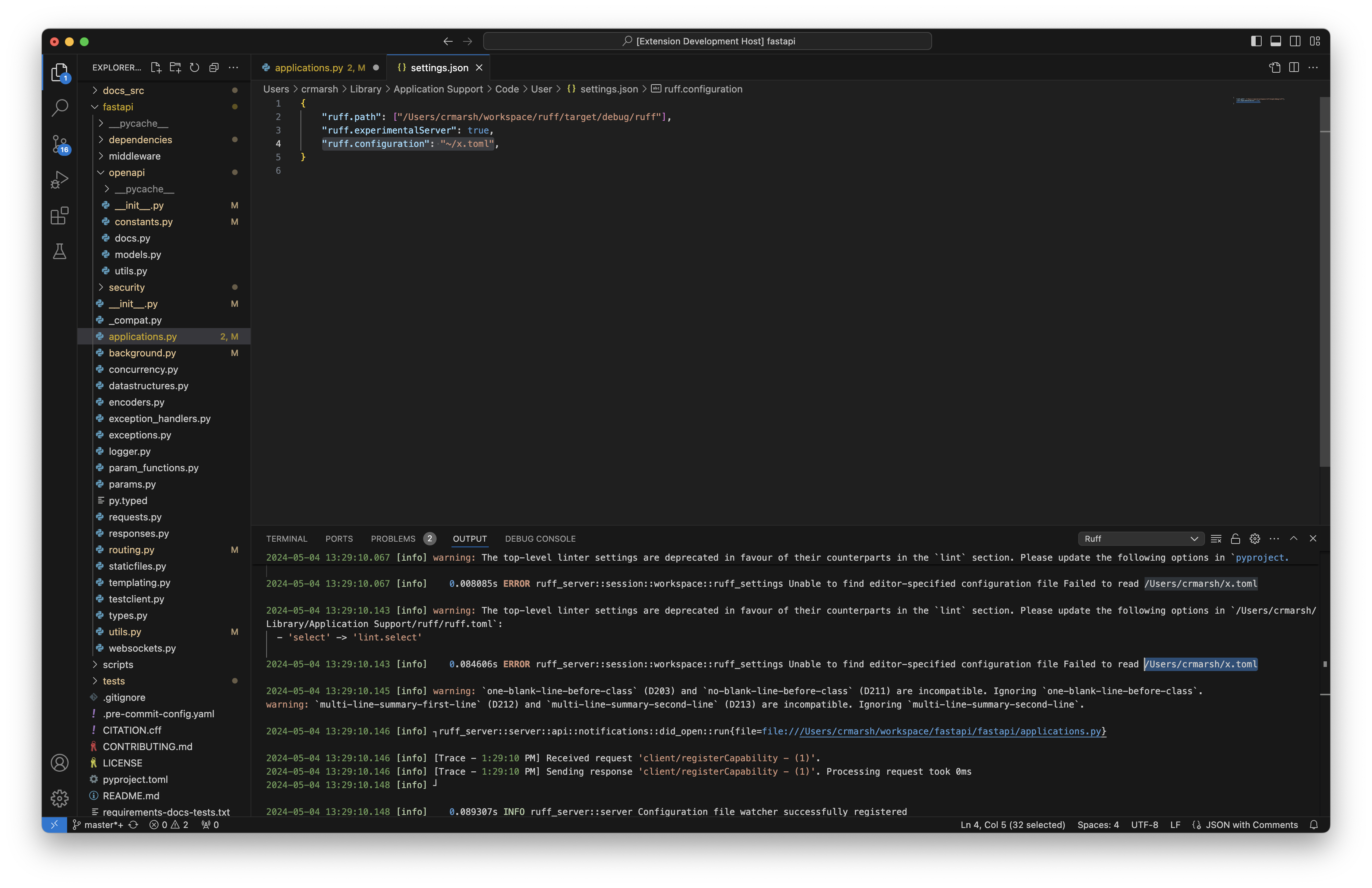
## Summary

Fixes https://github.com/astral-sh/ruff/issues/11207.

The server would hang after handling a shutdown request on
`IoThreads::join()` because a global sender (`MESSENGER`, used to send
`window/showMessage` notifications) would remain allocated even after
the event loop finished, which kept the writer I/O thread channel open.

To fix this, I've made a few structural changes to `ruff server`. I've
wrapped the send/receive channels and thread join handle behind a new
struct, `Connection`, which facilitates message sending and receiving,
and also runs `IoThreads::join()` after the event loop finishes. To
control the number of sender channels, the `Connection` wraps the sender
channel in an `Arc` and only allows the creation of a wrapper type,
`ClientSender`, which hold a weak reference to this `Arc` instead of
direct channel access. The wrapper type implements the channel methods
directly to prevent access to the inner channel (which would allow the
channel to be cloned). ClientSender's function is analogous to
[`WeakSender` in
`tokio`](https://docs.rs/tokio/latest/tokio/sync/mpsc/struct.WeakSender.html).
Additionally, the receiver channel cannot be accessed directly - the
`Connection` only exposes an iterator over it.

These changes will guarantee that all channels are closed before the I/O
threads are joined.

## Test Plan

Repeatedly open and close an editor utilizing `ruff server` while
observing the task monitor. The net total amount of open `ruff`
instances should be zero once all editor windows have closed.

The following logs should also appear after the server is shut down:

<img width="835" alt="Screenshot 2024-04-30 at 3 56 22 PM"
src="https://github.com/astral-sh/ruff/assets/19577865/404b74f5-ef08-4bb4-9fa2-72e72b946695">

This can be tested on VS Code by changing the settings and then checking
`Output`.
## Summary

This PR removes the `ImportMap` implementation and all its routing
through ruff.

The import map was added in https://github.com/astral-sh/ruff/pull/3243
but we then never ended up using it to do cross file analysis.

We are now working on adding multifile analysis to ruff, and revisit
import resolution as part of it.


```
hyperfine --warmup 10 --runs 20 --setup "./target/release/ruff clean" \
              "./target/release/ruff check crates/ruff_linter/resources/test/cpython -e -s --extend-select=I" \
              "./target/release/ruff-import check crates/ruff_linter/resources/test/cpython -e -s --extend-select=I"
Benchmark 1: ./target/release/ruff check crates/ruff_linter/resources/test/cpython -e -s --extend-select=I
  Time (mean ± σ):      37.6 ms ±   0.9 ms    [User: 52.2 ms, System: 63.7 ms]
  Range (min … max):    35.8 ms …  39.8 ms    20 runs

Benchmark 2: ./target/release/ruff-import check crates/ruff_linter/resources/test/cpython -e -s --extend-select=I
  Time (mean ± σ):      36.0 ms ±   0.7 ms    [User: 50.3 ms, System: 58.4 ms]
  Range (min … max):    34.5 ms …  37.6 ms    20 runs

Summary
  ./target/release/ruff-import check crates/ruff_linter/resources/test/cpython -e -s --extend-select=I ran
    1.04 ± 0.03 times faster than ./target/release/ruff check crates/ruff_linter/resources/test/cpython -e -s --extend-select=I
```

I suspect that the performance improvement should even be more
significant for users that otherwise don't have any diagnostics.


```
hyperfine --warmup 10 --runs 20 --setup "cd ../ecosystem/airflow && ../../ruff/target/release/ruff clean" \
              "./target/release/ruff check ../ecosystem/airflow -e -s --extend-select=I" \
              "./target/release/ruff-import check ../ecosystem/airflow -e -s --extend-select=I"
Benchmark 1: ./target/release/ruff check ../ecosystem/airflow -e -s --extend-select=I
  Time (mean ± σ):      53.7 ms ±   1.8 ms    [User: 68.4 ms, System: 63.0 ms]
  Range (min … max):    51.1 ms …  58.7 ms    20 runs

Benchmark 2: ./target/release/ruff-import check ../ecosystem/airflow -e -s --extend-select=I
  Time (mean ± σ):      50.8 ms ±   1.4 ms    [User: 50.7 ms, System: 60.9 ms]
  Range (min … max):    48.5 ms …  55.3 ms    20 runs

Summary
  ./target/release/ruff-import check ../ecosystem/airflow -e -s --extend-select=I ran
    1.06 ± 0.05 times faster than ./target/release/ruff check ../ecosystem/airflow -e -s --extend-select=I

```

## Test Plan

`cargo test`
## Summary
Fixes#11185Fixes#11214
Document path and package information is now forwarded to the Ruff
linter, which allows `per-file-ignores` to correctly match against the
file name. This also fixes an issue where the import sorting rule didn't
distinguish between third-party and first-party packages since we didn't
pass in the package root.
## Test Plan
`per-file-ignores` should ignore files as expected. One quick way to
check is by adding this to your `pyproject.toml`:
```toml
[tool.ruff.lint.per-file-ignores]
"__init__.py" = ["ALL"]
```
Then, confirm that no diagnostics appear when you add code to an
`__init__.py` file (besides syntax errors).
The import sorting fix can be verified by failing to reproduce the
original issue - an `I001` diagnostic should not appear in
`other_module.py`.
## Summary

Fixes https://github.com/astral-sh/ruff/issues/11158.

A settings file in the ruff user configuration directory will be used as
a configuration fallback, if it exists.

## Test Plan

Create a `pyproject.toml` or `ruff.toml` configuration file in the ruff
user configuration directory.

* On Linux, that will be `$XDG_CONFIG_HOME/ruff/` or `$HOME/.config`
* On macOS, that will be `$HOME/Library/Application Support`
* On Windows, that will be `{FOLDERID_LocalAppData}`

Then, open a file inside of a workspace with no configuration. The
settings in the user configuration file should be used.
## Summary
Closes#10985.
The server now supports a custom TOML configuration file as a client
setting. The setting must be an absolute path to a file. If the file is
called `pyproject.toml`, the server will attempt to parse it as a
pyproject file - otherwise, it will attempt to parse it as a `ruff.toml`
file, even if the file has a name besides `ruff.toml`.
If an option is set in both the custom TOML configuration file and in
the client settings directly, the latter will be used.
## Test Plan
1. Create a `ruff.toml` file outside of the workspace you are testing.
Set an option that is different from the one in the configuration for
your test workspace.
2. Set the path to the configuration in NeoVim:
```lua
require('lspconfig').ruff.setup {
init_options = {
settings = {
configuration = "absolute/path/to/your/configuration"
}
}
}
```
3. Confirm that the option in the configuration file is used, regardless
of what the option is set to in the workspace configuration.
4. Add the same option, with a different value, to the NeoVim
configuration directly. For example:
```lua
require('lspconfig').ruff.setup {
init_options = {
settings = {
configuration = "absolute/path/to/your/configuration",
lint = {
select = []
}
}
}
}
```
5. Confirm that the option set in client settings is used, regardless of
the value in either the custom configuration file or in the workspace
configuration.
## Summary

This is intended to address
https://github.com/astral-sh/ruff-vscode/issues/425, and is a follow-up
to https://github.com/astral-sh/ruff/pull/11062.

A new client setting is now supported by the server,
`prioritizeFileConfiguration`. This is a boolean setting (default:
`false`) that, if set to `true`, will instruct the configuration
resolver to prioritize file configuration (aka discovered TOML files)
over configuration passed in by the editor.

A corresponding extension PR has been opened, which makes this setting
available for VS Code:
https://github.com/astral-sh/ruff-vscode/pull/457.

## Test Plan

To test this with VS Code, you'll need to check out [the VS Code
PR](https://github.com/astral-sh/ruff-vscode/pull/457) that adds this
setting.

The test process is similar to
https://github.com/astral-sh/ruff/pull/11062, but in scenarios where the
editor configuration would take priority over file configuration, file
configuration should take priority.
## Summary
Fixes#11114.
As part of the `onClose` handler, we publish an empty array of
diagnostics for the document being closed, similar to
[`ruff-lsp`](187d7790be/ruff_lsp/server.py (L459-L464)).
This prevent phantom diagnostics from lingering after a document is
closed. We'll only do this if the client doesn't support pull
diagnostics, because otherwise clearing diagnostics is their
responsibility.
## Test Plan
Diagnostics should no longer appear for a document in the Problems tab
after the document is closed.
<!--
Thank you for contributing to Ruff! To help us out with reviewing,
please consider the following:

- Does this pull request include a summary of the change? (See below.)
- Does this pull request include a descriptive title?
- Does this pull request include references to any relevant issues?
-->

## Summary

Add support for hover menu to ruff_server, as requested in
[10595](https://github.com/astral-sh/ruff/issues/10595).
Majority of new code is in hover.rs.
I reused the regex from ruff-lsp's implementation. Also reused the
format_rule_text function from ruff/src/commands/rule.rs
Added capability registration in server.rs, and added the handler to
api.rs.

## Test Plan

Tested in NVIM v0.10.0-dev-2582+g2a8cef6bd, configured with lspconfig
using the default options (other than cmd pointing to my test build,
with options "server" and "--preview"). OS: Ubuntu 24.04, kernel
6.8.0-22.

---------

Co-authored-by: Jane Lewis <me@jane.engineering>
 Dhruv Manilawala
 Micha Reiser
 Josiah Outram Halstead
 Dimitri Papadopoulos Orfanos
 Charlie Marsh
 Piotr Osiewicz
 T-256
T-256
 renovate[bot]
 Jane Lewis
 Nolan
Nolan