Previously we just omitted diagnostic summaries when using `--fix` or
`--diff` with a stdin file. Now, we still write the summaries to stderr
instead of the main writer (which is generally stdout but could be
changed by `--output-file`).
Rebase of https://github.com/astral-sh/ruff/pull/5119 authored by
@evanrittenhouse with additional refinements.

## Changes

- Adds `--unsafe-fixes` / `--no-unsafe-fixes` flags to `ruff check`
- Violations with unsafe fixes are not shown as fixable unless opted-in
- Fix applicability is respected now
    - `Applicability::Never` fixes are no longer applied
    - `Applicability::Sometimes` fixes require opt-in
    - `Applicability::Always` fixes are unchanged
- Hints for availability of `--unsafe-fixes` added to `ruff check`
output

## Examples

Check hints at hidden unsafe fixes
```
❯ ruff check example.py --no-cache --select F601,W292
example.py:1:14: F601 Dictionary key literal `'a'` repeated
example.py:2:15: W292 [*] No newline at end of file
Found 2 errors.
[*] 1 fixable with the `--fix` option (1 hidden fix can be enabled with the `--unsafe-fixes` option).
```

We could add an indicator for which violations have hidden fixes in the
future.

Check treats unsafe fixes as applicable with opt-in
```
❯ ruff check example.py --no-cache --select F601,W292 --unsafe-fixes
example.py:1:14: F601 [*] Dictionary key literal `'a'` repeated
example.py:2:15: W292 [*] No newline at end of file
Found 2 errors.
[*] 2 fixable with the --fix option.
```

Also can be enabled in the config file

```
❯ cat ruff.toml
unsafe-fixes = true
```

And opted-out per invocation

```
❯ ruff check example.py --no-cache --select F601,W292 --no-unsafe-fixes
example.py:1:14: F601 Dictionary key literal `'a'` repeated
example.py:2:15: W292 [*] No newline at end of file
Found 2 errors.
[*] 1 fixable with the `--fix` option (1 hidden fix can be enabled with the `--unsafe-fixes` option).
```

Diff does not include unsafe fixes
```
❯ ruff check example.py --no-cache --select F601,W292 --diff
--- example.py
+++ example.py
@@ -1,2 +1,2 @@
 x = {'a': 1, 'a': 1}
-print(('foo'))
+print(('foo'))
\ No newline at end of file

Would fix 1 error.
```

Unless there is opt-in
```
❯ ruff check example.py --no-cache --select F601,W292 --diff --unsafe-fixes
--- example.py
+++ example.py
@@ -1,2 +1,2 @@
-x = {'a': 1}
-print(('foo'))
+x = {'a': 1, 'a': 1}
+print(('foo'))
\ No newline at end of file

Would fix 2 errors.
```

https://github.com/astral-sh/ruff/pull/7790 will improve the diff
messages following this pull request

Similarly, `--fix` and `--fix-only` require the `--unsafe-fixes` flag to
apply unsafe fixes.

## Related

Replaces #5119
Closes https://github.com/astral-sh/ruff/issues/4185
Closes https://github.com/astral-sh/ruff/issues/7214
Closes https://github.com/astral-sh/ruff/issues/4845
Closes https://github.com/astral-sh/ruff/issues/3863
Addresses https://github.com/astral-sh/ruff/issues/6835
Addresses https://github.com/astral-sh/ruff/issues/7019
Needs follow-up https://github.com/astral-sh/ruff/issues/6962
Needs follow-up https://github.com/astral-sh/ruff/issues/4845
Needs follow-up https://github.com/astral-sh/ruff/issues/7436
Needs follow-up https://github.com/astral-sh/ruff/issues/7025
Needs follow-up https://github.com/astral-sh/ruff/issues/6434
Follow-up #7790
Follow-up https://github.com/astral-sh/ruff/pull/7792

---------

Co-authored-by: Evan Rittenhouse <evanrittenhouse@gmail.com>
## Summary

The implementation here differs from the non-`stdin` version -- this is
now more consistent.

## Test Plan

```
❯ cat Untitled.ipynb | cargo run -p ruff_cli -- check --stdin-filename Untitled.ipynb --diff -n
    Finished dev [unoptimized + debuginfo] target(s) in 0.11s
     Running `target/debug/ruff check --stdin-filename Untitled.ipynb --diff -n`
--- Untitled.ipynb:cell 2
+++ Untitled.ipynb:cell 2
@@ -1 +0,0 @@
-import os
--- Untitled.ipynb:cell 4
+++ Untitled.ipynb:cell 4
@@ -1 +0,0 @@
-import sys
```
## Summary

We now list each changed file when running with `--check`.

Closes https://github.com/astral-sh/ruff/issues/7782.

## Test Plan

```
❯ cargo run -p ruff_cli -- format foo.py --check
   Compiling ruff_cli v0.0.292 (/Users/crmarsh/workspace/ruff/crates/ruff_cli)
rgo +    Finished dev [unoptimized + debuginfo] target(s) in 1.41s
     Running `target/debug/ruff format foo.py --check`
warning: `ruff format` is a work-in-progress, subject to change at any time, and intended only for experimentation.
Would reformat: foo.py
1 file would be reformatted
```
## Summary

This PR enables `ruff format` to format Jupyter notebooks.

Most of the work is contained in a new `format_source` method that
formats a generic `SourceKind`, then returns `Some(transformed)` if the
source required formatting, or `None` otherwise.

Closes https://github.com/astral-sh/ruff/issues/7598.

## Test Plan

Ran `cat foo.py | cargo run -p ruff_cli -- format --stdin-filename
Untitled.ipynb`; verified that the console showed a reasonable error:

```console
warning: Failed to read notebook Untitled.ipynb: Expected a Jupyter Notebook, which must be internally stored as JSON, but this file isn't valid JSON: EOF while parsing a value at line 1 column 0
```

Ran `cat Untitled.ipynb | cargo run -p ruff_cli -- format
--stdin-filename Untitled.ipynb`; verified that the JSON output
contained formatted source code.
## Summary

When writing back notebooks via `stdout`, we need to write back the
entire JSON content, not _just_ the fixed source code. Otherwise,
writing the output _back_ to the file will yield an invalid notebook.

Closes https://github.com/astral-sh/ruff/issues/7747

## Test Plan

`cargo test`
## Summary

This PR fixes the bug where the `NotebookIndex` was not being computed
when
using stdin as the input source.

## Test Plan

On `main`, the diagnostic output won't include the cell number when
using stdin
while it'll be included after this fix.

### `main`

```console
$ cat ~/playground/ruff/notebooks/test.ipynb | cargo run --bin ruff -- check --isolated --no-cache - --stdin-filename ~/playground/ruff/notebooks/test.ipynb
/Users/dhruv/playground/ruff/notebooks/test.ipynb:2:8: F401 [*] `math` imported but unused
/Users/dhruv/playground/ruff/notebooks/test.ipynb:7:8: F811 Redefinition of unused `random` from line 1
/Users/dhruv/playground/ruff/notebooks/test.ipynb:8:8: F401 [*] `pprint` imported but unused
/Users/dhruv/playground/ruff/notebooks/test.ipynb:12:4: F632 [*] Use `==` to compare constant literals
/Users/dhruv/playground/ruff/notebooks/test.ipynb:13:38: F632 [*] Use `==` to compare constant literals
Found 5 errors.
[*] 4 potentially fixable with the --fix option.
```

### `dhruv/notebook-index-stdin`

```console
$ cat ~/playground/ruff/notebooks/test.ipynb | cargo run --bin ruff -- check --isolated --no-cache - --stdin-filename ~/playground/ruff/notebooks/test.ipynb
/Users/dhruv/playground/ruff/notebooks/test.ipynb:cell 3:2:8: F401 [*] `math` imported but unused
/Users/dhruv/playground/ruff/notebooks/test.ipynb:cell 5:1:8: F811 Redefinition of unused `random` from line 1
/Users/dhruv/playground/ruff/notebooks/test.ipynb:cell 5:2:8: F401 [*] `pprint` imported but unused
/Users/dhruv/playground/ruff/notebooks/test.ipynb:cell 6:2:4: F632 [*] Use `==` to compare constant literals
/Users/dhruv/playground/ruff/notebooks/test.ipynb:cell 6:3:38: F632 [*] Use `==` to compare constant literals
Found 5 errors.
[*] 4 potentially fixable with the --fix option.
```
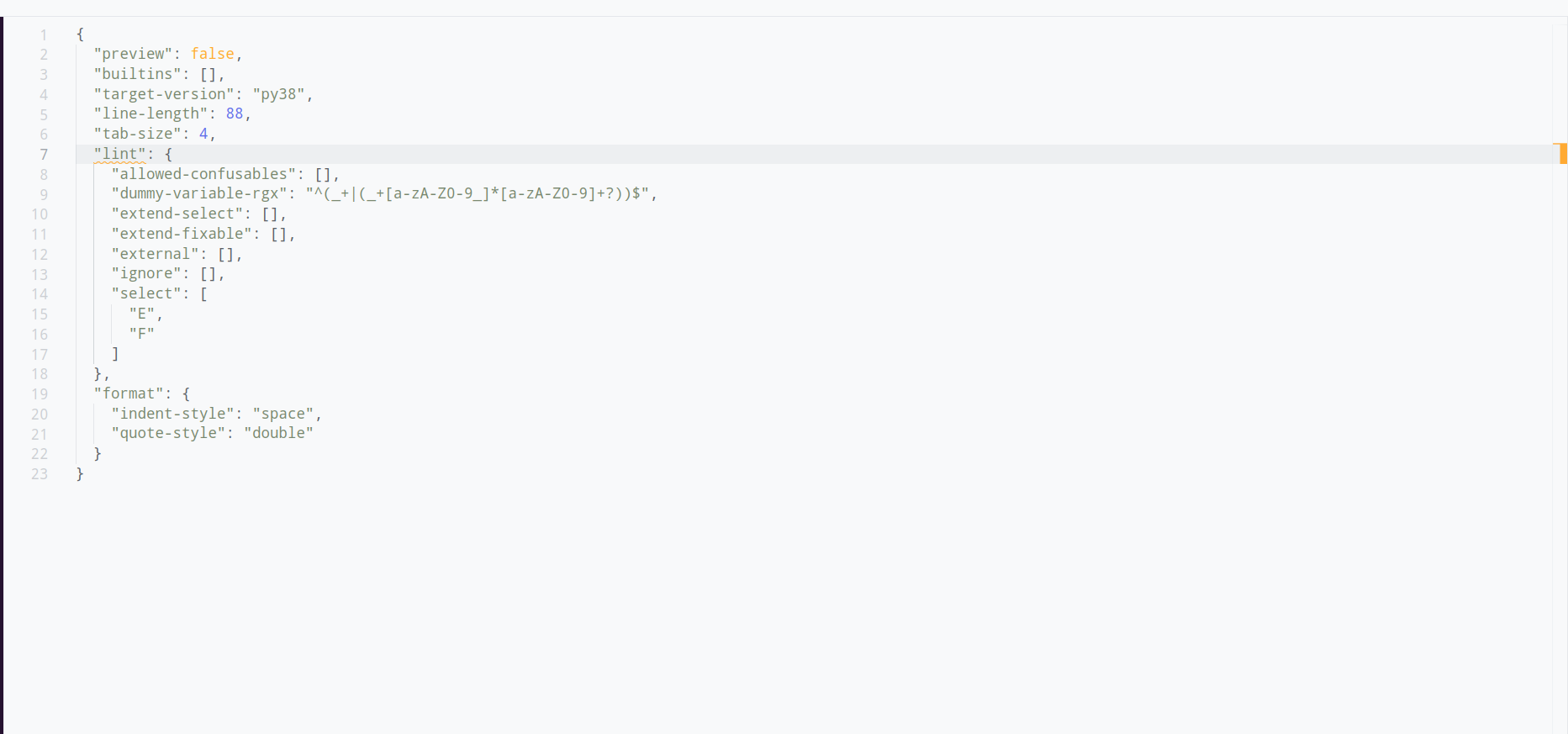
## Summary
This PR adds a new `lint` section to the configuration that groups all linter-specific settings. The existing top-level configurations continue to work without any warning because the `lint.*` settings are experimental.
The configuration merges the top level and `lint.*` settings where the settings in `lint` have higher precedence (override the top-level settings). The reasoning behind this is that the settings in `lint.` are more specific and more specific settings should override less specific settings.
I decided against showing the new `lint.*` options on our website because it would make the page extremely long (it's technically easy to do, just attribute `lint` with `[option_group`]). We may want to explore adding an `alias` field to the `option` attribute and show the alias on the website along with its regular name.
## Test Plan
* I added new integration tests
* I verified that the generated `options.md` is identical
* Verified the default settings in the playground
## Summary

This PR fixes the bug where the cell indices displayed in the `--diff` output
and the ones in the normal output were different. This was due to the fact that
the `--diff` output was using the `enumerate` function to iterate over
the cells which starts at 0.

## Test Plan

Ran the following command with and without the `--diff` flag:

```console
cargo run --bin ruff -- check --no-cache --isolated ~/playground/ruff/notebooks/test.ipynb
```

### `main`

<details><summary>Diagnostics output:</summary>
<p>

```console
$ cargo run --bin ruff -- check --no-cache --isolated ~/playground/ruff/notebooks/test.ipynb
/Users/dhruv/playground/ruff/notebooks/test.ipynb:cell 3:2:8: F401 [*] `math` imported but unused
/Users/dhruv/playground/ruff/notebooks/test.ipynb:cell 5:1:8: F811 Redefinition of unused `random` from line 1
/Users/dhruv/playground/ruff/notebooks/test.ipynb:cell 5:2:8: F401 [*] `pprint` imported but unused
/Users/dhruv/playground/ruff/notebooks/test.ipynb:cell 6:2:4: F632 [*] Use `==` to compare constant literals
/Users/dhruv/playground/ruff/notebooks/test.ipynb:cell 6:3:38: F632 [*] Use `==` to compare constant literals
Found 5 errors.
[*] 4 potentially fixable with the --fix option.
```

</p>
</details>

<details><summary>Diff output:</summary>
<p>

```console
$ cargo run --bin ruff -- check --no-cache --isolated ~/playground/ruff/notebooks/test.ipynb --diff
--- /Users/dhruv/playground/ruff/notebooks/test.ipynb:cell 2
+++ /Users/dhruv/playground/ruff/notebooks/test.ipynb:cell 2
@@ -1,2 +1 @@
-import random
-import math
+import random
--- /Users/dhruv/playground/ruff/notebooks/test.ipynb:cell 4
+++ /Users/dhruv/playground/ruff/notebooks/test.ipynb:cell 4
@@ -1,4 +1,3 @@
 import random
-import pprint

 random.randint(10, 20)
--- /Users/dhruv/playground/ruff/notebooks/test.ipynb:cell 5
+++ /Users/dhruv/playground/ruff/notebooks/test.ipynb:cell 5
@@ -1,3 +1,3 @@
 foo = 1
-if foo is 2:
-    raise ValueError(f"Invalid foo: {foo is 1}")
+if foo == 2:
+    raise ValueError(f"Invalid foo: {foo == 1}")

Would fix 4 errors.
```

</p>
</details>

### `dhruv/consistent-cell-indices`

<details><summary>Diagnostic output:</summary>
<p>

```console
$ cargo run --bin ruff -- check --no-cache --isolated ~/playground/ruff/notebooks/test.ipynb
/Users/dhruv/playground/ruff/notebooks/test.ipynb:cell 3:2:8: F401 [*] `math` imported but unused
/Users/dhruv/playground/ruff/notebooks/test.ipynb:cell 5:1:8: F811 Redefinition of unused `random` from line 1
/Users/dhruv/playground/ruff/notebooks/test.ipynb:cell 5:2:8: F401 [*] `pprint` imported but unused
/Users/dhruv/playground/ruff/notebooks/test.ipynb:cell 6:2:4: F632 [*] Use `==` to compare constant literals
/Users/dhruv/playground/ruff/notebooks/test.ipynb:cell 6:3:38: F632 [*] Use `==` to compare constant literals
Found 5 errors.
[*] 4 potentially fixable with the --fix option.
```

</p>
</details>

<details><summary>Diff output:</summary>
<p>

```console
$ cargo run --bin ruff -- check --no-cache --isolated ~/playground/ruff/notebooks/test.ipynb --diff
--- /Users/dhruv/playground/ruff/notebooks/test.ipynb:cell 3
+++ /Users/dhruv/playground/ruff/notebooks/test.ipynb:cell 3
@@ -1,2 +1 @@
-import random
-import math
+import random
--- /Users/dhruv/playground/ruff/notebooks/test.ipynb:cell 5
+++ /Users/dhruv/playground/ruff/notebooks/test.ipynb:cell 5
@@ -1,4 +1,3 @@
 import random
-import pprint

 random.randint(10, 20)
--- /Users/dhruv/playground/ruff/notebooks/test.ipynb:cell 6
+++ /Users/dhruv/playground/ruff/notebooks/test.ipynb:cell 6
@@ -1,3 +1,3 @@
 foo = 1
-if foo is 2:
-    raise ValueError(f"Invalid foo: {foo is 1}")
+if foo == 2:
+    raise ValueError(f"Invalid foo: {foo == 1}")

Would fix 4 errors.
```

</p>
</details>

fixes: #6673
I got confused and refactored a bit, now the naming should be more
consistent. This is the basis for the range formatting work.

Chages:
* `format_module` -> `format_module_source` (format a string)
* `format_node` -> `format_module_ast` (format a program parsed into an
AST)
* Added `parse_ok_tokens` that takes `Token` instead of `Result<Token>`
* Call the source code `source` consistently
* Added a `tokens_and_ranges` helper
* `python_ast` -> `module` (because that's the type)
## Summary
Currently, this happens
```sh
$ echo "print()" | ruff format -

#Notice that nothing went to stdout
```
Which does not match `ruff check --fix - ` behavior and deletes my code
every time I format it (more or less 5 times per minute 😄).

I just checked that my example works as the change was very
straightforward.
## Summary

## Stack Summary

This stack splits `Settings` into `FormatterSettings` and `LinterSettings` and moves it into `ruff_workspace`. This change is necessary to add the `FormatterSettings` to `Settings` without adding `ruff_python_formatter` as a dependency to `ruff_linter` (and the linter should not contain the formatter settings).

A quick overview of our settings struct at play:

* `Options`: 1:1 representation of the options in the `pyproject.toml` or `ruff.toml`.  Used for deserialization.
* `Configuration`: Resolved `Options`, potentially merged from multiple configurations (when using `extend`). The representation is very close if not identical to the `Options`.
* `Settings`: The resolved configuration that uses a data format optimized for reading. Optional fields are initialized with their default values. Initialized by `Configuration::into_settings` .

The goal of this stack is to split `Settings` into tool-specific resolved `Settings` that are independent of each other. This comes at the advantage that the individual crates don't need to know anything about the other tools. The downside is that information gets duplicated between `Settings`. Right now the duplication is minimal (`line-length`, `tab-width`) but we may need to come up with a solution if more expensive data needs sharing.

This stack focuses on `Settings`. Splitting `Configuration` into some smaller structs is something I'll follow up on later.

## PR Summary

This PR moves the `ResolverSettings` and `Settings` struct to `ruff_workspace`. `LinterSettings` remains in `ruff_linter` because it gets passed to lint rules, the `Checker` etc.

## Test Plan

`cargo test`
## Stack Summary

This stack splits `Settings` into `FormatterSettings` and `LinterSettings` and moves it into `ruff_workspace`. This change is necessary to add the `FormatterSettings` to `Settings` without adding `ruff_python_formatter` as a dependency to `ruff_linter` (and the linter should not contain the formatter settings).

A quick overview of our settings struct at play:

* `Options`: 1:1 representation of the options in the `pyproject.toml` or `ruff.toml`.  Used for deserialization.
* `Configuration`: Resolved `Options`, potentially merged from multiple configurations (when using `extend`). The representation is very close if not identical to the `Options`.
* `Settings`: The resolved configuration that uses a data format optimized for reading. Optional fields are initialized with their default values. Initialized by `Configuration::into_settings` .

The goal of this stack is to split `Settings` into tool-specific resolved `Settings` that are independent of each other. This comes at the advantage that the individual crates don't need to know anything about the other tools. The downside is that information gets duplicated between `Settings`. Right now the duplication is minimal (`line-length`, `tab-width`) but we may need to come up with a solution if more expensive data needs sharing.

This stack focuses on `Settings`. Splitting `Configuration` into some smaller structs is something I'll follow up on later.

## PR Summary

This PR extracts the linter-specific settings into a new `LinterSettings` struct and adds it as a `linter` field to the `Settings` struct. This is in preparation for moving `Settings` from `ruff_linter` to `ruff_workspace`

## Test Plan

`cargo test`
## Summary
This PR updates the `FileCache` to include an optional `NotebookIndex`
to support caching for Jupyter Notebooks.
We only require the index to compute the diagnostics and thus we don't
really need to store the entire `Notebook` on the `Diagnostics` struct.
This means we only need the index to be stored in the cache to
reconstruct the `Diagnostics`.
## Test Plan
Update an existing test case to run over the fixtures under
`ruff_notebook` crate where there are multiple Jupyter Notebook.
Locally, the following commands were run in order:
1. Remove the cache: `rm -rf .ruff_cache`
2. Run without cache: `cargo run --bin ruff -- check --isolated
crates/ruff_notebook/resources/test/fixtures/jupyter/unused_variable.ipynb
--no-cache`
3. Run with cache: `cargo run --bin ruff -- check --isolated
crates/ruff_notebook/resources/test/fixtures/jupyter/unused_variable.ipynb`
4. Check whether the `.ruff_cache` directory was created or not
5. Run with cache again and verify: `cargo run --bin ruff -- check
--isolated
crates/ruff_notebook/resources/test/fixtures/jupyter/unused_variable.ipynb`
## Benchmarks
https://github.com/astral-sh/ruff/pull/6863#issuecomment-1715675186fixes: #6671
## Summary

<!-- What's the purpose of the change? What does it do, and why? -->

Extends work in #7046 (some relevant discussion there)

Changes:

- All nursery rules are now referred to as preview rules
- Documentation for the nursery is updated to describe preview
- Adds a "PREVIEW" selector for preview rules
- This is primarily to allow `--preview --ignore PREVIEW --extend-select
FOO001,BAR200`
- Using `--preview` enables preview rules that match selectors

Notable decisions:

- Preview rules are not selectable by their rule code without enabling
preview
- Retains the "NURSERY" selector for backwards compatibility
- Nursery rules are selectable by their rule code for backwards
compatiblity

Additional work:

- Selection of preview rules without the "--preview" flag should display
a warning
- Use of deprecated nursery selection behavior should display a warning
- Nursery selection should be removed after some time

## Test Plan

<!-- How was it tested? -->

Manual confirmation (i.e. we don't have an preview rules yet just
nursery rules so I added a preview rule for manual testing)

New unit tests

---------

Co-authored-by: Charlie Marsh <charlie.r.marsh@gmail.com>
## Summary

This PR adds the `--preview` and `--no-preview` options to the `format` command (hidden) and passes it through to the formatte.

## Test Plan

I added the `dbg(f.options().preview())` statement in `FormatNodeRule::fmt` and verified that the option gets correctly passed to the formatter.
## Summary

This PR moves `ruff/jupyter` into its own `ruff_notebook` crate. Beyond
the move itself, there were a few challenges:

1. `ruff_notebook` relies on the source map abstraction. I've moved the
source map into `ruff_diagnostics`, since it doesn't have any
dependencies on its own and is used alongside diagnostics.
2. `ruff_notebook` has a couple tests for end-to-end linting and
autofixing. I had to leave these tests in `ruff` itself.
3. We had code in `ruff/jupyter` that relied on Python lexing, in order
to provide a more targeted error message in the event that a user saves
a `.py` file with a `.ipynb` extension. I removed this in order to avoid
a dependency on the parser, it felt like it wasn't worth retaining just
for that dependency.

## Test Plan

`cargo test`
## Summary

I think the fallthrough here for some branches is a little confusing.
Now each branch either runs a command that returns `Result<ExitStatus>`,
or runs a command that returns `Result<()>` and then explicitly returns
`Ok(ExitStatus::SUCCESS)`.
## Summary

This PR refactors the error-handling cases around Jupyter notebooks to
use errors rather than `Box<Diagnostics>`, which creates some oddities
in the downstream handling. So, instead of formatting errors as
diagnostics _eagerly_ (in the notebook methods), we now return errors
and convert those errors to diagnostics at the last possible moment (in
`diagnostics.rs`). This is more ergonomic, as errors can be composed and
reported-on in different ways, whereas diagnostics require a `Printer`,
etc.

See, e.g.,
https://github.com/astral-sh/ruff/pull/7013#discussion_r1311136301.

## Test Plan

Ran `cargo run` over a Python file labeled with a `.ipynb` suffix, and
saw:

```
foo.ipynb:1:1: E999 SyntaxError: Expected a Jupyter Notebook, which must be internally stored as JSON, but found a Python source file: expected value at line 1 column 1
```
Per discussion at https://github.com/astral-sh/ruff/discussions/6998

<!--
Thank you for contributing to Ruff! To help us out with reviewing,
please consider the following:

- Does this pull request include a summary of the change? (See below.)
- Does this pull request include a descriptive title?
- Does this pull request include references to any relevant issues?
-->

## Summary

<!-- What's the purpose of the change? What does it do, and why? -->

Adds a `--preview` and `--no-preview` option to the CLI for `ruff check`
and corresponding settings. The CLI options are hidden for now.

Available in the settings as `preview = true` or `preview = false`.

Does not include environment variable configuration, although we may add
it in the future.

## Test Plan

<!-- How was it tested? -->

`cargo build`

Future work will build on this setting, such as toggling the mode during
a test.
## Summary

Ensures that we use the same error types and messages. Also renames
those struct to `FormatCommand*` for consistency, and removes the
`FormatCommandResult::Skipped` variant in favor of skipping in the
iterator directly.
## Summary
Returns an exit code of 1 if any files would be reformatted:
```
ruff on charlie/format-check:main [$?⇡] is 📦 v0.0.286 via 🐍 v3.11.2 via 🦀 v1.72.0
❯ cargo run -p ruff_cli -- format foo.py --check
Compiling ruff_cli v0.0.286 (/Users/crmarsh/workspace/ruff/crates/ruff_cli)
Finished dev [unoptimized + debuginfo] target(s) in 1.69s
Running `target/debug/ruff format foo.py --check`
warning: `ruff format` is a work-in-progress, subject to change at any time, and intended only for experimentation.
1 file would be reformatted
ruff on charlie/format-check:main [$?⇡] is 📦 v0.0.286 via 🐍 v3.11.2 via 🦀 v1.72.0 took 2s
❯ echo $?
1
```
Closes#6966.
## Summary

This is similar to `commands::check` vs. `commands::check_stdin`, and
gets the logic out of the parent file (`lib.rs`). It also ensures that
we avoid formatting files that should be excluded when `--force-exclude`
is provided.
 konsti
 Zanie Blue
 Charlie Marsh
 Dhruv Manilawala
 Micha Reiser
 Leiser Fernández Gallo