mirror of https://github.com/astral-sh/ruff
27 Commits
| Author | SHA1 | Message | Date |
|---|---|---|---|
 Micha Reiser
|
196e4befba
|
Update MSRV to 1.85 and toolchain to 1.87 (#18126) | |
|
Micha Reiser
|
fa628018b2
|
Use `#[expect(lint)]` over `#[allow(lint)]` where possible (#17822) | |
 Dhruv Manilawala
|
d56d241317
|
Notify users for invalid client settings (#16361)
## Summary As mentioned in https://github.com/astral-sh/ruff/pull/16296#discussion_r1967047387 This PR updates the client settings resolver to notify the user if there are any errors in the config using a very basic approach. In addition, each error related to specific settings are logged. This isn't the best approach because it can log the same message multiple times when both workspace and global settings are provided and they both are the same. This is the case for a single workspace VS Code instance. I do have some ideas on how to improve this and will explore them during my free time (low priority): * Avoid resolving the global settings multiple times as they're static * Include the source of the setting (workspace or global?) * Maybe use a struct (`ResolvedClientSettings` + `Vec<ClientSettingsResolverError>`) instead to make unit testing easier ## Test Plan Using: ```jsonc { "ruff.logLevel": "debug", // Invalid settings "ruff.configuration": "$RANDOM", "ruff.lint.select": ["RUF000", "I001"], "ruff.lint.extendSelect": ["B001", "B002"], "ruff.lint.ignore": ["I999", "F401"] } ``` The error logs: ``` 2025-02-27 12:30:04.318736000 ERROR Failed to load settings from `configuration`: error looking key 'RANDOM' up: environment variable not found 2025-02-27 12:30:04.319196000 ERROR Failed to load settings from `configuration`: error looking key 'RANDOM' up: environment variable not found 2025-02-27 12:30:04.320549000 ERROR Unknown rule selectors found in `lint.select`: ["RUF000"] 2025-02-27 12:30:04.320669000 ERROR Unknown rule selectors found in `lint.extendSelect`: ["B001"] 2025-02-27 12:30:04.320764000 ERROR Unknown rule selectors found in `lint.ignore`: ["I999"] ``` Notification preview: <img width="470" alt="Screenshot 2025-02-27 at 12 29 06 PM" src="https://github.com/user-attachments/assets/61f41d5c-2558-46b3-a1ed-82114fd8ec22" /> |
|
|
Dhruv Manilawala
|
be03cb04c1
|
Expand `ruff.configuration` to allow inline config (#16296)
## Summary [Internal design document](https://www.notion.so/astral-sh/In-editor-settings-19e48797e1ca807fa8c2c91b689d9070?pvs=4) This PR expands `ruff.configuration` to allow inline configuration directly in the editor. For example: ```json { "ruff.configuration": { "line-length": 100, "lint": { "unfixable": ["F401"], "flake8-tidy-imports": { "banned-api": { "typing.TypedDict": { "msg": "Use `typing_extensions.TypedDict` instead" } } } }, "format": { "quote-style": "single" } } } ``` This means that now `ruff.configuration` accepts either a path to configuration file or the raw config itself. It's _mostly_ similar to `--config` with one difference that's highlighted in the following section. So, it can be said that the format of `ruff.configuration` when provided the config map is same as the one on the [playground] [^1]. ## Limitations <details><summary><b>Casing (<code>kebab-case</code> v/s/ <code>camelCase</code>)</b></summary> <p> The config keys needs to be in `kebab-case` instead of `camelCase` which is being used for other settings in the editor. This could be a bit confusing. For example, the `line-length` option can be set directly via an editor setting or can be configured via `ruff.configuration`: ```json { "ruff.configuration": { "line-length": 100 }, "ruff.lineLength": 120 } ``` #### Possible solution We could use feature flag with [conditional compilation](https://doc.rust-lang.org/reference/conditional-compilation.html#the-cfg_attr-attribute) to indicate that when used in `ruff_server`, we need the `Options` fields to be renamed as `camelCase` while for other crates it needs to be renamed as `kebab-case`. But, this might not work very easily because it will require wrapping the `Options` struct and create two structs in which we'll have to add `#[cfg_attr(...)]` because otherwise `serde` will complain: ``` error: duplicate serde attribute `rename_all` --> crates/ruff_workspace/src/options.rs:43:38 | 43 | #[cfg_attr(feature = "editor", serde(rename_all = "camelCase"))] | ^^^^^^^^^^ ``` </p> </details> <details><summary><b>Nesting (flat v/s nested keys)</b></summary> <p> This is the major difference between `--config` flag on the command-line v/s `ruff.configuration` and it makes it such that `ruff.configuration` has same value format as [playground] [^1]. The config keys needs to be split up into keys which can result in nested structure instead of flat structure: So, the following **won't work**: ```json { "ruff.configuration": { "format.quote-style": "single", "lint.flake8-tidy-imports.banned-api.\"typing.TypedDict\".msg": "Use `typing_extensions.TypedDict` instead" } } ``` But, instead it would need to be split up like the following: ```json { "ruff.configuration": { "format": { "quote-style": "single" }, "lint": { "flake8-tidy-imports": { "banned-api": { "typing.TypedDict": { "msg": "Use `typing_extensions.TypedDict` instead" } } } } } } ``` #### Possible solution (1) The way we could solve this and make it same as `--config` would be to add a manual logic of converting the JSON map into an equivalent TOML string which would be then parsed into `Options`. So, the following JSON map: ```json { "lint.flake8-tidy-imports": { "banned-api": {"\"typing.TypedDict\".msg": "Use typing_extensions.TypedDict instead"}}} ``` would need to be converted into the following TOML string: ```toml lint.flake8-tidy-imports = { banned-api = { "typing.TypedDict".msg = "Use typing_extensions.TypedDict instead" } } ``` by recursively convering `"key": value` into `key = value` which is to remove the quotes from key and replacing `:` with `=`. #### Possible solution (2) Another would be to just accept `Map<String, String>` strictly and convert it into `key = value` and then parse it as a TOML string. This would also match `--config` but quotes might become a nuisance because JSON only allows double quotes and so it'll require escaping any inner quotes or use single quotes. </p> </details> ## Test Plan ### VS Code **Requires https://github.com/astral-sh/ruff-vscode/pull/702** **`settings.json`**: ```json { "ruff.lint.extendSelect": ["TID"], "ruff.configuration": { "line-length": 50, "format": { "quote-style": "single" }, "lint": { "unfixable": ["F401"], "flake8-tidy-imports": { "banned-api": { "typing.TypedDict": { "msg": "Use `typing_extensions.TypedDict` instead" } } } } } } ``` Following video showcases me doing the following: 1. Check diagnostics that it includes `TID` 2. Run `Ruff: Fix all auto-fixable problems` to test `unfixable` 3. Run `Format: Document` to test `line-length` and `quote-style` https://github.com/user-attachments/assets/0a38176f-3fb0-4960-a213-73b2ea5b1180 ### Neovim **`init.lua`**: ```lua require('lspconfig').ruff.setup { init_options = { settings = { lint = { extendSelect = { 'TID' }, }, configuration = { ['line-length'] = 50, format = { ['quote-style'] = 'single', }, lint = { unfixable = { 'F401' }, ['flake8-tidy-imports'] = { ['banned-api'] = { ['typing.TypedDict'] = { msg = 'Use typing_extensions.TypedDict instead', }, }, }, }, }, }, }, } ``` Same steps as in the VS Code test: https://github.com/user-attachments/assets/cfe49a9b-9a89-43d7-94f2-7f565d6e3c9d ## Documentation Preview https://github.com/user-attachments/assets/e0062f58-6ec8-4e01-889d-fac76fd8b3c7 [playground]: https://play.ruff.rs [^1]: This has one advantage that the value can be copy-pasted directly into the playground |
|
|
Dhruv Manilawala
|
1447553bc2
|
Improve logging system using `logLevel`, avoid trace value (#15232)
## Summary
Refer to the VS Code PR
(https://github.com/astral-sh/ruff-vscode/pull/659) for details on the
change.
This PR changes the following:
1. Add tracing span for both request (request id and method name) and
notification (method name) handler
2. Remove the `RUFF_TRACE` environment variable. This was being used to
turn on / off logging for the server
3. Similarly, remove reading the `trace` value from the initialization
options
4. Remove handling the `$/setTrace` notification
5. Remove the specialized `TraceLogWriter` used for Zed and VS Code
(https://github.com/astral-sh/ruff/pull/12564)
Regarding the (5) for the Zed editor, the reason that was implemented
was because there was no way of looking at the stderr messages in the
editor which has been changed. Now, it captures the stderr as part of
the "Server Logs".
(
|
|
|
Micha Reiser
|
c847cad389
|
Update insta snapshots (#14366) | |
|
Dhruv Manilawala
|
2e77b775b0
|
Consider `--preview` flag for `server` subcommand (#12208)
## Summary This PR removes the requirement of `--preview` flag to run the `ruff server` and instead considers it to be an indicator to turn on preview mode for the linter and the formatter. resolves: #12161 ## Test Plan Add test cases to assert the `preview` value is updated accordingly. In an editor context, I used the local `ruff` executable in Neovim with the `--preview` flag and verified that the preview-only violations are being highlighted. Running with: ```lua require('lspconfig').ruff.setup({ cmd = { '/Users/dhruv/work/astral/ruff/target/debug/ruff', 'server', '--preview', }, }) ``` The screenshot shows that `E502` is highlighted with the below config in `pyproject.toml`: <img width="877" alt="Screenshot 2024-07-17 at 16 43 09" src="https://github.com/user-attachments/assets/c7016ef3-55b1-4a14-bbd3-a07b1bcdd323"> |
|
|
Dhruv Manilawala
|
22cebdf29b |
Add server config to filter out syntax error diagnostics (#12059)
## Summary Follow-up from #11901 This PR adds a new server setting to show / hide syntax errors. ## Test Plan ### VS Code Using https://github.com/astral-sh/ruff-vscode/pull/504 with the following config: ```json { "ruff.nativeServer": true, "ruff.path": ["/Users/dhruv/work/astral/ruff/target/debug/ruff"], "ruff.showSyntaxErrors": true } ``` First, set `ruff.showSyntaxErrors` to `true`: <img width="1177" alt="Screenshot 2024-06-27 at 08 34 58" src="https://github.com/astral-sh/ruff/assets/67177269/5d77547a-a908-4a00-8714-7c00784e8679"> And then set it to `false`: <img width="1185" alt="Screenshot 2024-06-27 at 08 35 19" src="https://github.com/astral-sh/ruff/assets/67177269/9720f089-f10c-420b-a2c1-2bbb2245be35"> ### Neovim Using the following Ruff server config: ```lua require('lspconfig').ruff.setup { init_options = { settings = { showSyntaxErrors = false, }, }, } ``` First, set `showSyntaxErrors` to `true`: <img width="1279" alt="Screenshot 2024-06-27 at 08 28 03" src="https://github.com/astral-sh/ruff/assets/67177269/e694e231-91ba-47f8-8e8a-ad2e82b85a45"> And then set it to `false`: <img width="1284" alt="Screenshot 2024-06-27 at 08 28 20" src="https://github.com/astral-sh/ruff/assets/67177269/25b86a57-02b1-44f7-9f65-cf5fdde93b0c"> |
|
 Jane Lewis
|
3ab7a8da73
|
Add Jupyter Notebook document change snapshot test (#11944)
## Summary Closes #11914. This PR introduces a snapshot test that replays the LSP requests made during a document formatting request, and confirms that the notebook document is updated in the expected way. |
|
|
Jane Lewis
|
c8ff89c73c
|
`ruff server`: Support the usage of tildes and environment variables in `logFile` (#11945)
## Summary Fixes #11911. `shellexpand` is now used on `logFile` to expand the file path, allowing the usage of `~` and environment variables. ## Test Plan 1. Set `logFile` in either Neovim or Helix to a file path that needs expansion, like `~/.config/helix/ruff_logs.txt`. 2. Ensure that `RUFF_TRACE` is set to `messages` or `verbose` 3. Open a Python file in Neovim/Helix 4. Confirm that a file at the path specified was created, with the expected logs. |
|
|
Jane Lewis
|
507f5c1137
|
`ruff server`: Tracing system now respects log level and trace level, with options to log to a file (#11747)
## Summary Fixes #10968. Fixes #11545. The server's tracing system has been rewritten from the ground up. The server now has trace level and log level settings which restrict the tracing events and spans that get logged. * A `logLevel` setting has been added, which lets a user set the log level. By default, it is set to `"info"`. * A `logFile` setting has also been added, which lets the user supply an optional file to send tracing output (it does not have to exist as a file yet). By default, if this is unset, tracing output will be sent to `stderr`. * A `$/setTrace` handler has also been added, and we also set the trace level from the initialization options. For editors without direct support for tracing, the environment variable `RUFF_TRACE` can override the trace level. * Small changes have been made to how we display tracing output. We no longer use `tracing-tree`, and instead use `tracing_subscriber::fmt::Layer` to format output. Thread names are now included in traces, and I've made some adjustment to thread worker names to be more useful. ## Test Plan In VS Code, with `ruff.trace.server` set to its default value, no logs from Ruff should appear. After changing `ruff.trace.server` to either `messages` or `verbose`, you should see log messages at `info` level or higher appear in Ruff's output: <img width="1005" alt="Screenshot 2024-06-10 at 10 35 04 AM" src="https://github.com/astral-sh/ruff/assets/19577865/6050d107-9815-4bd2-96d0-e86f096a57f5"> In Helix, by default, no logs from Ruff should appear. To set the trace level in Helix, you'll need to modify your language configuration as follows: ```toml [language-server.ruff] command = "/Users/jane/astral/ruff/target/debug/ruff" args = ["server", "--preview"] environment = { "RUFF_TRACE" = "messages" } ``` After doing this, logs of `info` level or higher should be visible in Helix: <img width="1216" alt="Screenshot 2024-06-10 at 10 39 26 AM" src="https://github.com/astral-sh/ruff/assets/19577865/8ff88692-d3f7-4fd1-941e-86fb338fcdcc"> You can use `:log-open` to quickly open the Helix log file. In Neovim, by default, no logs from Ruff should appear. To set the trace level in Neovim, you'll need to modify your configuration as follows: ```lua require('lspconfig').ruff.setup { cmd = {"/path/to/debug/executable", "server", "--preview"}, cmd_env = { RUFF_TRACE = "messages" } } ``` You should see logs appear in `:LspLog` that look like the following: <img width="1490" alt="Screenshot 2024-06-11 at 11 24 01 AM" src="https://github.com/astral-sh/ruff/assets/19577865/576cd5fa-03cf-477a-b879-b29a9a1200ff"> You can adjust `logLevel` and `logFile` in `settings`: ```lua require('lspconfig').ruff.setup { cmd = {"/path/to/debug/executable", "server", "--preview"}, cmd_env = { RUFF_TRACE = "messages" }, settings = { logLevel = "debug", logFile = "your/log/file/path/log.txt" } } ``` The `logLevel` and `logFile` can also be set in Helix like so: ```toml [language-server.ruff.config.settings] logLevel = "debug" logFile = "your/log/file/path/log.txt" ``` Even if this log file does not exist, it should now be created and written to after running the server: <img width="1148" alt="Screenshot 2024-06-10 at 10 43 44 AM" src="https://github.com/astral-sh/ruff/assets/19577865/ab533cf7-d5ac-4178-97f1-e56da17450dd"> |
|
 T-256
T-256
|
5b500fc4dc
|
`ruff server`: Add support for documents not exist on disk (#11588)
Co-authored-by: T-256 <Tester@test.com> Co-authored-by: Micha Reiser <micha@reiser.io> |
|
|
Micha Reiser
|
921bc15542
|
use owned ast and tokens in bench (#11598) | |
|
Dhruv Manilawala
|
37ad994318
|
Use default settings if initialization options is empty or not provided (#11566)
## Summary This PR fixes the bug to avoid flattening the global-only settings for the new server. This was added in https://github.com/astral-sh/ruff/pull/11497, possibly to correctly de-serialize an empty value (`{}`). But, this lead to a bug where the configuration under the `settings` key was not being read for global-only variant. By using #[serde(default)], we ensure that the settings field in the `GlobalOnly` variant is optional and that an empty JSON object `{}` is correctly deserialized into `GlobalOnly` with a default `ClientSettings` instance. fixes: #11507 ## Test Plan Update the snapshot and existing test case. Also, verify the following settings in Neovim: 1. Nothing ```lua ruff = { cmd = { '/Users/dhruv/work/astral/ruff/target/debug/ruff', 'server', '--preview', }, } ``` 2. Empty dictionary ```lua ruff = { cmd = { '/Users/dhruv/work/astral/ruff/target/debug/ruff', 'server', '--preview', }, init_options = vim.empty_dict(), } ``` 3. Empty `settings` ```lua ruff = { cmd = { '/Users/dhruv/work/astral/ruff/target/debug/ruff', 'server', '--preview', }, init_options = { settings = vim.empty_dict(), }, } ``` 4. With some configuration: ```lua ruff = { cmd = { '/Users/dhruv/work/astral/ruff/target/debug/ruff', 'server', '--preview', }, init_options = { settings = { configuration = '/tmp/ruff-repro/pyproject.toml', }, }, } ``` |
|
|
Jane Lewis
|
94abea4b08
|
`ruff server`: Fix multiple issues with Neovim and Helix (#11497)
## Summary Fixes https://github.com/astral-sh/ruff/issues/11236. This PR fixes several issues, most of which relate to non-VS Code editors (Helix and Neovim). 1. Global-only initialization options are now correctly deserialized from Neovim and Helix 2. Empty diagnostics are now published correctly for Neovim and Helix. 3. A workspace folder is created at the current working directory if the initialization parameters send an empty list of workspace folders. 4. The server now gracefully handles opening files outside of any known workspace, and will use global fallback settings taken from client editor settings and a user settings TOML, if it exists. ## Test Plan I've tested to confirm that each issue has been fixed. * Global-only initialization options are now correctly deserialized from Neovim and Helix + the server gracefully handles opening files outside of any known workspace https://github.com/astral-sh/ruff/assets/19577865/4f33477f-20c8-4e50-8214-6608b1a1ea6b * Empty diagnostics are now published correctly for Neovim and Helix https://github.com/astral-sh/ruff/assets/19577865/c93f56a0-f75d-466f-9f40-d77f99cf0637 * A workspace folder is created at the current working directory if the initialization parameters send an empty list of workspace folders. https://github.com/astral-sh/ruff/assets/19577865/b4b2e818-4b0d-40ce-961d-5831478cc726 |
|
|
Jane Lewis
|
b0731ef9cb
|
`ruff server`: Support Jupyter Notebook (`*.ipynb`) files (#11206)
## Summary Closes https://github.com/astral-sh/ruff/issues/10858. `ruff server` now supports `*.ipynb` (aka Jupyter Notebook) files. Extensive internal changes have been made to facilitate this, which I've done some work to contextualize with documentation and an pre-review that highlights notable sections of the code. `*.ipynb` cells should behave similarly to `*.py` documents, with one major exception. The format command `ruff.applyFormat` will only apply to the currently selected notebook cell - if you want to format an entire notebook document, use `Format Notebook` from the VS Code context menu. ## Test Plan The VS Code extension does not yet have Jupyter Notebook support enabled, so you'll first need to enable it manually. To do this, checkout the `pre-release` branch and modify `src/common/server.ts` as follows: Before:  After:  I recommend testing this PR with large, complicated notebook files. I used notebook files from [this popular repository](https://github.com/jakevdp/PythonDataScienceHandbook/tree/master/notebooks) in my preliminary testing. The main thing to test is ensuring that notebook cells behave the same as Python documents, besides the aforementioned issue with `ruff.applyFormat`. You should also test adding and deleting cells (in particular, deleting all the code cells and ensure that doesn't break anything), changing the kind of a cell (i.e. from markup -> code or vice versa), and creating a new notebook file from scratch. Finally, you should also test that source actions work as expected (and across the entire notebook). Note: `ruff.applyAutofix` and `ruff.applyOrganizeImports` are currently broken for notebook files, and I suspect it has something to do with https://github.com/astral-sh/ruff/issues/11248. Once this is fixed, I will update the test plan accordingly. --------- Co-authored-by: nolan <nolan.king90@gmail.com> |
|
|
Jane Lewis
|
d7f093ef9e
|
`ruff server`: Support `noqa` comment code action (#11276)
## Summary Fixes https://github.com/astral-sh/ruff/issues/10594. Code actions to disable a diagnostic via `noqa` comment are now available. https://github.com/astral-sh/ruff/assets/19577865/6d3bcf11-a9d9-499b-8c7f-a10cd39cfbba `DiagnosticFix` has been changed so that `noqa` code actions appear even for diagnostics with no available quick fix. It can contain quick fix edits, `noqa` comment edits, or both. ## Test Plan The scenarios that need to be tested are as follows: * A code action to disable a diagnostic should be available for every diagnostic. * Using this code action should append to the appropriate line with the diagnostic, or modify an existing `noqa` comment. * Adding a `noqa` comment manually should make a diagnostic disappear * `Fix all auto-fixable problems` should not add `noqa` comments * Removing a code from a `noqa` comment should make the diagnostic re-appear |
|
 Charlie Marsh
|
9db11dcce2
|
Touch-up error messages in server file discovery (#11285)
## Summary Just making these messages a little more consistent with how we format them in Ruff, uv, etc. |
|
|
Charlie Marsh
|
9d45987c19
|
Expand tildes when resolving Ruff server configuration file (#11283)
## Summary Users can now include tildes and environment variables in the provided path, just like with `--config`. Closes #11277. ## Test Plan Set the configuration path to `"ruff.configuration": "~/x.toml"`; verified that the server attempted to read from `/Users/crmarsh/x.toml`. 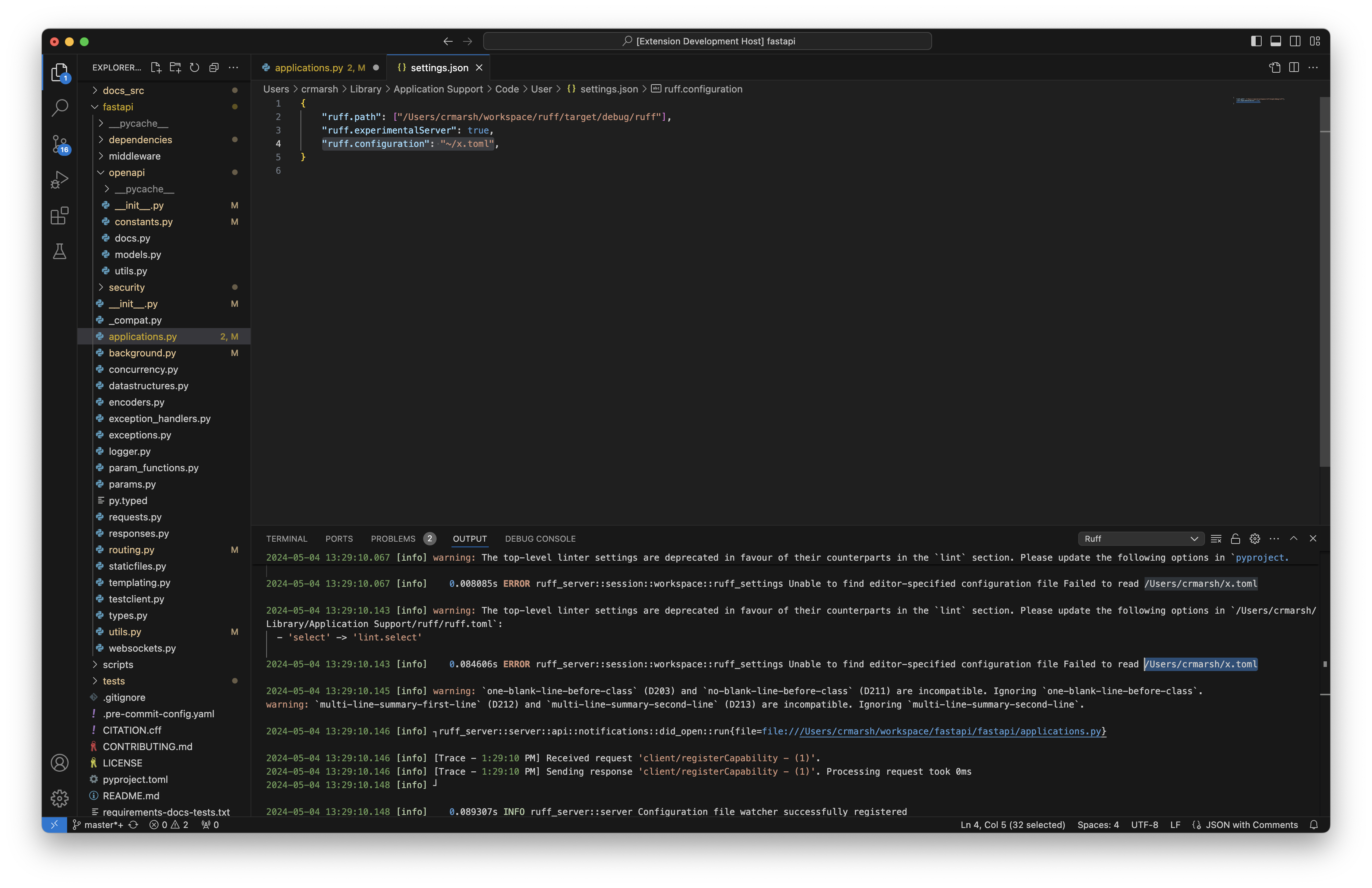 |
|
|
Jane Lewis
|
632965d0fa
|
`ruff server`: Support a custom TOML configuration file (#11140)
## Summary Closes #10985. The server now supports a custom TOML configuration file as a client setting. The setting must be an absolute path to a file. If the file is called `pyproject.toml`, the server will attempt to parse it as a pyproject file - otherwise, it will attempt to parse it as a `ruff.toml` file, even if the file has a name besides `ruff.toml`. If an option is set in both the custom TOML configuration file and in the client settings directly, the latter will be used. ## Test Plan 1. Create a `ruff.toml` file outside of the workspace you are testing. Set an option that is different from the one in the configuration for your test workspace. 2. Set the path to the configuration in NeoVim: ```lua require('lspconfig').ruff.setup { init_options = { settings = { configuration = "absolute/path/to/your/configuration" } } } ``` 3. Confirm that the option in the configuration file is used, regardless of what the option is set to in the workspace configuration. 4. Add the same option, with a different value, to the NeoVim configuration directly. For example: ```lua require('lspconfig').ruff.setup { init_options = { settings = { configuration = "absolute/path/to/your/configuration", lint = { select = [] } } } } ``` 5. Confirm that the option set in client settings is used, regardless of the value in either the custom configuration file or in the workspace configuration. |
|
|
Jane Lewis
|
16a1f3cbcc
|
`ruff server`: Support setting to prioritize project configuration over editor configuration (#11086)
## Summary This is intended to address https://github.com/astral-sh/ruff-vscode/issues/425, and is a follow-up to https://github.com/astral-sh/ruff/pull/11062. A new client setting is now supported by the server, `prioritizeFileConfiguration`. This is a boolean setting (default: `false`) that, if set to `true`, will instruct the configuration resolver to prioritize file configuration (aka discovered TOML files) over configuration passed in by the editor. A corresponding extension PR has been opened, which makes this setting available for VS Code: https://github.com/astral-sh/ruff-vscode/pull/457. ## Test Plan To test this with VS Code, you'll need to check out [the VS Code PR](https://github.com/astral-sh/ruff-vscode/pull/457) that adds this setting. The test process is similar to https://github.com/astral-sh/ruff/pull/11062, but in scenarios where the editor configuration would take priority over file configuration, file configuration should take priority. |
|
|
Jane Lewis
|
35ca887e02
|
`ruff server`: Ruff configuration from client settings overrides project configuration (#11062)
## Summary This is a follow-up to https://github.com/astral-sh/ruff/pull/10984 that implements configuration resolution for editor configuration. By 'editor configuration', I'm referring to the client settings that correspond to Ruff configuration/options, like `preview`, `select`, and so on. These will be combined with 'project configuration' (configuration taken from project files such as `pyproject.toml`) to generate the final linter and formatter settings used by `RuffSettings`. Editor configuration takes priority over project configuration. In a follow-up pull request, I'll implement a new client setting that allows project configuration to override editor configuration, as per [this issue](https://github.com/astral-sh/ruff-vscode/issues/425). ## Review guide The first commit, e38966d8843becc7234fa7d46009c16af4ba41e9, is just doing re-arrangement so that we can pass the right things to `RuffSettings::resolve`. The actual resolution logic is in the second commit, 0eec9ee75c10e5ec423bd9f5ce1764f4d7a5ad86. It might help to look at these comments individually since the diff is rather messy. ## Test Plan For the settings to show up in VS Code, you'll need to checkout this branch: https://github.com/astral-sh/ruff-vscode/pull/456. To test that the resolution for a specific setting works as expected, run through the following scenarios, setting it in project and editor configuration as needed: | Set in project configuration? | Set in editor configuration? | Expected Outcome | |-------------------------------|--------------------------------------------------|------------------------------------------------------------------------------------------| | No | No | The editor should behave as if the setting was set to its default value. | | Yes | No | The editor should behave as if the setting was set to the value in project configuration. | | No | Yes | The editor should behave as if the setting was set to the value in editor configuration. | | Yes | Yes (but distinctive from project configuration) | The editor should behave as if the setting was set to the value in editor configuration. | An exception to this is `extendSelect`, which does not have an analog in TOML configuration. Instead, you should verify that `extendSelect` amends the `select` setting. If `select` is set in both editor and project configuration, `extendSelect` will only append to the `select` value in editor configuration, so make sure to un-set it there if you're testing `extendSelect` with `select` in project configuration. |
|
|
Jane Lewis
|
2cc487eb22
|
`ruff server`: Introduce settings for directly configuring the linter and formatter (#10984)
## Summary The following client settings have been introduced to the language server: * `lint.preview` * `format.preview` * `lint.select` * `lint.extendSelect` * `lint.ignore` * `exclude` * `lineLength` `exclude` and `lineLength` apply to both the linter and formatter. This does not actually use the settings yet, but makes them available for future use. ## Test Plan Snapshot tests have been updated. |
|
|
Jane Lewis
|
2882604451
|
`ruff server`: Important errors are now shown as popups (#10951)
## Summary Fixes #10866. Introduces the `show_err_msg!` macro which will send a message to be shown as a popup to the client via the `window/showMessage` LSP method. ## Test Plan Insert various `show_err_msg!` calls in common code paths (for example, at the beginning of `event_loop`) and confirm that these messages appear in your editor. To test that panicking works correctly, add this to the top of the `fn run` definition in `crates/ruff_server/src/server/api/requests/execute_command.rs`: ```rust panic!("This should appear"); ``` Then, try running a command like `Ruff: Format document` from the command palette (`Ctrl/Cmd+Shift+P`). You should see the following messages appear:  |
|
|
Jane Lewis
|
c3e28f9d55
|
The linter and code actions can now be disabled in client settings for `ruff server` (#10800)
## Summary This is a follow-up to https://github.com/astral-sh/ruff/pull/10764. Support for diagnostics, quick fixes, and source actions can now be disabled via client settings. ## Test Plan ### Manual Testing Set up your workspace as described in the test plan in https://github.com/astral-sh/ruff/pull/10764, up to step 2. You don't need to add a debug statement. The configuration for `folder_a` and `folder_b` should be as follows: `folder_a`: ```json { "ruff.codeAction.fixViolation": { "enable": true } } ``` `folder_b` ```json { "ruff.codeAction.fixViolation": { "enable": false } } ``` Finally, open up your VS Code User Settings and un-check the `Ruff > Fix All` setting. 1. Open a Python file in `folder_a` that has existing problems. The problems should be highlighted, and quick fix should be available. `source.fixAll` should not be available as a source action. 2. Open a Python file in `folder_b` that has existing problems. The problems should be highlighted, but quick fixes should not be available for any of them. `source.fixAll` should not be available as a source action. 3. Open up your VS Code Workspace Settings (second tab under the search bar) and un-check `Ruff > Lint: Enable` 4. Both files you tested in steps 1 and 2 should now lack any visible diagnostics. `source.organizeImports` should still be available as a source action. |
|
|
Jane Lewis
|
a184dc68f5
|
Implement client setting initialization and resolution for `ruff server` (#10764)
## Summary

When a language server initializes, it is passed a serialized JSON
object, which is known as its "initialization options". Until now, `ruff
server` has ignored those initialization options, meaning that
user-provided settings haven't worked. This PR is the first step for
supporting settings from the LSP client. It implements procedures to
deserialize initialization options into a settings object, and then
resolve those settings objects into concrete settings for each
workspace.

One of the goals for user settings implementation in `ruff server` is
backwards compatibility with `ruff-lsp`'s settings. We won't support all
settings that `ruff-lsp` had, but the ones that we do support should
work the same and use the same schema as `ruff-lsp`.

These are the existing settings from `ruff-lsp` that we will continue to
support, and which are part of the settings schema in this PR:

| Setting | Default Value | Description |

|----------------------------------------|---------------|----------------------------------------------------------------------------------------|
| `codeAction.disableRuleComment.enable` | `true` | Whether to display
Quick Fix actions to disable rules via `noqa` suppression comments. |
| `codeAction.fixViolation.enable` | `true` | Whether to display Quick
Fix actions to autofix violations. |
| `fixAll` | `true` | Whether to register Ruff as capable of handling
`source.fixAll` actions. |
| `lint.enable` | `true` | Whether to enable linting. Set to `false` to
use Ruff exclusively as a formatter. |
| `organizeImports` | `true` | Whether to register Ruff as capable of
handling `source.organizeImports` actions. |

To be clear: this PR does not implement 'support' for these settings,
individually. Rather, it constructs a framework for these settings to be
used by the server in the future.

Notably, we are choosing *not* to support `lint.args` and `format.args`
as settings for `ruff server`. This is because we're now interfacing
with Ruff at a lower level than its CLI, and converting CLI arguments
back into configuration is too involved.

We will have support for linter and formatter specific settings in
follow-up PRs. We will also 'hook up' user settings to work with the
server in follow up PRs.

## Test Plan

### Snapshot Tests

Tests have been created in
`crates/ruff_server/src/session/settings/tests.rs` to ensure that
deserialization and settings resolution works as expected.

### Manual Testing

Since we aren't using the resolved settings anywhere yet, we'll have to
add a few printing statements.

We want to capture what the resolved settings look like when sent as
part of a snapshot, so modify `Session::take_snapshot` to be the
following:

```rust
    pub(crate) fn take_snapshot(&self, url: &Url) -> Option<DocumentSnapshot> {
        let resolved_settings = self.workspaces.client_settings(url, &self.global_settings);
        tracing::info!("Resolved settings for document {url}: {resolved_settings:?}");
        Some(DocumentSnapshot {
            configuration: self.workspaces.configuration(url)?.clone(),
            resolved_client_capabilities: self.resolved_client_capabilities.clone(),
            client_settings: resolved_settings,
            document_ref: self.workspaces.snapshot(url)?,
            position_encoding: self.position_encoding,
            url: url.clone(),
        })
    }
```

Once you've done that, build the server and start up your extension
testing environment.

1. Set up a workspace in VS Code with two workspace folders, each one
having some variant of Ruff file-based configuration (`pyproject.toml`,
`ruff.toml`, etc.). We'll call these folders `folder_a` and `folder_b`.
2. In each folder, open up `.vscode/settings.json`.
3. In folder A, use these settings:
```json
{
    "ruff.codeAction.disableRuleComment": {
        "enable": true
    }
}
```
4. In folder B, use these settings:
```json
{

    "ruff.codeAction.disableRuleComment": {
        "enable": false
    }
}
```
5. Finally, open up your VS Code User Settings and un-check the `Ruff >
Code Action: Disable Rule Comment` setting.
6. When opening files in `folder_a`, you should see logs that look like
this:
```
Resolved settings for document <file>: ResolvedClientSettings { fix_all: true, organize_imports: true, lint_enable: true, disable_rule_comment_enable: true, fix_violation_enable: true }
```
7. When opening files in `folder_b`, you should see logs that look like
this:
```
Resolved settings for document <file>: ResolvedClientSettings { fix_all: true, organize_imports: true, lint_enable: true, disable_rule_comment_enable: false, fix_violation_enable: true }
```
8. To test invalid configuration, change `.vscode/settings.json` in
either folder to be this:
```json
{
    "ruff.codeAction.disableRuleComment": {
        "enable": "invalid"
    },
}
```
10. You should now see these error logs:
```
<time> [info]    <duration> ERROR ruff_server::session::settings Failed to deserialize initialization options: data did not match any variant of untagged enum InitializationOptions. Falling back to default client settings...

<time> [info]    <duration> WARN ruff_server::server No workspace settings found for file:///Users/jane/testbed/pandas
   <duration> WARN ruff_server::server No workspace settings found for file:///Users/jane/foss/scipy
```
11. Opening files in either folder should now print the following
configuration:
```
Resolved settings for document <file>: ResolvedClientSettings { fix_all: true, organize_imports: true, lint_enable: true, disable_rule_comment_enable: true, fix_violation_enable: true }
```
|
|
|
Jane Lewis
|
257964a8bc
|
`ruff server` now supports `source.fixAll` source action (#10597)
## Summary `ruff server` now has source action `source.fixAll` as an available code action. This also fixes https://github.com/astral-sh/ruff/issues/10593 in the process of revising the code for quick fix code actions. ## Test Plan https://github.com/astral-sh/ruff/assets/19577865/f4c07425-e68a-445f-a4ed-949c9197a6be |