Closes https://github.com/astral-sh/ruff/issues/7347Closes#3970 via use of `include`
We could update examples in our documentation, but I worry since we do
not have versioned documentation users on older versions would be
confused. Instead, I'll open an issue to track updating use of `ruff
check .` in the documentation sometime in the future.
## Summary

This PR addresses the incompatibility with `jupyterlab-lsp` +
`python-lsp-ruff` arising from the inference of source type from file
extension, raised in #6847.

In particular it follows the suggestion in
https://github.com/astral-sh/ruff/issues/6847#issuecomment-1765724679 to
specify a mapping from file extension to source type.

The source types are

- python
- pyi
- ipynb

Usage:

```sh
ruff check --no-cache --stdin-filename Untitled.ipynb --extension ipynb:python
```

Unlike the original suggestion, `:` instead of `=` is used to associate
file extensions to language since that is what is used with
`--per-file-ignores` which is an existing option that accepts a mapping.

## Test Plan

2 tests added to `integration_test.rs` to ensure the override works as
expected

---------

Co-authored-by: Charlie Marsh <charlie.r.marsh@gmail.com>
## Summary

Being able to set `--no-cache` without touching the command line makes
comparing formatter speed with e.g. Hyperfine a lot easier; Black allows
one to set `BLACK_CACHE_DIR=/dev/null`, but setting
`RUFF_CACHE_DIR=/dev/null` has Ruff choke:

```
error: Failed to initialize cache at /dev/null: Not a directory (os error 20)
error: Failed to initialize cache at /dev/null: Not a directory (os error 20)
warning: Failed to open cache file '/dev/null/0.1.4/18160934645386409287': Not a directory (os error 20)
```

Alternately, we could make a `/dev/null` (or `nul` on Windows) cache
directory imply `--no-cache`?

## Test Plan

None yet.
## Summary
Since `--format` was changed to `--output-format` for `check`, it feels
like it makes sense for the same to work for the auxiliary commands.
This
* adds the same deprecation warning that used to be a thing in #7514
(and un-became a thing in #7984)
Fixes#7990.
## Test Plan
* `cargo run --bin=ruff -- rule --all --output-format=json` works
* `cargo run --bin=ruff -- rule --format=json` works with warnings
## Summary
This PR introduces a new `pycodestyl.max-line-length` option that allows overriding the global `line-length` option for `E501` only.
This is useful when using the formatter and `E501` together, where the formatter uses a lower limit and `E501` is only used to catch extra-long lines.
Closes#7644
## Considerations
~~Our fix infrastructure asserts in some places that the fix doesn't exceed the configured `line-width`. With this change, the question is whether it should use the `pycodestyle.max-line-width` or `line-width` option to make that decision.
I opted for the global `line-width` for now, considering that it should be the lower limit. However, this constraint isn't enforced and users not using the formatter may only specify `pycodestyle.max-line-width` because they're unaware of the global option (and it solves their need).~~
~~I'm interested to hear your thoughts on whether we should use `pycodestyle.max-line-width` or `line-width` to decide on whether to emit a fix or not.~~
Edit: The linter users `pycodestyle.max-line-width`. The `line-width` option has been removed from the `LinterSettings`
## Test Plan
Added integration test. Built the documentation and verified that the links are correct.
Adds a new `ruff version` sub-command which displays long version
information in the style of `cargo` and `rustc`. We include the number
of commits since the last release tag if its a development build, in the
style of Python's versioneer.

```
❯ ruff version
ruff 0.1.0+14 (947940e91 2023-10-18)
```

```
❯ ruff version --output-format json
{
  "version": "0.1.0",
  "commit_info": {
    "short_commit_hash": "947940e91",
    "commit_hash": "947940e91269f20f6b3f8f8c7c63f8e914680e80",
    "commit_date": "2023-10-18",
    "last_tag": "v0.1.0",
    "commits_since_last_tag": 14
  }
}%
```

```
❯ cargo version
cargo 1.72.1 (103a7ff2e 2023-08-15)
```
## Test plan

I've tested this manually locally, but want to at least add unit tests
for the message formatting. We'd also want to check the next release to
ensure the information is correct.

I checked build behavior with a detached head and branches.

## Future work

We could include rustc and cargo versions from the build, the current
Python version, and other diagnostic information for bug reports.

The `--version` and `-V` output is unchanged. However, we could update
it to display the long ruff version without the rust and cargo versions
(this is what cargo does). We'll need to be careful to ensure this does
not break downstream packages which parse our version string.

```
❯ ruff --version
ruff 0.1.0
```

The LSP should be updated to use `ruff version --output-format json`
instead of parsing `ruff --version`.
**Summary** `ruff format --diff` is similar to `ruff format --check`,
but we don't only error with the list of file that would be formatted,
but also show a diff between the unformatted input and the formatted
output.
```console
$ ruff format --diff scratch.py scratch.pyi scratch.ipynb
warning: `ruff format` is not yet stable, and subject to change in future versions.
--- scratch.ipynb
+++ scratch.ipynb
@@ -1,3 +1,4 @@
import numpy
-maths = (numpy.arange(100)**2).sum()
-stats= numpy.asarray([1,2,3,4]).median()
+
+maths = (numpy.arange(100) ** 2).sum()
+stats = numpy.asarray([1, 2, 3, 4]).median()
--- scratch.py
+++ scratch.py
@@ -1,3 +1,3 @@
x = 1
-y=2
+y = 2
z = 3
2 files would be reformatted, 1 file left unchanged
```
With `--diff`, the summary message gets printed to stderr to allow e.g.
`ruff format --diff . > format.patch`.
At the moment, jupyter notebooks are formatted as code diffs, while
everything else is a real diff that could be applied. This means that
the diffs containing jupyter notebooks are not real diffs and can't be
applied. We could change this to json diffs, but they are hard to read.
We could also split the diff option into a human diff option, where we
deviate from the machine readable diff constraints, and a proper machine
readable, appliable diff output that you can pipe into other tools.
To make the tests work, the results (and errors, if any) are sorted
before printing them. Previously, the print order was random, i.e. two
identical runs could have different output.
Open question: Should this go into the markdown docs? Or will this be
subsumed by the integration of the formatter into `ruff check`?
**Test plan** Fixtures for the change and no change cases, including a
jupyter notebook and for file input and stdin.
Fixes#7231
---------
Co-authored-by: Micha Reiser <micha@reiser.io>
See the provided breaking changes note for details.

Removes support for the deprecated `--format`option in the `ruff check`
CLI, `format` inference as `output-format` in the configuration file,
and the `RUFF_FORMAT` environment variable.

The error message for use of `format` in the configuration file could be
better, but would require some awkward serde wrappers and it seems hard
to present the correct schema to the user still.
Rebase of https://github.com/astral-sh/ruff/pull/5119 authored by
@evanrittenhouse with additional refinements.

## Changes

- Adds `--unsafe-fixes` / `--no-unsafe-fixes` flags to `ruff check`
- Violations with unsafe fixes are not shown as fixable unless opted-in
- Fix applicability is respected now
    - `Applicability::Never` fixes are no longer applied
    - `Applicability::Sometimes` fixes require opt-in
    - `Applicability::Always` fixes are unchanged
- Hints for availability of `--unsafe-fixes` added to `ruff check`
output

## Examples

Check hints at hidden unsafe fixes
```
❯ ruff check example.py --no-cache --select F601,W292
example.py:1:14: F601 Dictionary key literal `'a'` repeated
example.py:2:15: W292 [*] No newline at end of file
Found 2 errors.
[*] 1 fixable with the `--fix` option (1 hidden fix can be enabled with the `--unsafe-fixes` option).
```

We could add an indicator for which violations have hidden fixes in the
future.

Check treats unsafe fixes as applicable with opt-in
```
❯ ruff check example.py --no-cache --select F601,W292 --unsafe-fixes
example.py:1:14: F601 [*] Dictionary key literal `'a'` repeated
example.py:2:15: W292 [*] No newline at end of file
Found 2 errors.
[*] 2 fixable with the --fix option.
```

Also can be enabled in the config file

```
❯ cat ruff.toml
unsafe-fixes = true
```

And opted-out per invocation

```
❯ ruff check example.py --no-cache --select F601,W292 --no-unsafe-fixes
example.py:1:14: F601 Dictionary key literal `'a'` repeated
example.py:2:15: W292 [*] No newline at end of file
Found 2 errors.
[*] 1 fixable with the `--fix` option (1 hidden fix can be enabled with the `--unsafe-fixes` option).
```

Diff does not include unsafe fixes
```
❯ ruff check example.py --no-cache --select F601,W292 --diff
--- example.py
+++ example.py
@@ -1,2 +1,2 @@
 x = {'a': 1, 'a': 1}
-print(('foo'))
+print(('foo'))
\ No newline at end of file

Would fix 1 error.
```

Unless there is opt-in
```
❯ ruff check example.py --no-cache --select F601,W292 --diff --unsafe-fixes
--- example.py
+++ example.py
@@ -1,2 +1,2 @@
-x = {'a': 1}
-print(('foo'))
+x = {'a': 1, 'a': 1}
+print(('foo'))
\ No newline at end of file

Would fix 2 errors.
```

https://github.com/astral-sh/ruff/pull/7790 will improve the diff
messages following this pull request

Similarly, `--fix` and `--fix-only` require the `--unsafe-fixes` flag to
apply unsafe fixes.

## Related

Replaces #5119
Closes https://github.com/astral-sh/ruff/issues/4185
Closes https://github.com/astral-sh/ruff/issues/7214
Closes https://github.com/astral-sh/ruff/issues/4845
Closes https://github.com/astral-sh/ruff/issues/3863
Addresses https://github.com/astral-sh/ruff/issues/6835
Addresses https://github.com/astral-sh/ruff/issues/7019
Needs follow-up https://github.com/astral-sh/ruff/issues/6962
Needs follow-up https://github.com/astral-sh/ruff/issues/4845
Needs follow-up https://github.com/astral-sh/ruff/issues/7436
Needs follow-up https://github.com/astral-sh/ruff/issues/7025
Needs follow-up https://github.com/astral-sh/ruff/issues/6434
Follow-up #7790
Follow-up https://github.com/astral-sh/ruff/pull/7792

---------

Co-authored-by: Evan Rittenhouse <evanrittenhouse@gmail.com>
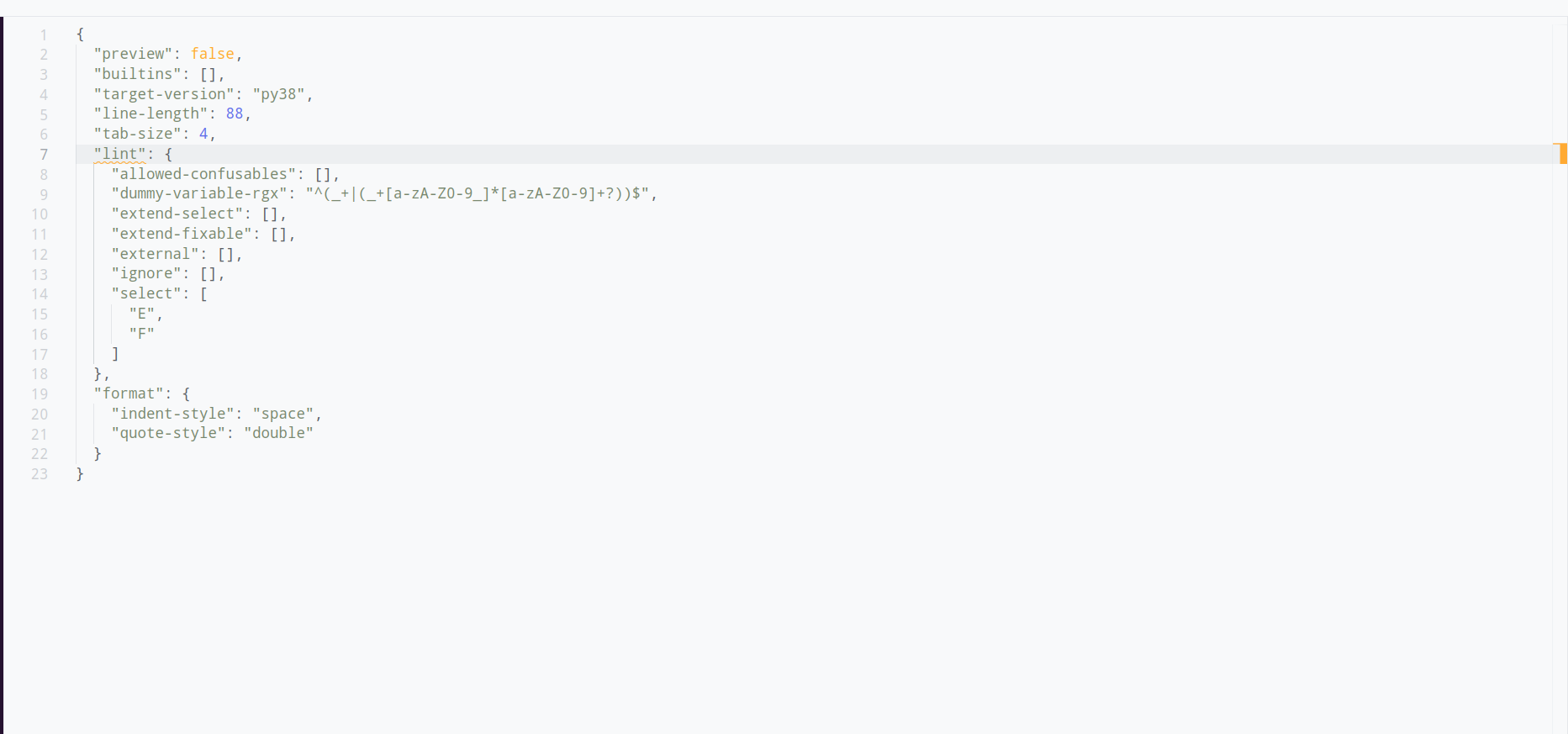
## Summary
This PR adds a new `lint` section to the configuration that groups all linter-specific settings. The existing top-level configurations continue to work without any warning because the `lint.*` settings are experimental.
The configuration merges the top level and `lint.*` settings where the settings in `lint` have higher precedence (override the top-level settings). The reasoning behind this is that the settings in `lint.` are more specific and more specific settings should override less specific settings.
I decided against showing the new `lint.*` options on our website because it would make the page extremely long (it's technically easy to do, just attribute `lint` with `[option_group`]). We may want to explore adding an `alias` field to the `option` attribute and show the alias on the website along with its regular name.
## Test Plan
* I added new integration tests
* I verified that the generated `options.md` is identical
* Verified the default settings in the playground
## Summary

This PR adds the `--preview` and `--no-preview` options to the `format` command (hidden) and passes it through to the formatte.

## Test Plan

I added the `dbg(f.options().preview())` statement in `FormatNodeRule::fmt` and verified that the option gets correctly passed to the formatter.
Per discussion at https://github.com/astral-sh/ruff/discussions/6998

<!--
Thank you for contributing to Ruff! To help us out with reviewing,
please consider the following:

- Does this pull request include a summary of the change? (See below.)
- Does this pull request include a descriptive title?
- Does this pull request include references to any relevant issues?
-->

## Summary

<!-- What's the purpose of the change? What does it do, and why? -->

Adds a `--preview` and `--no-preview` option to the CLI for `ruff check`
and corresponding settings. The CLI options are hidden for now.

Available in the settings as `preview = true` or `preview = false`.

Does not include environment variable configuration, although we may add
it in the future.

## Test Plan

<!-- How was it tested? -->

`cargo build`

Future work will build on this setting, such as toggling the mode during
a test.
## Summary
Returns an exit code of 1 if any files would be reformatted:
```
ruff on charlie/format-check:main [$?⇡] is 📦 v0.0.286 via 🐍 v3.11.2 via 🦀 v1.72.0
❯ cargo run -p ruff_cli -- format foo.py --check
Compiling ruff_cli v0.0.286 (/Users/crmarsh/workspace/ruff/crates/ruff_cli)
Finished dev [unoptimized + debuginfo] target(s) in 1.69s
Running `target/debug/ruff format foo.py --check`
warning: `ruff format` is a work-in-progress, subject to change at any time, and intended only for experimentation.
1 file would be reformatted
ruff on charlie/format-check:main [$?⇡] is 📦 v0.0.286 via 🐍 v3.11.2 via 🦀 v1.72.0 took 2s
❯ echo $?
1
```
Closes#6966.
## Summary

This extends the `ruff_dev` formatter script util. Instead of only doing
stability checks, you can now choose different compatible options on the
CLI and get statistics.

* It adds an option the formats all files that ruff would check to allow
looking at an entire black-formatted repository with `git diff`
* It computes the [Jaccard
index](https://en.wikipedia.org/wiki/Jaccard_index) as a measure of
deviation between input and output, which is useful as single number
metric for assessing our current deviations from black.
* It adds progress bars to both the single projects as well as the
multi-project mode.
* It adds an option to write the multi-project output to a file

Sample usage:

```
$ cargo run --bin ruff_dev -- format-dev --stability-check crates/ruff/resources/test/cpython
$ cargo run --bin ruff_dev -- format-dev --stability-check /home/konsti/projects/django
Syntax error in /home/konsti/projects/django/tests/test_runner_apps/tagged/tests_syntax_error.py: source contains syntax errors (parser error): BaseError { error: UnrecognizedToken(Name { name: "syntax_error" }, None), offset: 131, source_path: "<filename>" }
Found 0 stability errors in 2755 files (jaccard index 0.911) in 9.75s
$ cargo run --bin ruff_dev -- format-dev --write /home/konsti/projects/django
```

Options:

```
Several utils related to the formatter which can be run on one or more repositories. The selected set of files in a repository is the same as for `ruff check`.

* Check formatter stability: Format a repository twice and ensure that it looks that the first and second formatting look the same. * Format: Format the files in a repository to be able to check them with `git diff` * Statistics: The subcommand the Jaccard index between the (assumed to be black formatted) input and the ruff formatted output

Usage: ruff_dev format-dev [OPTIONS] [FILES]...

Arguments:
  [FILES]...
          Like `ruff check`'s files. See `--multi-project` if you want to format an ecosystem checkout

Options:
      --stability-check
          Check stability

          We want to ensure that once formatted content stays the same when formatted again, which is known as formatter stability or formatter idempotency, and that the formatter prints syntactically valid code. As our test cases cover only a limited amount of code, this allows checking entire repositories.

      --write
          Format the files. Without this flag, the python files are not modified

      --format <FORMAT>
          Control the verbosity of the output

          [default: default]

          Possible values:
          - minimal: Filenames only
          - default: Filenames and reduced diff
          - full:    Full diff and invalid code

  -x, --exit-first-error
          Print only the first error and exit, `-x` is same as pytest

      --multi-project
          Checks each project inside a directory, useful e.g. if you want to check all of the ecosystem checkouts

      --error-file <ERROR_FILE>
          Write all errors to this file in addition to stdout. Only used in multi-project mode
```

## Test Plan

I ran this on django (2755 files, jaccard index 0.911) and discovered a
magic trailing comma problem and that we really needed to implement
import formatting. I ran the script on cpython to identify
https://github.com/astral-sh/ruff/pull/5558.
## Summary

This adds a `ruff rule --all` switch that prints out a human-readable
Markdown or a machine-readable JSON document of the lint rules known to
Ruff.

I needed a machine-readable document of the rules [for a
project](https://github.com/astral-sh/ruff/discussions/5078), and
figured it could be useful for other people – or tooling! – to be able
to interrogate Ruff about its arcane knowledge.

The JSON output is an array of the same objects printed by `ruff rule
--format=json`.

## Test Plan

I ran `ruff rule --all --format=json`. I think more might be needed, but
maybe a snapshot test is overkill?
## Summary

A new CLI option (`-o`/`--output-file`) to write output to a file
instead of stdout.

Major change is to remove the lock acquired on stdout. The argument is
that the output is buffered and thus the lock is acquired only when
writing a block (8kb). As per the benchmark below there is a slight
performance penalty.

Reference:
https://rustmagazine.org/issue-3/javascript-compiler/#printing-is-slow

## Benchmarks

_Output is truncated to only contain useful information:_

Command: `check --isolated --no-cache --select=ALL --show-source
./test-repos/cpython"`

Latest HEAD (361d45f2b2) with and without
the manual lock on stdout:

```console
Benchmark 1: With lock
  Time (mean ± σ):      5.687 s ±  0.075 s    [User: 17.110 s, System: 0.486 s]
  Range (min … max):    5.615 s …  5.860 s    10 runs

Benchmark 2: Without lock
  Time (mean ± σ):      5.719 s ±  0.064 s    [User: 17.095 s, System: 0.491 s]
  Range (min … max):    5.640 s …  5.865 s    10 runs

Summary
  (1) ran 1.01 ± 0.02 times faster than (2)
```

This PR:

```console
Benchmark 1: This PR
  Time (mean ± σ):      5.855 s ±  0.058 s    [User: 17.197 s, System: 0.491 s]
  Range (min … max):    5.786 s …  5.987 s    10 runs

Benchmark 2: Latest HEAD with lock
  Time (mean ± σ):      5.645 s ±  0.033 s    [User: 16.922 s, System: 0.495 s]
  Range (min … max):    5.600 s …  5.712 s    10 runs

Summary
  (2) ran 1.04 ± 0.01 times faster than (1)
```

## Test Plan

Run all of the commands which gives output with and without the
`--output-file=ruff.out` option:
* `--show-settings`
* `--show-files`
* `--show-fixes`
* `--diff`
* `--select=ALL`
* `--select=All --show-source`
* `--watch` (only stdout allowed)

resolves: #4754
## Summary

This adds a new subcommand that can be used as

```shell
cargo build --bin ruff_dev --profile=release-debug
perf record -g -F 999 target/release-debug/ruff_dev repeat --repeat 30 --exit-zero --no-cache path/to/cpython > /dev/null
flamegraph --perfdata perf.data
```

## Test Plan

This is a ruff internal script. I successfully used it to profile
cpython with the instructions above
* Create dummy format CLI

* Hide format from clap, too

Missed that this is a separate option from `#[doc(hidden)]`

* Remove cargo feature and replace with warning

* No-alloc files parameter matching

* beta warning: warn -> warn_user_once

* Rephrase warning
 Zanie Blue
 Felix Williams
 Aarni Koskela
 Charlie Marsh
 Micha Reiser
 konsti
 Dhruv Manilawala
 Jonathan Plasse
 Aaron Cunningham