## Summary
Closes https://github.com/astral-sh/ruff/issues/10858.
`ruff server` now supports `*.ipynb` (aka Jupyter Notebook) files.
Extensive internal changes have been made to facilitate this, which I've
done some work to contextualize with documentation and an pre-review
that highlights notable sections of the code.
`*.ipynb` cells should behave similarly to `*.py` documents, with one
major exception. The format command `ruff.applyFormat` will only apply
to the currently selected notebook cell - if you want to format an
entire notebook document, use `Format Notebook` from the VS Code context
menu.
## Test Plan
The VS Code extension does not yet have Jupyter Notebook support
enabled, so you'll first need to enable it manually. To do this,
checkout the `pre-release` branch and modify `src/common/server.ts` as
follows:
Before:

After:

I recommend testing this PR with large, complicated notebook files. I
used notebook files from [this popular
repository](https://github.com/jakevdp/PythonDataScienceHandbook/tree/master/notebooks)
in my preliminary testing.
The main thing to test is ensuring that notebook cells behave the same
as Python documents, besides the aforementioned issue with
`ruff.applyFormat`. You should also test adding and deleting cells (in
particular, deleting all the code cells and ensure that doesn't break
anything), changing the kind of a cell (i.e. from markup -> code or vice
versa), and creating a new notebook file from scratch. Finally, you
should also test that source actions work as expected (and across the
entire notebook).
Note: `ruff.applyAutofix` and `ruff.applyOrganizeImports` are currently
broken for notebook files, and I suspect it has something to do with
https://github.com/astral-sh/ruff/issues/11248. Once this is fixed, I
will update the test plan accordingly.
---------
Co-authored-by: nolan <nolan.king90@gmail.com>
## Summary
Users can now include tildes and environment variables in the provided
path, just like with `--config`.
Closes#11277.
## Test Plan
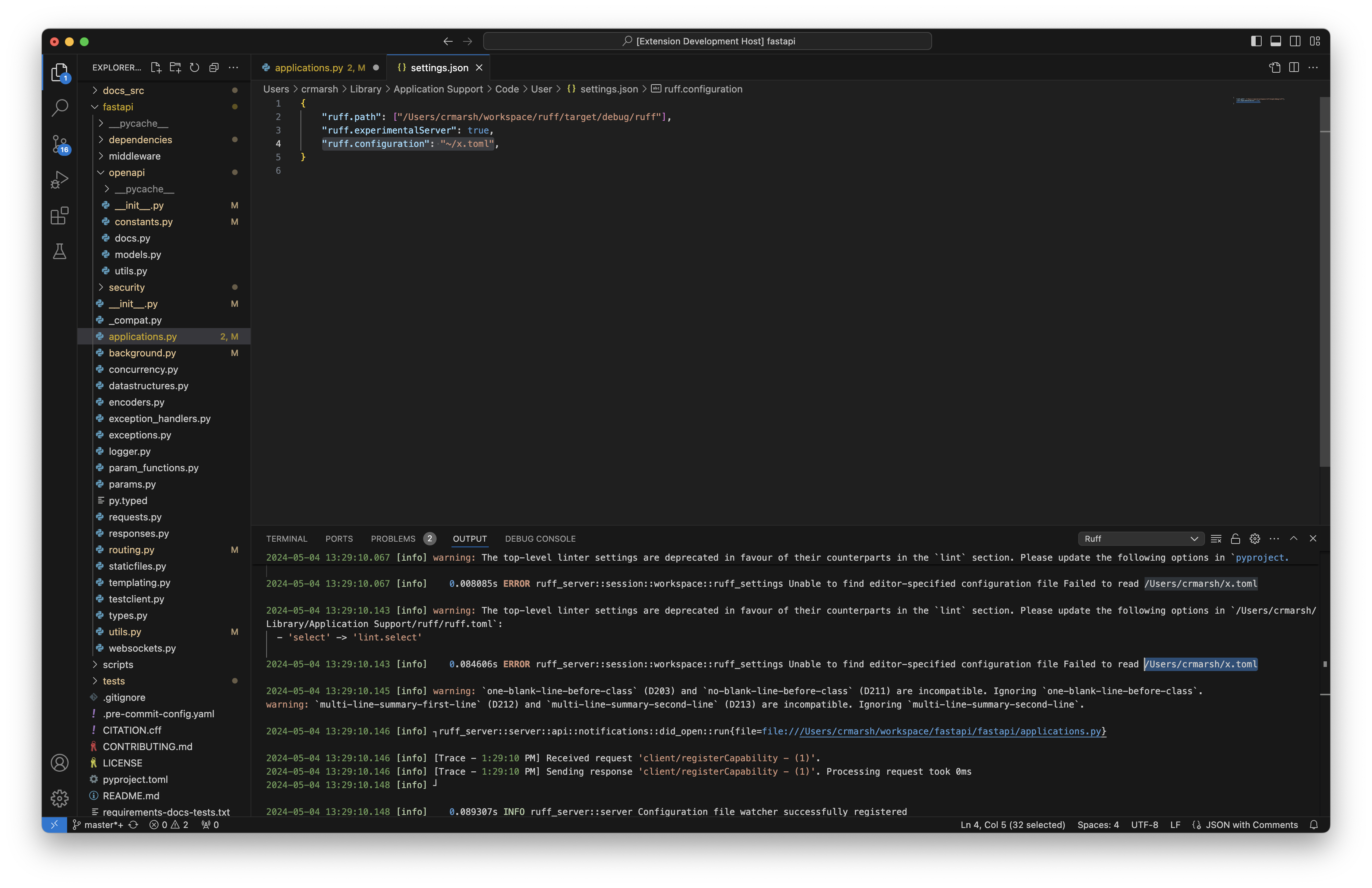
Set the configuration path to `"ruff.configuration": "~/x.toml"`;
verified that the server attempted to read from `/Users/crmarsh/x.toml`.
<!--
Thank you for contributing to Ruff! To help us out with reviewing,
please consider the following:

- Does this pull request include a summary of the change? (See below.)
- Does this pull request include a descriptive title?
- Does this pull request include references to any relevant issues?
-->

## Summary

Add support for hover menu to ruff_server, as requested in
[10595](https://github.com/astral-sh/ruff/issues/10595).
Majority of new code is in hover.rs.
I reused the regex from ruff-lsp's implementation. Also reused the
format_rule_text function from ruff/src/commands/rule.rs
Added capability registration in server.rs, and added the handler to
api.rs.

## Test Plan

Tested in NVIM v0.10.0-dev-2582+g2a8cef6bd, configured with lspconfig
using the default options (other than cmd pointing to my test build,
with options "server" and "--preview"). OS: Ubuntu 24.04, kernel
6.8.0-22.

---------

Co-authored-by: Jane Lewis <me@jane.engineering>
## Summary

Configuration is no longer the property of a workspace but rather of
individual documents. Just like the Ruff CLI, each document is
configured based on the 'nearest' project configuration. See [the Ruff
documentation](https://docs.astral.sh/ruff/configuration/#config-file-discovery)
for more details.

To reduce the amount of times we resolve configuration for a file, we
have an index for each workspace that stores a reference-counted pointer
to a configuration for a given folder. If another file in the same
folder is opened, the configuration is simply re-used rather than us
re-resolving it.

## Guide for reviewing

The first commit is just the restructuring work, which adds some noise
to the diff. If you want to quickly understand what's actually changed,
I recommend looking at the two commits that come after it.
f7c073d441 makes configuration a property
of `DocumentController`/`DocumentRef`, moving it out of `Workspace`, and
it also sets up the `ConfigurationIndex`, though it doesn't implement
its key function, `get_or_insert`. In the commit after it,
fc35618f17, we implement `get_or_insert`.

## Test Plan

The best way to test this would be to ensure that the behavior matches
the Ruff CLI. Open a project with multiple configuration files (or add
them yourself), and then introduce problems in certain files that won't
show due to their configuration. Add those same problems to a section of
the project where those rules are run. Confirm that the lint rules are
run as expected with `ruff check`. Then, open your editor and confirm
that the diagnostics shown match the CLI output.

As an example - I have a workspace with two separate folders, `pandas`
and `scipy`. I created a `pyproject.toml` file in `pandas/pandas/io` and
a `ruff.toml` file in `pandas/pandas/api`. I changed the `select` and
`preview` settings in the sub-folder configuration files and confirmed
that these were reflected in the diagnostics. I also confirmed that this
did not change the diagnostics for the `scipy` folder whatsoever.
## Summary
I used `cargo-shear` (see
[tweet](https://twitter.com/boshen_c/status/1770106165923586395)) to
remove some unused dependencies that `cargo udeps` wasn't reporting.

<!-- What's the purpose of the change? What does it do, and why? -->

## Test Plan

`cargo test`
<!--
Thank you for contributing to Ruff! To help us out with reviewing,
please consider the following:

- Does this pull request include a summary of the change? (See below.)
- Does this pull request include a descriptive title?
- Does this pull request include references to any relevant issues?
-->

## Summary

This PR introduces the `ruff_server` crate and a new `ruff server`
command. `ruff_server` is a re-implementation of
[`ruff-lsp`](https://github.com/astral-sh/ruff-lsp), written entirely in
Rust. It brings significant performance improvements, much tighter
integration with Ruff, a foundation for supporting entirely new language
server features, and more!

This PR is an early version of `ruff_lsp` that we're calling the
**pre-release** version. Anyone is more than welcome to use it and
submit bug reports for any issues they encounter - we'll have some
documentation on how to set it up with a few common editors, and we'll
also provide a pre-release VSCode extension for those interested.

This pre-release version supports:
- **Diagnostics for `.py` files**
- **Quick fixes**
- **Full-file formatting**
- **Range formatting**
- **Multiple workspace folders**
- **Automatic linter/formatter configuration** - taken from any
`pyproject.toml` files in the workspace.

Many thanks to @MichaReiser for his [proof-of-concept
work](https://github.com/astral-sh/ruff/pull/7262), which was important
groundwork for making this PR possible.

## Architectural Decisions

I've made an executive choice to go with `lsp-server` as a base
framework for the LSP, in favor of `tower-lsp`. There were several
reasons for this:

1. I would like to avoid `async` in our implementation. LSPs are mostly
computationally bound rather than I/O bound, and `async` adds a lot of
complexity to the API, while also making harder to reason about
execution order. This leads into the second reason, which is...
2. Any handlers that mutate state should be blocking and run in the
event loop, and the state should be lock-free. This is the approach that
`rust-analyzer` uses (also with the `lsp-server`/`lsp-types` crates as a
framework), and it gives us assurances about data mutation and execution
order. `tower-lsp` doesn't support this, which has caused some
[issues](https://github.com/ebkalderon/tower-lsp/issues/284) around data
races and out-of-order handler execution.
3. In general, I think it makes sense to have tight control over
scheduling and the specifics of our implementation, in exchange for a
slightly higher up-front cost of writing it ourselves. We'll be able to
fine-tune it to our needs and support future LSP features without
depending on an upstream maintainer.

## Test Plan

The pre-release of `ruff_server` will have snapshot tests for common
document editing scenarios. An expanded test suite is on the roadmap for
future version of `ruff_server`.
 Micha Reiser
 Charlie Marsh
 Jane Lewis
 Nolan
Nolan