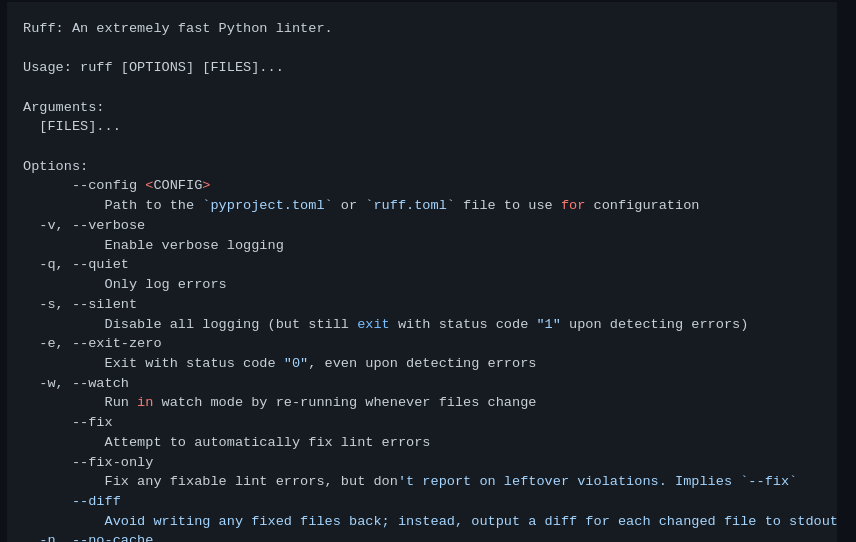
Following up on #2018/#2019 discussion, this moves the readme's development-related bits to `CONTRIBUTING.md` to avoid duplication, and fixes up the commands accordingly 😄
As per Cargo.toml our minimal supported Rust version is 1.65.0, so we
should be using that version in our CI for cargo test and cargo build.

This was apparently accidentally changed in
79ca66ace5.
As we surface rule names more to users we want
them to be easier to type than PascalCase.

Prior art:

Pylint and ESLint also use kebab-case for their rule names.
Clippy uses snake_case but only for syntactical reasons
(so that the argument to e.g. #![allow(clippy::some_lint)]
can be parsed as a path[1]).

[1]: https://doc.rust-lang.org/reference/paths.html
This PR adds a new check that turns expressions such as `[1, 2, 3] + foo` into `[1, 2, 3, *foo]`, since the latter is easier to read and faster:

```
~ $ python3.11 -m timeit -s 'b = [6, 5, 4]' '[1, 2, 3] + b'
5000000 loops, best of 5: 81.4 nsec per loop
~ $ python3.11 -m timeit -s 'b = [6, 5, 4]' '[1, 2, 3, *b]'
5000000 loops, best of 5: 66.2 nsec per loop
```

However there's a couple of gotchas:

* This felt like a `simplify` rule, so I borrowed an unused `SIM` code even if the upstream `flake8-simplify` doesn't do this transform. If it should be assigned some other code, let me know 😄
* **More importantly** this transform could be unsafe if the other operand of the `+` operation has overridden `__add__` to do something else. What's the `ruff` policy around potentially unsafe operations? (I think some of the suggestions other ported rules give could be semantically different from the original code, but I'm not sure.)
* I'm not a very established Rustacean, so there's no doubt my code isn't quite idiomatic. (For instance, is there a neater way to write that four-way `match` statement?)

Thanks for `ruff`, by the way! :)
# This commit has been generated via the following Python script:
# (followed by `cargo +nightly fmt` and `cargo dev generate-all`)
# For the reasoning see the previous commit(s).

import re
import sys

for path in (
    'src/violations.rs',
    'src/rules/flake8_tidy_imports/banned_api.rs',
    'src/rules/flake8_tidy_imports/relative_imports.rs',
):
    with open(path) as f:
        text = ''

        while line := next(f, None):

            if line.strip() != 'fn message(&self) -> String {':
                text += line
                continue

            text += '    #[derive_message_formats]\n' + line

            body = next(f)
            while (line := next(f)) != '    }\n':
                body += line

            # body = re.sub(r'(?<!code\| |\.push\()format!', 'format!', body)
            body = re.sub(
                r'("[^"]+")\s*\.to_string\(\)', r'format!(\1)', body, re.DOTALL
            )
            body = re.sub(
                r'(r#".+?"#)\s*\.to_string\(\)', r'format!(\1)', body, re.DOTALL
            )

            text += body + '    }\n'

            while (line := next(f)).strip() != 'fn placeholder() -> Self {':
                text += line
            while (line := next(f)) != '    }\n':
                pass

    with open(path, 'w') as f:
        f.write(text)
Fixes: #1953

@charliermarsh thank you for the tips in the issue.

I'm not very familiar with Rust, so please excuse if my string formatting syntax is messy.

In terms of testing, I compared output of `flake8 --format=pylint ` and `cargo run --format=pylint` on the same code and the output syntax seems to check out.
This is slightly buggy due to Instagram/LibCST#855; it will complain `[ERROR] Failed to fix nested with: Failed to extract CST from source` when trying to fix nested parenthesized `with` statements lacking trailing commas. But presumably people who write parenthesized `with` statements already knew that they don’t need to nest them.

Signed-off-by: Anders Kaseorg <andersk@mit.edu>
I accept any suggestion. By the way, I have a doubt, I have checked and all flake8-pie plugins can be fixed by ruff, but is it necessary that this one is also fixed automatically ?

rel #1543
The idea is to follow the Rust naming convention for lints[1]:

> the lint name should make sense when read as
> "allow lint-name" or "allow lint-name items"

Following that convention prefixing "Banned" is
redundant as it could be prefixed to any lint name.

[1]: https://rust-lang.github.io/rfcs/0344-conventions-galore.html#lints
Implements [flake8-commas](https://github.com/PyCQA/flake8-commas). Fixes#1058.
The plugin is mostly redundant with Black (and also deprecated upstream), but very useful for projects which can't/won't use an auto-formatter.
This linter works on tokens. Before porting to Rust, I cleaned up the Python code ([link](https://gist.github.com/bluetech/7c5dcbdec4a73dd5a74d4bc09c72b8b9)) and made sure the tests pass. In the Rust version I tried to add explanatory comments, to the best of my understanding of the original logic.
Some changes I did make:
- Got rid of rule C814 - "missing trailing comma in Python 2". Ruff doesn't support Python 2.
- Merged rules C815 - "missing trailing comma in Python 3.5+" and C816 - "missing trailing comma in Python 3.6+" into C812 - "missing trailing comma". These Python versions are outdated, didn't think it was worth the complication.
- Added autofixes for C812 and C819.
Autofix is missing for C818 - "trailing comma on bare tuple prohibited". It needs to turn e.g. `x = 1,` into `x = (1, )`, it's a bit difficult to do with tokens only, so I skipped it for now.
I ran the rules on cpython/Lib and on a big internal code base and it works as intended (though I only sampled the diffs).
This makes it easier to see which rules you're enabling when selecting
one of the pylint codes (like `PLC`). This also makes it clearer what
those abbreviations stand for. When I first saw the pylint section, I
was very confused by that, so other might be as well.

See it rendered here:
https://github.com/thomkeh/ruff/blob/patch-1/README.md#pylint-plc-ple-plr-plw
This PR implements `reverse-relative`, from isort, but renames it to
`relative-imports-order` with the respected value `closest-to-furthest`
and `furthest-to-closest`, and the latter being the default.
Closes#1813.
This PR implements `W505` (`DocLineTooLong`), which is similar to `E501`
(`LineTooLong`) but confined to doc lines.
I based the "doc line" definition on pycodestyle, which defines a doc
line as a standalone comment or string statement. Our definition is a
bit more liberal, since we consider any string statement a doc line
(even if it's part of a multi-line statement) -- but that seems fine to
me.
Note that, unusually, this rule requires custom extraction from both the
token stream (to find standalone comments) and the AST (to find string
statements).
Closes#1784.
Ref #998

- Implements SIM401 with fix
- Added tests

Notes:
- only recognize simple ExprKind::Name variables in expr patterns for
now
- bug-fix from reference implementation: check 3-conditions (dict-key,
target-variable, dict-name) to be equal, `flake8_simplify` only test
first two (only first in second pattern)
When checking changes in the 0.0.218 release I noticed that auto fixing
PT004 and PT005 was disabled but this change was not reflected in
README. So I create this small PR to do this.

Co-authored-by: Charlie Marsh <charlie.r.marsh@gmail.com>
A part of #827. Posting this for visibility. Still has some work to do
to be done.

Things that still need done before this is ready:

- [x] Does not work when the item is being assigned to a variable
- [x] Does not work if being used in a function call
- [x] Fix incorrectly removed calls in the function
- [x] Has not been tested with pyupgrade negative test cases

Tests from pyupgrade can be seen here:
https://github.com/asottile/pyupgrade/blob/main/tests/features/format_literals_test.py

Co-authored-by: Charlie Marsh <charlie.r.marsh@gmail.com>
In isort, this is called `add-imports`, but I prefer the declarative
name.
The idea is that by adding the following to your `pyproject.toml`, you
can ensure that the import is included in all files:
```toml
[tool.ruff.isort]
required-imports = ["from __future__ import annotations"]
```
I mostly reverse-engineered isort's logic for making decisions, though I
made some slight tweaks that I think are preferable. A few comments:
- Like isort, we don't enforce this on empty files (like empty
`__init__.py`).
- Like isort, we require that the import is at the top-level.
- isort will skip any docstrings, and any comments on the first three
lines (I think, based on testing). Ruff places the import after the last
docstring or comment in the file preamble (that is: after the last
docstring or comment that comes before the _first_ non-docstring and
non-comment).
Resolves#1700.
This commit is a first attempt at addressing issue #1003.

The default `isort` behavior is `force-sort-within-sections = false`,
which places `from X import Y` statements after `import X` statements.

When `force-sort-within-sections = true` all imports are sorted by
module name.

When module names are equivalent, the `import` statement comes before
the `from` statement.
Imagine a .py file containing the following comment:

    # TODO: Lorem ipsum dolor sit amet, consectetur adipiscing elit, sed
    # do eiusmod tempor incididunt ut labore et dolore magna aliqua.

Since `git grep` only matches individual lines `git grep TODO` would
only output the first line of the comment, cutting off potentially
important information. (git grep currently doesn't support multiline
grepping). Projects using such a workflow therefore probably format
the comment in a single line instead:

    # TODO: Lorem ipsum dolor sit amet, consectetur adipiscing elit, sed do eiusmod tempor incididunt ut labore et dolore magna aliqua.

This commit introduces a setting to accomdate this workflow by making
the line-length checks (`E501`) optionally ignore overlong lines
if they start with a recognized task tag.

Co-authored-by: Charlie Marsh <charlie.r.marsh@gmail.com>
Programmers often leave comments to themselves and others such as:

    # TODO: Use a faster algorithm?

The keywords used to prefix such comments are just a convention and vary
from project to project. Other common keywords include FIXME and HACK.

The keywords in use for the codebase are of interest to ruff because
ruff does also lint comments. For example the ERA lint detects
commented-out code but ignores comments starting with such a keyword.
Previously the ERA lint simply hardcoded the regular expression
TODO|FIXME|XXX to achieve that. This commit introduces a new `task-tags`
setting to make this configurable (and to allow other comment lints to
recognize the same set of keywords).

The term "task tags" has probably been popularized by the Eclipse
IDE.[1] For Python there has been the proposal PEP 350[2], which
referred to such keywords as "codetags". That proposal however has been
rejected. We are choosing the term "task tags" over "code tags" because
the former is more descriptive: a task tag describes a task.

While according to the PEP 350 such keywords are also sometimes used for
non-tasks e.g. NOBUG to describe a well-known problem that will never be
addressed due to design problems or domain limitations, such keywords
are so rare that we are neglecting them here in favor of more
descriptive terminology. The vast majority of such keywords does
describe tasks, so naming the setting "task-tags" is apt.

[1]: https://www.eclipse.org/pdt/help/html/task_tags.htm
[2]: https://peps.python.org/pep-0350/

Co-authored-by: Charlie Marsh <charlie.r.marsh@gmail.com>
 Aarni Koskela
 Ville Skyttä
 Martin Fischer
 Colin Delahunty
 Charlie Marsh
 Damien Allen
 Anders Kaseorg
 Maksudul Haque
 skykasko
 Edgar R. M
 Leonardo Esparis
 Harutaka Kawamura
 Ran Benita
 Tom Fryers
 Thomas MK
 max0x53
 Nicola Soranzo
 Jan Katins
 Ash Berlin-Taylor
 nefrob
 messense
 Jeroen Van Goey
 Chammika Mannakkara
 Grzegorz Bokota
 Matt Oberle
 Diego Palacios
 Pedram Navid
 jvstme
 Víctor
 Pedram Navid
 Reiner Gerecke
 Adam Turner
 Mathieu Kniewallner