- Removes "experimental" labels from command documentation
- Removes preview warnings
- Removes `PreviewMode` from most structs and methods — we could keep it
around but I figure we can propagate it again easily where needed in the
future
- Enables preview behavior by default everywhere, e.g., `uv venv` will
download Python versions
This PR migrates uv's use of `chrono` to `jiff`.

I did most of this work a while back as one of my tests to ensure Jiff
could actually be used in a real world project. I decided to revive
this because I noticed that `reqwest-retry` dropped its Chrono
dependency,
which is I believe the only other thing requiring Chrono in uv.
(Although, we use a fork of `reqwest-middleware` at present, and that
hasn't been updated to latest upstream yet. I wasn't quite sure of the
process we have for that.)

In course of doing this, I actually made two changes to uv:

First is that the lock file now writes an RFC 3339 timestamp for
`exclude-newer`. Previously, we were using Chrono's `Display`
implementation for this which is a non-standard but "human readable"
format. I think the right thing to do here is an RFC 3339 timestamp.

Second is that, in addition to an RFC 3339 timestamp, `--exclude-newer`
used to accept a "UTC date." But this PR changes it to a "local date."
That is, a date in the user's system configured time zone. I think
this makes more sense than a UTC date, but one alternative is to drop
support for a date and just rely on an RFC 3339 timestamp. The main
motivation here is that automatically assuming UTC is often somewhat
confusing, since just writing an unqualified date like `2024-08-19` is
often assumed to be interpreted relative to the writer's "local" time.
## Summary

The strategy here is: if the user provides supported environments, we
use those as the initial forks when resolving. As a result, we never add
or explore branches that are disjoint with the supported environments.
(If the supported environments change, we ignore the lockfile entirely,
so we don't have to worry about any interactions between supported
environments and the preference forks.)

Closes https://github.com/astral-sh/uv/issues/6184.
A dockerfile using `ubuntu` instead of `python` as base image currently
silently fails to install.

```dockerfile
FROM ubuntu
RUN apt-get update && apt-get install -y curl --no-install-recommends
RUN curl -LsSf https://astral.sh/uv/install.sh | sh
RUN uv --version
```

```console
$ docker buildx build --progress plain --no-cache .
[...]
#6 [3/4] RUN curl -LsSf https://astral.sh/uv/install.sh | sh
#6 0.144 curl: (77) error setting certificate file: /etc/ssl/certs/ca-certificates.crt
#6 DONE 0.2s

#7 [4/4] RUN uv --version
#7 0.113 /bin/sh: 1: uv: not found
#7 ERROR: process "/bin/sh -c uv --version" did not complete successfully: exit code: 127
```

There's two underlying problems: Pipefail, and missing
`ca-certificates`.

In most shells, the source of a pipe erroring doesn't fail the entire
command, so `curl -LsSf https://astral.sh/uv/install.sh | sh` passes
even if the curl part fails. In bash, you can prefix the command with
`set -o pipefail &&` to change this behavior. But in the `ubuntu` docker
container, dash is the default shell, not bash. dash doesn't have a
pipefail option (in the version in ubuntu), so the [best
practice](https://docs.docker.com/build/building/best-practices/#using-pipes)
is `RUN ["/bin/bash", "-c", "set -o pipefail && curl -LsSf
https://astral.sh/uv/install.sh | sh"]`. That's not very readable, so
i'm going for `RUN curl -LsSf https://astral.sh/uv/install.sh >
/tmp/uv-installer.sh && sh /tmp/uv-installer.sh && rm
/tmp/uv-installer.sh` instead.

```dockerfile
FROM ubuntu
RUN apt-get update && apt-get install -y curl --no-install-recommends
RUN curl -LsSf https://astral.sh/uv/install.sh > /tmp/uv-installer.sh && sh /tmp/uv-installer.sh && rm /tmp/uv-installer.sh \
RUN uv --version
```

```console
$ docker buildx build --progress plain --no-cache .
[...]
#6 [3/3] RUN curl -LsSf https://astral.sh/uv/install.sh > /tmp/uv-installer.sh && sh /tmp/uv-installer.sh && rm /tmp/uv-installer.sh RUN uv --version
#6 0.179 curl: (77) error setting certificate file: /etc/ssl/certs/ca-certificates.crt
#6 ERROR: process "/bin/sh -c curl -LsSf https://astral.sh/uv/install.sh > /tmp/uv-installer.sh && sh /tmp/uv-installer.sh && rm /tmp/uv-installer.sh RUN uv --version" did not complete successfully: exit code: 77
```

The source for this error is `ca-certificates` missing, which is a
recommended package. We need to drop `--no-install-recommends` and the
installation passes again.
Resolve#6152
## Summary
## Test Plan
Execution result of `cargo run generate-shell-completion --help`
```bash
Generate shell completion
Usage: uv generate-shell-completion <SHELL>
Arguments:
<SHELL> The shell to generate the completion script for [possible values: bash, elvish, fish, nushell, powershell, zsh]
```
Execution result of `cargo run help generate-shell-completion`
```bash
Generate shell completion
Usage: uv generate-shell-completion <SHELL>
Arguments:
<SHELL>
The shell to generate the completion script for
[possible values: bash, elvish, fish, nushell, powershell, zsh]
```
## Summary

Resolves https://github.com/astral-sh/uv/issues/4537

- First commit avoids overwriting dependencies with different markers.
- Second commit supports adding from requirements files.

## Test Plan

`cargo test`
## Summary
This PR adds descriptions for the `UV_TOOL_DIR`, `UV_PYTHON_INSTALL_DIR`
and `XDG_*` environment variables.
Additionally, it moves some env vars that are not command-line arguments
to the below "uv respects" section.
Closes#5746
## Summary

`mkdocs` supports [validation rules for
links](https://www.mkdocs.org/user-guide/configuration/#validation),
which can be tightened to report more issues than the default
configuration. I used the recommended "maximal strictness" configuration
from the documentation.

Adding the `anchors` rule helped spot 4 errors:
```console
WARNING -  Doc file 'guides/install-python.md' contains a link '../concepts/python-versions.md#python-distributions', but the doc 'concepts/python-versions.md' does not contain an anchor '#python-distributions'.
WARNING -  Doc file 'guides/install-python.md' contains a link '../concepts/python-versions.md#discovery-order', but the doc 'concepts/python-versions.md' does not contain an anchor '#discovery-order'.
WARNING -  Doc file 'guides/projects.md' contains a link '../concepts/projects.md#lock-file', but the doc 'concepts/projects.md' does not contain an anchor '#lock-file'.
WARNING -  Doc file 'pip/environments.md' contains a link '../concepts/python-versions.md#discovery-order', but the doc 'concepts/python-versions.md' does not contain an anchor '#discovery-order'.
```

## Test Plan

Local run of the documentation + `mkdocs build --strict`.
## Summary

We now persist the `ResolverInstallerOptions` when writing out a tool
receipt. When upgrading, we grab the saved options, and merge with the
command-line arguments and user-level filesystem settings (CLI > receipt
> filesystem).
The loose consensus is that "fetch" doesn't have much meaning and that a
boolean flag makes more sense from the command line.

1. Adds `--allow-python-downloads` (hidden, default) and
`--no-python-downloads` to the CLI to quickly enable or disable
downloads
2. Deprecates `--python-fetch` in favor of the options from (1)
3. Removes  `python-fetch` in favor of a `python-downloads` setting
5. Adds a `never` variant to the enum, allowing even explicit installs
to be disabled via the configuration file

## Test plan

I tested this with various `pyproject.toml`-level settings and `uv venv
--preview --python 3.12.2` and `uv python install 3.12.2` with and
without the new CLI flags.
## Summary

I think this seems reasonable... Otherwise, we might not go back to PyPI
to revalidate the list of available versions despite the user passing
`--upgrade`.
## Summary

Previously, we wouldn't respect configuration files in directories
_above_ a workspace root. But this is somewhat problematic, because any
`pyproject.toml` will define a workspace root...

Instead, I think we should _start_ the search at the workspace root, but
go above it if necessary.

Closes: #5929.

See: https://github.com/astral-sh/uv/pull/4295.
## Summary
Resolves#5188. Most of the changes involve creating a new function in
`tool/common.rs` to contain the common functionality previously found in
`tool/install.rs`.
## Test Plan
`cargo test`
```console
❯ ./target/debug/uv tool upgrade black
warning: `uv tool upgrade` is experimental and may change without warning.
Resolved 6 packages in 25ms
Uninstalled 1 package in 3ms
Installed 1 package in 19ms
- black==23.1.0
+ black==24.4.2
Installed 2 executables: black, blackd
```
Following #5869, the documentation has some less-than-helpful
suggestions to use `uv help python` for details — we should link to the
`uv python` section instead.
## Summary
After referring to https://github.com/astral-sh/uv/pull/5637 and doing
additional testing.
The default value in a stable state seems more reasonable to be
``only-system``. ``managed`` in preview.
```
cpython-3.11.9-windows-x86_64-none C:\Users\name\AppData\Local\Programs\Python\Python311\python.exe
cpython-3.10.14-windows-x86_64-none C:\Users\name\AppData\Roaming\uv\data\python\cpython-3.10.14-windows-x86_64-none\install\python.exe
cpython-3.10.11-windows-x86_64-none C:\Users\name\AppData\Local\Programs\Python\Python310\python.exe
cpython-3.9.19-windows-x86_64-none C:\Users\name\AppData\Roaming\uv\data\python\cpython-3.9.19-windows-x86_64-none\python.exe
```
test on uv 0.2.33 (build from
257007ccaf)
### Stable version
``uv venv -p 3.10`` is ``3.10.11`` (System Python)
``uv venv -p 3.9`` is ``No interpreter found``(3.9.19 for managed
Python)
``uv venv -p 3.9 --python-preference only-system`` is ``No interpreter
found``(fail)
``uv venv -p 3.9 --python-preference only-managed`` is
``3.9.19``(success)
Do not use managed Python, only use the system Python, so it can be
determined as ``only-system``.
### Preview mode
**Note:** ``3.10.14`` is managed python, ``3.10.11`` is system python.
``uv venv -p 3.11 --preview`` is ``3.11.9`` (System Python)
``uv venv -p 3.10 --preview`` is ``3.10.14``
``uv venv -p 3.10 --preview --python-preference only-managed`` is
``3.10.14``
``uv venv -p 3.10 --preview --python-preference managed`` is ``3.10.14``
``uv venv -p 3.10 --preview --python-preference system`` is ``3.10.11``
``venv -p 3.10 --preview --python-preference only-system`` is
``3.10.11``
Prioritize the managed Python and then select the system Python, so it
can be determined as ``managed``.
-----
fixed#5754
## Test Plan
Run website in local.

This PR rewrites the resolver concept and adds a resolver internals page
targeted at power users.
The new resolution concept documentation has three parts:
* An introduction for people how never heard of "resolution" before, and
a motivating example what it does. I've also shoved the part about
equally valid resolutions in there.
* Features you commonly use: Non-universal vs. universal resolution,
lowest resolution amd pre-releases.
* Expert features, we don't advertise them, you'll only need them in
complex cases when you already know and i kept them to the reference
points you need in this case: Constraints, overrides and exclude-newer.
I intentionally didn't lay out any detail of the resolution itself, the
idea is that users get a vague sense of "uv has to select fitting
versions", but then they learn the options they have to use and some
common failure points without ever coming near SAT or even graphs.
The resolution internals reference page is targeted at power users who
need to understand what is going on behind the scenes. It assumes ample
prior knowledge and exists to explain the uv-specific behaviors for
someone who already understands dependency resolution conceptually and
has interacted with their dependency tree before. I had a section on the
lockfile but removed it because it found the lockfile to be too
self-documenting.
I haven't touched the readme.
Closes#5603Closes#5238Closes#5237
---------
Co-authored-by: Zanie Blue <contact@zanie.dev>
To enforce the 100 character line limit in markdown files introduced in
https://github.com/astral-sh/uv/pull/5635, and to automate the
formatting of markdown files, i've added prettier and formatted our
markdown files with it.

I've excluded the changelog and the generated references documentation
from this for having too many changes, but we can also include them.

I'm not particular on which style we use. My main motivations are
(major) not having to reflow markdown files myself anymore and (minor)
consistence between all markdown files. I've chosen prettier for similar
reason as we chose black, it's a single good style that's automated and
shared in the community. I do prefer prettier's style of not breaking
inside of a link name though.

This PR is in two parts, the first adds prettier to CI and documents
using it, while the second actually formats the docs. When merge
conflicts arise, we can drop the last commit and regenerate it with `npx
prettier --prose-wrap always --write BENCHMARKS.md CONTRIBUTING.md
README.md STYLE.md docs/*.md docs/concepts/**/*.md docs/guides/**/*.md
docs/pip/**/*.md`.

---------

Co-authored-by: Zanie Blue <contact@zanie.dev>
## Summary
Partially resolves#5561. Haven't added overrides support yet but I can
add it tomorrow if the current approach for constraints is ok.
## Test Plan
`cargo test`
Manually checked trace logs after changing the constraints.
Addressing some feedback about the first-steps covering the help and
version commands.

I'm not sure what else to do here since the first steps with uv are very
dependent on the features you need.
Collapses the previous default into "managed" and makes the "managed"
behavior match "installed". People should use "only-managed" if they
want that behavior, it seems overly complicated otherwise.
## Summary

This PR deprecates the `--isolated` flag. The treatment varies across
the APIs:

- For non-preview APIs, we warn but treat it as equivalent to
`--no-config`.
- For preview APIs, we warn and ignore it, with two exceptions...
- For `tool run` and `run` specifically, we don't even warn, because we
can't differentiate the command-specific `--isolated` from the global
`--isolated`.
## Summary

It's hard for me to imagine a scenario in which a user passed
`--reinstall`, but wanted us to keep respecting cached data for a
package. For example, to actually "rebuild and reinstall" an editable
today, you have to pass both `--reinstall` and `--refresh`.

This PR makes `--reinstall` imply `--refresh`, so we always validate
that the cached data is fresh.

Closes https://github.com/astral-sh/uv/issues/5424.
## Summary

Spotted some issues in the settings documentation, and room for small
improvements by linking to PEPs/RFCs.

Also updating contribution documentation to mention that it's necessary
to enable the virtual environment before running `mkdocs serve`.

## Test Plan

Running documentation locally.
## Summary

Addressing this [issue](https://github.com/astral-sh/uv/issues/5147) by
adding the capability for Symbolic linking as a link mode when
installing or syncing dependencies.
## Summary

Write the project guide that was added in
https://github.com/astral-sh/uv/pull/5135.

I tried to expand on details as much as I felt was necessary for someone
new to python package managers (which was myself a couple months ago).
## Summary

This is an alternative to `--require-hashes` which will validate a hash
if it's present, but ignore requirements that omit hashes or are absent
from the lockfile entirely.

So, e.g., transitive dependencies that are missing will _not_ error; nor
will dependencies that are included but lack a hash.

Closes https://github.com/astral-sh/uv/issues/3305.
## Summary

A bunch of fixes and improvements on different parts of the
documentation. For Docker documentation changes, links to the relevant
documentations have been included in the commit messages.
<!--
Thank you for contributing to uv! To help us out with reviewing, please
consider the following:

- Does this pull request include a summary of the change? (See below.)
- Does this pull request include a descriptive title?
- Does this pull request include references to any relevant issues?
-->

## Summary

While playing out with `uv` preview features, I've noticed 2 issues with
the development dependencies documentation:
- it is mentioned that the feature is not implemented, but it looks like
it actually is
- despite what is said, it doesn't seem that it's possible to use a map
for development dependencies yet:
  ```toml
  [tool.uv.dev-dependencies]
  test = [
      "pytest >=8.1.1,<9"
  ]
  lint = [
      "mypy >=1,<2"
  ]

  [tool.uv]
  default-dev-dependencies = ["test"]
  ```

  ```console
  $ uv sync --preview
  error: Failed to parse: `pyproject.toml`
    Caused by: TOML parse error at line 32, column 1
     |
  32 | [tool.uv.dev-dependencies]
     | ^^^^^^^^^^^^^^^^^^^^^^^^^^
  invalid type: map, expected a sequence
  ```
## Summary

First part of https://github.com/astral-sh/uv/issues/5093.

Remaining:

- Global settings
- `pip`-specific settings (some will be copied-over from here)
- Auto-generating the "Possible values" for enums
## Summary
We want to have consistency between the Ruff and uv documentation for
the upcoming release. We don't love the Ruff docs, but we'd rather have
consistency and then work towards improving them both, rather than have
two very-different documentation sites that both have weaknesses.
The setup here is simpler than in Ruff as: (1) we don't yet generate any
docs from Rust and (2) we don't try to reuse the README in the uv
documentation (which adds a lot of complexity in Ruff). So the change
here is mostly a 1-to-1 port to MkDocs.
## Test Plan

## Summary

As discussed in #3542 - there has been some confusion about how to get
`uv` to work with ADO Artifacts so I'm adding a quick guide.

## Test Plan

Smoke-tested the examples on my machine.
Whew this is a lot.

The user-facing changes are:

- `uv toolchain` to `uv python` e.g. `uv python find`, `uv python
install`, ...
- `UV_TOOLCHAIN_DIR` to` UV_PYTHON_INSTALL_DIR`
- `<UV_STATE_DIR>/toolchains` to `<UV_STATE_DIR>/python` (with
[automatic
migration](https://github.com/astral-sh/uv/pull/4735/files#r1663029330))
- User-facing messages no longer refer to toolchains, instead using
"Python", "Python versions" or "Python installations"

The internal changes are:

- `uv-toolchain` crate to `uv-python`
- `Toolchain` no longer referenced in type names
- Dropped unused `SystemPython` type (previously replaced)
- Clarified the type names for "managed Python installations"
- (more little things)
<!--
Thank you for contributing to uv! To help us out with reviewing, please
consider the following:

- Does this pull request include a summary of the change? (See below.)
- Does this pull request include a descriptive title?
- Does this pull request include references to any relevant issues?
-->

## Summary

<!-- What's the purpose of the change? What does it do, and why? -->

Fix PEP 508 link.

## Test Plan

See preview
https://github.com/SigureMo/uv/blob/fix-pep508-link-in-preview-doc/docs/specifying_dependencies.md
These docs are not yet meant to be consumed by end users, for now they
allow sharing the state of workspace support in terms of features that
are relevant to users, and to gather feedback on the design. We can
progressively update this doc as workspace support matures.
## Introduction
PEP 621 is limited. Specifically, it lacks
* Relative path support
* Editable support
* Workspace support
* Index pinning or any sort of index specification
The semantics of urls are a custom extension, PEP 440 does not specify
how to use git references or subdirectories, instead pip has a custom
stringly format. We need to somehow support these while still stying
compatible with PEP 621.
## `tool.uv.source`
Drawing inspiration from cargo, poetry and rye, we add `tool.uv.sources`
or (for now stub only) `tool.uv.workspace`:
```toml
[project]
name = "albatross"
version = "0.1.0"
dependencies = [
"tqdm >=4.66.2,<5",
"torch ==2.2.2",
"transformers[torch] >=4.39.3,<5",
"importlib_metadata >=7.1.0,<8; python_version < '3.10'",
"mollymawk ==0.1.0"
]
[tool.uv.sources]
tqdm = { git = "https://github.com/tqdm/tqdm", rev = "cc372d09dcd5a5eabdc6ed4cf365bdb0be004d44" }
importlib_metadata = { url = "https://github.com/python/importlib_metadata/archive/refs/tags/v7.1.0.zip" }
torch = { index = "torch-cu118" }
mollymawk = { workspace = true }
[tool.uv.workspace]
include = [
"packages/mollymawk"
]
[tool.uv.indexes]
torch-cu118 = "https://download.pytorch.org/whl/cu118"
```
See `docs/specifying_dependencies.md` for a detailed explanation of the
format. The basic gist is that `project.dependencies` is what ends up on
pypi, while `tool.uv.sources` are your non-published additions. We do
support the full range or PEP 508, we just hide it in the docs and
prefer the exploded table for easier readability and less confusing with
actual url parts.
This format should eventually be able to subsume requirements.txt's
current use cases. While we will continue to support the legacy `uv pip`
interface, this is a piece of the uv's own top level interface. Together
with `uv run` and a lockfile format, you should only need to write
`pyproject.toml` and do `uv run`, which generates/uses/updates your
lockfile behind the scenes, no more pip-style requirements involved. It
also lays the groundwork for implementing index pinning.
## Changes
This PR implements:
* Reading and lowering `project.dependencies`,
`project.optional-dependencies` and `tool.uv.sources` into a new
requirements format, including:
* Git dependencies
* Url dependencies
* Path dependencies, including relative and editable
* `pip install` integration
* Error reporting for invalid `tool.uv.sources`
* Json schema integration (works in pycharm, see below)
* Draft user-level docs (see `docs/specifying_dependencies.md`)
It does not implement:
* No `pip compile` testing, deprioritizing towards our own lockfile
* Index pinning (stub definitions only)
* Development dependencies
* Workspace support (stub definitions only)
* Overrides in pyproject.toml
* Patching/replacing dependencies
One technically breaking change is that we now require user provided
pyproject.toml to be valid wrt to PEP 621. Included files still fall
back to PEP 517. That means `pip install -r requirements.txt` requires
it to be valid while `pip install -r requirements.txt` with `-e .` as
content falls back to PEP 517 as before.
## Implementation
The `pep508` requirement is replaced by a new `UvRequirement` (name up
for bikeshedding, not particularly attached to the uv prefix). The still
existing `pep508_rs::Requirement` type is a url format copied from pip's
requirements.txt and doesn't appropriately capture all features we
want/need to support. The bulk of the diff is changing the requirement
type throughout the codebase.
We still use `VerbatimUrl` in many places, where we would expect a
parsed/decomposed url type, specifically:
* Reading core metadata except top level pyproject.toml files, we fail a
step later instead if the url isn't supported.
* Allowed `Urls`.
* `PackageId` with a custom `CanonicalUrl` comparison, instead of
canonicalizing urls eagerly.
* `PubGrubPackage`: We eventually convert the `VerbatimUrl` back to a
`Dist` (`Dist::from_url`), instead of remembering the url.
* Source dist types: We use verbatim url even though we know and require
that these are supported urls we can and have parsed.
I tried to make improve the situation be replacing `VerbatimUrl`, but
these changes would require massive invasive changes (see e.g.
https://github.com/astral-sh/uv/pull/3253). A main problem is the ref
`VersionOrUrl` and applying overrides, which assume the same
requirement/url type everywhere. In its current form, this PR increases
this tech debt.
I've tried to split off PRs and commits, but the main refactoring is
still a single monolith commit to make it compile and the tests pass.
## Demo
Adding
d1ae3b85d5/pyproject.json
as json schema (v7) to pycharm for `pyproject.toml`, you can try the IDE
support already:
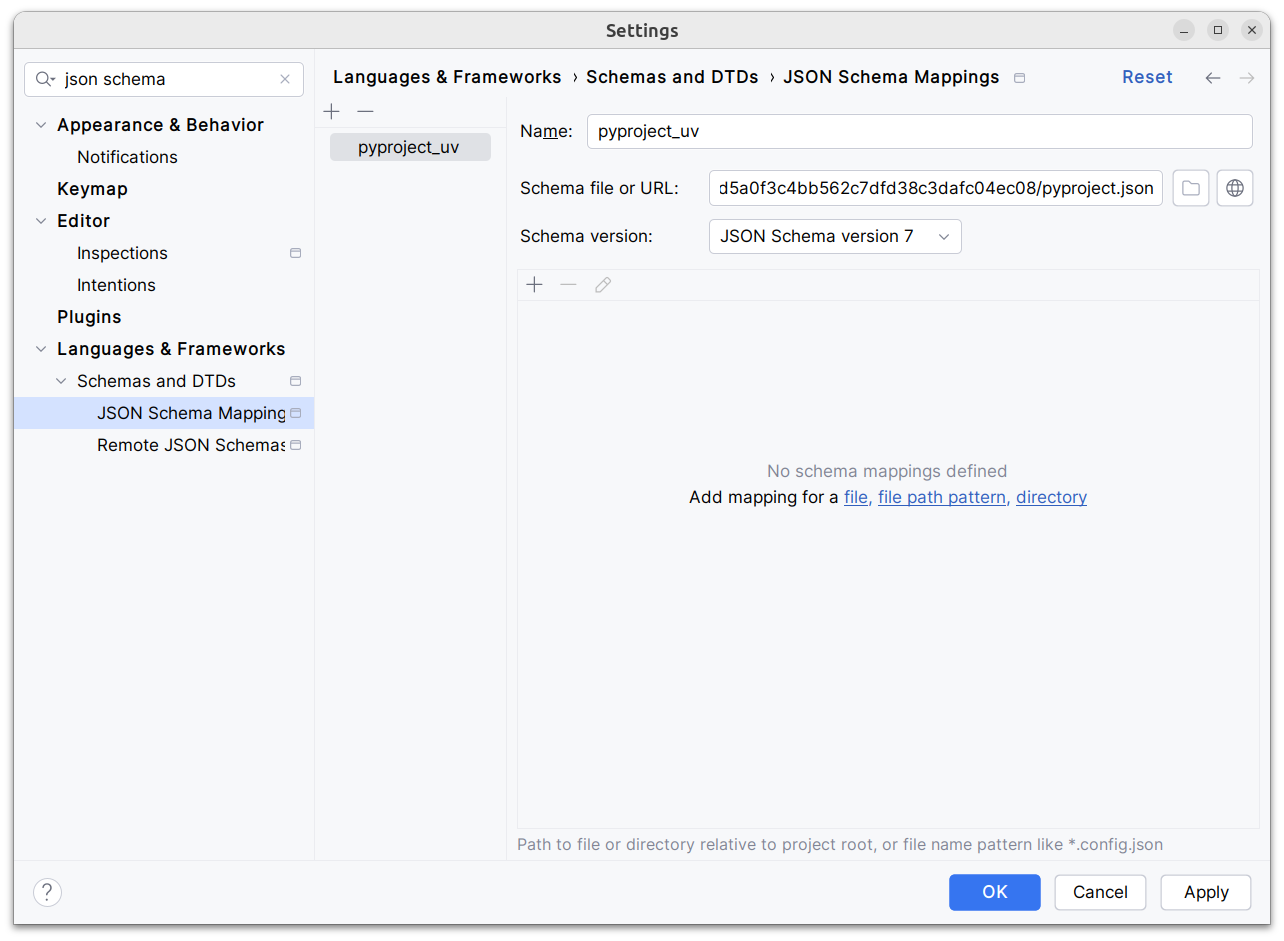
[dove.webm](https://github.com/astral-sh/uv/assets/6826232/c293c272-c80b-459d-8c95-8c46a8d198a1)
 Zanie Blue
 Andrew Gallant
 Charlie Marsh
 Mathieu Kniewallner
 konsti
 Di-Is
Di-Is
 Ahmed Ilyas
 Jo
Jo
 eth3lbert
 Theo BABILON
 Adrian Sampson
 Delgan
 FishAlchemist
 Jelle Zijlstra
 Mark Ture
 InSync
 Ian Wilkinson
 Danny
Danny
 Ibraheem Ahmed
 Benjamin Hodgson
 Nyakku Shigure