This updates the surrounding code to use the new ResolverEnvironment
type. In some cases, this simplifies caller code by removing case
analysis. There *shouldn't* be any behavior changes here. Some test
snapshots were updated to account for some minor tweaks to error
messages.

I didn't split this up into separate commits because it would have been
too difficult/costly.
## Summary

This is similar to https://github.com/astral-sh/uv/pull/6171 but more
expansive... _Anywhere_ that we test requirements for platform
compatibility, we _need_ to respect the resolver-friendly markers. In
fixing the motivating issue (#6621), I also realized that we had a bunch
of bugs here around `pip install` with `--python-platform` and
`--python-version`, because we always performed our `satisfy` and `Plan`
operations on the interpreter's markers, not the adjusted markers!

Closes https://github.com/astral-sh/uv/issues/6621.
## Summary

This PR modifies the lockfile to include the impactful resolution
settings, like the resolution and pre-release mode. If any of those
values change, we want to ignore the existing lockfile. Otherwise,
`--resolution lowest-direct` will typically have no effect, which is
really unintuitive.

Closes https://github.com/astral-sh/uv/issues/5226.
This is an attempt to solve https://github.com/astral-sh/uv/issues/ by
applying the extra marker of the requirement to overrides and
constraints.
Say in `a` we have a requirements
```
b==1; python_version < "3.10"
c==1; extra == "feature"
```
and overrides
```
b==2; python_version < "3.10"
b==3; python_version >= "3.10"
c==2; python_version < "3.10"
c==3; python_version >= "3.10"
```
Our current strategy is to discard the markers in the original
requirements. This means that on 3.12 for `a` we install `b==3`, but it
also means that we add `c` to `a` without `a[feature]`, causing #4826.
With this PR, the new requirement become,
```
b==2; python_version < "3.10"
b==3; python_version >= "3.10"
c==2; python_version < "3.10" and extra == "feature"
c==3; python_version >= "3.10" and extra == "feature"
```
allowing to override markers while preserving optional dependencies as
such.
Fixes#4826
This commit touches a lot of code, but the conceptual change here is
pretty simple: make it so we can run the resolver without providing a
`MarkerEnvironment`. This also indicates that the resolver should run in
universal mode. That is, the effect of a missing marker environment is
that all marker expressions that reference the marker environment are
evaluated to `true`. That is, they are ignored. (The only markers we
evaluate in that context are extras, which are the only markers that
aren't dependent on the environment.)

One interesting change here is that a `Resolver` no longer needs an
`Interpreter`. Previously, it had only been using it to construct a
`PythonRequirement`, by filling in the installed version from the
`Interpreter` state. But we now construct a `PythonRequirement`
explicitly since its `target` Python version should no longer be tied to
the `MarkerEnvironment`. (Currently, the marker environment is mutated
such that its `python_full_version` is derived from multiple sources,
including the CLI, which I found a touch confusing.)

The change in behavior can now be observed through the
`--unstable-uv-lock-file` flag. First, without it:

```
$ cat requirements.in
anyio>=4.3.0 ; sys_platform == "linux"
anyio<4 ; sys_platform == "darwin"
$ cargo run -qp uv -- pip compile -p3.10 requirements.in
anyio==4.3.0
exceptiongroup==1.2.1
    # via anyio
idna==3.7
    # via anyio
sniffio==1.3.1
    # via anyio
typing-extensions==4.11.0
    # via anyio
```

And now with it:

```
$ cargo run -qp uv -- pip compile -p3.10 requirements.in --unstable-uv-lock-file
  x No solution found when resolving dependencies:
  `-> Because you require anyio>=4.3.0 and anyio<4, we can conclude that the requirements are unsatisfiable.
```

This is expected at this point because the marker expressions are being
explicitly ignored, *and* there is no forking done yet to account for
the conflict.
## Introduction
PEP 621 is limited. Specifically, it lacks
* Relative path support
* Editable support
* Workspace support
* Index pinning or any sort of index specification
The semantics of urls are a custom extension, PEP 440 does not specify
how to use git references or subdirectories, instead pip has a custom
stringly format. We need to somehow support these while still stying
compatible with PEP 621.
## `tool.uv.source`
Drawing inspiration from cargo, poetry and rye, we add `tool.uv.sources`
or (for now stub only) `tool.uv.workspace`:
```toml
[project]
name = "albatross"
version = "0.1.0"
dependencies = [
"tqdm >=4.66.2,<5",
"torch ==2.2.2",
"transformers[torch] >=4.39.3,<5",
"importlib_metadata >=7.1.0,<8; python_version < '3.10'",
"mollymawk ==0.1.0"
]
[tool.uv.sources]
tqdm = { git = "https://github.com/tqdm/tqdm", rev = "cc372d09dcd5a5eabdc6ed4cf365bdb0be004d44" }
importlib_metadata = { url = "https://github.com/python/importlib_metadata/archive/refs/tags/v7.1.0.zip" }
torch = { index = "torch-cu118" }
mollymawk = { workspace = true }
[tool.uv.workspace]
include = [
"packages/mollymawk"
]
[tool.uv.indexes]
torch-cu118 = "https://download.pytorch.org/whl/cu118"
```
See `docs/specifying_dependencies.md` for a detailed explanation of the
format. The basic gist is that `project.dependencies` is what ends up on
pypi, while `tool.uv.sources` are your non-published additions. We do
support the full range or PEP 508, we just hide it in the docs and
prefer the exploded table for easier readability and less confusing with
actual url parts.
This format should eventually be able to subsume requirements.txt's
current use cases. While we will continue to support the legacy `uv pip`
interface, this is a piece of the uv's own top level interface. Together
with `uv run` and a lockfile format, you should only need to write
`pyproject.toml` and do `uv run`, which generates/uses/updates your
lockfile behind the scenes, no more pip-style requirements involved. It
also lays the groundwork for implementing index pinning.
## Changes
This PR implements:
* Reading and lowering `project.dependencies`,
`project.optional-dependencies` and `tool.uv.sources` into a new
requirements format, including:
* Git dependencies
* Url dependencies
* Path dependencies, including relative and editable
* `pip install` integration
* Error reporting for invalid `tool.uv.sources`
* Json schema integration (works in pycharm, see below)
* Draft user-level docs (see `docs/specifying_dependencies.md`)
It does not implement:
* No `pip compile` testing, deprioritizing towards our own lockfile
* Index pinning (stub definitions only)
* Development dependencies
* Workspace support (stub definitions only)
* Overrides in pyproject.toml
* Patching/replacing dependencies
One technically breaking change is that we now require user provided
pyproject.toml to be valid wrt to PEP 621. Included files still fall
back to PEP 517. That means `pip install -r requirements.txt` requires
it to be valid while `pip install -r requirements.txt` with `-e .` as
content falls back to PEP 517 as before.
## Implementation
The `pep508` requirement is replaced by a new `UvRequirement` (name up
for bikeshedding, not particularly attached to the uv prefix). The still
existing `pep508_rs::Requirement` type is a url format copied from pip's
requirements.txt and doesn't appropriately capture all features we
want/need to support. The bulk of the diff is changing the requirement
type throughout the codebase.
We still use `VerbatimUrl` in many places, where we would expect a
parsed/decomposed url type, specifically:
* Reading core metadata except top level pyproject.toml files, we fail a
step later instead if the url isn't supported.
* Allowed `Urls`.
* `PackageId` with a custom `CanonicalUrl` comparison, instead of
canonicalizing urls eagerly.
* `PubGrubPackage`: We eventually convert the `VerbatimUrl` back to a
`Dist` (`Dist::from_url`), instead of remembering the url.
* Source dist types: We use verbatim url even though we know and require
that these are supported urls we can and have parsed.
I tried to make improve the situation be replacing `VerbatimUrl`, but
these changes would require massive invasive changes (see e.g.
https://github.com/astral-sh/uv/pull/3253). A main problem is the ref
`VersionOrUrl` and applying overrides, which assume the same
requirement/url type everywhere. In its current form, this PR increases
this tech debt.
I've tried to split off PRs and commits, but the main refactoring is
still a single monolith commit to make it compile and the tests pass.
## Demo
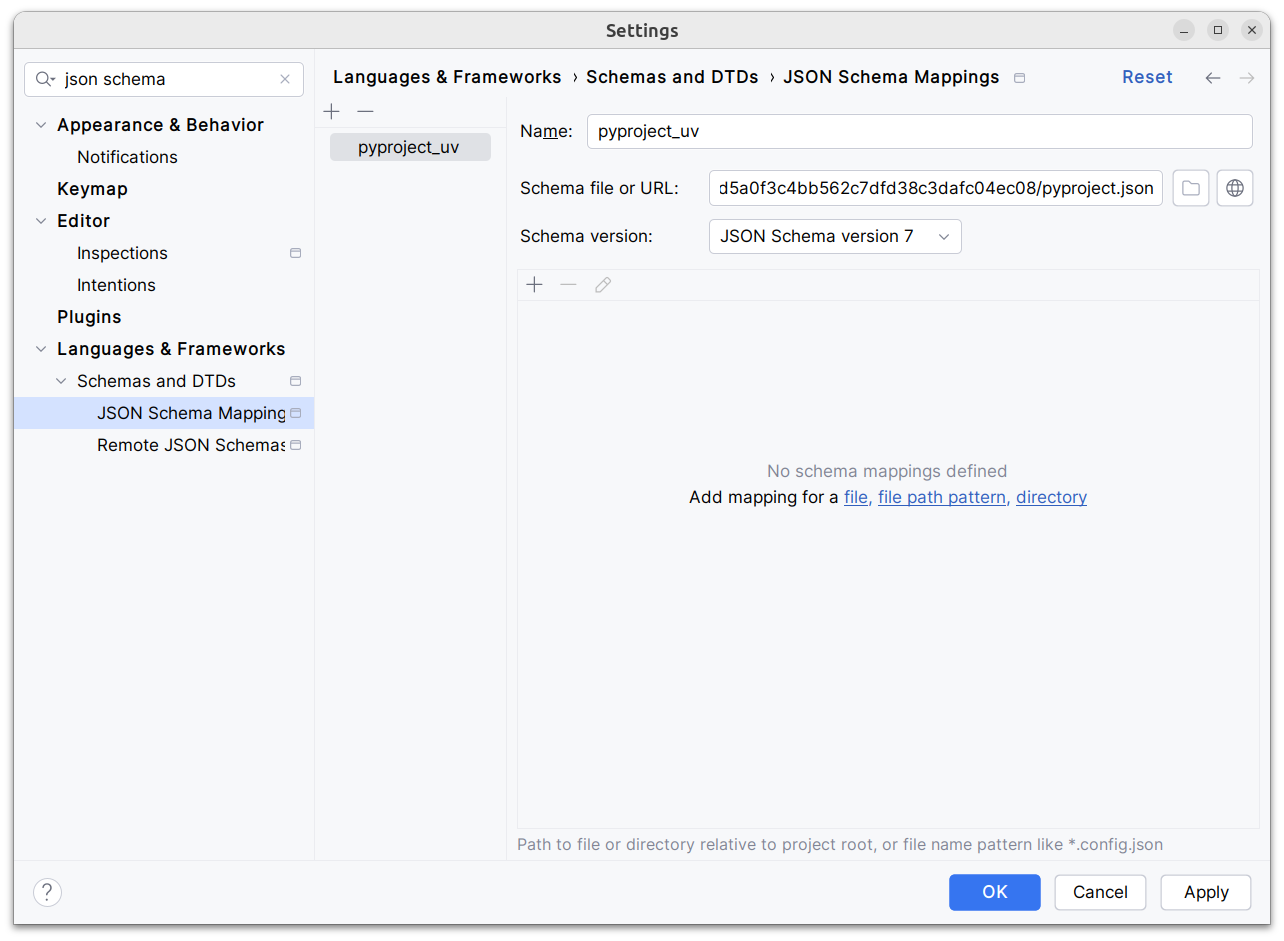
Adding
d1ae3b85d5/pyproject.json
as json schema (v7) to pycharm for `pyproject.toml`, you can try the IDE
support already:
[dove.webm](https://github.com/astral-sh/uv/assets/6826232/c293c272-c80b-459d-8c95-8c46a8d198a1)
In *some* places in our crates, `serde` (and `rkyv`) are optional
dependencies. I believe this was done out of reasons of "good sense,"
that is, it follows a Rust ecosystem pattern where serde integration
tends to be an opt-in crate feature. (And similarly for `rkyv`.)

However, ultimately, `uv` itself requires `serde` and `rkyv` to
function. Since our crates are strictly internal, there are limited
consumers for our crates without `serde` (and `rkyv`) enabled. I think
one possibility is that optional `serde` (and `rkyv`) integration means
that someone can do this:

    cargo test -p pep440_rs

And this will run tests _without_ `serde` or `rkyv` enabled. That in
turn could lead to faster iteration time by reducing compile times. But,
I'm not sure this is worth supporting. The iterative compilation times
of
individual crates are probably fast enough in debug mode, even with
`serde` and `rkyv` enabled. Namely, `serde` and `rkyv` themselves
shouldn't need to be re-compiled in most cases. On `main`:

```
from-scratch: `cargo test -p pep440_rs --lib` 0.685
incremental: `cargo test -p pep440_rs --lib` 0.278s
from-scratch: `cargo test -p pep440_rs --features serde,rkyv --lib` 3.948s
incremental: `cargo test -p pep440_rs --features serde,rkyv --lib` 0.321s
```

So while a from-scratch build does take significantly longer, an
incremental build is about the same.

The benefit of doing this change is two-fold:

1. It brings out crates into alignment with "reality." In particular,
   some crates were _implicitly_ relying on `serde` being enabled
   without explicitly declaring it. This technically means that our
   `Cargo.toml`s were wrong in some cases, but it is hard to observe it
   because of feature unification in a Cargo workspace.
2. We no longer need to deal with the cognitive burden of writing
   `#[cfg_attr(feature = "serde", ...)]` everywhere.
## Summary

This PR avoids: (1) using the lookahead resolver when `--no-deps` is
specified (we'll never use those requirements), and (2) including any
transitive requirements when searching for allowed URLs, etc., when
`--no-deps` is specified.

Closes https://github.com/astral-sh/uv/issues/3183.
## Summary

This PR adds basic struct definitions along with a "workspace" concept
for discovering settings. (The "workspace" terminology is used to match
Ruff; I did not invent it.)

A few notes:

- We discover any `pyproject.toml` or `uv.toml` file in any parent
directory of the current working directory. (We could adjust this to
look at the directories of the input files.)
- We don't actually do anything with the configuration yet; but those
PRs are large and I want this to be reviewed in isolation.
## Summary

This PR enables the resolver to "accept" URLs, prereleases, and local
version specifiers for direct dependencies of path dependencies. As a
result, `uv pip install .` and `uv pip install -e .` now behave
identically, in that neither has a restriction on URL dependencies and
the like.

Closes https://github.com/astral-sh/uv/issues/2643.
Closes https://github.com/astral-sh/uv/issues/1853.
## Summary

When determining "direct" dependencies, we need to ensure that we
respect markers. In the linked issue, the user had an optional
dependency like:

```toml
[project.optional-dependencies]
dev = [
  "setuptools>=64",
  "setuptools_scm>=8"
]
```

By not respecting markers, we tried to resolve `setuptools` to the
lowest-available version. However, since `setuptools>=64` _isn't_
enabled (since it's optional), we won't respect _that_ constraint.

To be consistent, we need to omit optional dependencies just as we will
at resolution time.

Closes https://github.com/astral-sh/uv/issues/2203.

## Test Plan

`cargo test`
First, replace all usages in files in-place. I used my editor for this.
If someone wants to add a one-liner that'd be fun.

Then, update directory and file names:

```
# Run twice for nested directories
find . -type d -print0 | xargs -0 rename s/puffin/uv/g
find . -type d -print0 | xargs -0 rename s/puffin/uv/g

# Update files
find . -type f -print0 | xargs -0 rename s/puffin/uv/g
```

Then add all the files again

```
# Add all the files again
git add crates
git add python/uv

# This one needs a force-add
git add -f crates/uv-trampoline
```
 Charlie Marsh
 Andrew Gallant
 konsti
 Zanie Blue