## Summary
This PR adds a first-class API for defining registry indexes, beyond our
existing `--index-url` and `--extra-index-url` setup.
Specifically, you now define indexes like so in a `uv.toml` or
`pyproject.toml` file:
```toml
[[tool.uv.index]]
name = "pytorch"
url = "https://download.pytorch.org/whl/cu121"
```
You can also provide indexes via `--index` and `UV_INDEX`, and override
the default index with `--default-index` and `UV_DEFAULT_INDEX`.
### Index priority
Indexes are prioritized in the order in which they're defined, such that
the first-defined index has highest priority.
Indexes are also inherited from parent configuration (e.g., the
user-level `uv.toml`), but are placed after any indexes in the current
project, matching our semantics for other array-based configuration
values.
You can mix `--index` and `--default-index` with the legacy
`--index-url` and `--extra-index-url` settings; the latter two are
merely treated as unnamed `[[tool.uv.index]]` entries.
### Index pinning
If an index includes a name (which is optional), it can then be
referenced via `tool.uv.sources`:
```toml
[[tool.uv.index]]
name = "pytorch"
url = "https://download.pytorch.org/whl/cu121"
[tool.uv.sources]
torch = { index = "pytorch" }
```
If an index is marked as `explicit = true`, it can _only_ be used via
such references, and will never be searched implicitly:
```toml
[[tool.uv.index]]
name = "pytorch"
url = "https://download.pytorch.org/whl/cu121"
explicit = true
[tool.uv.sources]
torch = { index = "pytorch" }
```
Indexes defined outside of the current project (e.g., in the user-level
`uv.toml`) can _not_ be explicitly selected.
(As of now, we only support using a single index for a given
`tool.uv.sources` definition.)
### Default index
By default, we include PyPI as the default index. This remains true even
if the user defines a `[[tool.uv.index]]` -- PyPI is still used as a
fallback. You can mark an index as `default = true` to (1) disable the
use of PyPI, and (2) bump it to the bottom of the prioritized list, such
that it's used only if a package does not exist on a prior index:
```toml
[[tool.uv.index]]
name = "pytorch"
url = "https://download.pytorch.org/whl/cu121"
default = true
```
### Name reuse
If a name is reused, the higher-priority index with that name is used,
while the lower-priority indexes are ignored entirely.
For example, given:
```toml
[[tool.uv.index]]
name = "pytorch"
url = "https://download.pytorch.org/whl/cu121"
[[tool.uv.index]]
name = "pytorch"
url = "https://test.pypi.org/simple"
```
The `https://test.pypi.org/simple` index would be ignored entirely,
since it's lower-priority than `https://download.pytorch.org/whl/cu121`
but shares the same name.
Closes#171.
## Future work
- Users should be able to provide authentication for named indexes via
environment variables.
- `uv add` should automatically write `--index` entries to the
`pyproject.toml` file.
- Users should be able to provide multiple indexes for a given package,
stratified by platform:
```toml
[tool.uv.sources]
torch = [
{ index = "cpu", markers = "sys_platform == 'darwin'" },
{ index = "gpu", markers = "sys_platform != 'darwin'" },
]
```
- Users should be able to specify a proxy URL for a given index, to
avoid writing user-specific URLs to a lockfile:
```toml
[[tool.uv.index]]
name = "test"
url = "https://private.org/simple"
proxy = "http://<omitted>/pypi/simple"
```
## Summary

This PR declares and documents all environment variables that are used
in one way or another in `uv`, either internally, or externally, or
transitively under a common struct.

I think over time as uv has grown there's been many environment
variables introduced. Its harder to know which ones exists, which ones
are missing, what they're used for, or where are they used across the
code. The docs only documents a handful of them, for others you'd have
to dive into the code and inspect across crates to know which crates
they're used on or where they're relevant.

This PR is a starting attempt to unify them, make it easier to discover
which ones we have, and maybe unlock future posibilities in automating
generating documentation for them.

I think we can split out into multiple structs later to better organize,
but given the high influx of PR's and possibly new environment variables
introduced/re-used, it would be hard to try to organize them all now
into their proper namespaced struct while this is all happening given
merge conflicts and/or keeping up to date.

I don't think this has any impact on performance as they all should
still be inlined, although it may affect local build times on changes to
the environment vars as more crates would likely need a rebuild. Lastly,
some of them are declared but not used in the code, for example those in
`build.rs`. I left them declared because I still think it's useful to at
least have a reference.

Did I miss any? Are their initial docs cohesive?

Note, `uv-static` is a terrible name for a new crate, thoughts? Others
considered `uv-vars`, `uv-consts`.

## Test Plan

Existing tests
As per
https://matklad.github.io/2021/02/27/delete-cargo-integration-tests.html

Before that, there were 91 separate integration tests binary.

(As discussed on Discord — I've done the `uv` crate, there's still a few
more commits coming before this is mergeable, and I want to see how it
performs in CI and locally).
## Summary

This is a longstanding piece of technical debt. After we resolve, we
have a bunch of `ResolvedDist` entries. We then convert those to
`Requirement` (which is lossy -- we lose information like "the index
that the package was resolved to"), and then back to `Dist`.
## Summary

Historically, we've allowed the use of wheels that were downloaded from
PyPI even when the user passes `--no-binary`, if the wheel exists in the
cache. This PR modifies the cache lookup code such that we respect
`--no-build` and `--no-binary` in those paths.

Closes https://github.com/astral-sh/uv/issues/2154.
## Summary

If `--config-settings` are provided, we cache the built wheels under one
more subdirectory.

We _don't_ invalidate the actual source (i.e., trigger a re-download) or
metadata, though -- those can be reused even when `--config-settings`
change.

Closes https://github.com/astral-sh/uv/issues/7028.
## Summary

This PR adds a more flexible cache invalidation abstraction for uv, and
uses that new abstraction to improve support for dynamic metadata.

Specifically, instead of relying solely on a timestamp, we now pass
around a `CacheInfo` struct which (as of now) contains
`Option<Timestamp>` and `Option<Commit>`. The `CacheInfo` is saved in
`dist-info` as `uv_cache.json`, so we can test already-installed
distributions for cache validity (along with testing _cached_
distributions for cache validity).

Beyond the defaults (`pyproject.toml`, `setup.py`, and `setup.cfg`
changes), users can also specify additional cache keys, and it's easy
for us to extend support in the future. Right now, cache keys can either
be instructions to include the current commit (for `setuptools_scm` and
similar) or file paths (for `hatch-requirements-txt` and similar):

```toml
[tool.uv]
cache-keys = [{ file = "requirements.txt" }, { git = true }]
```

This change should be fully backwards compatible.

Closes https://github.com/astral-sh/uv/issues/6964.

Closes https://github.com/astral-sh/uv/issues/6255.

Closes https://github.com/astral-sh/uv/issues/6860.
<!--
Thank you for contributing to uv! To help us out with reviewing, please
consider the following:

- Does this pull request include a summary of the change? (See below.)
- Does this pull request include a descriptive title?
- Does this pull request include references to any relevant issues?
-->

## Summary

Separate exceptions for different timeouts to make it easier to debug
issues like #6105.

<!-- What's the purpose of the change? What does it do, and why? -->

## Test Plan

<!-- How was it tested? -->
Not tested at all.
## Summary

Use a dedicated source type for non-package requirements. Also enables
us to support non-package `path` dependencies _and_ removes the need to
have the member `pyproject.toml` files available when we sync _and_
makes it explicit which dependencies are virtual vs. not (as evidenced
by the snapshot changes). All good things!
## Summary

This is similar to https://github.com/astral-sh/uv/pull/6171 but more
expansive... _Anywhere_ that we test requirements for platform
compatibility, we _need_ to respect the resolver-friendly markers. In
fixing the motivating issue (#6621), I also realized that we had a bunch
of bugs here around `pip install` with `--python-platform` and
`--python-version`, because we always performed our `satisfy` and `Plan`
operations on the interpreter's markers, not the adjusted markers!

Closes https://github.com/astral-sh/uv/issues/6621.
For users who were using absolute paths in the `pyproject.toml`
previously, this is a behavior change: We now convert all absolute paths
in `path` entries to relative paths. Since i assume that no-one relies
on absolute path in their lockfiles - they are intended to be portable -
I'm tagging this as a bugfix.

Closes https://github.com/astral-sh/uv/pull/6438
Fixes https://github.com/astral-sh/uv/issues/6371
Right now, the URL gets out-of-sync with the install path, since the
install path is canonicalized. This leads to a subtle error on Windows
(in CI) in which we don't preserve caching across resolution and
installation.
Surprisingly, this is a lockfile schema change: We can't store relative
paths in urls, so we have to store a `filename` entry instead of the
whole url.
Fixes#4355
## Summary

This PR adds a `DistExtension` field to some of our distribution types,
which requires that we validate that the file type is known and
supported when parsing (rather than when attempting to unzip). It
removes a bunch of extension parsing from the code too, in favor of
doing it once upfront.

Closes https://github.com/astral-sh/uv/issues/5858.
## Summary

Very subtle bug. The scenario is as follows:

- We resolve: `elmer-circuitbuilder = { git =
"https://github.com/ElmerCSC/elmer_circuitbuilder.git" }`

- The user then changes the request to: `elmer-circuitbuilder = { git =
"https://github.com/ElmerCSC/elmer_circuitbuilder.git", rev =
"44d2f4b19d6837ea990c16f494bdf7543d57483d" }`

- When we go to re-lock, we note two facts:

1. The "default branch" resolves to
`44d2f4b19d6837ea990c16f494bdf7543d57483d`.
2. The metadata for `44d2f4b19d6837ea990c16f494bdf7543d57483d` is
(whatever we grab from the lockfile).

- In the resolver, we then ask for the metadata for
`44d2f4b19d6837ea990c16f494bdf7543d57483d`. It's already in the cache,
so we return it; thus, we never add the
`44d2f4b19d6837ea990c16f494bdf7543d57483d` ->
`44d2f4b19d6837ea990c16f494bdf7543d57483d` mapping to the Git resolver,
because we never have to resolve it.

This would apply for any case in which a requested tag or branch was
replaced by its precise SHA. Replacing with a different commit is fine.

It only applied to `tool.uv.sources`, and not PEP 508 URLs, because the
underlying issue is that we aren't consistent about "automatically"
extracting the precise commit from a Git reference.

Closes https://github.com/astral-sh/uv/issues/5860.
## Summary

We allow the use of (e.g.) `.whl.metadata` files when `--no-binary` is
enabled, so it makes sense that we'd also also allow wheels to be
downloaded for metadata extraction. So now, we validate `--no-binary` at
install time, rather than metadata-fetch time.

Closes https://github.com/astral-sh/uv/issues/5699.
## Summary

The package was being installed as editable, but it wasn't marked as
such in `uv pip list`, as the `direct-url.json` was wrong.

Closes https://github.com/astral-sh/uv/issues/5543.
## Summary

The idea here is similar to what we do for wheels: we create the
`CachedEnvironment` in the `archive-v0` bucket, then symlink it to its
content-addressed location. This ensures that we can always recreate
these environments without concern for whether anyone else is accessing
them.

Part of the challenge here is that we want the virtual environments to
be relocatable, because we're now building them in one location but
persisting them in another. This requires that we write relative (rather
than absolute) paths to scripts and entrypoints. The main risk with
relocatable virtual environments is that the scripts and entrypoints
_themselves_ are not relocatable, because they use a relative shebang.
But that's fine for cached environments, which are never intended to
leave the cache.

Closes https://github.com/astral-sh/uv/issues/5503.
## Summary

Adds a `--relocatable` CLI arg to `uv venv`. This flag does two things:

* ensures that the associated activation scripts do not rely on a
hardcoded
absolute path to the virtual environment (to the extent possible; `.csh`
and
  `.nu` left as-is)
* persists a `relocatable` flag in `pyvenv.cfg`.

The flag in `pyvenv.cfg` in turn instructs the wheel `Installer` to
create script
entrypoints in a relocatable way (use `exec` trick + `dirname $0` on
POSIX;
use relative path to `python[w].exe` on Windows).

Fixes: #3863

## Test Plan

* Relocatable console scripts covered as additional scenarios in
existing test cases.
* Integration testing of boilerplate generation in `venv`.
* Manual testing of `uv venv` with and without `--relocatable`
## Summary

I don't think that "always reinstall" is tenable for `uv run`. My
perspective on this is that if you want "always reinstall", you can now
set it persistently in your `pyproject.toml` or `uv.toml`.

As a smaller change, we could instead disable this _only_ for the
Project API.

Closes https://github.com/astral-sh/uv/issues/4946.
## Summary

The current code was checking every constraint against every
requirement, regardless of whether they were applicable. In general,
this isn't a big deal, because this method is only used as a fast-path
to skip resolution -- so we just had way more false-negatives than we
should've when constraints were applied. But it's clearly wrong :)

## Test Plan

- `uv venv`
- `uv pip install flask`
- `uv pip install --verbose flask -c constraints.txt` (with `numpy<1.0`)

Prior to this change, Flask was reported as not satisfied.
## Summary

Move completely off tokio's multi-threaded runtime. We've slowly been
making changes to be smarter about scheduling in various places instead
of depending on tokio's general purpose work-stealing, notably
https://github.com/astral-sh/uv/pull/3627 and
https://github.com/astral-sh/uv/pull/4004. We now no longer benefit from
the multi-threaded runtime, as we run on all I/O on the main thread.
There's one remaining instance of `block_in_place` that can be swapped
for `rayon::spawn`.

This change is a small performance improvement due to removing some
unnecessary overhead of the multi-threaded runtime (e.g. spawning
threads), but nothing major. It also removes some noise from profiles.

## Test Plan

```
Benchmark 1: ./target/profiling/uv (resolve-warm)
  Time (mean ± σ):      14.9 ms ±   0.3 ms    [User: 3.0 ms, System: 17.3 ms]
  Range (min … max):    14.1 ms …  15.8 ms    169 runs

Benchmark 2: ./target/profiling/baseline (resolve-warm)
  Time (mean ± σ):      16.1 ms ±   0.3 ms    [User: 3.9 ms, System: 18.7 ms]
  Range (min … max):    15.1 ms …  17.3 ms    162 runs

Summary
  ./target/profiling/uv (resolve-warm) ran
    1.08 ± 0.03 times faster than ./target/profiling/baseline (resolve-warm)
```
Whew this is a lot.

The user-facing changes are:

- `uv toolchain` to `uv python` e.g. `uv python find`, `uv python
install`, ...
- `UV_TOOLCHAIN_DIR` to` UV_PYTHON_INSTALL_DIR`
- `<UV_STATE_DIR>/toolchains` to `<UV_STATE_DIR>/python` (with
[automatic
migration](https://github.com/astral-sh/uv/pull/4735/files#r1663029330))
- User-facing messages no longer refer to toolchains, instead using
"Python", "Python versions" or "Python installations"

The internal changes are:

- `uv-toolchain` crate to `uv-python`
- `Toolchain` no longer referenced in type names
- Dropped unused `SystemPython` type (previously replaced)
- Clarified the type names for "managed Python installations"
- (more little things)
Updates `--no-binary <package>` to take precedence over `--only-binary
:all:` and `--only-binary <package>` to take precedence over
`--no-binary :all:`.

I'm not entirely sure about this behavior, e.g. maybe I provided
`--only-binary :all:` later on the command line and really want it to
override those earlier arguments of `--no-binary <package>` for safety.
Right now we just fail to solve though since we can't satisfy the
overlapping requests.

Closes https://github.com/astral-sh/uv/issues/4063
## Summary

This is what I consider to be the "real" fix for #8072. We now treat
directory and path URLs as separate `ParsedUrl` types and
`RequirementSource` types. This removes a lot of `.is_dir()` forking
within the `ParsedUrl::Path` arms and makes some states impossible
(e.g., you can't have a `.whl` path that is editable). It _also_ fixes
the `direct_url.json` for direct URLs that refer to files. Previously,
we wrote out to these as if they were installed as directories, which is
just wrong.
## Summary

Right now, we're _always_ reinstalling local wheel archives, even if the
timestamp didn't change.

I want to fix the TODO properly but I will do so in a separate PR.
By splitting `path` into a lockable, relative (or absolute) and an
absolute installable path and by splitting between urls and paths by
dist type, we can store relative paths in the lockfile.
## Summary

As with other `.egg-info` and `.egg-link` distributions, it's easy to
support _existing_ `.egg-link` files. Like pip, we refuse to uninstall
these, since there's no way to know which files are part of the
distribution.

Closes https://github.com/astral-sh/uv/issues/4059.

## Test Plan

Verify that `vtk` is included here, which is installed as a `.egg-link`
file:

```
> conda create -c conda-forge -n uv-test python h5py vtk pyside6 cftime psutil

> cargo run pip freeze --python /opt/homebrew/Caskroom/miniforge/base/envs/uv-test/bin/python
aiohttp @ file:///Users/runner/miniforge3/conda-bld/aiohttp_1713964997382/work
aiosignal @ file:///home/conda/feedstock_root/build_artifacts/aiosignal_1667935791922/work
attrs @ file:///home/conda/feedstock_root/build_artifacts/attrs_1704011227531/work
cached-property @ file:///home/conda/feedstock_root/build_artifacts/cached_property_1615209429212/work
cftime @ file:///Users/runner/miniforge3/conda-bld/cftime_1715919201099/work
frozenlist @ file:///Users/runner/miniforge3/conda-bld/frozenlist_1702645558715/work
h5py @ file:///Users/runner/miniforge3/conda-bld/h5py_1715968397721/work
idna @ file:///home/conda/feedstock_root/build_artifacts/idna_1713279365350/work
loguru @ file:///Users/runner/miniforge3/conda-bld/loguru_1695547410953/work
msgpack @ file:///Users/runner/miniforge3/conda-bld/msgpack-python_1715670632250/work
multidict @ file:///Users/runner/miniforge3/conda-bld/multidict_1707040780513/work
numpy @ file:///Users/runner/miniforge3/conda-bld/numpy_1707225421156/work/dist/numpy-1.26.4-cp312-cp312-macosx_11_0_arm64.whl
pip==24.0
psutil @ file:///Users/runner/miniforge3/conda-bld/psutil_1705722460205/work
pyside6==6.7.1
setuptools==70.0.0
shiboken6==6.7.1
vtk==9.2.6
wheel==0.43.0
wslink @ file:///home/conda/feedstock_root/build_artifacts/wslink_1716591560747/work
yarl @ file:///Users/runner/miniforge3/conda-bld/yarl_1705508643525/work
```
## Summary

Avoid using work-stealing Tokio workers for bytecode compilation,
favoring instead dedicated threads. Tokio's work-stealing does not
really benefit us because we're spawning Python workers and scheduling
tasks ourselves — we don't want Tokio to re-balance our workers. Because
we're doing scheduling ourselves and compilation is a primarily
compute-bound task, we can also create dedicated runtimes for each
worker and avoid some synchronization overhead.

This is part of a general desire to avoid relying on Tokio's
work-stealing scheduler and be smarter about our workload. In this case
we already had the custom scheduler in place, Tokio was just getting in
the way (though the overhead is very minor).

## Test Plan

This improves performance by ~5% on my machine.

```
$ hyperfine --warmup 1 --prepare "target/profiling/uv-dev clear-compile .venv" "target/profiling/uv-dev compile .venv" "target/profiling/uv-dev-dedicated compile .venv"
Benchmark 1: target/profiling/uv-dev compile .venv
  Time (mean ± σ):      1.279 s ±  0.011 s    [User: 13.803 s, System: 2.998 s]
  Range (min … max):    1.261 s …  1.296 s    10 runs

Benchmark 2: target/profiling/uv-dev-dedicated compile .venv
  Time (mean ± σ):      1.220 s ±  0.021 s    [User: 13.997 s, System: 3.330 s]
  Range (min … max):    1.198 s …  1.272 s    10 runs

Summary
  target/profiling/uv-dev-dedicated compile .venv ran
    1.05 ± 0.02 times faster than target/profiling/uv-dev compile .venv

$ hyperfine --warmup 1 --prepare "target/profiling/uv-dev clear-compile .venv" "target/profiling/uv-dev compile .venv" "target/profiling/uv-dev-dedicated compile .venv"
Benchmark 1: target/profiling/uv-dev compile .venv
  Time (mean ± σ):      3.631 s ±  0.078 s    [User: 47.205 s, System: 4.996 s]
  Range (min … max):    3.564 s …  3.832 s    10 runs

Benchmark 2: target/profiling/uv-dev-dedicated compile .venv
  Time (mean ± σ):      3.521 s ±  0.024 s    [User: 48.201 s, System: 5.392 s]
  Range (min … max):    3.484 s …  3.566 s    10 runs

Summary
  target/profiling/uv-dev-dedicated compile .venv ran
    1.03 ± 0.02 times faster than target/profiling/uv-dev compile .venv
```
Add a `--package` option that allows switching the current project in
the workspace. Wherever you are in a workspace, you should be able to
run with any other project as root. This is the uv equivalent of `cargo
run -p`.

I don't love the `--package` name, esp. since `-p` is already taken and
in general to many things start with p already.

Part of this change is moving the workspace discovery of
`ProjectWorkspace` to `Workspace` itself.

## Usage

In albatross-virtual-workspace:

```console
$ uv venv
$ uv run --preview --package bird-feeder python -c "import albatross"
   Built file:///home/konsti/projects/uv/scripts/workspaces/albatross-virtual-workspace/packages/bird-feeder
   Built file:///home/konsti/projects/uv/scripts/workspaces/albatross-virtual-workspace/packages/seeds
Built 2 editables in 167ms
Resolved 5 packages in 4ms
Installed 5 packages in 1ms
 + anyio==4.4.0
 + bird-feeder==1.0.0 (from file:///home/konsti/projects/uv/scripts/workspaces/albatross-virtual-workspace/packages/bird-feeder)
 + idna==3.6
 + seeds==1.0.0 (from file:///home/konsti/projects/uv/scripts/workspaces/albatross-virtual-workspace/packages/seeds)
 + sniffio==1.3.1
Traceback (most recent call last):
  File "<string>", line 1, in <module>
ModuleNotFoundError: No module named 'albatross'
$ uv venv
$ uv run --preview --package albatross python -c "import albatross"
   Built file:///home/konsti/projects/uv/scripts/workspaces/albatross-virtual-workspace/packages/albatross
   Built file:///home/konsti/projects/uv/scripts/workspaces/albatross-virtual-workspace/packages/bird-feeder
   Built file:///home/konsti/projects/uv/scripts/workspaces/albatross-virtual-workspace/packages/seeds
Built 3 editables in 173ms
Resolved 7 packages in 6ms
Installed 7 packages in 1ms
 + albatross==0.1.0 (from file:///home/konsti/projects/uv/scripts/workspaces/albatross-virtual-workspace/packages/albatross)
 + anyio==4.4.0
 + bird-feeder==1.0.0 (from file:///home/konsti/projects/uv/scripts/workspaces/albatross-virtual-workspace/packages/bird-feeder)
 + idna==3.6
 + seeds==1.0.0 (from file:///home/konsti/projects/uv/scripts/workspaces/albatross-virtual-workspace/packages/seeds)
 + sniffio==1.3.1
 + tqdm==4.66.4
```

In albatross-root-workspace:

```console
$ uv venv
$ uv run --preview --package bird-feeder python -c "import albatross"
  Using Python 3.12.3 interpreter at: /home/konsti/.local/bin/python3
  Creating virtualenv at: .venv
  Activate with: source .venv/bin/activate
      Finished `dev` profile [unoptimized + debuginfo] target(s) in 0.10s
       Running `/home/konsti/projects/uv/target/debug/uv run --preview --package bird-feeder python -c 'import albatross'`
     Built file:///home/konsti/projects/uv/scripts/workspaces/albatross-root-workspace/packages/bird-feeder
     Built file:///home/konsti/projects/uv/scripts/workspaces/albatross-root-workspace/packages/seeds                                              Built 2 editables in 161ms
  Resolved 5 packages in 4ms
  Installed 5 packages in 1ms
   + anyio==4.4.0
   + bird-feeder==1.0.0 (from file:///home/konsti/projects/uv/scripts/workspaces/albatross-root-workspace/packages/bird-feeder)
   + idna==3.6
   + seeds==1.0.0 (from file:///home/konsti/projects/uv/scripts/workspaces/albatross-root-workspace/packages/seeds)
   + sniffio==1.3.1
  Traceback (most recent call last):
    File "<string>", line 1, in <module>
  ModuleNotFoundError: No module named 'albatross'
$ uv venv
$ cargo run run --preview --package albatross python -c "import albatross"
Using Python 3.12.3 interpreter at: /home/konsti/.local/bin/python3
Creating virtualenv at: .venv
Activate with: source .venv/bin/activate
    Finished `dev` profile [unoptimized + debuginfo] target(s) in 0.13s
     Running `/home/konsti/projects/uv/target/debug/uv run --preview --package albatross python -c 'import albatross'`
   Built file:///home/konsti/projects/uv/scripts/workspaces/albatross-root-workspace
   Built file:///home/konsti/projects/uv/scripts/workspaces/albatross-root-workspace/packages/bird-feeder
   Built file:///home/konsti/projects/uv/scripts/workspaces/albatross-root-workspace/packages/seeds
Built 3 editables in 168ms
Resolved 7 packages in 5ms
Installed 7 packages in 1ms
 + albatross==0.1.0 (from file:///home/konsti/projects/uv/scripts/workspaces/albatross-root-workspace)
 + anyio==4.4.0
 + bird-feeder==1.0.0 (from file:///home/konsti/projects/uv/scripts/workspaces/albatross-root-workspace/packages/bird-feeder)
 + idna==3.6
 + seeds==1.0.0 (from file:///home/konsti/projects/uv/scripts/workspaces/albatross-root-workspace/packages/seeds)
 + sniffio==1.3.1
 + tqdm==4.66.4
```
With the change, we remove the special casing of workspace dependencies
and resolve `tool.uv` for all git and directory distributions. This
gives us support for non-editable workspace dependencies and path
dependencies in other workspaces. It removes a lot of special casing
around workspaces. These changes are the groundwork for supporting
`tool.uv` with dynamic metadata.

The basis for this change is moving `Requirement` from
`distribution-types` to `pypi-types` and the lowering logic from
`uv-requirements` to `uv-distribution`. This changes should be split out
in separate PRs.

I've included an example workspace `albatross-root-workspace2` where
`bird-feeder` depends on `a` from another workspace `ab`. There's a
bunch of failing tests and regressed error messages that still need
fixing. It does fix the audited package count for the workspace tests.
## Summary
There are a few behavior changes in here:
- We now enforce `--require-hashes` for editables, like pip. So if you
use `--require-hashes` with an editable requirement, we'll reject it. I
could change this if it seems off.
- We now treat source tree requirements, editable or not (e.g., both `-e
./black` and `./black`) as if `--refresh` is always enabled. This
doesn't mean that we _always_ rebuild them; but if you pass
`--reinstall`, then yes, we always rebuild them. I think this is an
improvement and is close to how editables work today.
Closes#3844.
Closes#2695.
When parsing requirements from any source, directly parse the url parts
(and reject unsupported urls) instead of parsing url parts at a later
stage. This removes a bunch of error branches and concludes the work
parsing url parts once and passing them around everywhere.

Many usages of the assembled `VerbatimUrl` remain, but these can be
removed incrementally.

Please review commit-by-commit.
This is split out from workspaces support, which needs editables in the
bluejay commands. It consists mainly of refactorings:

* Move the `editable` module one level up.
* Introduce a `BuiltEditableMetadata` type for `(LocalEditable,
Metadata23, Requirements)`.
* Add editables to `InstalledPackagesProvider` so we can use
`EmptyInstalledPackages` for them.
## Summary

The main motivation here is that the `.filename()` method that we
implement on `Url` will do URL decoding for the last segment, which we
were missing here.

The errors are a bit awkward, because in
`crates/uv-resolver/src/lock.rs`, we wrap in `failed to extract filename
from URL: {url}`, so in theory we want the underlying errors to _omit_
the URL? But sometimes they use `#[error(transparent)]`?
## Summary

This PR introduces parallelism to the resolver. Specifically, we can
perform PubGrub resolution on a separate thread, while keeping all I/O
on the tokio thread. We already have the infrastructure set up for this
with the channel and `OnceMap`, which makes this change relatively
simple. The big change needed to make this possible is removing the
lifetimes on some of the types that need to be shared between the
resolver and pubgrub thread.

A related PR, https://github.com/astral-sh/uv/pull/1163, found that
adding `yield_now` calls improved throughput. With optimal scheduling we
might be able to get away with everything on the same thread here.
However, in the ideal pipeline with perfect prefetching, the resolution
and prefetching can run completely in parallel without depending on one
another. While this would be very difficult to achieve, even with our
current prefetching pattern we see a consistent performance improvement
from parallelism.

This does also require reverting a few of the changes from
https://github.com/astral-sh/uv/pull/3413, but not all of them. The
sharing is isolated to the resolver task.

## Test Plan

On smaller tasks performance is mixed with ~2% improvements/regressions
on both sides. However, on medium-large resolution tasks we see the
benefits of parallelism, with improvements anywhere from 10-50%.

```
./scripts/requirements/jupyter.in
Benchmark 1: ./target/profiling/baseline (resolve-warm)
  Time (mean ± σ):      29.2 ms ±   1.8 ms    [User: 20.3 ms, System: 29.8 ms]
  Range (min … max):    26.4 ms …  36.0 ms    91 runs

Benchmark 2: ./target/profiling/parallel (resolve-warm)
  Time (mean ± σ):      25.5 ms ±   1.0 ms    [User: 19.5 ms, System: 25.5 ms]
  Range (min … max):    23.6 ms …  27.8 ms    99 runs

Summary
  ./target/profiling/parallel (resolve-warm) ran
    1.15 ± 0.08 times faster than ./target/profiling/baseline (resolve-warm)
```
```
./scripts/requirements/boto3.in
Benchmark 1: ./target/profiling/baseline (resolve-warm)
  Time (mean ± σ):     487.1 ms ±   6.2 ms    [User: 464.6 ms, System: 61.6 ms]
  Range (min … max):   480.0 ms … 497.3 ms    10 runs

Benchmark 2: ./target/profiling/parallel (resolve-warm)
  Time (mean ± σ):     430.8 ms ±   9.3 ms    [User: 529.0 ms, System: 77.2 ms]
  Range (min … max):   417.1 ms … 442.5 ms    10 runs

Summary
  ./target/profiling/parallel (resolve-warm) ran
    1.13 ± 0.03 times faster than ./target/profiling/baseline (resolve-warm)
```
```
./scripts/requirements/airflow.in
Benchmark 1: ./target/profiling/baseline (resolve-warm)
  Time (mean ± σ):     478.1 ms ±  18.8 ms    [User: 482.6 ms, System: 205.0 ms]
  Range (min … max):   454.7 ms … 508.9 ms    10 runs

Benchmark 2: ./target/profiling/parallel (resolve-warm)
  Time (mean ± σ):     308.7 ms ±  11.7 ms    [User: 428.5 ms, System: 209.5 ms]
  Range (min … max):   287.8 ms … 323.1 ms    10 runs

Summary
  ./target/profiling/parallel (resolve-warm) ran
    1.55 ± 0.08 times faster than ./target/profiling/baseline (resolve-warm)
```
## Summary

Uses the editable handling from `pip sync`, and improves the
abstractions such that we can pass those resolved editables into the
resolver.

---------

Co-authored-by: konstin <konstin@mailbox.org>
## Summary

I think this is overall good change because it explicitly encodes (in
the type system) something that was previously implicit. I'm not a huge
fan of the names here, open to input.

It covers some of https://github.com/astral-sh/uv/issues/3506 but I
don't think it _closes_ it.
## Summary

This PR consolidates the concurrency limits used throughout `uv` and
exposes two limits, `UV_CONCURRENT_DOWNLOADS` and
`UV_CONCURRENT_BUILDS`, as environment variables.

Currently, `uv` has a number of concurrent streams that it buffers using
relatively arbitrary limits for backpressure. However, many of these
limits are conflated. We run a relatively small number of tasks overall
and should start most things as soon as possible. What we really want to
limit are three separate operations:
- File I/O. This is managed by tokio's blocking pool and we should not
really have to worry about it.
- Network I/O.
- Python build processes.

Because the current limits span a broad range of tasks, it's possible
that a limit meant for network I/O is occupied by tasks performing
builds, reading from the file system, or even waiting on a `OnceMap`. We
also don't limit build processes that end up being required to perform a
download. While this may not pose a performance problem because our
limits are relatively high, it does mean that the limits do not do what
we want, making it tricky to expose them to users
(https://github.com/astral-sh/uv/issues/1205,
https://github.com/astral-sh/uv/issues/3311).

After this change, the limits on network I/O and build processes are
centralized and managed by semaphores. All other tasks are unbuffered
(note that these tasks are still bounded, so backpressure should not be
a problem).
## Summary
Ensures that we track the origins for requirements regardless of whether
they come from `pyproject.toml` or `setup.py` or `setup.cfg`.
Closes#3480.
This commit touches a lot of code, but the conceptual change here is
pretty simple: make it so we can run the resolver without providing a
`MarkerEnvironment`. This also indicates that the resolver should run in
universal mode. That is, the effect of a missing marker environment is
that all marker expressions that reference the marker environment are
evaluated to `true`. That is, they are ignored. (The only markers we
evaluate in that context are extras, which are the only markers that
aren't dependent on the environment.)

One interesting change here is that a `Resolver` no longer needs an
`Interpreter`. Previously, it had only been using it to construct a
`PythonRequirement`, by filling in the installed version from the
`Interpreter` state. But we now construct a `PythonRequirement`
explicitly since its `target` Python version should no longer be tied to
the `MarkerEnvironment`. (Currently, the marker environment is mutated
such that its `python_full_version` is derived from multiple sources,
including the CLI, which I found a touch confusing.)

The change in behavior can now be observed through the
`--unstable-uv-lock-file` flag. First, without it:

```
$ cat requirements.in
anyio>=4.3.0 ; sys_platform == "linux"
anyio<4 ; sys_platform == "darwin"
$ cargo run -qp uv -- pip compile -p3.10 requirements.in
anyio==4.3.0
exceptiongroup==1.2.1
    # via anyio
idna==3.7
    # via anyio
sniffio==1.3.1
    # via anyio
typing-extensions==4.11.0
    # via anyio
```

And now with it:

```
$ cargo run -qp uv -- pip compile -p3.10 requirements.in --unstable-uv-lock-file
  x No solution found when resolving dependencies:
  `-> Because you require anyio>=4.3.0 and anyio<4, we can conclude that the requirements are unsatisfiable.
```

This is expected at this point because the marker expressions are being
explicitly ignored, *and* there is no forking done yet to account for
the conflict.
## Summary

Fixes https://github.com/astral-sh/uv/issues/1343. This is kinda a first
draft at the moment, but does at least mostly work locally (barring some
bits of the test suite that seem to not work for me in general).

## Test Plan

Mostly running the existing tests and checking the revised output is
sane

## Outstanding issues

Most of these come down to "AFAIK, the existing tools don't support
these patterns, but `uv` does" and so I'm not sure there's an existing
good answer here! Most of the answers so far are "whatever was easiest
to build"

- [x] ~~Is "-r pyproject.toml" correct? Should it show something else or
get skipped entirely~~ No it wasn't. Fixed in
3044fa8b86
- [ ] If the requirements file is stdin, that just gets skipped. Should
it be recorded?
- [ ] Overrides get shown as "--override<override.txt>". Correct?
- [x] ~~Some of the tests (e.g.
`dependency_excludes_non_contiguous_range_of_compatible_versions`) make
assumptions about the order of package versions being outputted, which
this PR breaks. I'm not sure if the text is fairly arbitrary and can be
replaced or whether the behaviour needs fixing?~~ - fixed by removing
the custom pubgrub PartialEq/Hash
- [ ] Are all the `TrackedFromStr` et al changes needed, or is there an
easier way? I don't think so, I think it's necessary to track these sort
of things fairly comprehensively to make this feature work, and this
sort of invasive change feels necessary, but happy to be proved wrong
there :)
- [x] ~~If you have a requirement coming in from two or more different
requirements files only one turns up. I've got a closed-source example
for this (can go into more detail if needed), mostly consisting of a
complicated set of common deps creating a larger set. It's a rarer case,
but worth considering.~~ 042432b200
- [ ] Doesn't add annotations for `setup.py` yet
- This is pretty hard, as the correct location to insert the path is
`crates/pypi-types/src/metadata.rs`'s `parse_pkg_info`, which as it's
based off a source distribution has entirely thrown away such matters as
"where did this package requirement get built from". Could add "`built
package name`" as a dep, but that's a little odd.
## Summary

All of the resolver code is run on the main thread, so a lot of the
`Send` bounds and uses of `DashMap` and `Arc` are unnecessary. We could
also switch to using single-threaded versions of `Mutex` and `Notify` in
some places, but there isn't really a crate that provides those I would
be comfortable with using.

The `Arc` in `OnceMap` can't easily be removed because of the uv-auth
code which uses the
[reqwest-middleware](https://docs.rs/reqwest-middleware/latest/reqwest_middleware/trait.Middleware.html)
crate, that seems to adds unnecessary `Send` bounds because of
`async-trait`. We could duplicate the code and create a `OnceMapLocal`
variant, but I don't feel that's worth it.
## Summary
Users often find themselves dropped into environments that contain
`.egg-info` packages. While we won't support installing these, it's not
hard to support identifying them (e.g., in `pip freeze`) and
_uninstalling_ them.
Closes https://github.com/astral-sh/uv/issues/2841.
Closes#2928.
Closes#3341.
## Test Plan
Ran `cargo run pip freeze --python
/opt/homebrew/Caskroom/miniforge/base/envs/TEST/bin/python`, with an
environment that includes `pip` as an `.egg-info`
(`/opt/homebrew/Caskroom/miniforge/base/envs/TEST/lib/python3.12/site-packages/pip-24.0-py3.12.egg-info`):
```
cffi @ file:///Users/runner/miniforge3/conda-bld/cffi_1696001825047/work
pip==24.0
pycparser @ file:///home/conda/feedstock_root/build_artifacts/pycparser_1711811537435/work
setuptools==69.5.1
wheel==0.43.0
```
Then ran `cargo run pip uninstall`, verified that `pip` was uninstalled,
and no longer listed in `pip freeze`.
## Introduction
PEP 621 is limited. Specifically, it lacks
* Relative path support
* Editable support
* Workspace support
* Index pinning or any sort of index specification
The semantics of urls are a custom extension, PEP 440 does not specify
how to use git references or subdirectories, instead pip has a custom
stringly format. We need to somehow support these while still stying
compatible with PEP 621.
## `tool.uv.source`
Drawing inspiration from cargo, poetry and rye, we add `tool.uv.sources`
or (for now stub only) `tool.uv.workspace`:
```toml
[project]
name = "albatross"
version = "0.1.0"
dependencies = [
"tqdm >=4.66.2,<5",
"torch ==2.2.2",
"transformers[torch] >=4.39.3,<5",
"importlib_metadata >=7.1.0,<8; python_version < '3.10'",
"mollymawk ==0.1.0"
]
[tool.uv.sources]
tqdm = { git = "https://github.com/tqdm/tqdm", rev = "cc372d09dcd5a5eabdc6ed4cf365bdb0be004d44" }
importlib_metadata = { url = "https://github.com/python/importlib_metadata/archive/refs/tags/v7.1.0.zip" }
torch = { index = "torch-cu118" }
mollymawk = { workspace = true }
[tool.uv.workspace]
include = [
"packages/mollymawk"
]
[tool.uv.indexes]
torch-cu118 = "https://download.pytorch.org/whl/cu118"
```
See `docs/specifying_dependencies.md` for a detailed explanation of the
format. The basic gist is that `project.dependencies` is what ends up on
pypi, while `tool.uv.sources` are your non-published additions. We do
support the full range or PEP 508, we just hide it in the docs and
prefer the exploded table for easier readability and less confusing with
actual url parts.
This format should eventually be able to subsume requirements.txt's
current use cases. While we will continue to support the legacy `uv pip`
interface, this is a piece of the uv's own top level interface. Together
with `uv run` and a lockfile format, you should only need to write
`pyproject.toml` and do `uv run`, which generates/uses/updates your
lockfile behind the scenes, no more pip-style requirements involved. It
also lays the groundwork for implementing index pinning.
## Changes
This PR implements:
* Reading and lowering `project.dependencies`,
`project.optional-dependencies` and `tool.uv.sources` into a new
requirements format, including:
* Git dependencies
* Url dependencies
* Path dependencies, including relative and editable
* `pip install` integration
* Error reporting for invalid `tool.uv.sources`
* Json schema integration (works in pycharm, see below)
* Draft user-level docs (see `docs/specifying_dependencies.md`)
It does not implement:
* No `pip compile` testing, deprioritizing towards our own lockfile
* Index pinning (stub definitions only)
* Development dependencies
* Workspace support (stub definitions only)
* Overrides in pyproject.toml
* Patching/replacing dependencies
One technically breaking change is that we now require user provided
pyproject.toml to be valid wrt to PEP 621. Included files still fall
back to PEP 517. That means `pip install -r requirements.txt` requires
it to be valid while `pip install -r requirements.txt` with `-e .` as
content falls back to PEP 517 as before.
## Implementation
The `pep508` requirement is replaced by a new `UvRequirement` (name up
for bikeshedding, not particularly attached to the uv prefix). The still
existing `pep508_rs::Requirement` type is a url format copied from pip's
requirements.txt and doesn't appropriately capture all features we
want/need to support. The bulk of the diff is changing the requirement
type throughout the codebase.
We still use `VerbatimUrl` in many places, where we would expect a
parsed/decomposed url type, specifically:
* Reading core metadata except top level pyproject.toml files, we fail a
step later instead if the url isn't supported.
* Allowed `Urls`.
* `PackageId` with a custom `CanonicalUrl` comparison, instead of
canonicalizing urls eagerly.
* `PubGrubPackage`: We eventually convert the `VerbatimUrl` back to a
`Dist` (`Dist::from_url`), instead of remembering the url.
* Source dist types: We use verbatim url even though we know and require
that these are supported urls we can and have parsed.
I tried to make improve the situation be replacing `VerbatimUrl`, but
these changes would require massive invasive changes (see e.g.
https://github.com/astral-sh/uv/pull/3253). A main problem is the ref
`VersionOrUrl` and applying overrides, which assume the same
requirement/url type everywhere. In its current form, this PR increases
this tech debt.
I've tried to split off PRs and commits, but the main refactoring is
still a single monolith commit to make it compile and the tests pass.
## Demo
Adding
d1ae3b85d5/pyproject.json
as json schema (v7) to pycharm for `pyproject.toml`, you can try the IDE
support already:
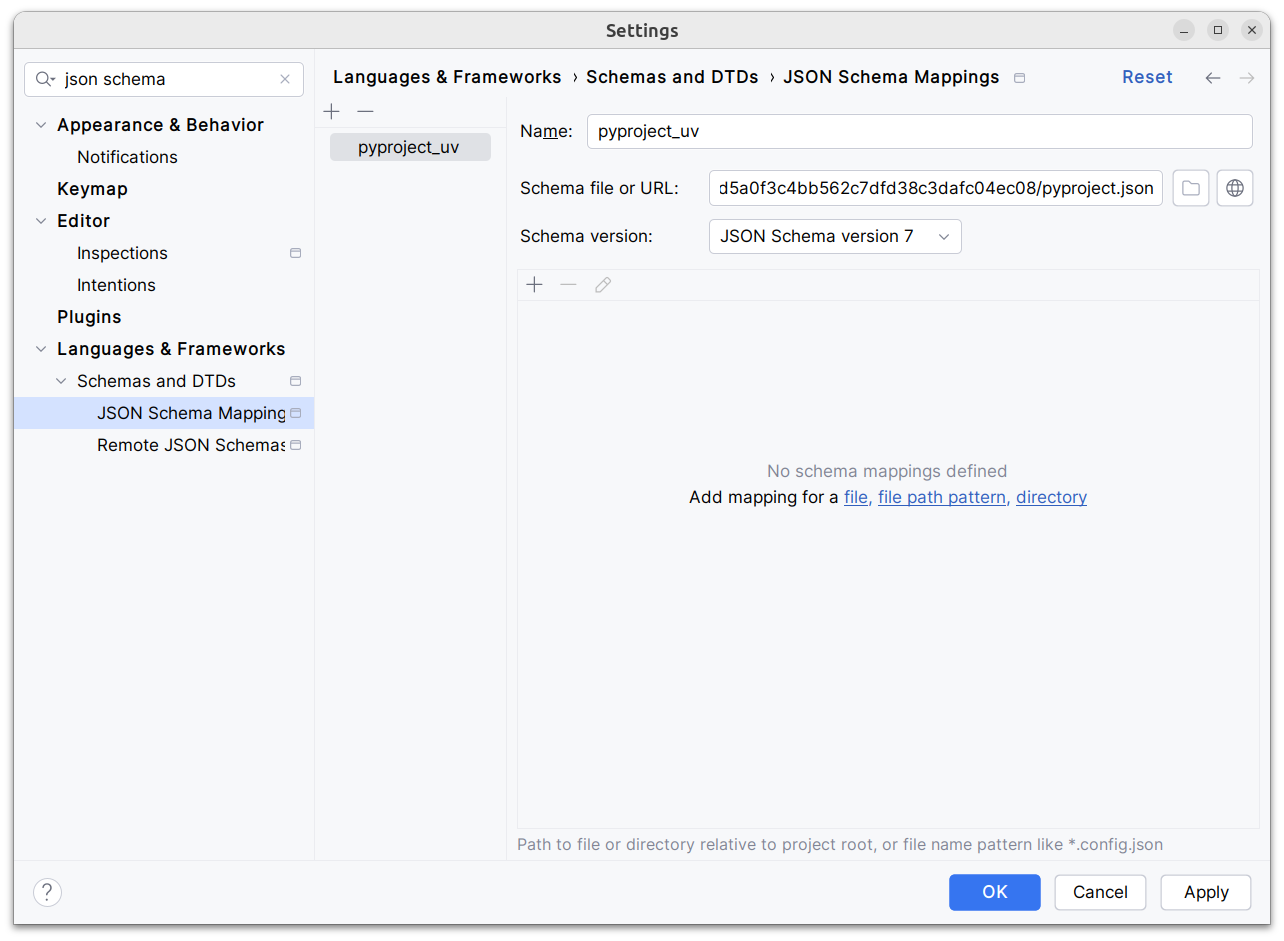
[dove.webm](https://github.com/astral-sh/uv/assets/6826232/c293c272-c80b-459d-8c95-8c46a8d198a1)
Another split out from https://github.com/astral-sh/uv/pull/3263. This
abstracts the copy&pasted check whether an installed distribution
satisfies a requirement used by both plan.rs and site_packages.rs into a
shared module. It's less useful here than with the new requirement but
helps with reducing https://github.com/astral-sh/uv/pull/3263 diff size.
Previously, a noop `uv pip install` would only show "Audited {}
package(s)" but no details, not even with `-vv`. Now it debug logs which
requirements were met and it also debug logs which requirement was
missing to trigger the full routine, allowing it investigate caching
behaviour.

First `uv pip install -v jupyter`:

```
DEBUG At least one requirement is not satisfied: jupyter
```

Second `uv pip install -v jupyter`:

```
DEBUG Found a virtualenv named .venv at: /home/konsti/projects/uv-main/.venv
DEBUG Cached interpreter info for Python 3.12.1, skipping probing: .venv/bin/python
DEBUG Using Python 3.12.1 environment at .venv/bin/python
DEBUG Trying to lock if free: .venv/.lock
DEBUG Requirement satisfied: anyio
DEBUG Requirement satisfied: anyio>=3.1.0
DEBUG Requirement satisfied: argon2-cffi-bindings
DEBUG Requirement satisfied: argon2-cffi>=21.1
DEBUG Requirement satisfied: arrow>=0.15.0
DEBUG Requirement satisfied: asttokens>=2.1.0
DEBUG Requirement satisfied: async-lru>=1.0.0
DEBUG Requirement satisfied: attrs>=22.2.0
DEBUG Requirement satisfied: babel>=2.10
...
DEBUG Requirement satisfied: webencodings
DEBUG Requirement satisfied: webencodings>=0.4
DEBUG Requirement satisfied: websocket-client>=1.7
DEBUG Requirement satisfied: widgetsnbextension~=4.0.10
DEBUG All editables satisfied:
Audited 1 package in 12ms
```

This will clash with the `tool.uv.sources` PR, i'll rebase it on top.
Previously, uv-auth would fail to compile due to a missing process
feature. I chose to make all tokio features we use top level features,
so we can share the tokio cache between all test invocations.
Previously, we got `pypi_types::DirectUrl` (the pypa spec
direct_url.json format) and `distribution_types::DirectUrl` (an enum of
all the url types we support). This lead me to confusion, so i'm
renaming the latter one to the more appropriate `ParsedUrl`.
## Summary
This PR enables `--require-hashes` with unnamed requirements. The key
change is that `PackageId` becomes `VersionId` (since it refers to a
package at a specific version), and the new `PackageId` consists of
_either_ a package name _or_ a URL. The hashes are keyed by `PackageId`,
so we can generate the `RequiredHashes` before we have names for all
packages, and enforce them throughout.
Closes#2979.
## Summary

Similar to `Revision`, we now store IDs in the `Archive` entires rather
than absolute paths. This makes the cache robust to moves, etc.

Closes https://github.com/astral-sh/uv/issues/2908.
## Summary

This PR formalizes some of the concepts we use in the cache for
"pointers to things".

In the wheel cache, we have files like
`annotated_types-0.6.0-py3-none-any.http`. This represents an unzipped
wheel, cached alongside an HTTP caching policy. We now have a struct for
this to encapsulate the logic: `HttpArchivePointer`.

Similarly, we have files like `annotated_types-0.6.0-py3-none-any.rev`.
This represents an unzipped local wheel, alongside with a timestamp. We
now have a struct for this to encapsulate the logic:
`LocalArchivePointer`.

We have similar structs for source distributions too.
## Summary
This PR enables hash generation for URL requirements when the user
provides `--generate-hashes` to `pip compile`. While we include the
hashes from the registry already, today, we omit hashes for URLs.
To power hash generation, we introduce a `HashPolicy` abstraction:
```rust
#[derive(Debug, Clone, Copy, PartialEq, Eq)]
pub enum HashPolicy<'a> {
/// No hash policy is specified.
None,
/// Hashes should be generated (specifically, a SHA-256 hash), but not validated.
Generate,
/// Hashes should be validated against a pre-defined list of hashes. If necessary, hashes should
/// be generated so as to ensure that the archive is valid.
Validate(&'a [HashDigest]),
}
```
All of the methods on the distribution database now accept this policy,
instead of accepting `&'a [HashDigest]`.
Closes#2378.
## Summary
This PR adds support for hash-checking mode in `pip install` and `pip
sync`. It's a large change, both in terms of the size of the diff and
the modifications in behavior, but it's also one that's hard to merge in
pieces (at least, with any test coverage) since it needs to work
end-to-end to be useful and testable.
Here are some of the most important highlights:
- We store hashes in the cache. Where we previously stored pointers to
unzipped wheels in the `archives` directory, we now store pointers with
a set of known hashes. So every pointer to an unzipped wheel also
includes its known hashes.
- By default, we don't compute any hashes. If the user runs with
`--require-hashes`, and the cache doesn't contain those hashes, we
invalidate the cache, redownload the wheel, and compute the hashes as we
go. For users that don't run with `--require-hashes`, there will be no
change in performance. For users that _do_, the only change will be if
they don't run with `--generate-hashes` -- then they may see some
repeated work between resolution and installation, if they use `pip
compile` then `pip sync`.
- Many of the distribution types now include a `hashes` field, like
`CachedDist` and `LocalWheel`.
- Our behavior is similar to pip, in that we enforce hashes when pulling
any remote distributions, and when pulling from our own cache. Like pip,
though, we _don't_ enforce hashes if a distribution is _already_
installed.
- Hash validity is enforced in a few different places:
1. During resolution, we enforce hash validity based on the hashes
reported by the registry. If we need to access a source distribution,
though, we then enforce hash validity at that point too, prior to
running any untrusted code. (This is enforced in the distribution
database.)
2. In the install plan, we _only_ add cached distributions that have
matching hashes. If a cached distribution is missing any hashes, or the
hashes don't match, we don't return them from the install plan.
3. In the downloader, we _only_ return distributions with matching
hashes.
4. The final combination of "things we install" are: (1) the wheels from
the cache, and (2) the downloaded wheels. So this ensures that we never
install any mismatching distributions.
- Like pip, if `--require-hashes` is provided, we require that _all_
distributions are pinned with either `==` or a direct URL. We also
require that _all_ distributions have hashes.
There are a few notable TODOs:
- We don't support hash-checking mode for unnamed requirements. These
should be _somewhat_ rare, though? Since `pip compile` never outputs
unnamed requirements. I can fix this, it's just some additional work.
- We don't automatically enable `--require-hashes` with a hash exists in
the requirements file. We require `--require-hashes`.
Closes#474.
## Test Plan
I'd like to add some tests for registries that report incorrect hashes,
but otherwise: `cargo test`
 Charlie Marsh
 samypr100
 Amos Wenger
 Michal Čihař
 konsti
 Pavel Dikov
 Ibraheem Ahmed
 Zanie Blue
 renovate[bot]
 Adolfo Ochagavía
 Andrew Gallant
 Tom Parker-Shemilt
 Shantanu