Part of https://github.com/astral-sh/uv/issues/4392

We shouldn't link to PyPI, and dropping the workspace-level
documentation link should mean that we get the auto-generated `docs.rs`
links.
## Summary

This is causing some cyclic dependencies issues for me, because these
can be used in virtually _any_ crate (like `uv-install-wheel`), which
then means that all of `uv-configuration` becomes a dependency, etc. I
think this should be a leaf crate so that we can safely depend on it
anywhere.
## Summary

I should've noticed this during review -- my bad -- but it looks like
after lowering, we're converting back to `uv_pep508::Requirement`. This
is mostly okay, but it's lossy for some lowerings. For example, we lose
index pinning. With this PR, we now preserve the lowered types
(`Requirement`).

Closes https://github.com/astral-sh/uv/issues/15037.
## Summary

We weren't including these in the cache key when constructing the
install plan. We likely still read them from the cache later, but we may
have reported the wrong number of prepares, etc.
Prior to this PR, there were numerous places where uv would leak
credentials in logs. We had a way to mask credentials by calling methods
or a recently-added `redact_url` function, but this was not secure by
default. There were a number of other types (like `GitUrl`) that would
leak credentials on display.

This PR adds a `DisplaySafeUrl` newtype to prevent leaking credentials
when logging by default. It takes a maximalist approach, replacing the
use of `Url` almost everywhere. This includes when first parsing config
files, when storing URLs in types like `GitUrl`, and also when storing
URLs in types that in practice will never contain credentials (like
`DirectorySourceUrl`). The idea is to make it easy for developers to do
the right thing and for the compiler to support this (and to minimize
ever having to manually convert back and forth). Displaying credentials
now requires an active step. Note that despite this maximalist approach,
the use of the newtype should be zero cost.

One conspicuous place this PR does not use `DisplaySafeUrl` is in the
`uv-auth` crate. That would require new clones since there are calls to
`request.url()` that return a `&Url`. One option would have been to make
`DisplaySafeUrl` wrap a `Cow`, but this would lead to lifetime
annotations all over the codebase. I've created a separate PR based on
this one (#13576) that updates `uv-auth` to use `DisplaySafeUrl` with
one new clone. We can discuss the tradeoffs there.

Most of this PR just replaces `Url` with `DisplaySafeUrl`. The core is
`uv_redacted/lib.rs`, where the newtype is implemented. To make it
easier to review the rest, here are some points of note:

* `DisplaySafeUrl` has a `Display` implementation that masks
credentials. Currently, it will still display the username when there is
both a username and password. If we think is the wrong choice, it can
now be changed in one place.
* `DisplaySafeUrl` has a `remove_credentials()` method and also a
`.to_string_with_credentials()` method. This allows us to use it in a
variety of scenarios.
* `IndexUrl::redacted()` was renamed to
`IndexUrl::removed_credentials()` to make it clearer that we are not
masking.
* We convert from a `DisplaySafeUrl` to a `Url` when calling `reqwest`
methods like `.get()` and `.head()`.
* We convert from a `DisplaySafeUrl` to a `Url` when creating a
`uv_auth::Index`. That is because, as mentioned above, I will be
updating the `uv_auth` crate to use this newtype in a separate PR.
* A number of tests (e.g., in `pip_install.rs`) that formerly used
filters to mask tokens in the test output no longer need those filters
since tokens in URLs are now masked automatically.
* The one place we are still knowingly writing credentials to
`pyproject.toml` is when a URL with credentials is passed to `uv add`
with `--raw`. Since displaying credentials is no longer automatic, I
have added a `to_string_with_credentials()` method to the `Pep508Url`
trait. This is used when `--raw` is passed. Adding it to that trait is a
bit weird, but it's the simplest way to achieve the goal. I'm open to
suggestions on how to improve this, but note that because of the way
we're using generic bounds, it's not as simple as just creating a
separate trait for that method.
We want to build `uv-build` without depending on the network crates. In
preparation for that, we split uv-git into uv-git and uv-git-types,
where only uv-git depends on reqwest, so that uv-build can use
uv-git-types.
## Summary

This PR declares and documents all environment variables that are used
in one way or another in `uv`, either internally, or externally, or
transitively under a common struct.

I think over time as uv has grown there's been many environment
variables introduced. Its harder to know which ones exists, which ones
are missing, what they're used for, or where are they used across the
code. The docs only documents a handful of them, for others you'd have
to dive into the code and inspect across crates to know which crates
they're used on or where they're relevant.

This PR is a starting attempt to unify them, make it easier to discover
which ones we have, and maybe unlock future posibilities in automating
generating documentation for them.

I think we can split out into multiple structs later to better organize,
but given the high influx of PR's and possibly new environment variables
introduced/re-used, it would be hard to try to organize them all now
into their proper namespaced struct while this is all happening given
merge conflicts and/or keeping up to date.

I don't think this has any impact on performance as they all should
still be inlined, although it may affect local build times on changes to
the environment vars as more crates would likely need a rebuild. Lastly,
some of them are declared but not used in the code, for example those in
`build.rs`. I left them declared because I still think it's useful to at
least have a reference.

Did I miss any? Are their initial docs cohesive?

Note, `uv-static` is a terrible name for a new crate, thoughts? Others
considered `uv-vars`, `uv-consts`.

## Test Plan

Existing tests
As per
https://matklad.github.io/2021/02/27/delete-cargo-integration-tests.html

Before that, there were 91 separate integration tests binary.

(As discussed on Discord — I've done the `uv` crate, there's still a few
more commits coming before this is mergeable, and I want to see how it
performs in CI and locally).
## Summary

This is a longstanding piece of technical debt. After we resolve, we
have a bunch of `ResolvedDist` entries. We then convert those to
`Requirement` (which is lossy -- we lose information like "the index
that the package was resolved to"), and then back to `Dist`.
## Summary

This PR adds a more flexible cache invalidation abstraction for uv, and
uses that new abstraction to improve support for dynamic metadata.

Specifically, instead of relying solely on a timestamp, we now pass
around a `CacheInfo` struct which (as of now) contains
`Option<Timestamp>` and `Option<Commit>`. The `CacheInfo` is saved in
`dist-info` as `uv_cache.json`, so we can test already-installed
distributions for cache validity (along with testing _cached_
distributions for cache validity).

Beyond the defaults (`pyproject.toml`, `setup.py`, and `setup.cfg`
changes), users can also specify additional cache keys, and it's easy
for us to extend support in the future. Right now, cache keys can either
be instructions to include the current commit (for `setuptools_scm` and
similar) or file paths (for `hatch-requirements-txt` and similar):

```toml
[tool.uv]
cache-keys = [{ file = "requirements.txt" }, { git = true }]
```

This change should be fully backwards compatible.

Closes https://github.com/astral-sh/uv/issues/6964.

Closes https://github.com/astral-sh/uv/issues/6255.

Closes https://github.com/astral-sh/uv/issues/6860.
## Summary

I don't think that "always reinstall" is tenable for `uv run`. My
perspective on this is that if you want "always reinstall", you can now
set it persistently in your `pyproject.toml` or `uv.toml`.

As a smaller change, we could instead disable this _only_ for the
Project API.

Closes https://github.com/astral-sh/uv/issues/4946.
Whew this is a lot.

The user-facing changes are:

- `uv toolchain` to `uv python` e.g. `uv python find`, `uv python
install`, ...
- `UV_TOOLCHAIN_DIR` to` UV_PYTHON_INSTALL_DIR`
- `<UV_STATE_DIR>/toolchains` to `<UV_STATE_DIR>/python` (with
[automatic
migration](https://github.com/astral-sh/uv/pull/4735/files#r1663029330))
- User-facing messages no longer refer to toolchains, instead using
"Python", "Python versions" or "Python installations"

The internal changes are:

- `uv-toolchain` crate to `uv-python`
- `Toolchain` no longer referenced in type names
- Dropped unused `SystemPython` type (previously replaced)
- Clarified the type names for "managed Python installations"
- (more little things)
Add a `--package` option that allows switching the current project in
the workspace. Wherever you are in a workspace, you should be able to
run with any other project as root. This is the uv equivalent of `cargo
run -p`.

I don't love the `--package` name, esp. since `-p` is already taken and
in general to many things start with p already.

Part of this change is moving the workspace discovery of
`ProjectWorkspace` to `Workspace` itself.

## Usage

In albatross-virtual-workspace:

```console
$ uv venv
$ uv run --preview --package bird-feeder python -c "import albatross"
   Built file:///home/konsti/projects/uv/scripts/workspaces/albatross-virtual-workspace/packages/bird-feeder
   Built file:///home/konsti/projects/uv/scripts/workspaces/albatross-virtual-workspace/packages/seeds
Built 2 editables in 167ms
Resolved 5 packages in 4ms
Installed 5 packages in 1ms
 + anyio==4.4.0
 + bird-feeder==1.0.0 (from file:///home/konsti/projects/uv/scripts/workspaces/albatross-virtual-workspace/packages/bird-feeder)
 + idna==3.6
 + seeds==1.0.0 (from file:///home/konsti/projects/uv/scripts/workspaces/albatross-virtual-workspace/packages/seeds)
 + sniffio==1.3.1
Traceback (most recent call last):
  File "<string>", line 1, in <module>
ModuleNotFoundError: No module named 'albatross'
$ uv venv
$ uv run --preview --package albatross python -c "import albatross"
   Built file:///home/konsti/projects/uv/scripts/workspaces/albatross-virtual-workspace/packages/albatross
   Built file:///home/konsti/projects/uv/scripts/workspaces/albatross-virtual-workspace/packages/bird-feeder
   Built file:///home/konsti/projects/uv/scripts/workspaces/albatross-virtual-workspace/packages/seeds
Built 3 editables in 173ms
Resolved 7 packages in 6ms
Installed 7 packages in 1ms
 + albatross==0.1.0 (from file:///home/konsti/projects/uv/scripts/workspaces/albatross-virtual-workspace/packages/albatross)
 + anyio==4.4.0
 + bird-feeder==1.0.0 (from file:///home/konsti/projects/uv/scripts/workspaces/albatross-virtual-workspace/packages/bird-feeder)
 + idna==3.6
 + seeds==1.0.0 (from file:///home/konsti/projects/uv/scripts/workspaces/albatross-virtual-workspace/packages/seeds)
 + sniffio==1.3.1
 + tqdm==4.66.4
```

In albatross-root-workspace:

```console
$ uv venv
$ uv run --preview --package bird-feeder python -c "import albatross"
  Using Python 3.12.3 interpreter at: /home/konsti/.local/bin/python3
  Creating virtualenv at: .venv
  Activate with: source .venv/bin/activate
      Finished `dev` profile [unoptimized + debuginfo] target(s) in 0.10s
       Running `/home/konsti/projects/uv/target/debug/uv run --preview --package bird-feeder python -c 'import albatross'`
     Built file:///home/konsti/projects/uv/scripts/workspaces/albatross-root-workspace/packages/bird-feeder
     Built file:///home/konsti/projects/uv/scripts/workspaces/albatross-root-workspace/packages/seeds                                              Built 2 editables in 161ms
  Resolved 5 packages in 4ms
  Installed 5 packages in 1ms
   + anyio==4.4.0
   + bird-feeder==1.0.0 (from file:///home/konsti/projects/uv/scripts/workspaces/albatross-root-workspace/packages/bird-feeder)
   + idna==3.6
   + seeds==1.0.0 (from file:///home/konsti/projects/uv/scripts/workspaces/albatross-root-workspace/packages/seeds)
   + sniffio==1.3.1
  Traceback (most recent call last):
    File "<string>", line 1, in <module>
  ModuleNotFoundError: No module named 'albatross'
$ uv venv
$ cargo run run --preview --package albatross python -c "import albatross"
Using Python 3.12.3 interpreter at: /home/konsti/.local/bin/python3
Creating virtualenv at: .venv
Activate with: source .venv/bin/activate
    Finished `dev` profile [unoptimized + debuginfo] target(s) in 0.13s
     Running `/home/konsti/projects/uv/target/debug/uv run --preview --package albatross python -c 'import albatross'`
   Built file:///home/konsti/projects/uv/scripts/workspaces/albatross-root-workspace
   Built file:///home/konsti/projects/uv/scripts/workspaces/albatross-root-workspace/packages/bird-feeder
   Built file:///home/konsti/projects/uv/scripts/workspaces/albatross-root-workspace/packages/seeds
Built 3 editables in 168ms
Resolved 7 packages in 5ms
Installed 7 packages in 1ms
 + albatross==0.1.0 (from file:///home/konsti/projects/uv/scripts/workspaces/albatross-root-workspace)
 + anyio==4.4.0
 + bird-feeder==1.0.0 (from file:///home/konsti/projects/uv/scripts/workspaces/albatross-root-workspace/packages/bird-feeder)
 + idna==3.6
 + seeds==1.0.0 (from file:///home/konsti/projects/uv/scripts/workspaces/albatross-root-workspace/packages/seeds)
 + sniffio==1.3.1
 + tqdm==4.66.4
```
## Summary
There are a few behavior changes in here:
- We now enforce `--require-hashes` for editables, like pip. So if you
use `--require-hashes` with an editable requirement, we'll reject it. I
could change this if it seems off.
- We now treat source tree requirements, editable or not (e.g., both `-e
./black` and `./black`) as if `--refresh` is always enabled. This
doesn't mean that we _always_ rebuild them; but if you pass
`--reinstall`, then yes, we always rebuild them. I think this is an
improvement and is close to how editables work today.
Closes#3844.
Closes#2695.
## Introduction
PEP 621 is limited. Specifically, it lacks
* Relative path support
* Editable support
* Workspace support
* Index pinning or any sort of index specification
The semantics of urls are a custom extension, PEP 440 does not specify
how to use git references or subdirectories, instead pip has a custom
stringly format. We need to somehow support these while still stying
compatible with PEP 621.
## `tool.uv.source`
Drawing inspiration from cargo, poetry and rye, we add `tool.uv.sources`
or (for now stub only) `tool.uv.workspace`:
```toml
[project]
name = "albatross"
version = "0.1.0"
dependencies = [
"tqdm >=4.66.2,<5",
"torch ==2.2.2",
"transformers[torch] >=4.39.3,<5",
"importlib_metadata >=7.1.0,<8; python_version < '3.10'",
"mollymawk ==0.1.0"
]
[tool.uv.sources]
tqdm = { git = "https://github.com/tqdm/tqdm", rev = "cc372d09dcd5a5eabdc6ed4cf365bdb0be004d44" }
importlib_metadata = { url = "https://github.com/python/importlib_metadata/archive/refs/tags/v7.1.0.zip" }
torch = { index = "torch-cu118" }
mollymawk = { workspace = true }
[tool.uv.workspace]
include = [
"packages/mollymawk"
]
[tool.uv.indexes]
torch-cu118 = "https://download.pytorch.org/whl/cu118"
```
See `docs/specifying_dependencies.md` for a detailed explanation of the
format. The basic gist is that `project.dependencies` is what ends up on
pypi, while `tool.uv.sources` are your non-published additions. We do
support the full range or PEP 508, we just hide it in the docs and
prefer the exploded table for easier readability and less confusing with
actual url parts.
This format should eventually be able to subsume requirements.txt's
current use cases. While we will continue to support the legacy `uv pip`
interface, this is a piece of the uv's own top level interface. Together
with `uv run` and a lockfile format, you should only need to write
`pyproject.toml` and do `uv run`, which generates/uses/updates your
lockfile behind the scenes, no more pip-style requirements involved. It
also lays the groundwork for implementing index pinning.
## Changes
This PR implements:
* Reading and lowering `project.dependencies`,
`project.optional-dependencies` and `tool.uv.sources` into a new
requirements format, including:
* Git dependencies
* Url dependencies
* Path dependencies, including relative and editable
* `pip install` integration
* Error reporting for invalid `tool.uv.sources`
* Json schema integration (works in pycharm, see below)
* Draft user-level docs (see `docs/specifying_dependencies.md`)
It does not implement:
* No `pip compile` testing, deprioritizing towards our own lockfile
* Index pinning (stub definitions only)
* Development dependencies
* Workspace support (stub definitions only)
* Overrides in pyproject.toml
* Patching/replacing dependencies
One technically breaking change is that we now require user provided
pyproject.toml to be valid wrt to PEP 621. Included files still fall
back to PEP 517. That means `pip install -r requirements.txt` requires
it to be valid while `pip install -r requirements.txt` with `-e .` as
content falls back to PEP 517 as before.
## Implementation
The `pep508` requirement is replaced by a new `UvRequirement` (name up
for bikeshedding, not particularly attached to the uv prefix). The still
existing `pep508_rs::Requirement` type is a url format copied from pip's
requirements.txt and doesn't appropriately capture all features we
want/need to support. The bulk of the diff is changing the requirement
type throughout the codebase.
We still use `VerbatimUrl` in many places, where we would expect a
parsed/decomposed url type, specifically:
* Reading core metadata except top level pyproject.toml files, we fail a
step later instead if the url isn't supported.
* Allowed `Urls`.
* `PackageId` with a custom `CanonicalUrl` comparison, instead of
canonicalizing urls eagerly.
* `PubGrubPackage`: We eventually convert the `VerbatimUrl` back to a
`Dist` (`Dist::from_url`), instead of remembering the url.
* Source dist types: We use verbatim url even though we know and require
that these are supported urls we can and have parsed.
I tried to make improve the situation be replacing `VerbatimUrl`, but
these changes would require massive invasive changes (see e.g.
https://github.com/astral-sh/uv/pull/3253). A main problem is the ref
`VersionOrUrl` and applying overrides, which assume the same
requirement/url type everywhere. In its current form, this PR increases
this tech debt.
I've tried to split off PRs and commits, but the main refactoring is
still a single monolith commit to make it compile and the tests pass.
## Demo
Adding
d1ae3b85d5/pyproject.json
as json schema (v7) to pycharm for `pyproject.toml`, you can try the IDE
support already:
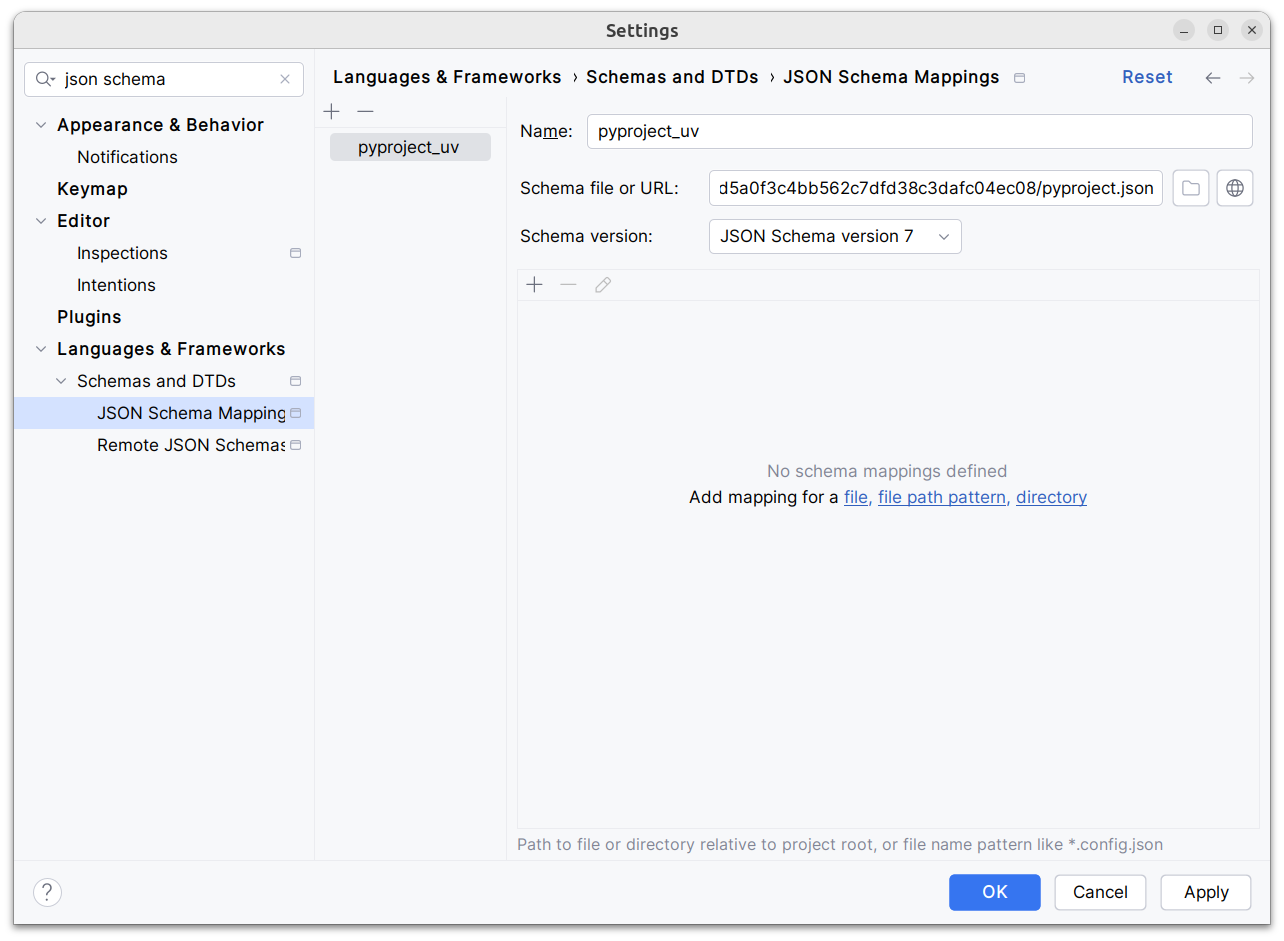
[dove.webm](https://github.com/astral-sh/uv/assets/6826232/c293c272-c80b-459d-8c95-8c46a8d198a1)
Previously, uv-auth would fail to compile due to a missing process
feature. I chose to make all tokio features we use top level features,
so we can share the tokio cache between all test invocations.
## Summary
This PR adds support for hash-checking mode in `pip install` and `pip
sync`. It's a large change, both in terms of the size of the diff and
the modifications in behavior, but it's also one that's hard to merge in
pieces (at least, with any test coverage) since it needs to work
end-to-end to be useful and testable.
Here are some of the most important highlights:
- We store hashes in the cache. Where we previously stored pointers to
unzipped wheels in the `archives` directory, we now store pointers with
a set of known hashes. So every pointer to an unzipped wheel also
includes its known hashes.
- By default, we don't compute any hashes. If the user runs with
`--require-hashes`, and the cache doesn't contain those hashes, we
invalidate the cache, redownload the wheel, and compute the hashes as we
go. For users that don't run with `--require-hashes`, there will be no
change in performance. For users that _do_, the only change will be if
they don't run with `--generate-hashes` -- then they may see some
repeated work between resolution and installation, if they use `pip
compile` then `pip sync`.
- Many of the distribution types now include a `hashes` field, like
`CachedDist` and `LocalWheel`.
- Our behavior is similar to pip, in that we enforce hashes when pulling
any remote distributions, and when pulling from our own cache. Like pip,
though, we _don't_ enforce hashes if a distribution is _already_
installed.
- Hash validity is enforced in a few different places:
1. During resolution, we enforce hash validity based on the hashes
reported by the registry. If we need to access a source distribution,
though, we then enforce hash validity at that point too, prior to
running any untrusted code. (This is enforced in the distribution
database.)
2. In the install plan, we _only_ add cached distributions that have
matching hashes. If a cached distribution is missing any hashes, or the
hashes don't match, we don't return them from the install plan.
3. In the downloader, we _only_ return distributions with matching
hashes.
4. The final combination of "things we install" are: (1) the wheels from
the cache, and (2) the downloaded wheels. So this ensures that we never
install any mismatching distributions.
- Like pip, if `--require-hashes` is provided, we require that _all_
distributions are pinned with either `==` or a direct URL. We also
require that _all_ distributions have hashes.
There are a few notable TODOs:
- We don't support hash-checking mode for unnamed requirements. These
should be _somewhat_ rare, though? Since `pip compile` never outputs
unnamed requirements. I can fix this, it's just some additional work.
- We don't automatically enable `--require-hashes` with a hash exists in
the requirements file. We require `--require-hashes`.
Closes#474.
## Test Plan
I'd like to add some tests for registries that report incorrect hashes,
but otherwise: `cargo test`
Needed to prevent circular dependencies in my toolchain work (#2931). I
think this is probably a reasonable change as we move towards persistent
configuration too?

Unfortunately `BuildIsolation` needs to be in `uv-types` to avoid
circular dependencies still. We might be able to resolve that in the
future.
This is driving me a little crazy and is becoming a larger problem in
#2596 where I need to move more types (like `Upgrade` and `Reinstall`)
into this crate. Anything that's shared across our core resolver,
install, and build crates needs to be defined in this crate to avoid
cyclic dependencies. We've outgrown it being a single file with some
shared traits.

There are no behavioral changes here.
Scott schafer got me the idea: We can avoid repeating the path for
workspaces dependencies everywhere if we declare them in the virtual
package once and treat them as workspace dependencies from there on.
## Summary

I tried out `cargo shear` to see if there are any unused dependencies
that `cargo udeps` isn't reporting. It turned out, there are a few. This
PR removes those dependencies.

## Test Plan

`cargo build`
Follow-up to #2086: Don't use timeouts for the entire workers, but only
for the section that's about communicating with the (potentially broken)
`python` subprocess. I've also raised the timeout to 60s.
Add a `--compile` option to `pip install` and `pip sync`.
I chose to implement this as a separate pass over the entire venv. If we
wanted to compile during installation, we'd have to make sure that
writing is exclusive, to avoid concurrent processes writing broken
`.pyc` files. Additionally, this ensures that the entire site-packages
are bytecode compiled, even if there are packages that aren't from this
`uv` invocation. The disadvantage is that we do not update RECORD and
rely on this comment from [PEP 491](https://peps.python.org/pep-0491/):
> Uninstallers should be smart enough to remove .pyc even if it is not
mentioned in RECORD.
If this is a problem we can change it to run during installation and
write RECORD entries.
Internally, this is implemented as an async work-stealing subprocess
worker pool. The producer is a directory traversal over site-packages,
sending each `.py` file to a bounded async FIFO queue/channel. Each
worker has a long-running python process. It pops the queue to get a
single path (or exists if the channel is closed), then sends it to
stdin, waits until it's informed that the compilation is done through a
line on stdout, and repeat. This is fast, e.g. installing `jupyter
plotly` on Python 3.12 it processes 15876 files in 319ms with 32 threads
(vs. 3.8s with a single core). The python processes internally calls
`compileall.compile_file`, the same as pip.
Like pip, we ignore and silence all compilation errors
(https://github.com/astral-sh/uv/issues/1559). There is a 10s timeout to
handle the case when the workers got stuck. For the reviewers, please
check if i missed any spots where we could deadlock, this is the hardest
part of this PR.
I've added `uv-dev compile <dir>` and `uv-dev clear-compile <dir>`
commands, mainly for my own benchmarking. I don't want to expose them in
`uv`, they almost certainly not the correct workflow and we don't want
to support them.
Fixes#1788Closes#1559Closes#1928
First, replace all usages in files in-place. I used my editor for this.
If someone wants to add a one-liner that'd be fun.

Then, update directory and file names:

```
# Run twice for nested directories
find . -type d -print0 | xargs -0 rename s/puffin/uv/g
find . -type d -print0 | xargs -0 rename s/puffin/uv/g

# Update files
find . -type f -print0 | xargs -0 rename s/puffin/uv/g
```

Then add all the files again

```
# Add all the files again
git add crates
git add python/uv

# This one needs a force-add
git add -f crates/uv-trampoline
```
 konsti
 Zanie Blue
 Zsolt Dollenstein
 Charlie Marsh
 John Mumm
 samypr100
 Amos Wenger
 Micha Reiser