## Summary

Discovered while working on https://github.com/astral-sh/uv/issues/9516.
In the linked repo, the root uses a `../dependency` path for the
workspace member, which we weren't normalizing.
This updates the surrounding code to use the new ResolverEnvironment
type. In some cases, this simplifies caller code by removing case
analysis. There *shouldn't* be any behavior changes here. Some test
snapshots were updated to account for some minor tweaks to error
messages.

I didn't split this up into separate commits because it would have been
too difficult/costly.
## Summary

This is similar to https://github.com/astral-sh/uv/pull/6171 but more
expansive... _Anywhere_ that we test requirements for platform
compatibility, we _need_ to respect the resolver-friendly markers. In
fixing the motivating issue (#6621), I also realized that we had a bunch
of bugs here around `pip install` with `--python-platform` and
`--python-version`, because we always performed our `satisfy` and `Plan`
operations on the interpreter's markers, not the adjusted markers!

Closes https://github.com/astral-sh/uv/issues/6621.
* Use a dedicated `ResolverMarkers` check in the fork state. This is
better than the `MarkerTree::And(Vec::new())` check.
* Report the timing correct naming universal resolution instead of two
spaces around an empty string when there are no markers.
* On resolution error, show the split that we're in. I'm not sure how to
word this, since we're doing a universal resolution until we fork, so
the trace may contain information from requirements that are not part of
this fork.
Downstack PR: #4481

## Introduction

We support forking the dependency resolution to support conflicting
registry requirements for different platforms, say on package range is
required for an older python version while a newer is required for newer
python versions, or dependencies that are different per platform. We
need to extend this support to direct URL requirements.

```toml
dependencies = [
  "iniconfig @ 62565a6e1ceac6173dc9db836a5b46/iniconfig-2.0.0-py3-none-any.whl ; python_version >= '3.12'",
  "iniconfig @ b3c12c6d70988d7baea9578f3c48f3/iniconfig-1.1.1-py2.py3-none-any.whl ; python_version < '3.12'"
]
```

This did not work because `Urls` was built on the assumption that there
is a single allowed URL per package. We collect all allowed URL ahead of
resolution by following direct URL dependencies (including path
dependencies) transitively, i.e. a registry distribution can't require a
URL.

## The same package can have Registry and URL requirements

Consider the following two cases:

requirements.in:
```text
werkzeug==2.0.0
werkzeug @ 960bb4017c4aed12b5ed8b78e0153e/Werkzeug-2.0.0-py3-none-any.whl
```
pyproject.toml:
```toml
dependencies = [
  "iniconfig == 1.1.1 ; python_version < '3.12'",
  "iniconfig @ git+https://github.com/pytest-dev/iniconfig@93f5930e668c0d1ddf4597e38dd0dea4e2665e7a ; python_version >= '3.12'",
]
```

In the first case, we want the URL to override the registry dependency,
in the second case we want to fork and have one branch use the registry
and the other the URL. We have to know about this in
`PubGrubRequirement::from_registry_requirement`, but we only fork after
the current method.

Consider the following case too:

a:
```
c==1.0.0
b @ https://b.zip
```
b:
```
c @ https://c_new.zip ; python_version >= '3.12'",
c @ https://c_old.zip ; python_version < '3.12'",
```

When we convert the requirements of `a`, we can't know the url of `c`
yet. The solution is to remove the `Url` from `PubGrubPackage`: The
`Url` is redundant with `PackageName`, there can be only one url per
package name per fork. We now do the following: We track the urls from
requirements in `PubGrubDependency`. After forking, we call
`add_package_version_dependencies` where we apply override URLs, check
if the URL is allowed and check if the url is unique in this fork. When
we request a distribution, we ask the fork urls for the real URL. Since
we prioritize url dependencies over registry dependencies and skip
packages with `Urls` entries in pre-visiting, we know that when fetching
a package, we know if it has a url or not.

## URL conflicts

pyproject.toml (invalid):
```toml
dependencies = [
  "iniconfig @ e96292c7f723f1fa332fe4ed6dfbec/iniconfig-1.1.0.tar.gz",
  "iniconfig @ b3c12c6d70988d7baea9578f3c48f3/iniconfig-1.1.1-py2.py3-none-any.whl ; python_version < '3.12'",
  "iniconfig @ 62565a6e1ceac6173dc9db836a5b46/iniconfig-2.0.0-py3-none-any.whl ; python_version >= '3.12'",
]
```

On the fork state, we keep `ForkUrls` that check for conflicts after
forking, rejecting the third case because we added two packages of the
same name with different URLs.

We need to flatten out the requirements before transformation into
pubgrub requirements to get the full list of other requirements which
may contain a URL, which was changed in a previous PR: #4430.

## Complex Example

a:
```toml
dependencies = [
  # Force a split
  "anyio==4.3.0 ; python_version >= '3.12'",
  "anyio==4.2.0 ; python_version < '3.12'",
  # Include URLs transitively
  "b"
]
```
b:
```toml
dependencies = [
  # Only one is used in each split.
  "b1 ; python_version < '3.12'",
  "b2 ; python_version >= '3.12'",
  "b3 ; python_version >= '3.12'",
]
```
b1:
```toml
dependencies = [
  "iniconfig @ b3c12c6d70988d7baea9578f3c48f3/iniconfig-1.1.1-py2.py3-none-any.whl",
]
```
b2:
```toml
dependencies = [
  "iniconfig @ 62565a6e1ceac6173dc9db836a5b46/iniconfig-2.0.0-py3-none-any.whl",
]
```
b3:
```toml
dependencies = [
  "iniconfig @ e96292c7f723f1fa332fe4ed6dfbec/iniconfig-1.1.0.tar.gz",
]
```

In this example, all packages are url requirements (directory
requirements) and the root package is `a`. We first split on `a`, `b`
being in each split. In the first fork, we reach `b1`, the fork URLs are
empty, we insert the iniconfig 1.1.1 URL, and then we skip over `b2` and
`b3` since the mark is disjoint with the fork markers. In the second
fork, we skip over `b1`, visit `b2`, insert the iniconfig 2.0.0 URL into
the again empty fork URLs, then visit `b3` and try to insert the
iniconfig 1.1.0 URL. At this point we find a conflict for the iniconfig
URL and error.

## Closing

The git tests are slow, but they make the best example for different URL
types i could find.

Part of #3927. This PR does not handle `Locals` or pre-releases yet.
## Summary

This is what I consider to be the "real" fix for #8072. We now treat
directory and path URLs as separate `ParsedUrl` types and
`RequirementSource` types. This removes a lot of `.is_dir()` forking
within the `ParsedUrl::Path` arms and makes some states impossible
(e.g., you can't have a `.whl` path that is editable). It _also_ fixes
the `direct_url.json` for direct URLs that refer to files. Previously,
we wrote out to these as if they were installed as directories, which is
just wrong.
By splitting `path` into a lockable, relative (or absolute) and an
absolute installable path and by splitting between urls and paths by
dist type, we can store relative paths in the lockfile.
## Summary

Should be no behavior changes, but one piece of technical debt I noticed
left over in the URL resolver. We already have structured paths, so we
shouldn't need to compare verbatim URLs.
## Summary

If the user requests a package as both editable and non-editable, the
editable now "wins".

Previously, `pip install -e . .` would install as editable. However,
`pip install -e . -r requirements.txt` would _not_ if `requirements.txt`
contained `.`, because we ignored `editable` when deduplicating and the
order of iteration was just dependent on internals.

Closes https://github.com/astral-sh/uv/issues/4053.
When creating a lockfile, lock the combined dependencies for all
packages in a workspace. This make the lockfile independent of where you
are in the workspace.
Fixes#3983
## Summary

This PR removes the static resolver map:

```rust
static RESOLVED_GIT_REFS: Lazy<Mutex<FxHashMap<RepositoryReference, GitSha>>> =
    Lazy::new(Mutex::default);
```

With a `GitResolver` struct that we now pass around on the
`BuildContext`. There should be no behavior changes here; it's purely an
internal refactor with an eye towards making it cleaner for us to
"pre-populate" the list of resolved SHAs.
With the change, we remove the special casing of workspace dependencies
and resolve `tool.uv` for all git and directory distributions. This
gives us support for non-editable workspace dependencies and path
dependencies in other workspaces. It removes a lot of special casing
around workspaces. These changes are the groundwork for supporting
`tool.uv` with dynamic metadata.

The basis for this change is moving `Requirement` from
`distribution-types` to `pypi-types` and the lowering logic from
`uv-requirements` to `uv-distribution`. This changes should be split out
in separate PRs.

I've included an example workspace `albatross-root-workspace2` where
`bird-feeder` depends on `a` from another workspace `ab`. There's a
bunch of failing tests and regressed error messages that still need
fixing. It does fix the audited package count for the workspace tests.
## Summary
There are a few behavior changes in here:
- We now enforce `--require-hashes` for editables, like pip. So if you
use `--require-hashes` with an editable requirement, we'll reject it. I
could change this if it seems off.
- We now treat source tree requirements, editable or not (e.g., both `-e
./black` and `./black`) as if `--refresh` is always enabled. This
doesn't mean that we _always_ rebuild them; but if you pass
`--reinstall`, then yes, we always rebuild them. I think this is an
improvement and is close to how editables work today.
Closes#3844.
Closes#2695.
When parsing requirements from any source, directly parse the url parts
(and reject unsupported urls) instead of parsing url parts at a later
stage. This removes a bunch of error branches and concludes the work
parsing url parts once and passing them around everywhere.

Many usages of the assembled `VerbatimUrl` remain, but these can be
removed incrementally.

Please review commit-by-commit.
This is split out from workspaces support, which needs editables in the
bluejay commands. It consists mainly of refactorings:

* Move the `editable` module one level up.
* Introduce a `BuiltEditableMetadata` type for `(LocalEditable,
Metadata23, Requirements)`.
* Add editables to `InstalledPackagesProvider` so we can use
`EmptyInstalledPackages` for them.
This commit touches a lot of code, but the conceptual change here is
pretty simple: make it so we can run the resolver without providing a
`MarkerEnvironment`. This also indicates that the resolver should run in
universal mode. That is, the effect of a missing marker environment is
that all marker expressions that reference the marker environment are
evaluated to `true`. That is, they are ignored. (The only markers we
evaluate in that context are extras, which are the only markers that
aren't dependent on the environment.)

One interesting change here is that a `Resolver` no longer needs an
`Interpreter`. Previously, it had only been using it to construct a
`PythonRequirement`, by filling in the installed version from the
`Interpreter` state. But we now construct a `PythonRequirement`
explicitly since its `target` Python version should no longer be tied to
the `MarkerEnvironment`. (Currently, the marker environment is mutated
such that its `python_full_version` is derived from multiple sources,
including the CLI, which I found a touch confusing.)

The change in behavior can now be observed through the
`--unstable-uv-lock-file` flag. First, without it:

```
$ cat requirements.in
anyio>=4.3.0 ; sys_platform == "linux"
anyio<4 ; sys_platform == "darwin"
$ cargo run -qp uv -- pip compile -p3.10 requirements.in
anyio==4.3.0
exceptiongroup==1.2.1
    # via anyio
idna==3.7
    # via anyio
sniffio==1.3.1
    # via anyio
typing-extensions==4.11.0
    # via anyio
```

And now with it:

```
$ cargo run -qp uv -- pip compile -p3.10 requirements.in --unstable-uv-lock-file
  x No solution found when resolving dependencies:
  `-> Because you require anyio>=4.3.0 and anyio<4, we can conclude that the requirements are unsatisfiable.
```

This is expected at this point because the marker expressions are being
explicitly ignored, *and* there is no forking done yet to account for
the conflict.
## Introduction
PEP 621 is limited. Specifically, it lacks
* Relative path support
* Editable support
* Workspace support
* Index pinning or any sort of index specification
The semantics of urls are a custom extension, PEP 440 does not specify
how to use git references or subdirectories, instead pip has a custom
stringly format. We need to somehow support these while still stying
compatible with PEP 621.
## `tool.uv.source`
Drawing inspiration from cargo, poetry and rye, we add `tool.uv.sources`
or (for now stub only) `tool.uv.workspace`:
```toml
[project]
name = "albatross"
version = "0.1.0"
dependencies = [
"tqdm >=4.66.2,<5",
"torch ==2.2.2",
"transformers[torch] >=4.39.3,<5",
"importlib_metadata >=7.1.0,<8; python_version < '3.10'",
"mollymawk ==0.1.0"
]
[tool.uv.sources]
tqdm = { git = "https://github.com/tqdm/tqdm", rev = "cc372d09dcd5a5eabdc6ed4cf365bdb0be004d44" }
importlib_metadata = { url = "https://github.com/python/importlib_metadata/archive/refs/tags/v7.1.0.zip" }
torch = { index = "torch-cu118" }
mollymawk = { workspace = true }
[tool.uv.workspace]
include = [
"packages/mollymawk"
]
[tool.uv.indexes]
torch-cu118 = "https://download.pytorch.org/whl/cu118"
```
See `docs/specifying_dependencies.md` for a detailed explanation of the
format. The basic gist is that `project.dependencies` is what ends up on
pypi, while `tool.uv.sources` are your non-published additions. We do
support the full range or PEP 508, we just hide it in the docs and
prefer the exploded table for easier readability and less confusing with
actual url parts.
This format should eventually be able to subsume requirements.txt's
current use cases. While we will continue to support the legacy `uv pip`
interface, this is a piece of the uv's own top level interface. Together
with `uv run` and a lockfile format, you should only need to write
`pyproject.toml` and do `uv run`, which generates/uses/updates your
lockfile behind the scenes, no more pip-style requirements involved. It
also lays the groundwork for implementing index pinning.
## Changes
This PR implements:
* Reading and lowering `project.dependencies`,
`project.optional-dependencies` and `tool.uv.sources` into a new
requirements format, including:
* Git dependencies
* Url dependencies
* Path dependencies, including relative and editable
* `pip install` integration
* Error reporting for invalid `tool.uv.sources`
* Json schema integration (works in pycharm, see below)
* Draft user-level docs (see `docs/specifying_dependencies.md`)
It does not implement:
* No `pip compile` testing, deprioritizing towards our own lockfile
* Index pinning (stub definitions only)
* Development dependencies
* Workspace support (stub definitions only)
* Overrides in pyproject.toml
* Patching/replacing dependencies
One technically breaking change is that we now require user provided
pyproject.toml to be valid wrt to PEP 621. Included files still fall
back to PEP 517. That means `pip install -r requirements.txt` requires
it to be valid while `pip install -r requirements.txt` with `-e .` as
content falls back to PEP 517 as before.
## Implementation
The `pep508` requirement is replaced by a new `UvRequirement` (name up
for bikeshedding, not particularly attached to the uv prefix). The still
existing `pep508_rs::Requirement` type is a url format copied from pip's
requirements.txt and doesn't appropriately capture all features we
want/need to support. The bulk of the diff is changing the requirement
type throughout the codebase.
We still use `VerbatimUrl` in many places, where we would expect a
parsed/decomposed url type, specifically:
* Reading core metadata except top level pyproject.toml files, we fail a
step later instead if the url isn't supported.
* Allowed `Urls`.
* `PackageId` with a custom `CanonicalUrl` comparison, instead of
canonicalizing urls eagerly.
* `PubGrubPackage`: We eventually convert the `VerbatimUrl` back to a
`Dist` (`Dist::from_url`), instead of remembering the url.
* Source dist types: We use verbatim url even though we know and require
that these are supported urls we can and have parsed.
I tried to make improve the situation be replacing `VerbatimUrl`, but
these changes would require massive invasive changes (see e.g.
https://github.com/astral-sh/uv/pull/3253). A main problem is the ref
`VersionOrUrl` and applying overrides, which assume the same
requirement/url type everywhere. In its current form, this PR increases
this tech debt.
I've tried to split off PRs and commits, but the main refactoring is
still a single monolith commit to make it compile and the tests pass.
## Demo
Adding
d1ae3b85d5/pyproject.json
as json schema (v7) to pycharm for `pyproject.toml`, you can try the IDE
support already:
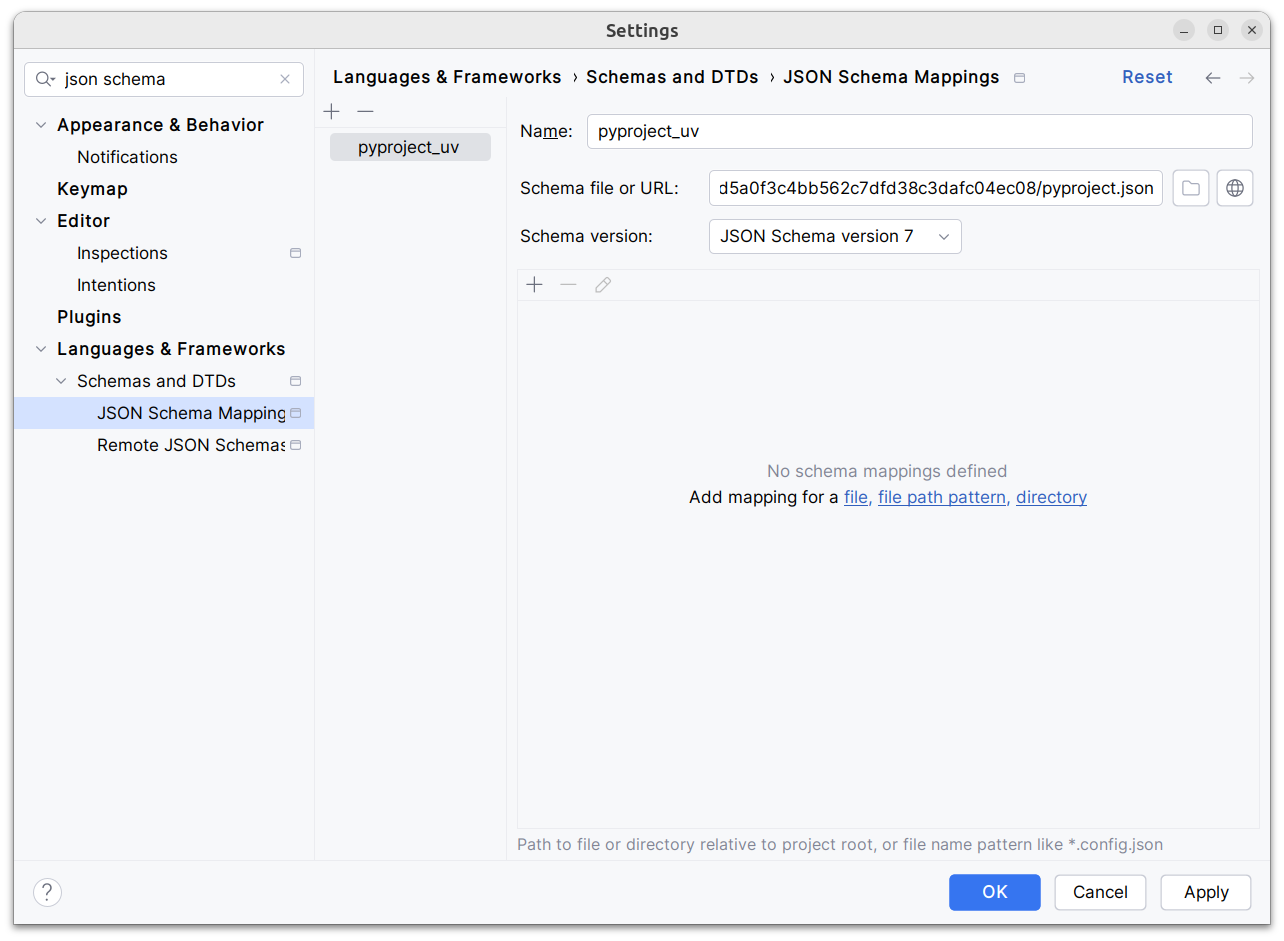
[dove.webm](https://github.com/astral-sh/uv/assets/6826232/c293c272-c80b-459d-8c95-8c46a8d198a1)
## Summary

This PR avoids: (1) using the lookahead resolver when `--no-deps` is
specified (we'll never use those requirements), and (2) including any
transitive requirements when searching for allowed URLs, etc., when
`--no-deps` is specified.

Closes https://github.com/astral-sh/uv/issues/3183.
## Summary

This PR leverages our lookahead direct URL resolution to significantly
improve the range of Git URLs that we can accept (e.g., if a user
provides the same requirement, once as a direct dependency, and once as
a tag). We did some of this in #2285, but the solution here is more
general and works for arbitrary transitive URLs.

Closes https://github.com/astral-sh/uv/issues/2614.
## Summary

We iterate over the project "requirements" directly in a variety of
places. However, it's not always the case that an input "requirement" on
its own will _actually_ be part of the resolution, since we support
"overrides".

Historically, then, overrides haven't worked as expected for _direct_
dependencies (and we have some tests that demonstrate the current,
"wrong" behavior). This is just a bug, but it's not really one that
comes up in practice, since it's rare to apply an override to your _own_
dependency.

However, we're now considering expanding the lookahead concept to
include local transitive dependencies. In this case, it's more and more
important that overrides and constraints are handled consistently.

This PR modifies all the locations in which we iterate over requirements
directly, and modifies them to respect overrides (and constraints, where
necessary).
## Summary

This PR enables the resolver to "accept" URLs, prereleases, and local
version specifiers for direct dependencies of path dependencies. As a
result, `uv pip install .` and `uv pip install -e .` now behave
identically, in that neither has a restriction on URL dependencies and
the like.

Closes https://github.com/astral-sh/uv/issues/2643.
Closes https://github.com/astral-sh/uv/issues/1853.
## Summary

This PR ensures that we expand environment variables _before_ sniffing
for the URL scheme (e.g., `file://` vs. `https://` vs. something else).

Closes https://github.com/astral-sh/uv/issues/2375.
## Summary

This PR removes the URL conflict errors when the output of a `uv pip
compile` is used as a constraint to a subsequent `uv pip compile`.

If you run `uv pip compile`, the output file will contain your Git
dependencies, but pinned to a specific commit, like:

```
git+https://github.com/pallets/werkzeug@32e69512134c2f8183c6438b2b2e13fd24e9d19f
```

If you then use the output as a constraint to a subsequent resolution
(e.g., perhaps you require
`git+https://github.com/pallets/werkzeug@main`), we currently fail. I
think this is a reasonable workflow to support when all of these
requirements are coming from _your own_ dependencies. So we now assume
when resolving that the former is a more precise variant of the latter.

Closes https://github.com/astral-sh/uv/issues/1903.

Closes https://github.com/astral-sh/uv/issues/2266.

## Test Plan

`cargo test`
## Summary

This revives a PR from long ago
(https://github.com/astral-sh/uv/pull/383 and
https://github.com/zanieb/pubgrub/pull/24) that modifies how we deal
with dependencies that are declared multiple times within a single
package.

To quote from the originating PR:

> Uses an experimental pubgrub branch (#370) that allows us to handle
multiple version ranges for a single dependency to the solver which
results in better error messages because the derivation tree contains
all of the relevant versions. Previously, the version ranges were merged
(by us) in the resolver before handing them to pubgrub since only one
range could be provided per package. Since we don't merge the versions
anymore, we no longer give the solver an empty range for conflicting
requirements; instead the solver comes to that conclusion from the
provided versions. You can see the improved error message for direct
dependencies in [this
snapshot](https://github.com/astral-sh/puffin/pull/383/files#diff-a0437f2c20cde5e2f15199a3bf81a102b92580063268417847ec9c793a115bd0).

The main issue with that PR was around its handling of URL dependencies,
so this PR _also_ refactors how we handle those. Previously, we stored
URL dependencies on `PubGrubPackage`, but they were omitted from the
hash and equality implementations of `PubGrubPackage`. This led to some
really careful codepaths wherein we had to ensure that we always visited
URLs before non-URL packages, so that the URL-inclusive versions were
included in any hashmaps, etc. I considered preserving this approach,
but it would require us to rely on lots of internal details of PubGrub
(since we'd now be relying on PubGrub to merge those packages in the
"right" order).

So, instead, we now _always_ set the URL on a given package, whenever
that package was _given_ a URL upfront. I think this is easier to reason
about: if the user provided a URL for `flask`, then we should just
always add the URL for `flask`. If we see some other URL for `flask`, we
error, like before. If we see some unknown URL for `flask`, we error,
like before.

Closes https://github.com/astral-sh/uv/issues/1522.

Closes https://github.com/astral-sh/uv/issues/1821.

Closes https://github.com/astral-sh/uv/issues/1615.
 Charlie Marsh
 Andrew Gallant
 konsti