## Summary
There are a few behavior changes in here:
- We now enforce `--require-hashes` for editables, like pip. So if you
use `--require-hashes` with an editable requirement, we'll reject it. I
could change this if it seems off.
- We now treat source tree requirements, editable or not (e.g., both `-e
./black` and `./black`) as if `--refresh` is always enabled. This
doesn't mean that we _always_ rebuild them; but if you pass
`--reinstall`, then yes, we always rebuild them. I think this is an
improvement and is close to how editables work today.
Closes#3844.
Closes#2695.
When parsing requirements from any source, directly parse the url parts
(and reject unsupported urls) instead of parsing url parts at a later
stage. This removes a bunch of error branches and concludes the work
parsing url parts once and passing them around everywhere.

Many usages of the assembled `VerbatimUrl` remain, but these can be
removed incrementally.

Please review commit-by-commit.
## Summary

Closes https://github.com/astral-sh/uv/issues/3715.

## Test Plan

```
❯ echo "/../test" | cargo run pip compile -
error: Couldn't parse requirement in `-` at position 0
  Caused by: path could not be normalized: /../test
/../test
^^^^^^^^

❯ echo "-e /../test" | cargo run pip compile -
error: Invalid URL in `-`: `/../test`
  Caused by: path could not be normalized: /../test
  Caused by: cannot normalize a relative path beyond the base directory
```
## Summary

Uncertain about this, but we don't actually need the full
`SourceDistFilename`, only the name and version -- and we often have
that information already (as in the lockfile routines). So by flattening
the fields onto `RegistrySourceDist`, we can avoid re-parsing for
information we already have.
## Summary

I don't love this, but it turns out that setuptools is not robust to
parallel builds: https://github.com/pypa/setuptools/issues/3119. As a
result, if you run uv from multiple processes, and they each attempt to
build the same source distribution, you can hit failures.

This PR applies an advisory lock to the source distribution directory.
We apply it unconditionally, even if we ultimately find something in the
cache and _don't_ do a build, which helps ensure that we only build the
distribution once (and wait for that build to complete) rather than
kicking off builds from each thread.

Closes https://github.com/astral-sh/uv/issues/3512.

## Test Plan

Ran:

```sh
#!/bin/bash
make_venv(){
    target/debug/uv venv $1
    source $1/bin/activate
    target/debug/uv pip install opentracing --no-deps --verbose
}

for i in {1..8}
do
   make_venv ./$1/$i &
done
```
## Summary

I think this is overall good change because it explicitly encodes (in
the type system) something that was previously implicit. I'm not a huge
fan of the names here, open to input.

It covers some of https://github.com/astral-sh/uv/issues/3506 but I
don't think it _closes_ it.
## Summary

This PR consolidates the concurrency limits used throughout `uv` and
exposes two limits, `UV_CONCURRENT_DOWNLOADS` and
`UV_CONCURRENT_BUILDS`, as environment variables.

Currently, `uv` has a number of concurrent streams that it buffers using
relatively arbitrary limits for backpressure. However, many of these
limits are conflated. We run a relatively small number of tasks overall
and should start most things as soon as possible. What we really want to
limit are three separate operations:
- File I/O. This is managed by tokio's blocking pool and we should not
really have to worry about it.
- Network I/O.
- Python build processes.

Because the current limits span a broad range of tasks, it's possible
that a limit meant for network I/O is occupied by tasks performing
builds, reading from the file system, or even waiting on a `OnceMap`. We
also don't limit build processes that end up being required to perform a
download. While this may not pose a performance problem because our
limits are relatively high, it does mean that the limits do not do what
we want, making it tricky to expose them to users
(https://github.com/astral-sh/uv/issues/1205,
https://github.com/astral-sh/uv/issues/3311).

After this change, the limits on network I/O and build processes are
centralized and managed by semaphores. All other tasks are unbuffered
(note that these tasks are still bounded, so backpressure should not be
a problem).
## Summary

All of the resolver code is run on the main thread, so a lot of the
`Send` bounds and uses of `DashMap` and `Arc` are unnecessary. We could
also switch to using single-threaded versions of `Mutex` and `Notify` in
some places, but there isn't really a crate that provides those I would
be comfortable with using.

The `Arc` in `OnceMap` can't easily be removed because of the uv-auth
code which uses the
[reqwest-middleware](https://docs.rs/reqwest-middleware/latest/reqwest_middleware/trait.Middleware.html)
crate, that seems to adds unnecessary `Send` bounds because of
`async-trait`. We could duplicate the code and create a `OnceMapLocal`
variant, but I don't feel that's worth it.
## Introduction
PEP 621 is limited. Specifically, it lacks
* Relative path support
* Editable support
* Workspace support
* Index pinning or any sort of index specification
The semantics of urls are a custom extension, PEP 440 does not specify
how to use git references or subdirectories, instead pip has a custom
stringly format. We need to somehow support these while still stying
compatible with PEP 621.
## `tool.uv.source`
Drawing inspiration from cargo, poetry and rye, we add `tool.uv.sources`
or (for now stub only) `tool.uv.workspace`:
```toml
[project]
name = "albatross"
version = "0.1.0"
dependencies = [
"tqdm >=4.66.2,<5",
"torch ==2.2.2",
"transformers[torch] >=4.39.3,<5",
"importlib_metadata >=7.1.0,<8; python_version < '3.10'",
"mollymawk ==0.1.0"
]
[tool.uv.sources]
tqdm = { git = "https://github.com/tqdm/tqdm", rev = "cc372d09dcd5a5eabdc6ed4cf365bdb0be004d44" }
importlib_metadata = { url = "https://github.com/python/importlib_metadata/archive/refs/tags/v7.1.0.zip" }
torch = { index = "torch-cu118" }
mollymawk = { workspace = true }
[tool.uv.workspace]
include = [
"packages/mollymawk"
]
[tool.uv.indexes]
torch-cu118 = "https://download.pytorch.org/whl/cu118"
```
See `docs/specifying_dependencies.md` for a detailed explanation of the
format. The basic gist is that `project.dependencies` is what ends up on
pypi, while `tool.uv.sources` are your non-published additions. We do
support the full range or PEP 508, we just hide it in the docs and
prefer the exploded table for easier readability and less confusing with
actual url parts.
This format should eventually be able to subsume requirements.txt's
current use cases. While we will continue to support the legacy `uv pip`
interface, this is a piece of the uv's own top level interface. Together
with `uv run` and a lockfile format, you should only need to write
`pyproject.toml` and do `uv run`, which generates/uses/updates your
lockfile behind the scenes, no more pip-style requirements involved. It
also lays the groundwork for implementing index pinning.
## Changes
This PR implements:
* Reading and lowering `project.dependencies`,
`project.optional-dependencies` and `tool.uv.sources` into a new
requirements format, including:
* Git dependencies
* Url dependencies
* Path dependencies, including relative and editable
* `pip install` integration
* Error reporting for invalid `tool.uv.sources`
* Json schema integration (works in pycharm, see below)
* Draft user-level docs (see `docs/specifying_dependencies.md`)
It does not implement:
* No `pip compile` testing, deprioritizing towards our own lockfile
* Index pinning (stub definitions only)
* Development dependencies
* Workspace support (stub definitions only)
* Overrides in pyproject.toml
* Patching/replacing dependencies
One technically breaking change is that we now require user provided
pyproject.toml to be valid wrt to PEP 621. Included files still fall
back to PEP 517. That means `pip install -r requirements.txt` requires
it to be valid while `pip install -r requirements.txt` with `-e .` as
content falls back to PEP 517 as before.
## Implementation
The `pep508` requirement is replaced by a new `UvRequirement` (name up
for bikeshedding, not particularly attached to the uv prefix). The still
existing `pep508_rs::Requirement` type is a url format copied from pip's
requirements.txt and doesn't appropriately capture all features we
want/need to support. The bulk of the diff is changing the requirement
type throughout the codebase.
We still use `VerbatimUrl` in many places, where we would expect a
parsed/decomposed url type, specifically:
* Reading core metadata except top level pyproject.toml files, we fail a
step later instead if the url isn't supported.
* Allowed `Urls`.
* `PackageId` with a custom `CanonicalUrl` comparison, instead of
canonicalizing urls eagerly.
* `PubGrubPackage`: We eventually convert the `VerbatimUrl` back to a
`Dist` (`Dist::from_url`), instead of remembering the url.
* Source dist types: We use verbatim url even though we know and require
that these are supported urls we can and have parsed.
I tried to make improve the situation be replacing `VerbatimUrl`, but
these changes would require massive invasive changes (see e.g.
https://github.com/astral-sh/uv/pull/3253). A main problem is the ref
`VersionOrUrl` and applying overrides, which assume the same
requirement/url type everywhere. In its current form, this PR increases
this tech debt.
I've tried to split off PRs and commits, but the main refactoring is
still a single monolith commit to make it compile and the tests pass.
## Demo
Adding
d1ae3b85d5/pyproject.json
as json schema (v7) to pycharm for `pyproject.toml`, you can try the IDE
support already:
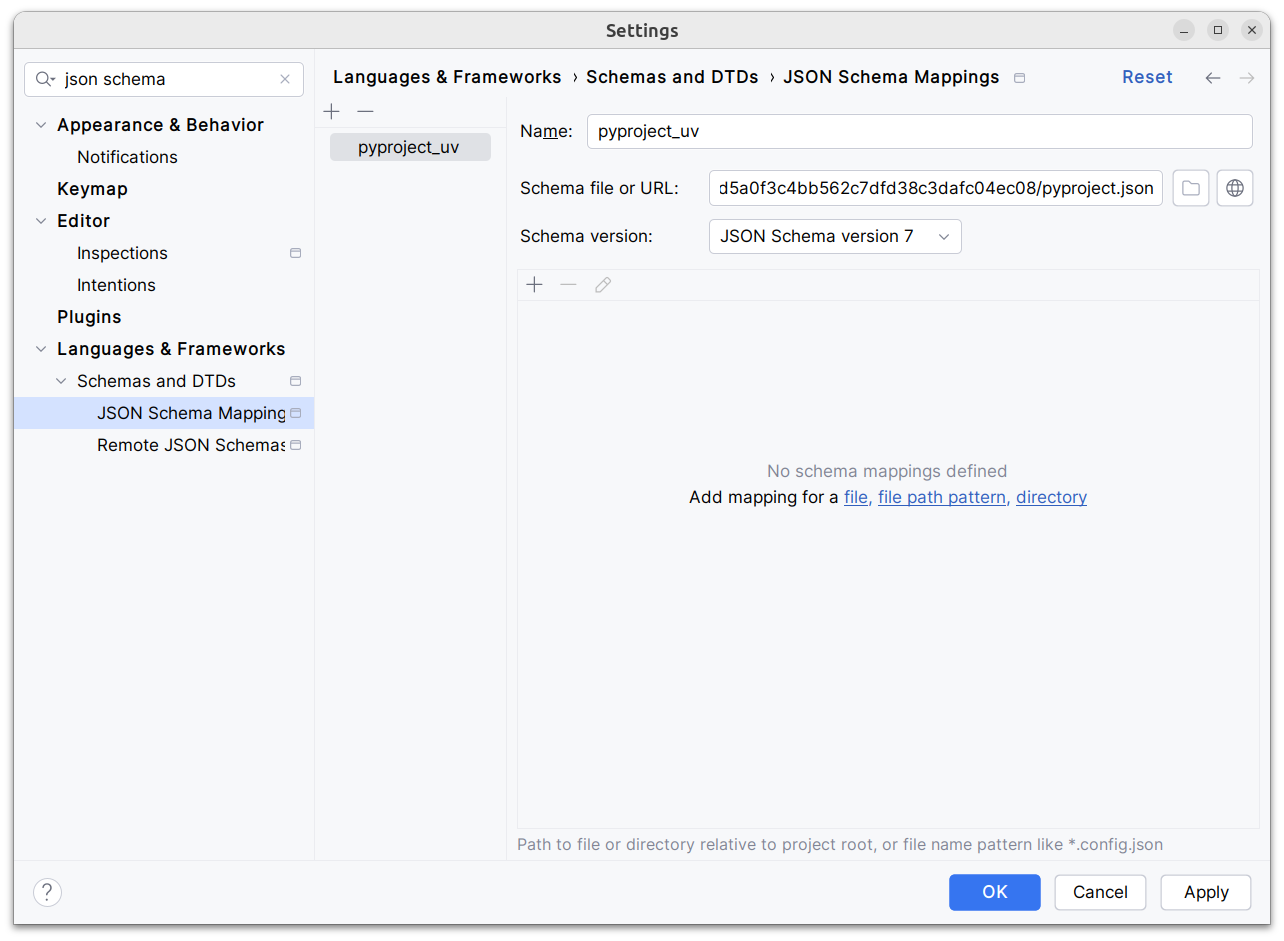
[dove.webm](https://github.com/astral-sh/uv/assets/6826232/c293c272-c80b-459d-8c95-8c46a8d198a1)
## Summary

This PR formalizes some of the concepts we use in the cache for
"pointers to things".

In the wheel cache, we have files like
`annotated_types-0.6.0-py3-none-any.http`. This represents an unzipped
wheel, cached alongside an HTTP caching policy. We now have a struct for
this to encapsulate the logic: `HttpArchivePointer`.

Similarly, we have files like `annotated_types-0.6.0-py3-none-any.rev`.
This represents an unzipped local wheel, alongside with a timestamp. We
now have a struct for this to encapsulate the logic:
`LocalArchivePointer`.

We have similar structs for source distributions too.
## Summary
This PR enables hash generation for URL requirements when the user
provides `--generate-hashes` to `pip compile`. While we include the
hashes from the registry already, today, we omit hashes for URLs.
To power hash generation, we introduce a `HashPolicy` abstraction:
```rust
#[derive(Debug, Clone, Copy, PartialEq, Eq)]
pub enum HashPolicy<'a> {
/// No hash policy is specified.
None,
/// Hashes should be generated (specifically, a SHA-256 hash), but not validated.
Generate,
/// Hashes should be validated against a pre-defined list of hashes. If necessary, hashes should
/// be generated so as to ensure that the archive is valid.
Validate(&'a [HashDigest]),
}
```
All of the methods on the distribution database now accept this policy,
instead of accepting `&'a [HashDigest]`.
Closes#2378.
## Summary

This PR modifies the distribution database to return both the
`Metadata23` and the computed hashes when clients request metadata.

No behavior changes, but this will be necessary to power
`--generate-hashes`.
## Summary
This PR adds support for hash-checking mode in `pip install` and `pip
sync`. It's a large change, both in terms of the size of the diff and
the modifications in behavior, but it's also one that's hard to merge in
pieces (at least, with any test coverage) since it needs to work
end-to-end to be useful and testable.
Here are some of the most important highlights:
- We store hashes in the cache. Where we previously stored pointers to
unzipped wheels in the `archives` directory, we now store pointers with
a set of known hashes. So every pointer to an unzipped wheel also
includes its known hashes.
- By default, we don't compute any hashes. If the user runs with
`--require-hashes`, and the cache doesn't contain those hashes, we
invalidate the cache, redownload the wheel, and compute the hashes as we
go. For users that don't run with `--require-hashes`, there will be no
change in performance. For users that _do_, the only change will be if
they don't run with `--generate-hashes` -- then they may see some
repeated work between resolution and installation, if they use `pip
compile` then `pip sync`.
- Many of the distribution types now include a `hashes` field, like
`CachedDist` and `LocalWheel`.
- Our behavior is similar to pip, in that we enforce hashes when pulling
any remote distributions, and when pulling from our own cache. Like pip,
though, we _don't_ enforce hashes if a distribution is _already_
installed.
- Hash validity is enforced in a few different places:
1. During resolution, we enforce hash validity based on the hashes
reported by the registry. If we need to access a source distribution,
though, we then enforce hash validity at that point too, prior to
running any untrusted code. (This is enforced in the distribution
database.)
2. In the install plan, we _only_ add cached distributions that have
matching hashes. If a cached distribution is missing any hashes, or the
hashes don't match, we don't return them from the install plan.
3. In the downloader, we _only_ return distributions with matching
hashes.
4. The final combination of "things we install" are: (1) the wheels from
the cache, and (2) the downloaded wheels. So this ensures that we never
install any mismatching distributions.
- Like pip, if `--require-hashes` is provided, we require that _all_
distributions are pinned with either `==` or a direct URL. We also
require that _all_ distributions have hashes.
There are a few notable TODOs:
- We don't support hash-checking mode for unnamed requirements. These
should be _somewhat_ rare, though? Since `pip compile` never outputs
unnamed requirements. I can fix this, it's just some additional work.
- We don't automatically enable `--require-hashes` with a hash exists in
the requirements file. We require `--require-hashes`.
Closes#474.
## Test Plan
I'd like to add some tests for registries that report incorrect hashes,
but otherwise: `cargo test`
To get more insights into test performance, allow instrumenting tests
with tracing-durations-export.
Usage:
```shell
# A single test
TRACING_DURATIONS_TEST_ROOT=$(pwd)/target/test-traces cargo test --features tracing-durations-export --test pip_install_scenarios no_binary -- --exact
# All tests
TRACING_DURATIONS_TEST_ROOT=$(pwd)/target/test-traces cargo nextest run --features tracing-durations-export
```
Then we can e.g. look at
`target/test-traces/pip_install_scenarios::no_binary.svg` and see the
builds it performs:

## Summary

If we build a source distribution from the registry, and the version
doesn't match that of the filename, we should error, just as we do for
mismatched package names. However, we should also backtrack here, which
we didn't previously.

Closes https://github.com/astral-sh/uv/issues/2953.

## Test Plan

Verified that `cargo run pip install docutils --verbose --no-cache
--reinstall` installs `docutils==0.21` instead of the invalid
`docutils==0.21.post1`.

In the logs, I see:

```
WARN Unable to extract metadata for docutils: Package metadata version `0.21` does not match given version `0.21.post1`
```
Needed to prevent circular dependencies in my toolchain work (#2931). I
think this is probably a reasonable change as we move towards persistent
configuration too?

Unfortunately `BuildIsolation` needs to be in `uv-types` to avoid
circular dependencies still. We might be able to resolve that in the
future.
## Summary
When you specify a source distribution via a path, it can either be a
path to an archive (like a `.tar.gz` file), or a source tree (a
directory). Right now, we handle both paths through the same methods in
the source database. This PR splits them up into separate handlers.
This will make hash generation a little easier, since we need to
generate hashes for archives, but _can't_ generate hashes for source
trees.
It also means that we can now store the unzipped source distribution in
the cache (in the case of archives), and avoid unzipping the source
distribution needlessly on every invocation; and, overall, let's un
enforce clearer expectations between the two routes (e.g., what errors
are possible vs. not), at the cost of duplicating some code.
Closes#2760 (incidentally -- not exactly the motivation for the change,
but it did accomplish it).
## Summary

I think this is a much clearer name for this concept: the set of
"versions" of a given wheel or source distribution. We also use
"Manifest" elsewhere to refer to the set of requirements, constraints,
etc., so this was overloaded.
## Summary
Upgrading `rs-async-zip` enables us to support data descriptors in
streaming. This both greatly improves performance for indexes that use
data descriptors _and_ ensures that we support them in a few other
places (e.g., zipped source distributions created in Finder).
Closes#2808.
## Summary

Rather than storing the `redirects` on the resolver, this PR just
re-uses the "convert this URL to precise" logic when we convert to a
`Resolution` after-the-fact. I think this is a lot simpler: it removes
state from the resolver, and simplifies a lot of the hooks around
distribution fetching (e.g., `get_or_build_wheel_metadata` no longer
returns `(Metadata23, Option<Url>)`).
## Summary

Now that we're resolving metadata more aggressively for local sources,
it's worth doing this. We now pull metadata from the `pyproject.toml`
directly if it's statically-defined.

Closes https://github.com/astral-sh/uv/issues/2629.
This is driving me a little crazy and is becoming a larger problem in
#2596 where I need to move more types (like `Upgrade` and `Reinstall`)
into this crate. Anything that's shared across our core resolver,
install, and build crates needs to be defined in this crate to avoid
cyclic dependencies. We've outgrown it being a single file with some
shared traits.

There are no behavioral changes here.
## Summary

`uv` was failing to install requirements defined like:

```
file://localhost/Users/crmarsh/Downloads/iniconfig-2.0.0-py3-none-any.whl
```

Closes https://github.com/astral-sh/uv/issues/2652.
## Summary

This PR enables the source distribution database to be used with unnamed
requirements (i.e., URLs without a package name). The (significant)
upside here is that we can now use PEP 517 hooks to resolve unnamed
requirement metadata _and_ reuse any computation in the cache.

The changes to `crates/uv-distribution/src/source/mod.rs` are quite
extensive, but mostly mechanical. The core idea is that we introduce a
new `BuildableSource` abstraction, which can either be a distribution,
or an unnamed URL:

```rust
/// A reference to a source that can be built into a built distribution.
///
/// This can either be a distribution (e.g., a package on a registry) or a direct URL.
///
/// Distributions can _also_ point to URLs in lieu of a registry; however, the primary distinction
/// here is that a distribution will always include a package name, while a URL will not.
#[derive(Debug, Clone, Copy)]
pub enum BuildableSource<'a> {
    Dist(&'a SourceDist),
    Url(SourceUrl<'a>),
}
```

All the methods on the source distribution database now accept
`BuildableSource`. `BuildableSource` has a `name()` method, but it
returns `Option<&PackageName>`, and everything is required to work with
and without a package name.

The main drawback of this approach (which isn't a terrible one) is that
we can no longer include the package name in the cache. (We do continue
to use the package name for registry-based distributions, since those
always have a name.). The package name was included in the cache route
for two reasons: (1) it's nice for debugging; and (2) we use it to power
`uv cache clean flask`, to identify the entries that are relevant for
Flask.

To solve this, I changed the `uv cache clean` code to look one level
deeper. So, when we want to determine whether to remove the cache entry
for a given URL, we now look into the directory to see if there are any
wheels that match the package name. This isn't as nice, but it does work
(and we have test coverage for it -- all passing).

I also considered removing the package name from the cache routes for
non-registry _wheels_, for consistency... But, it would require a cache
bump, and it didn't feel important enough to merit that.
## Summary

Some zip files can't be streamed; in particular, `rs-async-zip` doesn't
support data descriptors right now (though it may in the future). This
PR adds a fallback path for such zips that downloads the entire zip file
to disk, then unzips it from disk (which gives us `Seek`).

Closes https://github.com/astral-sh/uv/issues/2216.

## Test Plan

`cargo run pip install --extra-index-url https://buf.build/gen/python
hashb_foxglove_protocolbuffers_python==25.3.0.1.20240226043130+465630478360
--force-reinstall -n`
## Summary

PyPI now supports Metadata 2.2, which means distributions with Metadata
2.2-compliant metadata will start to appear. The upside is that if a
source distribution includes a `PKG-INFO` file with (1) a metadata
version of 2.2 or greater, and (2) no dynamic fields (at least, of the
fields we rely on), we can read the metadata from the `PKG-INFO` file
directly rather than running _any_ of the PEP 517 build hooks.

Closes https://github.com/astral-sh/uv/issues/2009.
## Summary

If a user provides a source distribution via a direct path, it can
either be an archive (like a `.tar.gz` or `.zip` file) or a directory.
If the former, we need to extract (e.g., unzip) the contents at some
point. Previously, this extraction was in `uv-build`; this PR lifts it
up to the distribution database.

The first benefit here is that various methods that take the
distribution are now simpler, as they can assume a directory.

The second benefit is that we no longer extract _multiple times_ when
working with a source distribution. (Previously, if we tried to get the
metadata, then fell back and built the wheel, we'd extract the wheel
_twice_.)
## Summary

This PR adds support for pip's `--no-build-isolation`. When enabled,
build requirements won't be installed during PEP 517-style builds, but
the source environment _will_ be used when executing the build steps
themselves.

Closes https://github.com/astral-sh/uv/issues/1715.
Address a few pedantic lints

lints are separated into separate commits so they can be reviewed
individually.

I've not added enforcement for any of these lints, but that could be
added if desirable.
## Summary#1562

It turns out that `hexdump` uses an invalid source distribution format
whereby the contents aren't nested in a top-level directory -- instead,
they're all just flattened at the top-level. In looking at pip's source
(51de88ca64/src/pip/_internal/utils/unpacking.py (L62)),
it only strips the top-level directory if all entries have the same
directory prefix (i.e., if it's the only thing in the directory). This
PR accommodates these "invalid" distributions.

I can't find any history on this method in `pip`. It looks like it dates
back over 15 years ago, to before `pip` was even called `pip`.

Closes https://github.com/astral-sh/uv/issues/1376.
First, replace all usages in files in-place. I used my editor for this.
If someone wants to add a one-liner that'd be fun.

Then, update directory and file names:

```
# Run twice for nested directories
find . -type d -print0 | xargs -0 rename s/puffin/uv/g
find . -type d -print0 | xargs -0 rename s/puffin/uv/g

# Update files
find . -type f -print0 | xargs -0 rename s/puffin/uv/g
```

Then add all the files again

```
# Add all the files again
git add crates
git add python/uv

# This one needs a force-add
git add -f crates/uv-trampoline
```
 Charlie Marsh
 konsti
 Ibraheem Ahmed
 Zanie Blue
 Taniguchi Yasufumi
 danieleades