## Summary
In a workspace, we now read configuration from the workspace root.
Previously, we read configuration from the first `pyproject.toml` or
`uv.toml` file in path -- but in a workspace, that would often be the
_project_ rather than the workspace configuration.
We need to read configuration from the workspace root, rather than its
members, because we lock the workspace globally, so all configuration
applies to the workspace globally.
As part of this change, the `uv-workspace` crate has been renamed to
`uv-settings` and its purpose has been narrowed significantly (it no
longer discovers a workspace; instead, it just reads the settings from a
directory).
If a user has a `uv.toml` in their directory or in a parent directory
but is _not_ in a workspace, we will still respect that use-case as
before.
Closes#4249.
Closes https://github.com/astral-sh/uv/issues/3857

Instead of using custom `Arch`, `Os`, and `Libc` types I just use
`target-lexicon`'s which enumerate way more variants and implement
display and parsing. We use a wrapper type to represent a couple special
cases to support the "x86" alias for "i686" and "macos" for "darwin".
Alternatively we could try to use our `platform-tags` types but those
capture more information (like operating system versions) that we don't
have for downloads.

As discussed in https://github.com/astral-sh/uv/pull/4160, this is not
sufficient for proper libc detection but that work is larger and will be
handled separately.
This PR re-adds the `aarch64-unknown-linux-gnu` binary, which will also
add the `manylinux_2_28` wheel for `aarch64` (in addition to the now
dual-tagged `musllinux_1_1` and `manylinux_2_217` wheel for `aarch64`).
We can consider dropping that _wheel_, but in my assessment removing a
release asset should now be treated as a breaking change -- so removing
it in a patch release was incorrect.

Closes https://github.com/astral-sh/uv/issues/4122.
We had previously changed the signature of
`DependencyProvider::get_dependencies` to return an iterator instead of
a hashmap to avoid the conversion cost from our dependencies `Vec` to
the pubgrub's hashmap. These changes are difficult to make in pubgrub
since they complicate the public api. But we don't actually use
`DependencyProvider::get_dependencies`, so we rolled those
customizations back in https://github.com/pubgrub-rs/pubgrub/pull/226
and instead opted to change only the internal
`add_incompatibility_from_dependencies` method that we exposed in our
fork. This aligns us closer with upstream, removes the design questions
about `DependencyProvider` from our concerns and reduces our diff (not
counting the github action) to +36 -12.
Fixes these two warnings on nightly:

```
warning: unexpected `cfg` condition name: `codspeed`
 --> crates/bench/src/lib.rs:5:15
  |
5 |     #[cfg(not(codspeed))]
  |               ^^^^^^^^ help: found config with similar value: `feature = "codspeed"`
  |
  = help: expected names are: `clippy`, `debug_assertions`, `doc`, `docsrs`, `doctest`, `feature`, `miri`, `overflow_checks`, `panic`, `proc_macro`, `relocation_model`, `rustfmt`, `sanitize`, `sanitizer_cfi_generalize_pointers`, `sanitizer_cfi_normalize_integers`, `target_abi`, `target_arch`, `target_endian`, `target_env`, `target_family`, `target_feature`, `target_has_atomic`, `target_has_atomic_equal_alignment`, `target_has_atomic_load_store`, `target_os`, `target_pointer_width`, `target_thread_local`, `target_vendor`, `test`, `ub_checks`, `unix`, and `windows`
  = help: consider using a Cargo feature instead
  = help: or consider adding in `Cargo.toml` the `check-cfg` lint config for the lint:
           [lints.rust]
           unexpected_cfgs = { level = "warn", check-cfg = ['cfg(codspeed)'] }
  = help: or consider adding `println!("cargo::rustc-check-cfg=cfg(codspeed)");` to the top of the `build.rs`
  = note: see <https://doc.rust-lang.org/nightly/rustc/check-cfg/cargo-specifics.html> for more information about checking conditional configuration
  = note: `#[warn(unexpected_cfgs)]` on by default

warning: unexpected `cfg` condition name: `codspeed`
 --> crates/bench/src/lib.rs:8:11
  |
8 |     #[cfg(codspeed)]
  |           ^^^^^^^^ help: found config with similar value: `feature = "codspeed"`
  |
  = help: consider using a Cargo feature instead
  = help: or consider adding in `Cargo.toml` the `check-cfg` lint config for the lint:
           [lints.rust]
           unexpected_cfgs = { level = "warn", check-cfg = ['cfg(codspeed)'] }
  = help: or consider adding `println!("cargo::rustc-check-cfg=cfg(codspeed)");` to the top of the `build.rs`
  = note: see <https://doc.rust-lang.org/nightly/rustc/check-cfg/cargo-specifics.html> for more information about checking conditional configuration
```

```
warning: unexpected `cfg` condition value: `unix`
 --> crates/uv-extract/src/tar.rs:6:16
  |
6 | #[cfg_attr(not(target_os = "unix"), allow(dead_code))]
  |                ^^^^^^^^^^^^^^^^^^
  |
  = note: expected values for `target_os` are: `aix`, `android`, `cuda`, `dragonfly`, `emscripten`, `espidf`, `freebsd`, `fuchsia`, `haiku`, `hermit`, `horizon`, `hurd`, `illumos`, `ios`, `l4re`, `linux`, `macos`, `netbsd`, `none`, `nto`, `openbsd`, `psp`, `redox`, `solaris`, `solid_asp3`, `teeos`, `tvos`, `uefi`, `unknown`, `visionos`, `vita`, `vxworks`, `wasi`, `watchos`, and `windows` and 2 more
  = note: see <https://doc.rust-lang.org/nightly/rustc/check-cfg/cargo-specifics.html> for more information about checking conditional configuration
  = note: requested on the command line with `-W unexpected-cfgs`
```

<!--
Thank you for contributing to uv! To help us out with reviewing, please
consider the following:

- Does this pull request include a summary of the change? (See below.)
- Does this pull request include a descriptive title?
- Does this pull request include references to any relevant issues?
-->
## Summary

We currently rely on libgit2 for most git-related functionality.
However, libgit2 has long-standing performance issues, as well as lags
significantly behind git in terms of new features. For these reasons we
now use the git CLI by default for fetching repositories
(https://github.com/astral-sh/uv/pull/1781). This PR completely drops
libgit2 in favor of the git CLI for all git-related functionality, which
should allow us to use features such as partial clones and sparse
checkouts in the future for performance.

There is also a lot of technical debt in the current git code as it's
mostly taken from Cargo. Switching to the git CLI *vastly* simplifies
the `uv-git` codebase.

Eventually we might want to look into switching to
[`gitoxide`](https://github.com/Byron/gitoxide), but it's currently too
immature for our use case.
## Summary

This PR changes the lock-file format to use inline tables for wheels and
source distributions, which currently use separate tables that make the
file harder to follow.

```diff
[[distribution]]
name = "typing-extensions"
version = "4.10.0"
source = "registry+https://pypi.org/simple"

- [distribution.sdist]
- url = "0d26ce356c/typing_extensions-4.10.0.tar.gz"
- hash = "sha256:b0abd7c89e8fb96f98db18d86106ff1d90ab692004eb746cf6eda2682f91b3cb"
- size = 77558
-
- [[distribution.wheel]]
- url = "dc04a3ea60/typing_extensions-4.10.0-py3-none-any.whl"
- hash = "sha256:69b1a937c3a517342112fb4c6df7e72fc39a38e7891a5730ed4985b5214b5475"
- size = 33926

+ sdist = { url = "0d26ce356c/typing_extensions-4.10.0.tar.gz", hash = "sha256:b0abd7c89e8fb96f98db18d86106ff1d90ab692004eb746cf6eda2682f91b3cb", size = 77558 }
+ wheel = [{ url = "dc04a3ea60/typing_extensions-4.10.0-py3-none-any.whl", hash = "sha256:69b1a937c3a517342112fb4c6df7e72fc39a38e7891a5730ed4985b5214b5475", size = 33926 }]
```

The downside is that the inline-tables end up quite long and TOML
doesn't support line breaks in inline tables, yet.

Part of https://github.com/astral-sh/uv/issues/3611.
Extends #3726

Moves toolchain storage out of `UV_BOOTSTRAP_DIR` (`./bin`) into the
proper user data directory as defined by #3726.

Replaces `UV_BOOTSTRAP_DIR` with `UV_TOOLCHAIN_DIR` for customization.
Installed toolchains will be discovered without opt-in, but the idea is
still that these are not yet user-facing.
## Summary

I haven't tested on Windows yet, but the idea here is that we should use
a portable representation when printing paths.

I decided to limit the scope here to paths that we write to output
files.

Closes https://github.com/astral-sh/uv/issues/3800.
## Summary

Restore API-compatibility with pre-1.1.0 versions of the `zip` crate,
and pin the dependency to the 0.6 series, due to concerns discussed in
https://github.com/astral-sh/uv/issues/3642.

## Test Plan

```
cargo run -p uv-dev -- fetch-python
cargo test
```
Pubgrub got a new feature where all unavailability is a custom, instead
of the reasonless `UnavailableDependencies` and our custom `String` type
previously (https://github.com/pubgrub-rs/pubgrub/pull/208). This PR
introduces a `UnavailableReason` that tracks either an entire version
being unusable, or a specific version. The error messages now also track
this difference properly.

The pubgrub commit is our main rebased onto the merged
https://github.com/pubgrub-rs/pubgrub/pull/208, i'll push
`konsti/main-rebase-generic-reason` to `main` after checking for rebase
problems.
## Introduction
PEP 621 is limited. Specifically, it lacks
* Relative path support
* Editable support
* Workspace support
* Index pinning or any sort of index specification
The semantics of urls are a custom extension, PEP 440 does not specify
how to use git references or subdirectories, instead pip has a custom
stringly format. We need to somehow support these while still stying
compatible with PEP 621.
## `tool.uv.source`
Drawing inspiration from cargo, poetry and rye, we add `tool.uv.sources`
or (for now stub only) `tool.uv.workspace`:
```toml
[project]
name = "albatross"
version = "0.1.0"
dependencies = [
"tqdm >=4.66.2,<5",
"torch ==2.2.2",
"transformers[torch] >=4.39.3,<5",
"importlib_metadata >=7.1.0,<8; python_version < '3.10'",
"mollymawk ==0.1.0"
]
[tool.uv.sources]
tqdm = { git = "https://github.com/tqdm/tqdm", rev = "cc372d09dcd5a5eabdc6ed4cf365bdb0be004d44" }
importlib_metadata = { url = "https://github.com/python/importlib_metadata/archive/refs/tags/v7.1.0.zip" }
torch = { index = "torch-cu118" }
mollymawk = { workspace = true }
[tool.uv.workspace]
include = [
"packages/mollymawk"
]
[tool.uv.indexes]
torch-cu118 = "https://download.pytorch.org/whl/cu118"
```
See `docs/specifying_dependencies.md` for a detailed explanation of the
format. The basic gist is that `project.dependencies` is what ends up on
pypi, while `tool.uv.sources` are your non-published additions. We do
support the full range or PEP 508, we just hide it in the docs and
prefer the exploded table for easier readability and less confusing with
actual url parts.
This format should eventually be able to subsume requirements.txt's
current use cases. While we will continue to support the legacy `uv pip`
interface, this is a piece of the uv's own top level interface. Together
with `uv run` and a lockfile format, you should only need to write
`pyproject.toml` and do `uv run`, which generates/uses/updates your
lockfile behind the scenes, no more pip-style requirements involved. It
also lays the groundwork for implementing index pinning.
## Changes
This PR implements:
* Reading and lowering `project.dependencies`,
`project.optional-dependencies` and `tool.uv.sources` into a new
requirements format, including:
* Git dependencies
* Url dependencies
* Path dependencies, including relative and editable
* `pip install` integration
* Error reporting for invalid `tool.uv.sources`
* Json schema integration (works in pycharm, see below)
* Draft user-level docs (see `docs/specifying_dependencies.md`)
It does not implement:
* No `pip compile` testing, deprioritizing towards our own lockfile
* Index pinning (stub definitions only)
* Development dependencies
* Workspace support (stub definitions only)
* Overrides in pyproject.toml
* Patching/replacing dependencies
One technically breaking change is that we now require user provided
pyproject.toml to be valid wrt to PEP 621. Included files still fall
back to PEP 517. That means `pip install -r requirements.txt` requires
it to be valid while `pip install -r requirements.txt` with `-e .` as
content falls back to PEP 517 as before.
## Implementation
The `pep508` requirement is replaced by a new `UvRequirement` (name up
for bikeshedding, not particularly attached to the uv prefix). The still
existing `pep508_rs::Requirement` type is a url format copied from pip's
requirements.txt and doesn't appropriately capture all features we
want/need to support. The bulk of the diff is changing the requirement
type throughout the codebase.
We still use `VerbatimUrl` in many places, where we would expect a
parsed/decomposed url type, specifically:
* Reading core metadata except top level pyproject.toml files, we fail a
step later instead if the url isn't supported.
* Allowed `Urls`.
* `PackageId` with a custom `CanonicalUrl` comparison, instead of
canonicalizing urls eagerly.
* `PubGrubPackage`: We eventually convert the `VerbatimUrl` back to a
`Dist` (`Dist::from_url`), instead of remembering the url.
* Source dist types: We use verbatim url even though we know and require
that these are supported urls we can and have parsed.
I tried to make improve the situation be replacing `VerbatimUrl`, but
these changes would require massive invasive changes (see e.g.
https://github.com/astral-sh/uv/pull/3253). A main problem is the ref
`VersionOrUrl` and applying overrides, which assume the same
requirement/url type everywhere. In its current form, this PR increases
this tech debt.
I've tried to split off PRs and commits, but the main refactoring is
still a single monolith commit to make it compile and the tests pass.
## Demo
Adding
d1ae3b85d5/pyproject.json
as json schema (v7) to pycharm for `pyproject.toml`, you can try the IDE
support already:
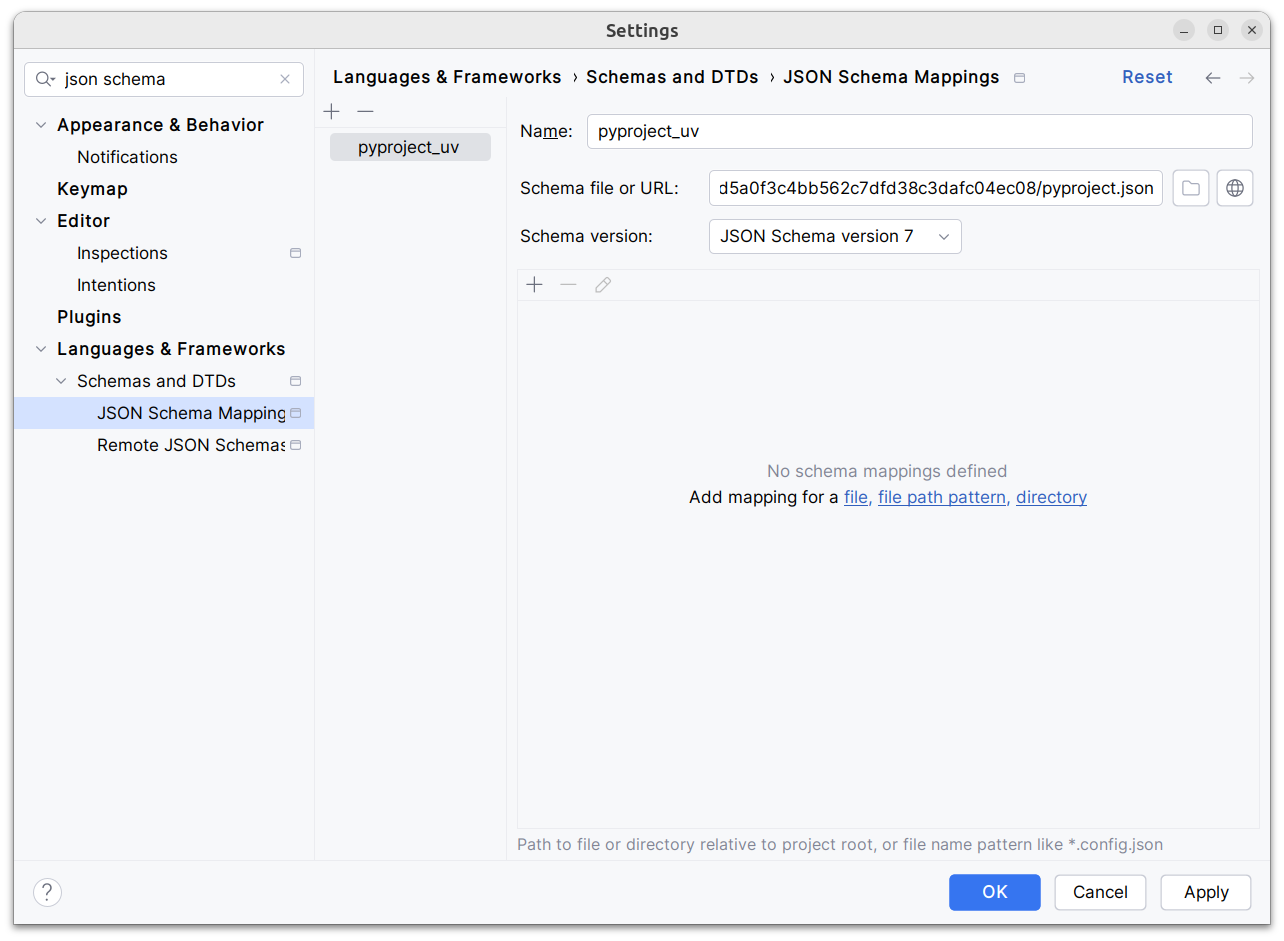
[dove.webm](https://github.com/astral-sh/uv/assets/6826232/c293c272-c80b-459d-8c95-8c46a8d198a1)
Moves all of `uv-toolchain` into `uv-interpreter`. We may split these
out in the future, but the refactoring I want to do for interpreter
discovery is easier if I don't have to deal with entanglement. Includes
some restructuring of `uv-interpreter`.

Part of #2386
Previously, uv-auth would fail to compile due to a missing process
feature. I chose to make all tokio features we use top level features,
so we can share the tokio cache between all test invocations.
## Summary

Enables `uv` to read configuration from (e.g.)
`/Users/crmarsh/.config/uv/uv.toml` on macOS and Linux, and
`C:\Users\Charlie\AppData\Roaming\uv\uv.toml` on Windows.

This differs slightly from Ruff, which uses the `Application Support`
directory on macOS. But I've deviated here. based on the preferences
expressed in https://github.com/astral-sh/ruff/issues/10739.
## Summary

This PR adds basic struct definitions along with a "workspace" concept
for discovering settings. (The "workspace" terminology is used to match
Ruff; I did not invent it.)

A few notes:

- We discover any `pyproject.toml` or `uv.toml` file in any parent
directory of the current working directory. (We could adjust this to
look at the directories of the input files.)
- We don't actually do anything with the configuration yet; but those
PRs are large and I want this to be reviewed in isolation.
## Summary

It turns out that `normalize_path` (sourced from Cargo) has a subtle
bug. If you pass it a relative path that traverses beyond the root, it
silently drops components. So, e.g., passing `../foo/bar`, it will just
drop the leading `..` and return `foo/bar`.

This PR encodes that behavior as a `Result` and avoids using it in such
cases.

Closes https://github.com/astral-sh/uv/issues/3012.
## Summary
This PR adds support for hash-checking mode in `pip install` and `pip
sync`. It's a large change, both in terms of the size of the diff and
the modifications in behavior, but it's also one that's hard to merge in
pieces (at least, with any test coverage) since it needs to work
end-to-end to be useful and testable.
Here are some of the most important highlights:
- We store hashes in the cache. Where we previously stored pointers to
unzipped wheels in the `archives` directory, we now store pointers with
a set of known hashes. So every pointer to an unzipped wheel also
includes its known hashes.
- By default, we don't compute any hashes. If the user runs with
`--require-hashes`, and the cache doesn't contain those hashes, we
invalidate the cache, redownload the wheel, and compute the hashes as we
go. For users that don't run with `--require-hashes`, there will be no
change in performance. For users that _do_, the only change will be if
they don't run with `--generate-hashes` -- then they may see some
repeated work between resolution and installation, if they use `pip
compile` then `pip sync`.
- Many of the distribution types now include a `hashes` field, like
`CachedDist` and `LocalWheel`.
- Our behavior is similar to pip, in that we enforce hashes when pulling
any remote distributions, and when pulling from our own cache. Like pip,
though, we _don't_ enforce hashes if a distribution is _already_
installed.
- Hash validity is enforced in a few different places:
1. During resolution, we enforce hash validity based on the hashes
reported by the registry. If we need to access a source distribution,
though, we then enforce hash validity at that point too, prior to
running any untrusted code. (This is enforced in the distribution
database.)
2. In the install plan, we _only_ add cached distributions that have
matching hashes. If a cached distribution is missing any hashes, or the
hashes don't match, we don't return them from the install plan.
3. In the downloader, we _only_ return distributions with matching
hashes.
4. The final combination of "things we install" are: (1) the wheels from
the cache, and (2) the downloaded wheels. So this ensures that we never
install any mismatching distributions.
- Like pip, if `--require-hashes` is provided, we require that _all_
distributions are pinned with either `==` or a direct URL. We also
require that _all_ distributions have hashes.
There are a few notable TODOs:
- We don't support hash-checking mode for unnamed requirements. These
should be _somewhat_ rare, though? Since `pip compile` never outputs
unnamed requirements. I can fix this, it's just some additional work.
- We don't automatically enable `--require-hashes` with a hash exists in
the requirements file. We require `--require-hashes`.
Closes#474.
## Test Plan
I'd like to add some tests for registries that report incorrect hashes,
but otherwise: `cargo test`
See https://github.com/astral-sh/uv/issues/2617

Note this also includes:
- #2918
- #2931 (pending)

A first step towards Python toolchain management in Rust.

First, we add a new crate to manage Python download metadata:

- Adds a new `uv-toolchain` crate
- Adds Rust structs for Python version download metadata
- Duplicates the script which downloads Python version metadata
- Adds a script to generate Rust code from the JSON metadata
- Adds a utility to download and extract the Python version

I explored some alternatives like a build script using things like
`serde` and `uneval` to automatically construct the code from our
structs but deemed it to heavy. Unlike Rye, I don't generate the Rust
directly from the web requests and have an intermediate JSON layer to
speed up iteration on the Rust types.

Next, we add add a `uv-dev` command `fetch-python` to download Python
versions per the bootstrapping script.

- Downloads a requested version or reads from `.python-versions`
- Extracts to `UV_BOOTSTRAP_DIR`
- Links executables for path extension

This command is not really intended to be user facing, but it's a good
PoC for the `uv-toolchain` API. Hash checking (via the sha256) isn't
implemented yet, we can do that in a follow-up.

Finally, we remove the `scripts/bootstrap` directory, update CI to use
the new command, and update the CONTRIBUTING docs.

<img width="1023" alt="Screenshot 2024-04-08 at 17 12 15"
src="https://github.com/astral-sh/uv/assets/2586601/57bd3cf1-7477-4bb8-a8e9-802a00d772cb">
To get more insights into test performance, allow instrumenting tests
with tracing-durations-export.
Usage:
```shell
# A single test
TRACING_DURATIONS_TEST_ROOT=$(pwd)/target/test-traces cargo test --features tracing-durations-export --test pip_install_scenarios no_binary -- --exact
# All tests
TRACING_DURATIONS_TEST_ROOT=$(pwd)/target/test-traces cargo nextest run --features tracing-durations-export
```
Then we can e.g. look at
`target/test-traces/pip_install_scenarios::no_binary.svg` and see the
builds it performs:

## Summary

This updates to the version of axoupdater used in cargo-dist 0.13.0's
own selfupdate command, with all relevant fixes for platforms. It also
tentatively introduces a mildly dangerous self-runtest that runs `uv
self update` and checks that the binary is installed and executable.

I *believe* some adjustments need to be made to your CI to have this new
test run, because it requires the `self-update` feature to be enabled,
and I didn't want to just start messing with how you do feature coverage
in your CI. **As a result I haven't yet had a chance to actually fully
run this in CI**, though I've locally tested it on windows (with the
guard disabled).


## Test Plan

Most of the machinery here is provided by axoupdater itself (cargo-dist
also includes a variant of these tests in its codebase). This initial
implementation has a couple major limitations:

* This is For Reals modifying the system that runs the test (so it's off
unless it detects it's running in CI, and if you want variations on this
test they'll need to be [run in
serial](5e7826f7b0/cargo-dist/tests/cli-tests.rs (L235))).
Since many of the testing issues were surrounding precise details of
Actual Deployed Executions, this seemed worth the tradeoff.
* The actual installer *script* it's ultimately invoking is the one you
last published, and *not* the one that cargo-dist will make when you
next publish.

We're already working on implementing some logic for "get cargo-dist to
generate a fresh installer script too", which is in fact the basis of a
huge amount of cargo-dist's own testsuite. Now that we're dogfooding
this stuff, it should be quite hard for this stuff to break without
cargo-dist's own codebase noticing it first.


<!-- How was it tested? -->
Needed to prevent circular dependencies in my toolchain work (#2931). I
think this is probably a reasonable change as we move towards persistent
configuration too?

Unfortunately `BuildIsolation` needs to be in `uv-types` to avoid
circular dependencies still. We might be able to resolve that in the
future.


