## Summary

This PR exposes uv's PEP 517 implementation via a `uv build` frontend,
such that you can use `uv build` to build source and binary
distributions (i.e., wheels and sdists) from a given directory.

There are some TODOs that I'll tackle in separate PRs:

- [x] Support building a wheel from a source distribution (rather than
from source) (#6898)
- [x] Stream the build output (#6912)

Closes https://github.com/astral-sh/uv/issues/1510

Closes https://github.com/astral-sh/uv/issues/1663.
Most times we compile with `cargo build`, we don't actually need
`uv-dev`. By making `uv-dev` dependent on a new `dev` feature, it
doesn't get built by default anymore, but only when passing `--features
dev`.

Hopefully a small improvement for compile times or at least system load.
Whew this is a lot.

The user-facing changes are:

- `uv toolchain` to `uv python` e.g. `uv python find`, `uv python
install`, ...
- `UV_TOOLCHAIN_DIR` to` UV_PYTHON_INSTALL_DIR`
- `<UV_STATE_DIR>/toolchains` to `<UV_STATE_DIR>/python` (with
[automatic
migration](https://github.com/astral-sh/uv/pull/4735/files#r1663029330))
- User-facing messages no longer refer to toolchains, instead using
"Python", "Python versions" or "Python installations"

The internal changes are:

- `uv-toolchain` crate to `uv-python`
- `Toolchain` no longer referenced in type names
- Dropped unused `SystemPython` type (previously replaced)
- Clarified the type names for "managed Python installations"
- (more little things)
## Summary
In a workspace, we now read configuration from the workspace root.
Previously, we read configuration from the first `pyproject.toml` or
`uv.toml` file in path -- but in a workspace, that would often be the
_project_ rather than the workspace configuration.
We need to read configuration from the workspace root, rather than its
members, because we lock the workspace globally, so all configuration
applies to the workspace globally.
As part of this change, the `uv-workspace` crate has been renamed to
`uv-settings` and its purpose has been narrowed significantly (it no
longer discovers a workspace; instead, it just reads the settings from a
directory).
If a user has a `uv.toml` in their directory or in a parent directory
but is _not_ in a workspace, we will still respect that use-case as
before.
Closes#4249.
Extends https://github.com/astral-sh/uv/pull/4121
Part of #2607

Adds support for managed toolchain fetching to `uv venv`, e.g.

```
❯ cargo run -q -- venv --python 3.9.18 --preview -v
DEBUG Searching for Python 3.9.18 in search path or managed toolchains
DEBUG Searching for managed toolchains at `/Users/zb/Library/Application Support/uv/toolchains`
DEBUG Found CPython 3.12.3 at `/opt/homebrew/bin/python3` (search path)
DEBUG Found CPython 3.9.6 at `/usr/bin/python3` (search path)
DEBUG Found CPython 3.12.3 at `/opt/homebrew/bin/python3` (search path)
DEBUG Requested Python not found, checking for available download...
DEBUG Using registry request timeout of 30s
INFO Fetching requested toolchain...
DEBUG Downloading https://github.com/indygreg/python-build-standalone/releases/download/20240224/cpython-3.9.18%2B20240224-aarch64-apple-darwin-pgo%2Blto-full.tar.zst to temporary location /Users/zb/Library/Application Support/uv/toolchains/.tmpgohKwp
DEBUG Extracting cpython-3.9.18%2B20240224-aarch64-apple-darwin-pgo%2Blto-full.tar.zst
DEBUG Moving /Users/zb/Library/Application Support/uv/toolchains/.tmpgohKwp/python to /Users/zb/Library/Application Support/uv/toolchains/cpython-3.9.18-macos-aarch64-none
Using Python 3.9.18 interpreter at: /Users/zb/Library/Application Support/uv/toolchains/cpython-3.9.18-macos-aarch64-none/install/bin/python3
Creating virtualenv at: .venv
INFO Removing existing directory
Activate with: source .venv/bin/activate
```

The preview flag is required. The fetch is performed if we can't find an
interpreter that satisfies the request. Once fetched, the toolchain will
be available for later invocations that include the `--preview` flag.
There will be follow-ups to improve toolchain management in general,
there is still outstanding work from the initial implementation.
## Summary

This PR removes the static resolver map:

```rust
static RESOLVED_GIT_REFS: Lazy<Mutex<FxHashMap<RepositoryReference, GitSha>>> =
    Lazy::new(Mutex::default);
```

With a `GitResolver` struct that we now pass around on the
`BuildContext`. There should be no behavior changes here; it's purely an
internal refactor with an eye towards making it cleaner for us to
"pre-populate" the list of resolved SHAs.
With the change, we remove the special casing of workspace dependencies
and resolve `tool.uv` for all git and directory distributions. This
gives us support for non-editable workspace dependencies and path
dependencies in other workspaces. It removes a lot of special casing
around workspaces. These changes are the groundwork for supporting
`tool.uv` with dynamic metadata.

The basis for this change is moving `Requirement` from
`distribution-types` to `pypi-types` and the lowering logic from
`uv-requirements` to `uv-distribution`. This changes should be split out
in separate PRs.

I've included an example workspace `albatross-root-workspace2` where
`bird-feeder` depends on `a` from another workspace `ab`. There's a
bunch of failing tests and regressed error messages that still need
fixing. It does fix the audited package count for the workspace tests.
When parsing requirements from any source, directly parse the url parts
(and reject unsupported urls) instead of parsing url parts at a later
stage. This removes a bunch of error branches and concludes the work
parsing url parts once and passing them around everywhere.

Many usages of the assembled `VerbatimUrl` remain, but these can be
removed incrementally.

Please review commit-by-commit.
## Summary

This PR consolidates the concurrency limits used throughout `uv` and
exposes two limits, `UV_CONCURRENT_DOWNLOADS` and
`UV_CONCURRENT_BUILDS`, as environment variables.

Currently, `uv` has a number of concurrent streams that it buffers using
relatively arbitrary limits for backpressure. However, many of these
limits are conflated. We run a relatively small number of tasks overall
and should start most things as soon as possible. What we really want to
limit are three separate operations:
- File I/O. This is managed by tokio's blocking pool and we should not
really have to worry about it.
- Network I/O.
- Python build processes.

Because the current limits span a broad range of tasks, it's possible
that a limit meant for network I/O is occupied by tasks performing
builds, reading from the file system, or even waiting on a `OnceMap`. We
also don't limit build processes that end up being required to perform a
download. While this may not pose a performance problem because our
limits are relatively high, it does mean that the limits do not do what
we want, making it tricky to expose them to users
(https://github.com/astral-sh/uv/issues/1205,
https://github.com/astral-sh/uv/issues/3311).

After this change, the limits on network I/O and build processes are
centralized and managed by semaphores. All other tasks are unbuffered
(note that these tasks are still bounded, so backpressure should not be
a problem).
## Introduction
PEP 621 is limited. Specifically, it lacks
* Relative path support
* Editable support
* Workspace support
* Index pinning or any sort of index specification
The semantics of urls are a custom extension, PEP 440 does not specify
how to use git references or subdirectories, instead pip has a custom
stringly format. We need to somehow support these while still stying
compatible with PEP 621.
## `tool.uv.source`
Drawing inspiration from cargo, poetry and rye, we add `tool.uv.sources`
or (for now stub only) `tool.uv.workspace`:
```toml
[project]
name = "albatross"
version = "0.1.0"
dependencies = [
"tqdm >=4.66.2,<5",
"torch ==2.2.2",
"transformers[torch] >=4.39.3,<5",
"importlib_metadata >=7.1.0,<8; python_version < '3.10'",
"mollymawk ==0.1.0"
]
[tool.uv.sources]
tqdm = { git = "https://github.com/tqdm/tqdm", rev = "cc372d09dcd5a5eabdc6ed4cf365bdb0be004d44" }
importlib_metadata = { url = "https://github.com/python/importlib_metadata/archive/refs/tags/v7.1.0.zip" }
torch = { index = "torch-cu118" }
mollymawk = { workspace = true }
[tool.uv.workspace]
include = [
"packages/mollymawk"
]
[tool.uv.indexes]
torch-cu118 = "https://download.pytorch.org/whl/cu118"
```
See `docs/specifying_dependencies.md` for a detailed explanation of the
format. The basic gist is that `project.dependencies` is what ends up on
pypi, while `tool.uv.sources` are your non-published additions. We do
support the full range or PEP 508, we just hide it in the docs and
prefer the exploded table for easier readability and less confusing with
actual url parts.
This format should eventually be able to subsume requirements.txt's
current use cases. While we will continue to support the legacy `uv pip`
interface, this is a piece of the uv's own top level interface. Together
with `uv run` and a lockfile format, you should only need to write
`pyproject.toml` and do `uv run`, which generates/uses/updates your
lockfile behind the scenes, no more pip-style requirements involved. It
also lays the groundwork for implementing index pinning.
## Changes
This PR implements:
* Reading and lowering `project.dependencies`,
`project.optional-dependencies` and `tool.uv.sources` into a new
requirements format, including:
* Git dependencies
* Url dependencies
* Path dependencies, including relative and editable
* `pip install` integration
* Error reporting for invalid `tool.uv.sources`
* Json schema integration (works in pycharm, see below)
* Draft user-level docs (see `docs/specifying_dependencies.md`)
It does not implement:
* No `pip compile` testing, deprioritizing towards our own lockfile
* Index pinning (stub definitions only)
* Development dependencies
* Workspace support (stub definitions only)
* Overrides in pyproject.toml
* Patching/replacing dependencies
One technically breaking change is that we now require user provided
pyproject.toml to be valid wrt to PEP 621. Included files still fall
back to PEP 517. That means `pip install -r requirements.txt` requires
it to be valid while `pip install -r requirements.txt` with `-e .` as
content falls back to PEP 517 as before.
## Implementation
The `pep508` requirement is replaced by a new `UvRequirement` (name up
for bikeshedding, not particularly attached to the uv prefix). The still
existing `pep508_rs::Requirement` type is a url format copied from pip's
requirements.txt and doesn't appropriately capture all features we
want/need to support. The bulk of the diff is changing the requirement
type throughout the codebase.
We still use `VerbatimUrl` in many places, where we would expect a
parsed/decomposed url type, specifically:
* Reading core metadata except top level pyproject.toml files, we fail a
step later instead if the url isn't supported.
* Allowed `Urls`.
* `PackageId` with a custom `CanonicalUrl` comparison, instead of
canonicalizing urls eagerly.
* `PubGrubPackage`: We eventually convert the `VerbatimUrl` back to a
`Dist` (`Dist::from_url`), instead of remembering the url.
* Source dist types: We use verbatim url even though we know and require
that these are supported urls we can and have parsed.
I tried to make improve the situation be replacing `VerbatimUrl`, but
these changes would require massive invasive changes (see e.g.
https://github.com/astral-sh/uv/pull/3253). A main problem is the ref
`VersionOrUrl` and applying overrides, which assume the same
requirement/url type everywhere. In its current form, this PR increases
this tech debt.
I've tried to split off PRs and commits, but the main refactoring is
still a single monolith commit to make it compile and the tests pass.
## Demo
Adding
d1ae3b85d5/pyproject.json
as json schema (v7) to pycharm for `pyproject.toml`, you can try the IDE
support already:
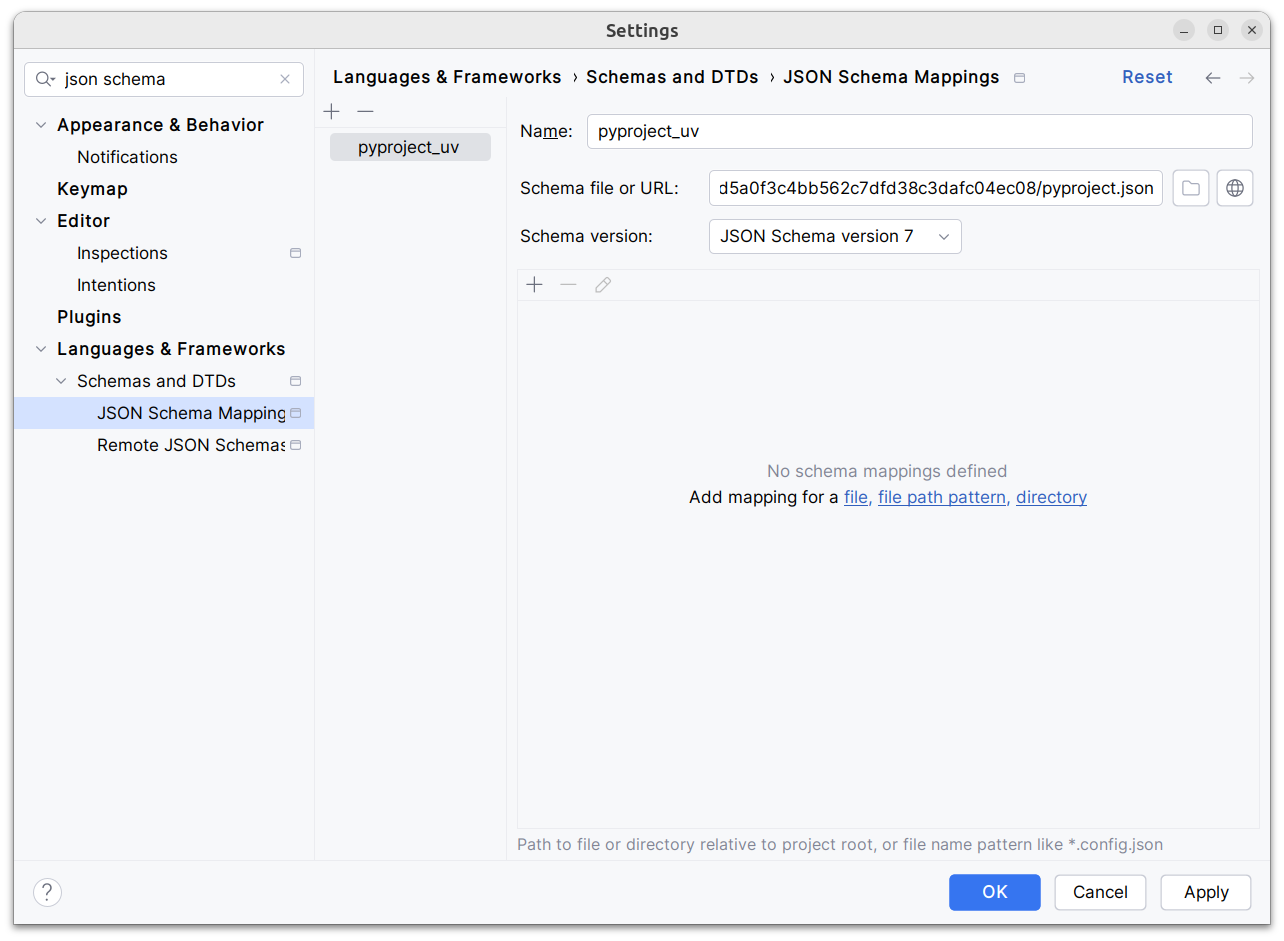
[dove.webm](https://github.com/astral-sh/uv/assets/6826232/c293c272-c80b-459d-8c95-8c46a8d198a1)
Moves all of `uv-toolchain` into `uv-interpreter`. We may split these
out in the future, but the refactoring I want to do for interpreter
discovery is easier if I don't have to deal with entanglement. Includes
some restructuring of `uv-interpreter`.

Part of #2386
See https://github.com/astral-sh/uv/issues/2617

Note this also includes:
- #2918
- #2931 (pending)

A first step towards Python toolchain management in Rust.

First, we add a new crate to manage Python download metadata:

- Adds a new `uv-toolchain` crate
- Adds Rust structs for Python version download metadata
- Duplicates the script which downloads Python version metadata
- Adds a script to generate Rust code from the JSON metadata
- Adds a utility to download and extract the Python version

I explored some alternatives like a build script using things like
`serde` and `uneval` to automatically construct the code from our
structs but deemed it to heavy. Unlike Rye, I don't generate the Rust
directly from the web requests and have an intermediate JSON layer to
speed up iteration on the Rust types.

Next, we add add a `uv-dev` command `fetch-python` to download Python
versions per the bootstrapping script.

- Downloads a requested version or reads from `.python-versions`
- Extracts to `UV_BOOTSTRAP_DIR`
- Links executables for path extension

This command is not really intended to be user facing, but it's a good
PoC for the `uv-toolchain` API. Hash checking (via the sha256) isn't
implemented yet, we can do that in a follow-up.

Finally, we remove the `scripts/bootstrap` directory, update CI to use
the new command, and update the CONTRIBUTING docs.

<img width="1023" alt="Screenshot 2024-04-08 at 17 12 15"
src="https://github.com/astral-sh/uv/assets/2586601/57bd3cf1-7477-4bb8-a8e9-802a00d772cb">
Needed to prevent circular dependencies in my toolchain work (#2931). I
think this is probably a reasonable change as we move towards persistent
configuration too?

Unfortunately `BuildIsolation` needs to be in `uv-types` to avoid
circular dependencies still. We might be able to resolve that in the
future.
This is driving me a little crazy and is becoming a larger problem in
#2596 where I need to move more types (like `Upgrade` and `Reinstall`)
into this crate. Anything that's shared across our core resolver,
install, and build crates needs to be defined in this crate to avoid
cyclic dependencies. We've outgrown it being a single file with some
shared traits.

There are no behavioral changes here.
Scott schafer got me the idea: We can avoid repeating the path for
workspaces dependencies everywhere if we declare them in the virtual
package once and treat them as workspace dependencies from there on.
## Summary

I tried out `cargo shear` to see if there are any unused dependencies
that `cargo udeps` isn't reporting. It turned out, there are a few. This
PR removes those dependencies.

## Test Plan

`cargo build`
The architecture of uv does not necessarily match that of the python
interpreter (#2326). In cross compiling/testing scenarios the operating
system can also mismatch. To solve this, we move arch and os detection
to python, vendoring the relevant pypa/packaging code, preventing
mismatches between what the python interpreter was compiled for and what
uv was compiled for.
To make the scripts more manageable, they are now a directory in a
tempdir and we run them with `python -m` . I've simplified the
pypa/packaging code since we're still building the tags in rust. A
`Platform` is now instantiated by querying the python interpreter for
its platform. The pypa/packaging files are copied verbatim for easier
updates except a `lru_cache()` python 3.7 backport.
Error handling is done by a `"result": "success|error"` field that allow
passing error details to rust:
```console
$ uv venv --no-cache
× Can't use Python at `/home/konsti/projects/uv/.venv/bin/python3`
╰─▶ Unknown operation system `linux`
```
I've used the [maturin sysconfig
collection](855f6d2cb1/sysconfig)
as reference. I'm unsure how to test these changes across the wide
variety of platforms.
Fixes#2326
Add a `--compile` option to `pip install` and `pip sync`.
I chose to implement this as a separate pass over the entire venv. If we
wanted to compile during installation, we'd have to make sure that
writing is exclusive, to avoid concurrent processes writing broken
`.pyc` files. Additionally, this ensures that the entire site-packages
are bytecode compiled, even if there are packages that aren't from this
`uv` invocation. The disadvantage is that we do not update RECORD and
rely on this comment from [PEP 491](https://peps.python.org/pep-0491/):
> Uninstallers should be smart enough to remove .pyc even if it is not
mentioned in RECORD.
If this is a problem we can change it to run during installation and
write RECORD entries.
Internally, this is implemented as an async work-stealing subprocess
worker pool. The producer is a directory traversal over site-packages,
sending each `.py` file to a bounded async FIFO queue/channel. Each
worker has a long-running python process. It pops the queue to get a
single path (or exists if the channel is closed), then sends it to
stdin, waits until it's informed that the compilation is done through a
line on stdout, and repeat. This is fast, e.g. installing `jupyter
plotly` on Python 3.12 it processes 15876 files in 319ms with 32 threads
(vs. 3.8s with a single core). The python processes internally calls
`compileall.compile_file`, the same as pip.
Like pip, we ignore and silence all compilation errors
(https://github.com/astral-sh/uv/issues/1559). There is a 10s timeout to
handle the case when the workers got stuck. For the reviewers, please
check if i missed any spots where we could deadlock, this is the hardest
part of this PR.
I've added `uv-dev compile <dir>` and `uv-dev clear-compile <dir>`
commands, mainly for my own benchmarking. I don't want to expose them in
`uv`, they almost certainly not the correct workflow and we don't want
to support them.
Fixes#1788Closes#1559Closes#1928
First, replace all usages in files in-place. I used my editor for this.
If someone wants to add a one-liner that'd be fun.

Then, update directory and file names:

```
# Run twice for nested directories
find . -type d -print0 | xargs -0 rename s/puffin/uv/g
find . -type d -print0 | xargs -0 rename s/puffin/uv/g

# Update files
find . -type f -print0 | xargs -0 rename s/puffin/uv/g
```

Then add all the files again

```
# Add all the files again
git add crates
git add python/uv

# This one needs a force-add
git add -f crates/uv-trampoline
```


