 4f87edbe66
## Introduction
PEP 621 is limited. Specifically, it lacks
* Relative path support
* Editable support
* Workspace support
* Index pinning or any sort of index specification
The semantics of urls are a custom extension, PEP 440 does not specify
how to use git references or subdirectories, instead pip has a custom
stringly format. We need to somehow support these while still stying
compatible with PEP 621.
## `tool.uv.source`
Drawing inspiration from cargo, poetry and rye, we add `tool.uv.sources`
or (for now stub only) `tool.uv.workspace`:
```toml
[project]
name = "albatross"
version = "0.1.0"
dependencies = [
"tqdm >=4.66.2,<5",
"torch ==2.2.2",
"transformers[torch] >=4.39.3,<5",
"importlib_metadata >=7.1.0,<8; python_version < '3.10'",
"mollymawk ==0.1.0"
]
[tool.uv.sources]
tqdm = { git = "https://github.com/tqdm/tqdm", rev = "cc372d09dcd5a5eabdc6ed4cf365bdb0be004d44" }
importlib_metadata = { url = "https://github.com/python/importlib_metadata/archive/refs/tags/v7.1.0.zip" }
torch = { index = "torch-cu118" }
mollymawk = { workspace = true }
[tool.uv.workspace]
include = [
"packages/mollymawk"
]
[tool.uv.indexes]
torch-cu118 = "https://download.pytorch.org/whl/cu118"
```
See `docs/specifying_dependencies.md` for a detailed explanation of the
format. The basic gist is that `project.dependencies` is what ends up on
pypi, while `tool.uv.sources` are your non-published additions. We do
support the full range or PEP 508, we just hide it in the docs and
prefer the exploded table for easier readability and less confusing with
actual url parts.
This format should eventually be able to subsume requirements.txt's
current use cases. While we will continue to support the legacy `uv pip`
interface, this is a piece of the uv's own top level interface. Together
with `uv run` and a lockfile format, you should only need to write
`pyproject.toml` and do `uv run`, which generates/uses/updates your
lockfile behind the scenes, no more pip-style requirements involved. It
also lays the groundwork for implementing index pinning.
## Changes
This PR implements:
* Reading and lowering `project.dependencies`,
`project.optional-dependencies` and `tool.uv.sources` into a new
requirements format, including:
* Git dependencies
* Url dependencies
* Path dependencies, including relative and editable
* `pip install` integration
* Error reporting for invalid `tool.uv.sources`
* Json schema integration (works in pycharm, see below)
* Draft user-level docs (see `docs/specifying_dependencies.md`)
It does not implement:
* No `pip compile` testing, deprioritizing towards our own lockfile
* Index pinning (stub definitions only)
* Development dependencies
* Workspace support (stub definitions only)
* Overrides in pyproject.toml
* Patching/replacing dependencies
One technically breaking change is that we now require user provided
pyproject.toml to be valid wrt to PEP 621. Included files still fall
back to PEP 517. That means `pip install -r requirements.txt` requires
it to be valid while `pip install -r requirements.txt` with `-e .` as
content falls back to PEP 517 as before.
## Implementation
The `pep508` requirement is replaced by a new `UvRequirement` (name up
for bikeshedding, not particularly attached to the uv prefix). The still
existing `pep508_rs::Requirement` type is a url format copied from pip's
requirements.txt and doesn't appropriately capture all features we
want/need to support. The bulk of the diff is changing the requirement
type throughout the codebase.
We still use `VerbatimUrl` in many places, where we would expect a
parsed/decomposed url type, specifically:
* Reading core metadata except top level pyproject.toml files, we fail a
step later instead if the url isn't supported.
* Allowed `Urls`.
* `PackageId` with a custom `CanonicalUrl` comparison, instead of
canonicalizing urls eagerly.
* `PubGrubPackage`: We eventually convert the `VerbatimUrl` back to a
`Dist` (`Dist::from_url`), instead of remembering the url.
* Source dist types: We use verbatim url even though we know and require
that these are supported urls we can and have parsed.
I tried to make improve the situation be replacing `VerbatimUrl`, but
these changes would require massive invasive changes (see e.g.
https://github.com/astral-sh/uv/pull/3253). A main problem is the ref
`VersionOrUrl` and applying overrides, which assume the same
requirement/url type everywhere. In its current form, this PR increases
this tech debt.
I've tried to split off PRs and commits, but the main refactoring is
still a single monolith commit to make it compile and the tests pass.
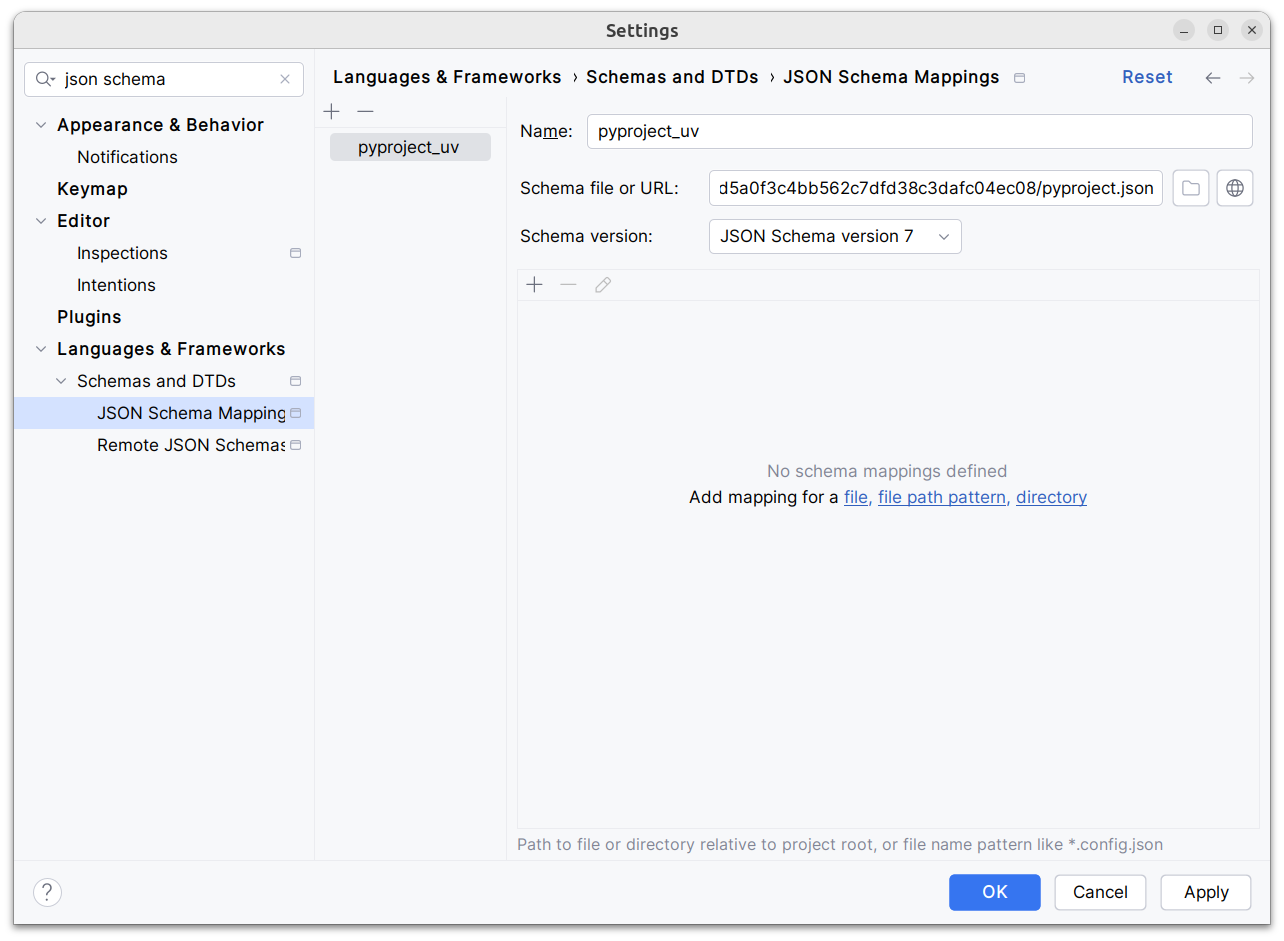
## Demo
Adding
d1ae3b85d5/pyproject.json
as json schema (v7) to pycharm for `pyproject.toml`, you can try the IDE
support already:
[dove.webm](https://github.com/astral-sh/uv/assets/6826232/c293c272-c80b-459d-8c95-8c46a8d198a1)
8.8 KiB
Warning: this documentation applies to a future version of uv. Please refer to README.md for documentation for the latest release.
Specifying dependencies
In uv, dependency specification is divided between two tables: project.dependencies and
tool.uv.sources.
At a high-level, the former is used to define the standards-compliant dependency metadata, propagated when uploading to PyPI or building a wheel. The latter is used to specify the sources required to install the dependencies, which can come from a Git repository, a URL, a local path, a different index, etc.
project.dependencies
The project.dependencies table represents the dependencies that are used when uploading to PyPI or
building a wheel. Individual dependencies are specified using [PEP 508](#PEP 508), and the table as
a whole follows the PEP 621
standard.
You should think of project.dependencies as defining the packages that are required for your
project, along with the version constraints that should be used when installing them.
project.dependencies is structured as a list in which each entry includes a dependency name and
version, and optionally extras or environment markers for platform-specific packages, as in:
[project]
name = "albatross"
version = "0.1.0"
dependencies = [
  # Any version in this range
  "tqdm >=4.66.2,<5",
  # Exactly this version of torch
  "torch ==2.2.2",
  # Install transformers with the torch extra
  "transformers[torch] >=4.39.3,<5",
  # Only install this package on older python versions
  # See "Environment Markers" for more information
  "importlib_metadata >=7.1.0,<8; python_version < '3.10'",
  "mollymawk ==0.1.0"
]
If you only require packages from PyPI or a single --index-url, then project.dependencies is all
you need. If, however, you depend on local packages, Git dependencies, or packages from a different
index, you should use tool.uv.sources.
tool.uv.sources
During development, you may rely on a package that isn't available on PyPI. For example, let’s say
that we need to pull in a version of tqdm from a specific Git commit, importlib_metadata from
a dedicated URL, torch from the PyTorch-specific index, and mollymawk from our own workspace.
We can express these requirements by enriching the project.dependencies table with
tool.uv.sources:
[project]
name = "albatross"
version = "0.1.0"
dependencies = [
  # Any version in this range.
  "tqdm >=4.66.2,<5",
  # Exactly this version of torch.
  "torch ==2.2.2",
  # Install transformers with the torch extra.
  "transformers[torch] >=4.39.3,<5",
  # Only install this package on Python versions prior to 3.10.
  "importlib_metadata >=7.1.0,<8; python_version < '3.10'",
  "mollymawk ==0.1.0"
]

[tool.uv.sources]
# Install a specific Git commit.
tqdm = { git = "https://github.com/tqdm/tqdm", rev = "cc372d09dcd5a5eabdc6ed4cf365bdb0be004d44" }
# Install a remote source distribution (`.zip`, `.tar.gz`) or wheel (`.whl`).
importlib_metadata = { url = "https://github.com/python/importlib_metadata/archive/refs/tags/v7.1.0.zip" }
# Pin a dependency for a specific registry.
torch = { index = "torch-cu118" }
# Use a package included in the same repository (editable installation).
mollymawk = { workspace = true }

# See "Workspaces".
[tool.uv.workspace]
include = [
  "packages/mollymawk"
]

# See "Indexes".
[tool.uv.indexes]
torch-cu118 = "https://download.pytorch.org/whl/cu118"
We support the following sources (which are mutually exclusive for a given dependency):
- Git: Use
gitwith a Git URL, optionally one ofrev,tag, orbranch, and optionally asubdirectoy, if the package isn't in the repository root. - URL: A
urlkey with anhttps://URL to a wheel (ending in.whl) or a source distribution (ending in.zipor.tar.gz), and optionally asubdirectoryif the source distribution isn't in the archive root. - Path: The
pathis an absolute or relative path to a wheel (ending in.whl), a source distribution (ending in.zipor.tar.gz), or a directory containing apyproject.toml. We recommend using workspaces over manual path dependencies. For directories, you can specifyeditable = truefor an editable installation. - Index: Set the
indexkey to the name of an index name to install it from this registry instead of your default index. - Workspace: Set
workspace = trueto use the workspace dependency. You need to explicitly require all workspace dependencies you use. They are editable by default; specifyeditable = falseto install them as regular dependencies.
Note that if a non-uv project uses this project as a Git- or path-dependency, only
project.dependencies is transferred, and you'll need to apply the information in the source table
using the configuration of the other project's package manager.
Optional dependencies
For libraries, you may want to make certain features and their dependencies optional. For example,
pandas has an excel extra
and a plot extra to limit the installation of Excel parsers and (e.g.) matplotlib to
those that explicitly require them. In the case of Pandas, you can install those extras with:
pandas[plot, excel].
Optional dependencies are specified in [project.optional-dependencies], a TOML table that maps
from extra name to its dependencies, following the [PEP 508](#PEP 508) syntax.
tool.uv.sources applies to this table equally.
[project]
name = "pandas"
version = "1.0.0"

[project.optional-dependencies]
plot = [
  "matplotlib>=3.6.3"
]
excel = [
  "odfpy>=1.4.1",
  "openpyxl>=3.1.0",
  "python-calamine>=0.1.7",
  "pyxlsb>=1.0.10",
  "xlrd>=2.0.1",
  "xlsxwriter>=3.0.5"
]
Development dependencies
N.B. This feature is not yet implemented.
Unlike optional dependencies, development dependencies are local-only and will not be published
to PyPI or other indexes. As such, development dependencies are included under [tool.uv] instead
of [project]. tool.uv.sources applies to them equally.
[tool.uv]
dev-dependencies = [
  "pytest >=8.1.1,<9"
]
You can also put development dependencies into groups and install them individually:
[tool.uv.dev-dependencies]
test = [
  "pytest >=8.1.1,<9"
]
lint = [
  "mypy >=1,<2"
]

[tool.uv]
default-dev-dependencies = ["test"]
PEP 508
The PEP 508 syntax allows you to specify, in order:
- The dependency name
- The extras you want (optional)
- The version specifier
- An environment marker (optional)
The version specifiers are comma separated and added together, e.g., foo >=1.2.3,<2,!=1.4.0 is
interpreted as "a version of foo that's at least 1.2.3, but less than 2, and not 1.4.0".
Specifiers are padded with trailing zeros if required, so foo ==2 matches foo 2.0.0, too.
You can use a star for the last digit with equals, e.g. foo ==2.1.* will accept any release from
the 2.1 series. Similarly, ~= matches where the last digit is equal or higher, e.g., foo ~=1.2
is equal to foo >=1.2,<2, and foo ~=1.2.3 is equal to foo >=1.2.3,<1.3.
Extras are comma-separated in square bracket between name and version, e.g., pandas[excel,plot] ==2.2.
Some dependencies are only required in specific environments, e.g., a specific Python version or
operating system. For example to install the importlib-metadata backport for the
importlib.metadata module, you would use importlib-metadata >=7.1.0,<8; python_version < '3.10'.
To install colorama on Windows (but omit it on other platforms), use
colorama >=0.4.6,<5; platform_system == "Windows".
You combine markers with and and or and parentheses, e.g., aiohttp >=3.7.4,<4; (sys_platform != 'win32' or implementation_name != 'pypy') and python_version >= '3.10'.
Note that versions within markers must be quoted, while versions outside of markers must not be
quoted.
Editables
A regular installation of a directory with a Python package first builds a wheel and then installs that wheel into your virtual environment, copying all source files. When you edit the source files, the virtual environment will contain outdated versions.
Editable installations instead add a link to the project within the virtual environment
(a .pth file), which instructs the interpreter to include your sources directly.
There are some limitations to editables (mainly: your build backend needs to support them, and native modules aren't recompiled before import), but they are useful for development, as your virtual environment will always use the latest version of your package.
uv uses editable installation for workspace packages and patched dependencies by default.