### Problem description
In current Chinese translation, "Windows context menu entry" in General
settings has been tranlated to 窗口上下文菜单项. and for Traditional Chinese,
it's 視窗內容功能表項目 (basically the same).

The previous translations were not conveying the correct meaning
associated with the term "Windows context menu entry". They were too
literal and did not clearly describe the functionality related to the
Windows Explorer context menu.

"窗口" in Chinese means a physical window, **not the Microsoft Windows
OS**. The Windows OS is usually referred to as "微软视窗" (rare) or left as
"Windows".

"上下文菜单" is a very "direct" translation of "Context menu" that is hard to
understand for most users. Chinese user usually call it "右键菜单", which is
"Right-Click Menu".

### Implementation description
I've changed it to 添加到文件资源管理器右键菜单 for Simplified Chinese, and
加至檔案總管的環境選單 for Tranditional Chinese.
Feature description
This pull request introduces full Polish language support to ImHex.
It is a new feature that allows users to switch the UI to Polish,
improving accessibility for Polish-speaking users.
Implementation description
-Translated a total of 10 JSON language files into Polish (pl_PL.json)
-All translations were done manually, with the help of tools such as
DeepL, large language models (LLMs), and technical dictionaries
-Validated the JSON files using [jsonlint.com](https://jsonlint.com/)
-Performed initial UI testing — all translated strings appear and render
correctly
Screenshots
Below is an example of the UI in Polish:


Additional things
-I'm a beginner with both ImHex and English, so I may have missed some
things
-I'm fully open to any suggestions or corrections — whether related to
translation accuracy or JSON formatting/style
-I would greatly appreciate it if the reviewer could:
-Confirm that the project still compiles correctly (it built fine on my
side using ninja)
-Check that the pl_PL.json files are properly formatted and follow the
project's standards
If there are preferred tools or workflows for validating and formatting
JSON in this repository, I’d be happy to adopt them in the future.
---------
Co-authored-by: paxcut <53811119+paxcut@users.noreply.github.com>
<!--
Please provide as much information as possible about what your PR aims
to do.
PRs with no description will most likely be closed until more
information is provided.
If you're planing on changing fundamental behaviour or add big new
features, please open a GitHub Issue first before starting to work on
it.
If it's not something big and you still want to contact us about it,
feel free to do so !
-->
### Description
This pull request introduces a complete Russian translation for ImHex,
ensuring that Russian-speaking users can navigate and utilize the
software in their native language. The translation covers all user
interface elements, menus, dialogs, and messages, providing a seamless
experience for Russian users.
### Testing
The translation has been thoroughly tested to ensure accuracy and
completeness. All translated text has been reviewed for grammatical
correctness and contextual appropriateness.
### Screenshots


Co-authored-by: Lemon4ksan <senya20151718@gmail.com>
### Problem description
This PR addresses issue #2013 that described a cluttered Event Manager.
This is a DX issue and should not impact the users whatsoever.
### Implementation description
The changes revolve around three main points:
1. the Event Manager (`event_manager.hpp`) was split into four
categories: GUI, Interaction, Lifecycle, and Provider, and two types:
Events, and Requests. This results in the following files:
- `events_gui.hpp`
- `events_interaction.hpp`
- `events_lifecycle.hpp`
- `events_provider.hpp`
- `requests_gui.hpp`
- `requests_interaction.hpp`
- `requests_lifecycle.hpp`
- `requests_provider.hpp`
2. Every event and request now has its own piece of documentation, with
a `@brief`, accompanied by a longer comment if needed, and gets its
`@param`s described.
3. The old `event_manager.hpp` import was removed and replaced by the
correct imports wherever needed, as to reduce spread of those files only
to where they are truly useful.
### Additional things
The commits have been split into (chrono-)logical steps:
- `feat`: split the Event Manager, and replace the imports
- `refactor`, `chore`: make various small changes to match the required
structure
- `docs`: add documentation for events and requests
Hopefully, this will help to review the PR.
*Note: Beware of very long rebuild times in between the commits, use
them sparingly! The Actions will ensure this PR builds anyways*
Closes#2013
---------
Signed-off-by: BioTheWolff <47079795+BioTheWolff@users.noreply.github.com>
Co-authored-by: Nik <werwolv98@gmail.com>
### Problem description
ImHex didn't support Hungarian :(

### Implementation description
I translated ImHex to Hungarian :)

### Translation Coverage
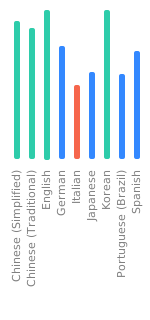
| Plugin        | Percentage |
|---------------|------------|
| builtin       | 99%        |
| diffing       | 100%       |
| disassembler  | 100%       |
| hashes        | 95%        |
| script_loader | 100%       |
| ui            | 100%       |
| visualizers   | 100%       |
| windows       | 100%       |
| yara_rules    | 100%       |

### Additional Notes
There are four Hungarian "special" characters that fall outside the
default Unicode ranges loaded by ImHex, resulting in them being replaced
with the "�" character. These letters are Ő (U+0150), ő (U+0151), Ű
(U+0170) and ű (U+0171), all included in the Latin Extended-A Unicode
block.

The easy fix for this is to include the "Unicode Latin Extended-A" range
when loading the font glyphs in
[init_tasks.cpp:189](99abc4e78a/plugins/builtin/source/content/init_tasks.cpp (L189)).
This change would also unlock the full character range of Bosnian,
Croatian, Czech, Estonian, Latvian, Lithuanian, Maltese, Polish,
Romanian, Slovak, Slovene and Turkish. I can add the commit to this PR
if maintainers are okay with it. **EDIT:** Added a commit that loads
Latin Extended-A by default.

Also note that some words are longer than their English counterparts,
resulting in certain UI labels overflowing from their parent containers,
and being cut off. I might change some of the longer labels to be more
compact in the future, but the container size limitations will have to
be addressed eventually (e.g. with horizontal scrollbars).

---------

Co-authored-by: Nik <werwolv98@gmail.com>
<!--
Please provide as much information as possible about what your PR aims
to do.
PRs with no description will most likely be closed until more
information is provided.
If you're planing on changing fundamental behaviour or add big new
features, please open a GitHub Issue first before starting to work on
it.
If it's not something big and you still want to contact us about it,
feel free to do so !
-->

### Problem description
<!-- Describe the bug that you fixed/feature request that you
implemented, or link to an existing issue describing it -->
Implement a Linux backend for the ProcessMemoryProvider plugin.

### Implementation description
<!-- Explain what you did to correct the problem -->
Most of the provider code is the same between Windows and Linux. The
primary differences are:
- enumerate PIDs in `/proc/` to get the process list
- use `/proc/<PID>/cmdline` as the process name
- parse `/proc/<PID>/maps` to get the module list
- reading/writing from memory is done using
`process_vm_readv`/`process_vm_writev`

NOTE: `sudo setcap CAP_SYS_PTRACE=+eip build/imhex` must be run to give
the binary permission to read another process' memory. Running as root
user should also work but I would not recommend it.

### Additional things
The existing translations keys no longer match since I moved the plugin
from `windows` to `builtin`.

I'm not well versed in C++ so I attempted to keep my changes rather
simple. Feedback is very welcome.

---------

Co-authored-by: WerWolv <werwolv98@gmail.com>
 WerWolv
 WerWolvTranslationBot
 Remik1r3n
 Shadow775711
 Geky
Geky
 Bananchiki
 Wolf
Wolf
 xtex
xtex
 SparkyTD
 York Waugh
 Truman Kilen