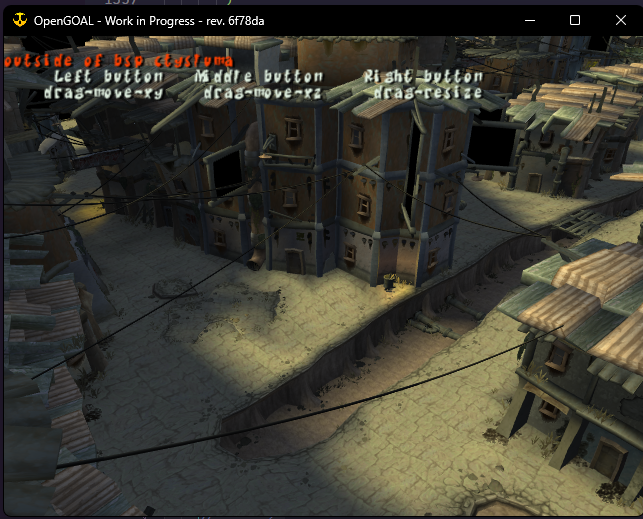
Got OpenGOAL building and running natively on Apple Silicon.
This is the rest of the port after the smaller arm64 emitter PRs. I was
told pushing one big PR was okay. This covers goalc, the runtime,
linker, kernel and the GOAL asm.
The new paths have native tests. I also found four more emitter bugs
while running it. They're in scalar sqrt, 128-bit stores, scalar max and
indexed stores above 4 GB.
Spent a while cleaning it up so it's easier to read. 4am gotta sleep lol
Closes#3841
---------
Co-authored-by: Tyler Wilding <xtvaser@gmail.com>
The dust storm will now always behave as if it was at 60 FPS. Particles
only spawn every 1/60th of a second and the push vector is converted as
if it was originally equivalent to 1/60th of a second.
Resolves#3075
TODO before merge:
- [x] Properly draw non-korean strings while in korean mode (language
selection)
- [x] Check jak 3
- [x] Translation scaffolding (allow korean characters, add to Crowdin,
fix japanese locale, etc)
- [x] Check translation of text lines
- [x] Check translation of subtitle lines
- [x] Cleanup PR / some performance optimization (it's take a bit too
long to build the text and it shouldn't since the information is in a
giant lookup table)
- [x] Wait until release is cut
I confirmed the font textures are identical between Jak 2 and Jak 3, so
thank god for that.
Some examples of converting the korean encoding to utf-8. These show off
all scenarios, pure korean / korean with ascii and japanese / korean
with replacements (flags):
<img width="316" height="611" alt="Screenshot 2025-07-26 191511"
src="https://github.com/user-attachments/assets/614383ba-8049-4bf4-937e-24ad3e605d41"
/>
<img width="254" height="220" alt="Screenshot 2025-07-26 191529"
src="https://github.com/user-attachments/assets/1f6e5a6c-8527-4f98-a988-925ec66e437d"
/>
And it working in game. `Input Options` is a custom not-yet-translated
string. It now shows up properly instead of a disgusting block of
glyphs, and all the original strings are hopefully the same
semantically!:
<img width="550" height="493" alt="Screenshot 2025-07-26 202838"
src="https://github.com/user-attachments/assets/9ebdf6c0-f5a3-4a30-84a1-e5840809a1a2"
/>
Quite the challenge. The crux of the problem is -- Naughty Dog came up
with their own encoding for representing korean syllable blocks, and
that source information is lost so it has to be reverse engineered.
Instead of trying to figure out their encoding from the text -- I went
at it from the angle of just "how do i draw every single korean
character using their glyph set".
One might think this is way too time consuming but it's important to
remember:
- Korean letters are designed to be composable from a relatively small
number of glyphs (more on this later)
- Someone at naughty dog did basically this exact process
- There is no other way! While there are loose patterns, there isn't an
overarching rhyme or reason, they just picked the right glyph for the
writing context (more on this later). And there are even situations
where there IS NO good looking glyph, or the one ND chose looks awful
and unreadable (we could technically fix this by adjusting the
positioning of the glyphs but....no more)!
Information on their encoding that gets passed to `convert-korean-text`:
- It's a raw stream of bytes
- It can contain normal font letters
- Every syllable block begins with: `0x04 <num_glyphs> <...the glyph
bytes...>`
- DO NOT confuse `num_glyphs` with num jamo, because some glyphs can
have multiple jamo!
- Every section of normal text starts with `0x03`. For example a space
would be `0x03 0x20`
- There are a very select few number of jamo glyphs on a secondary
texture page, these glyph bytes are preceeded with a `0x05`. These jamo
are a variant of some of the final vowels, moving them as low down as
possible.
Crash course on korean writing:
- Nice resource as this is basically what we are doing -
https://glyphsapp.com/learn/creating-a-hangeul-font
- Korean syllable blocks have either 2 or 3 jamo. Jamo are basically
letters and are the individual pieces that make up the syllable blocks.
- The jamo are split up into "initial", "medial" and "final" categories.
Within the "medial" category there are obvious visual variants:
- Horizontal
- Vertical
- Combination (horizontal + a vertical)
- These jamo are laid out in 6 main pre-defined "orientations":
- initial + vertical medial
- initial + horizontal medial
- initial + combination
- initial + vertical medial + final
- initial + horizontal medial + final
- initial + combination + final
- Sometimes, for stylistic reasons, jamo will be written in different
ways (ie. if there is nothing below a vertical vowel will be extended).
- Annoying, and ND's glyph set supports this stylistic choice!
- There are some combination of jamo that are never used, and some that
are only used for a single word in the entire language!
With all that in mind, my basic process was:
- Scan the game's entire corpus of korean text, that includes subtitles.
It's very easy to look at the font texture's glyphs and assign them to
their respective jamo
- This let me construct a mapping and see which glyphs were used under
which context
- I then shoved this information into a 2-D matrix in excel, and created
an in-game tool to check every single jamo permutation to fill in the
gaps / change them if naughty dogs was bad. Most of the time, ND's
encoding was fine.
-
https://docs.google.com/spreadsheets/d/e/2PACX-1vTtyMeb5-mL5rXseS9YllVj32BGCISOGZFic6nkRV5Er5aLZ9CLq1Hj_rTY7pRCn-wrQDH1rvTqUHwB/pubhtml?gid=886895534&single=true
anything in red is an addition / modification on my part.
- This was the most lengthy part but not as long as you may think, you
can do a lot of pruning. For example if you are checking a 3-jamo
variant (the ones with the most permutations) and you've verified that
the medial jamo is as far up vertically as it can be, and you are using
the lowest final jamo that are available -- there is nothing to check or
improve -- for better or worse! So those end up being the permutations
between the initial and medial instead of a three-way permutation
nightmare.
- Also, while it is a 2d matrix, there's a lot of pruning even within
that. For example, for the first 3 orientations, you dont have to care
about final vowels at all.
- At the end, I'm left with a lookup table that I can use the encode the
best looking korean syllable blocks possible given the context of the
jamo combination.
Relates to #1353

This adds no new functionality or overhead to the compiler, yet. This is
the preliminary work that has:
- added code to the compiler in several spots to flag when something is
used without being properly required/imported/whatever (disabled by
default)
- that was used to generate project wide file dependencies (some
circulars were manually fixed)
- then that graph underwent a transitive reduction and the result was
written to all `jak1` source files.

The next step will be making this actually produce and use a dependency
graph. Some of the reasons why I'm working on this:
- eliminates more `game.gp` boilerplate. This includes the `.gd` files
to some extent (`*-ag` files and `tpage` files will still need to be
handled) this is the point of the new `bundles` form. This should make
it even easier to add a new file into the source tree.
- a build order that is actually informed from something real and
compiler warnings that tell you when you are using something that won't
be available at build time.
- narrows the search space for doing LSP actions -- like searching for
references. Since it would be way too much work to store in the compiler
every location where every symbol/function/etc is used, I have to do
ad-hoc searches. By having a dependency graph i can significantly reduce
that search space.
- opens the doors for common shared code with a legitimate pattern.
Right now jak 2 shares code from the jak 1 folder. This is basically a
hack -- but by having an explicit require syntax, it would be possible
to reference arbitrary file paths, such as a `common` folder.

Some stats:
- Jak 1 has about 2500 edges between files, including transitives
- With transitives reduced at the source code level, each file seems to
have a modest amount of explicit requirements.

Known issues:
- Tracking the location for where `defmacro`s and virtual state
definitions were defined (and therefore the file) is still problematic.
Because those forms are in a macro environment, the reader does not
track them. I'm wondering if a workaround could be to search the
reader's text_db by not just the `goos::Object` but by the text
position. But for the purposes of finishing this work, I just statically
analyzed and searched the code with throwaway python code.
Removes trailing whitespace from goal_src files, eventually the
formatter will do this as well but it's not ready yet so this is a
decent interim solution.

A competent text editor will also do this / flag it for you.
Major change to how `deftype` shows up in our code:
- the decompiler will no longer emit the `offset-assert`,
`method-count-assert`, `size-assert` and `flag-assert` parameters. There
are extremely few cases where having this in the decompiled code is
helpful, as the types there come from `all-types` which already has
those parameters. This also doesn't break type consistency because:
- the asserts aren't compared.
- the first step of the test uses `all-types`, which has the asserts,
which will throw an error if they're bad.
- the decompiler won't emit the `heap-base` parameter unless necessary
now.
- the decompiler will try its hardest to turn a fixed-offset field into
an `overlay-at` field. It falls back to the old offset if all else
fails.
- `overlay-at` now supports field "dereferencing" to specify the offset
that's within a field that's a structure, e.g.:
```lisp
(deftype foobar (structure)
((vec vector :inline)
(flags int32 :overlay-at (-> vec w))
)
)
```
in this structure, the offset of `flags` will be 12 because that is the
final offset of `vec`'s `w` field within this structure.
- **removed ID from all method declarations.** IDs are only ever
automatically assigned now. Fixes#3068.
- added an `:overlay` parameter to method declarations, in order to
declare a new method that goes on top of a previously-defined method.
Syntax is `:overlay <method-name>`. Please do not ever use this.
- added `state-methods` list parameter. This lets you quickly specify a
list of states to be put in the method table. Same syntax as the
`states` list parameter. The decompiler will try to put as many states
in this as it can without messing with the method ID order.
Also changes `defmethod` to make the first type definition (before the
arguments) optional. The type can now be inferred from the first
argument. Fixes#3093.
---------
Co-authored-by: Hat Kid <6624576+Hat-Kid@users.noreply.github.com>
This change adds a few new features:
- Decompiler automatically knows the type of `find-parent-method` use in
jak 1 and jak2 when used in a method or virtual state handler.
- Decompiler inserts a call to `call-parent-method` or
`find-parent-state`
- Removed most casts related to these functions
There are still a few minor issues around this:
- There are still some casts needed when using `post` methods, as `post`
is just a `function`, and needs a cast to `(function none)` or similar.
It didn't seem easy to change the type of `post`, so I'm not going to
worry about it for this PR. It only shows up in like 3 places in jak 2.
(and 0 in jak 1)
- If "call the handler if it's not #f" logic should probably be another
macro.
Fixes#805
Adds controller LED features to Jak 2:
- progressive flickering denoting health
- copies tomb simon says puzzle colors
- unique colors for each gun
- orange color for being indax
- yellow color for being in mech
- purple color for being darkjak
- blue color for being in board
- red flash when wanted.

May add more features later?

Also did some minor clean-up on some types.
This renames the method object in `defmethod`s to `this` and adds
detection for the `set-time!` and `time-elapsed?` macros.

Definitely my biggest PR yet...
- state handlers that are not inlined lambdas have smarter type
checking, getting rid of 99.9% of the casts emitted (they were not
useful)
- art groups were not being properly linked to their "master" groups.
- `max` in `ja` in Jak 2 was not being detected.

Another huge PR...
Previously, `object` and `none` were both top-level types. This made
decompilation rather messy as they have no LCA and resulted in a lot of
variables coming out as type `none` which is very very wrong and
additionally there were plenty of casts to `object`. This changes it so
`none` becomes a child of `object` (it is still represented by
`NullType` which remains unusable in compilation).
This change makes `object` the sole top-level type, and the type that
can represent *any* GOAL object. I believe this matches the original
GOAL built-in type structure. A function that has a return type of
`object` can now return an integer or a `none` at the same time.
However, keep in mind that the return value of `(none)` is still
undefined, just as before. This also makes a cast to `object`
meaningless in 90% of the situations it showed up in (as every single
thing is already an `object`) and the decompiler will no longer emit
them. Casts to `none` are also reduced. Yay!
Additionally, state handlers also don't get the final `(none)` printed
out anymore. The return type of a state handler is completely
meaningless outside the event handler (which is return type `object`
anyway) so there are no limitations on what the last form needs to be. I
did this instead of making them return `object` to trick the decompiler
into not trying to output a variable to be used as a return value
(internally, in the decompiler they still have return type `none`, but
they have `object` elsewhere).
Fixes#1703Fixes#830Fixes#928
This PR adds detection of the `launch-particles` and `seconds-per-frame`
macros to the decompiler, removing a lot of bloat and hiding many
process register uses.

I also added `og:preserve-this` comments to as many manual patches and
comments as I could, which will soon be used in conjunction with CI to
hopefully catch any regressions in future big decomp update PRs.

I have some concerns about the `launch-particles` macro (more details in
`sparticle-launcher.gc`) , but thus far, I have not seen anything break
yet.

---------

Co-authored-by: water <awaterford111445@gmail.com>
This PR adds a frame rate option to the graphics menu for some of the
most common refresh rates.

Jak 2 has much better support for variable frame rates than Jak 1 out of
the box, but there are still some edge cases, most prominently the fact
that sprites are still limited to the 300 tick system, which is most
noticeable on glow sprites. For this, I abused the glow boost debug
setting to scale the glow based on the frame rate.

While testing, I noticed two other cases that I have also patched,
there's likely to be many more that are yet to be found, but aside from
that, the game is playable as normal.


https://github.com/open-goal/jak-project/assets/6624576/ad4db24f-cd27-4237-a155-0db7008160f3
Fixes empty boxed arrays of strings breaking some decomp
(`ctywide-speech` and `race-info`).

Adds `decomp-as` tag to decompiler types so that the static data
decompiler can use macros like `meters` and `seconds` on fields that
aren't of type `meters` or `time-frame`.

Adds `override` tag to decompiler types which overrides the type of
field with that name. The type must be a child type of the original
field's type (or the same type, but why would you do this?).

Fixes the camera being offset for `drillmtn` after loading `palout`
once.

This is a huge refactor sadly.
Adds support for adding custom subtitles to Jak 2 audio. Comes with a
new editor for the new system and format. Compared to the Jak 1 system,
this is much simpler to make an editor for.
Comes with a few subtitles already made as an example.
Cutscenes are not officially supported but you can technically subtitle
those with editor, so please don't right now.
This new system supports multiple subtitles playing at once (even from a
single source!) and will smartly push the subtitles up if there's a
message already playing:


Unlike in Jak 1, it will not hide the bottom HUD when subtitles are
active:

Sadly this leaves us with not much space for the subtitle region (and
the subtitles are shrunk when the minimap is enabled) but when you have
guards and citizens talking all the time, hiding the HUD every time
anyone spoke would get really frustrating.
The subtitle speaker is also color-coded now, because I thought that
would be fun to do.
TODO:
- [x] proper cutscene support.
- [x] merge mode for cutscenes so we don't have to rewrite the script?
---------
Co-authored-by: Hat Kid <6624576+Hat-Kid@users.noreply.github.com>
Somehow this was only causing issues (afaik) with
`draw-decoration-load-save` getting corrupted, perhaps because other
processes either use the shared dram stack or the gigantic spr stack.
Updates the decompiler for the new format and there's new macros. This
new format should be easier to read/parse.

Also rewrote `sp-init-fields!` (both jak 1 and 2) from assembly to GOAL.

Hopefully I did not miss any regressions in Jak 1/2 while updating the
files, it's a lot.
- better handling of the `disable-fog` settings for merc, should fix the
spotlights. There's a setting in the merc effect, and also a runtime
flag for the draw-control. I'm not actually sure what reads these, but
the draw-control one is definitely used to disable fog on the
spotlights.
- increase merc draw limit to try to fix the issue about partially drawn
citizens in the city
- remove useless debug prints (it's okay to die in init, and the medium
load buffer size mode is understood now)
Actors that use types from a level that got unloaded should now get
killed immediately instead of continuing to exist and eventually crash
the game.

NOTE: Will spam the console whenever a bad actor tries to spawn. I would
like to document all instances of where this happens!
I didn't actually visually notice much of a difference with these hacks
unlike in Jak 1, but I also avoided checking the missions thoroughly
since the game crashes very often right now.
Effects the following files:
- [x] vehicle-rider
- [x] vehicle-control
- [x] vehicle-effects
- [x] vehicle
~~- [ ] vehicle-util~~
- [x] vehicle-physics
- [x] vehicle-states
~~- [ ] vehicle-guard~~
~~- [ ] traffic-engine~~
~~- [ ] traffic-manager~~

With the exception of traffic-engine, most of these files are either
done or have 1-3 stubborn functions remaining. Draft while I try to
resolve as many as possible / cleanup names and such.

Co-authored-by: water <awaterford111445@gmail.com>
Adds the following files:

- `amphibian`
- `centurion`
- `ginsu`
- `grenadier`
- `hopper`
- `metalmonk`
- `monster-frog`
- `predator-graph`
- `predator-h`
- `predator`
- `rapid-gunner`
- `rhino`
- `rhino-wall`
- `tomb-baby-spider`

Also adds the DGOs for the following levels:

- Mar's Tomb
- Mountain Temple
- Drill Platform
- Sacred Site (Sage Hut)

Manual patches:

- The decompiler emits `(b! #t cfg-17)` in `(trans hostile hopper)`
without putting a `(label cfg-17)` anywhere
- Added cast to `art-joint-anim` in `(code broken rhino-wall)` and
`(code hit rhino-wall)`

Other notes:

- `amphibian` seems to occasionally crash when using its tongue attack.
Haven't investigated this yet
- `ginsu` crashes after being killed somewhere in the `deactivate`
method, possibly because of its `part-spawner`
- Predators aren't spawning in the forest hunt mission, not sure if
`forest-obs` might be needed for that or if it's something else
- The `rhino-wall` STR animation seems to load (albeit a bit broken due
to missing VAG stream playback), but causes the viewport to shrink as
soon as it's played
- I added `pegasus::74` to the `event_handler_hack` bool in
`variable_naming.cpp` because I got a `none` cast after changing the
return value of `enemy::74`
Notable things:
- This assert is hit when trying to save the pc-settings file, NYI
https://github.com/open-goal/jak-project/blob/e630b506903d7f7028dff89702be7f586c2120e7/game/kernel/common/Symbol4.h#L14
so right now settings aren't persisted. But RPC defaults to on
- The existing functions can probably be made generic based off the game
version, but I didn't spend time refactoring them yet as they aren't
really ready to be used in jak 2 yet (we have no screenshots for the
levels for example)
 Parker