If long_name is too long, it will result in the level being invisible
but the collide loading, lets detect this and point the user in correct
direction to solve it with a clear error message.

---------

Co-authored-by: Hat Kid <6624576+Hat-Kid@users.noreply.github.com>
I discovered that `yakow`s are kinda broken if you try to use them in
custom levels in jak 2/3.

It's due to the missing `yakow-lod0` texture and associated fix,
replacing it with `yak-medfur-end`. This solution works fine for the
decompiler on vanilla levels.

But for building custom levels, the requested art-groups were being
handled before the textures were, and so it was impossible to have
`yak-medfur-end` on hand to do the replacement. You'd hit an exception
here because `idx_in_level_texture` would still be `INT32_MAX`:

https://github.com/open-goal/jak-project/blob/c08118509b84feba002bd9e208f49162b4218556/decompiler/level_extractor/extract_merc.cpp#L806

My fix was just to swap the order when building custom levels, and
handle the textures first. I only made the changes for jak2/3, because I
see @Hat-Kid has a slightly different implementation for jak1.

There's one other small change relating to the `combo_id` /
`pc_combo_tex_id` short-circtuiting - I think `pc_combo_tex_id` is
always 0 for vanilla textures? So initially `yakow-lod0` actually ended
up matching the `combo_id` of the checkerboard texture from the
test-zone GLB. I just added another sanity check here that the texture
names match too.

(I also added yakows in the test-zone.jsonc files 🐄)
Follow-up later on improving the validation of the extractor (that may
require testing with all iso versions), but this is just some simple
safe-guarding code that will improve the error messaging, instead of
just a vague invalid map error.

Because merc effects for custom models would always have the
`envmap-usage` flag set, this would also set the `ignore-alpha` flag,
making transparency effects not work. Now the envmap flag is only set
when the effect actually has an envmap.
Custom levels for Jak 2/3 now support envmapped TIE geometry. The TIE
extract was also changed to ignore materials that have the specular flag
set, but are missing a roughness texture.

Jak 2/3 now also support the `build-actor` tool.

The `build-custom-level` and `build-actor` macros now have a few new
options:

- Both now have a `force-run` option (`#f` by default) that, when set to
`#t`, will always run level/art group generation even if the output
files are up to date.
- `build-custom-level` has a `gen-fr3` option (`#t` by default) that,
when set to `#f`, will skip generating the FR3 file for the custom level
and only generate the GOAL level file to skip the potentially slow
process of finding and adding art groups and textures. Useful for when
you want to temporarily edit only the GOAL side of the level (such as
entity placement, etc.).
- `build-actor` has a `texture-bucket` option (default 0) which will
determine what DMA sink group the model will be placed in, which is
useful to determine the draw order of the model. Previously, this was
omitted, resulting in shadows not drawing over custom actors because the
actors were put in a bucket that is drawn after shadows (this behavior
can be restored with `:texture-bucket #f`).
Migrates all code, there should be no change in the compilation output
(linter should check this)

At first i was considering making these builtins, which short of a bunch
of code generation, would require some sort of dynamic definition in
`Atoms.cpp`. This isn't hard but, i figured it would be better to keep
it simple and just generate the OG macros.

Fixes https://github.com/open-goal/jak-project/issues/233
Fix a missing scale factor when using the large mode in the animation
compressor. This would make some joints have a translation of near 0 if
the original animation had stuff moving a large distance

Co-authored-by: water111 <awaterford1111445@gmail.com>
Two new flags were added to the Blender plugin to allow reusing the mod
and/or eye draws of the original model that is being replaced. Works
pretty well for eyes, but the blerc draws can cause some Z-fighting with
the non-moving parts of the model.

Also a small refactor to the merc replacement code to de-duplicate some
code by moving stuff to `gltf_util.cpp`.
A few improvements to color palette selection. These were made by
tracing some particularly bad colors through and seeing where it made
obviously bad decisions for splitting. I tested on crystal cave, and a
test GLBs from Kuitar that previously had issues with alpha.

- The previous approach to splitting was based on trying to keep a tree
of deduplicated colors balanced (same count in each leaf). This is not
really a good idea for generating color palettes. A better approach is
to try to minimize the volume of the child node, limiting how inaccurate
a color can be. Splitting is now chosen based on the average of the
_deduplicated channel values_, which in practice seems to work pretty
well for Kuitar's levels. Other approaches could work here too.
- The previous approach of alternating through dimensions to split on
was kept.
- The depth of the KD tree during the initial split was increased,
allowing it to use up to 8192 colors, instead of just 1024.
- In most cases, not all child nodes of the tree have colors in them,
meaning that a tree of depth 13 would have less than 8192 colors. If
this happens, child nodes are split until the color count reaches 8192.
The selection of which nodes to split is somewhat arbitrary, but is
breadth-first. The axis for splitting is the one with the largest range.
(which might be a better idea in general?)

On crystal-cave, the worst case color error was reduced from 221 to 9.

---------

Co-authored-by: water111 <awaterford1111445@gmail.com>
Fixes the issue with animations doing a full 180 degree rotation and
disappearing. The quaternions in the GLB export "flip", and when
interpolating animation frames in between a flip, we got bogus
quaternions.

Fixes https://github.com/open-goal/jak-project/issues/3786

Also fix a crash in `goalc` when using merc models without any
materials.

Co-authored-by: water111 <awaterford1111445@gmail.com>
Store a small database of which models have already been swapped out in
a level to prevent duplicate processing.

Also a small fix for cases where using a model replacement that has no
armature would cause merc nightmares due to only having a `max_bones` of
3.
When a material in Blender has its IOR level changed to anything other
than the default value of 0.5, the `KHR_materials_specular` extension is
applied during the glTF export, which is what we use to check for
envmaps in custom models. If an envmap is undesired, but the IOR value
was accidentally changed, the program would assert during model
processing if there is no metallic roughness texture attached to the
material.

Since this is an easy mistake to make and is hard to spot, this adds a
better error message for such cases.
Base implementation of the popup menu and speedrunner mode in Jak 3.
Autosplitter is untested because I'm on Linux.

Also a couple of other misc changes:

- Model replacements can now have custom bone weights. Needs the "Use
Custom Bone Weights" property (provided by the OpenGOAL Blender plugin)
enabled in Blender.
- Better error message for lump syntax errors in custom level JSON
files.
By adding the `draco` library as a dependency, `tinygltf` can support
GLB files compressed with the Draco compression algorithm which allows
for drastically reduced file sizes for custom levels (TFL's Crescent Top
GLB for example went from 135 MB to 37 MB).
- Bug fix to KD tree splitting, should fix cases with bad vertex
colors/alphas.
- Normalize normals instead of asserting if they are the wrong length.
**the fact that blender exports normals incorrectly is a bug and I doubt
their implementation is correct if you've scaled things on only on
axis.**
- Automatically resize metallic texture (envmap strength) if it doesn't
match the size of the rgb texture instead of asserting

Co-authored-by: water111 <awaterford1111445@gmail.com>
I hope this is everything I needed, and nothing I didn't.

## What's Changed

This update adds a command-line parameter to goalc, `--iso-path`.
Providing a path to a directory like
`D:\Files\Repositories\ArchipelaGOAL\iso_data\jak1` will inform the
compiler to use that directory instead.

## Why is this useful?

When combined with `--proj-path`, the compiler can be pointed to a
completely different project folder, given the `(mi)` command, and
immediately begin building from that directory, with everything it
needs. This eliminates the need to copy `iso_data` to multiple `data`
directories.

If a subsequent change to the Launcher is made, each mod could be passed
an --iso-path pointing to a single shared folder, allowing mods to each
run their own REPL _without_ requiring a copy of `iso_data` in a
subfolder.

## Independent testing required!

My local repositories are a little suspect, with a mod, a fork of
mod-base, and a fork of jak-project, all on the same drive. My
decompiler_out and iso_data folders are in the mod repo, not mod-base
nor jak-project. So what I did was make the change in the mod-base fork,
point `--proj-path and --iso-path` to the mod folders, and then ran
`(mi)`. The output showed a build starting with no errors.

Then I had to create this PR, which my fork of mod-base is unable to do,
so I created a patch file, forked jak-project, then applied the patch
there.

All this is to say that it would be preferable if someone could apply
this code to their own installation and see if it works. Even I wouldn't
take my own word for this.

---------

Co-authored-by: Tyler Wilding <xtvaser@gmail.com>
This adds some new JSON entries to custom levels so they can support
vanilla sky textures and the texture remapping tables, allowing for
proper textures on objects that use `generic`, like dark eco pools or
dying enemies.

The comments explain it in more detail, but the gist is:

For skies:
- `sky` needs to be a vanilla level that has sky textures.
- The alpha tpage (fourth entry in `tpages`) needs to be that vanilla
level's alpha tpage (if `tex_remap` is the same level as `sky`, this
will be handled automatically).
- The tpage needs to be added to the custom level `.gd` and to
`textures` in the JSON.
- In `level-info.gc`, `sky` needs to be `#t`, your level's mood needs to
call `update-mood-sky-texture` (the default mood, `update-mood-default`,
handles this as an example) and `sun-fade` needs to be nonzero for the
sun to show up.

For `generic` textures:
- `tex_remap` needs to be the name of a vanilla level.
- When using a vanilla level's remap table, you need to adhere to the
order of the files in that level's `.gd` in your own level.
  - Code files are first.
- Then the tpages (in the order `tfrag`, `pris`, `shrub`, `alpha`,
`water`).
  - Then the art groups.
  - Lastly, the level file.
- The tpages need to be added to the `textures` in the JSON.
This only applies to the background for now:

- support for alpha for vertex colors in custom levels
- switch time of day palette generation from octree to k-d tree
- support for alpha masking in custom levels
- support for transparent textures
- support for envmap in custom levels

---------

Co-authored-by: water111 <awaterford1111445@gmail.com>
This adds a feature to `build_actor` to support importing skeletons and
animations from .glb files.

Multiple animations are handled and will use the name in the GLB. The
default `viewer` process will end up playing back the first animation.

There are a few limitations:
- You can only have around 100 bones. It is technically possibly to have
slightly more, but certain animations may fail to compress when there
are more than ~100 bones.
- Currently, all animations have 60 keyframes per second. This is a
higher quality than what is normally used. If animation size becomes
problematic, we could make this customizable somehow.
- There is no support for the `align` bone.

---------

Co-authored-by: water111 <awaterford1111445@gmail.com>
This adds support for replacing existing merc models in FR3 files with
custom GLB model files. The replacements go in
`custom_assets/<GAME>/merc_replacements`, similar to texture
replacements. When a `.glb` file with a file name that matches any model
present in an FR3 is detected (e.g. `eichar-lod0` for Jak), all merc
model data is replaced with the given model.

Additionally, models for custom actors can now also be added to vanilla
FR3s. The models for this go in
`custom_assets/<GAME>/models/<LEVEL_NAME>` (e.g.
`custom_assets/jak1/models/jungleb/test-actor-lod0.glb`) and will be
added to the FR3 that has a matching name (exception: to add things to
the common level file, the folder should be named `common` instead of
`GAME`).
For custom levels, these now go in
`custom_assets/<GAME>/models/custom_levels` (previously
`custom_assets/<GAME>/models`).

Another small change: When level ripping is enabled, the resulting model
files will now be stored in game name subfolders inside of `glb_out`.
This adds support for generating collide meshes when importing custom
models. A couple of things to keep in mind:

- A single `collide-mesh` may only have up to 255 vertices.
- When exporting a GLTF file in Blender, a `collide-mesh` will be
generated for every mesh object that has collision properties applied
(ideally, you would set all visual meshes to `ignore` and your collision
meshes to `invisible` in the OpenGOAL plugin's custom properties).
- Ensure that your actor using the model properly allocates enough
`collide-shape-prim-mesh`es for each `collide-mesh` ([example from the
original game that uses multiple
meshes](https://github.com/open-goal/jak-project/blob/f6688659f2ef85f5ceaacea6271580c9f4d91ed1/goal_src/jak1/levels/finalboss/robotboss.gc#L2628-L2806)).

~One annoying problem that I haven't fully figured out yet (unrelated to
the actual functionality):
`collide-mesh`es are stored in art groups as an `(array collide-mesh)`
in the `art-joint-geo`'s `extra`, so I had to add a new `Res` type to
support this. The way that `array`s are stored in `res-lump`s is a bit
of a hack right now. The lump only stores a pointer to the array, so the
size of that is 4 bytes, but because we have to generate all the actual
array data too, the current `ResLump` code in C++ doesn't handle this
case well and would assert, so I decided to omit the asserts if an
`array` tag is present and "fake" the size so the object file is
generated more closely to how the game expects it until we figure out
something better.~
This was fixed by generating the array data beforehand and creating a
`ResRef` class that takes the pointer to the array data and adds it to
the lump.
This does a couple of things:

- The `custom_levels` folder was renamed to `custom_assets` and contains
`levels`, `models` and `texture_replacements` folders for Jak 1, 2 and 3
in order to keep everything regarding custom stuff in one place.
- With this, texture replacements now use separate folders for all games
- A build actor tool was added that generates art groups for custom
actors
- Custom levels can now specify what custom models from the `models`
folder they want to import, this will add them to the level's FR3.
- A `test-zone-obs.gc` file was added, containing a `test-actor` process
that uses a custom model as an example.

The build actor tool is still very WIP, the joints and the default
animation are hardcoded, but it allows for importing any GLB file as a
merc model.
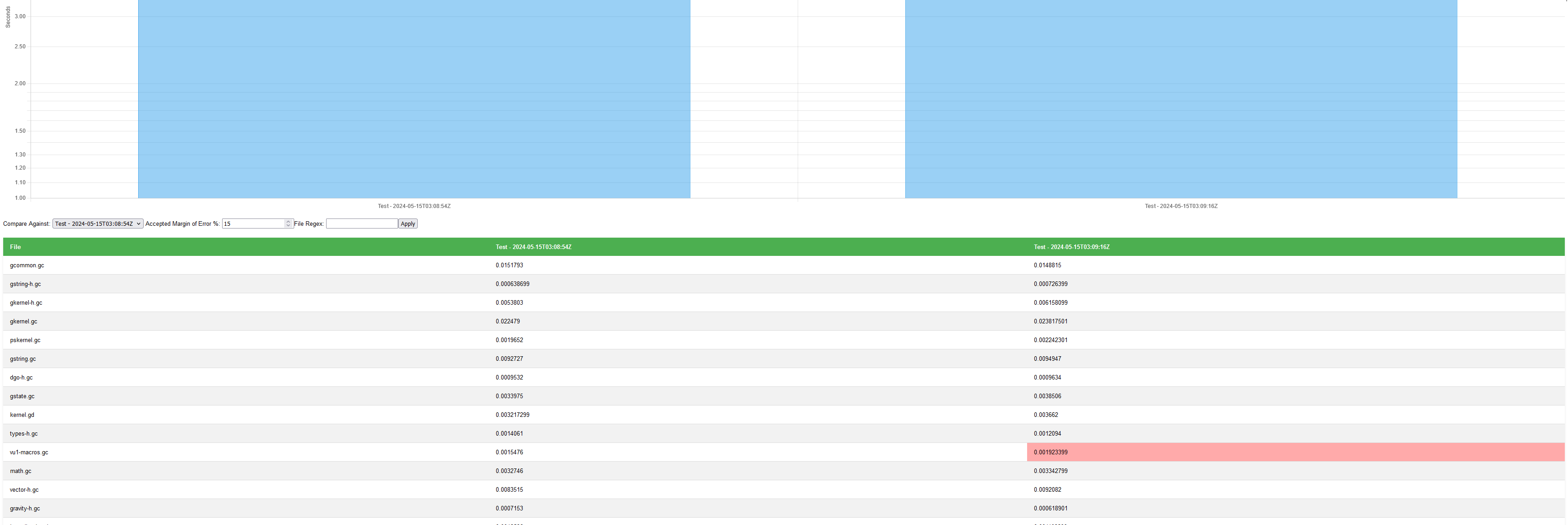
Adds a quick perf report feature to `goalc` that lets you compare how
much faster / slower it takes to compile the projects, with some simple
features like filtering the files, adjusting for how large of a margin
of error in the speeds you care about, and which test iteration you want
to compare against.
This is something I plan to use as I work more in `goalc` as an easy way
to track / show the results.
Relates to #1353

This adds no new functionality or overhead to the compiler, yet. This is
the preliminary work that has:
- added code to the compiler in several spots to flag when something is
used without being properly required/imported/whatever (disabled by
default)
- that was used to generate project wide file dependencies (some
circulars were manually fixed)
- then that graph underwent a transitive reduction and the result was
written to all `jak1` source files.

The next step will be making this actually produce and use a dependency
graph. Some of the reasons why I'm working on this:
- eliminates more `game.gp` boilerplate. This includes the `.gd` files
to some extent (`*-ag` files and `tpage` files will still need to be
handled) this is the point of the new `bundles` form. This should make
it even easier to add a new file into the source tree.
- a build order that is actually informed from something real and
compiler warnings that tell you when you are using something that won't
be available at build time.
- narrows the search space for doing LSP actions -- like searching for
references. Since it would be way too much work to store in the compiler
every location where every symbol/function/etc is used, I have to do
ad-hoc searches. By having a dependency graph i can significantly reduce
that search space.
- opens the doors for common shared code with a legitimate pattern.
Right now jak 2 shares code from the jak 1 folder. This is basically a
hack -- but by having an explicit require syntax, it would be possible
to reference arbitrary file paths, such as a `common` folder.

Some stats:
- Jak 1 has about 2500 edges between files, including transitives
- With transitives reduced at the source code level, each file seems to
have a modest amount of explicit requirements.

Known issues:
- Tracking the location for where `defmacro`s and virtual state
definitions were defined (and therefore the file) is still problematic.
Because those forms are in a macro environment, the reader does not
track them. I'm wondering if a workaround could be to search the
reader's text_db by not just the `goos::Object` but by the text
position. But for the purposes of finishing this work, I just statically
analyzed and searched the code with throwaway python code.
This adds hfrag, but with a few remaining issues:
- The textures aren't animated. Instead, it just uses one texture.
- The texture filtering isn't as good as at it could be.

I also cleaned up a few issues with the background renderers:
- Cleaned up some stuff that is common to hfrag, tie, tfrag, shrub
- Moved time-of-day color packing stuff to FR3 creation, rather than at
level load. This appears to reduce the frame time spikes when a level is
first drawn by about 5 or 6 ms in big levels.
- Cleaned up the x86 specific stuff used in time of day. Now there's
only one place where we have an `ifdef`, rather than spreading it all
over the rendering code.
This fixes issues with certain Jak 3 levels not rendering because there
is a mismatch between the DGO name, nickname and real level name (bsp
name).

FR3s use a different filename, so you can delete the ones you have after
this is merged.

This affects custom levels, but I don't have that toolchain set up so
someone else will have to test that.
Patching up the extractor while working on the launcher, fixes:
- makes it so you can compile successfully given a folder path
(currently assumes your project path contains `iso_data`)
- ignore `buildinfo.json` from validation code.
- fixes an edge-case that could recursively fill up your entire
hard-drive!
- allows overriding the decompilation configuration via flag
- adds a way to specify where the ISO should be extracted to
I noticed that jak 3's compilation was spending a lot of time accessing
the `unordered_map`s we use to store constants and symbol types.


I repurposed the `EnvironmentMap` originally made for GOOS for this. It
turns out that we were copying the entire constant map whenever we
encountered a `deftype`, and fixed that too.

This speeds up jak3 compiles from ~16 to 11 seconds for me.
The `test-play` macro is back, though it doesn't call `play` yet. We can
at least load all of `game.cgo`, which involves loading a lot of the
code we've decompiled, loading/linking objects files compiled by
OpenGOAL (like dir-tpages), and loading/linking Jak's art-groups (for
jak 3 they are stored v5 format that I added to the linker).

There were no major issues - just a few forgotten mips2c entries and
minor bugs/functions that needed stubs. Most of the work was updating
the linker. Hopefully I'll never have to touch that code again - I think
it supports everything we need for jak 3!
 ZedB0T