I did some manual modifications in a few places to work around some
truly mysterious control flow, and some unsupported stack array stuff.

Also fixes a bug in decompiling static improper lists.

As far as I can tell, guns work, other than some graphical issues and
the crazy particle spawning issue, but I strongly suspect these are
problems with the sparticle/graphics side.
A common thing that can be forgotten about / confusing to new people is
that:
1. if you add an object to the `allowed_objs` list but it's also in the
`banned_objs` list -- the ban still takes precedence with no failure
2. if you add an object to the `allowed_objs` list but have not allowed
the DGO in `inputs.jsonc` it will also silently log a failure and
continue.

This PR turns both situations into an explicit error with advice/a
reminder on what to do to fix it.
- Split up DGOs between threads in the multithreaded offline test
- fix some random warnings
- make the sig paths decompile a bit nicer to make some files smaller
When working with mips2c recently, I noticed adding the
`defmethod-mips2c` or `def-mips2c` code was a manual step. This is a bit
tedious to have to go and do yourself, but more importantly you have to
manually go and find the right spot in the source file else you might be
declaring it too early or too late.

This will automatically output the declaration for methods, and a
half-finished comment for the functions. I wasn't able to fully output
the function one because it seems the signature info from `all-types`
doesn't make it all the way through -- but maybe I'm wrong or this is an
easy fix?
Running reference tests/decompiler should now be possible on macos
(arm). Most of the changes were just cleaning up places where we were
sloppy with ifdefs, but there were two interesting ones:
- `Printer.cpp` was updated to not use a recursive function for printing
lists, to avoid stack overflow
- I replaced xxhash with another version of the same library that
supports arm (the one that comes in zstd). The interface is C instead of
C++ but it's not bad to use. I confirmed that the extractor succeeds on
jak 1 iso so it looks like this gives us the same results as the old
library.
A big one...

I figure even if we would like to change the way the particle/scene code
is output -- it'd be easier to find patterns with it all decompiled.

I've updated my script so it can easily be used to mass update these
files:
```bash
task update-gsrc-glob GLOB="**/*-part*.gc"
```
> for example will update gsrc files with `part` in their name -- if
they are in ref tests (so uncompleted ones aren't touched)

I found a few issues along the way that I'll have to make issues for
soon.
This solves two main problems:
- the looming threat of running out of memory since every thread would
consume duplicate (and probably not needed) resources
- though I will point out, jak 2's offline tests seem to hardly use any
memory even with 400+ files, duplicated across many threads. Where as
jak 1 does indeed use tons more memory. So I think there is something
going on besides just the source files
- condense the output so it's much easier to see what is happening / how
close the test is to completing.
- one annoying thing about the multiple thread change was errors were
typically buried far in the middle of the output, this fixes that
- refactors the offline test code in general to be a lot more modular

The pretty printing is not enabled by default, run with `-p` or
`--pretty-print` if you want to use it


https://user-images.githubusercontent.com/13153231/205513212-a65c20d4-ce36-44f6-826a-cd475505dbf9.mp4
- decompile `lights.gc`
- decompile remaining `target-death` function, you can die now
- fix float issue with `matrix-from-two-vectors-smooth!` making jak face
the wrong way in the slide thing
Mostly easy / particle def files. I did a bit in `ruins` but CFG
failures and missing `drawable` functions make it untestable for now so
I've put that on pause.
- You can define a `startup.gc` in your user folder, each line will be
executed on startup (deprecates the usefulness of some cli flags)
- You can define a `repl-config.json` file to override REPL settings.
Long-term this is a better approach than a bunch of CLI flags as well
- Via this, you can override the amount of time the repl will attempt to
listen for the target
- At the same time, I think i may have found why on Windows it can
sometimes take forever to timeout when the game dies, will dig into this
later
- Added some keybinds for common operations, shown here


https://user-images.githubusercontent.com/13153231/202890278-1ff2bb06-dddf-4bde-9178-aa0883799167.mp4
> builds the game, connects to it, attaches a debugger and continues,
launches it, gets the backtrace, stops the target -- all with only
keybinds.

If you want these keybinds to work inside VSCode's integrated terminal,
you need to add the following to your settings file
```json
"terminal.integrated.commandsToSkipShell": [
    "-workbench.action.quickOpen",
    "-workbench.action.quickOpenView"
  ]
```
- target-part
- ;; ERROR: Failed to convert to atomic ops: Variable could not be
constructed from register r0 in `process-drawable-shock-wall-effect`
- gun-part
  - missing sparticle decompiling case it seems related to `L155`

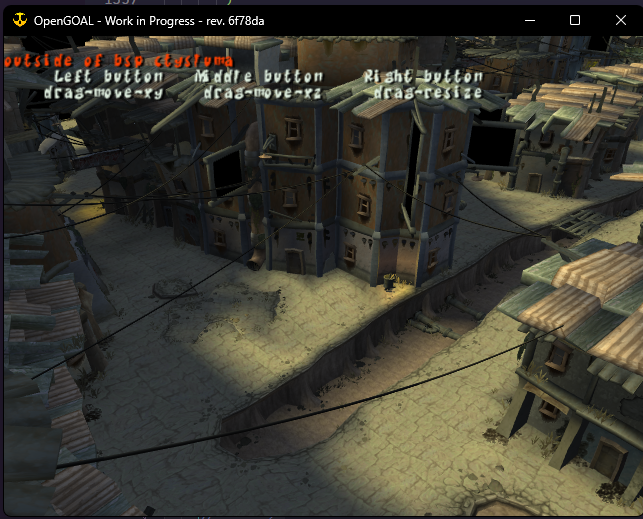
This is pretty rough but...im excited to see it working :)
The VU programs for the ocean renderer have changed a bit and
`ocean-texture` has a bunch of new stuff, otherwise things are
relatively similar to Jak 1.

This is the first time I used mips2c and I'm not sure I did it 100%
right, so that should be double-checked.
The only interesting one is `collide-hash`, which is untested.
The other two are very likely unused. I skipped the annoying code in
`collide-probe` because it's not used and the same as jak 1.
Couldn't finish any of the enemy/nav-enemy related files for one reason
or another, but quite a bit of work that will be easier to merge and
iterate on instead of keeping track of the branch.

enemy/idle-control has some very weird focus related code.

nav-mesh/nav-control still has a bunch of CFG resolution problems that
need to be manually resolved.

Co-authored-by: water <awaterford111445@gmail.com>
- fix issue described in
https://github.com/open-goal/jak-project/issues/1939
- fix `text`, which was manually patched with the wrong offset (was
reading the symbol value off by one byte)
- clean up some random useless prints
- make the offline tests keep trying if there's a comparison error,
clean up the output a bit so the diffs are all at the end.
The offline-tests are going to end up taking too long for jak 2, I did
some rough math and by the end of it we'll be spending almost 2 minutes
for a full offline test on my machine.

These changes allow us to throw hardware at the problem

Still some work to do to make the output nicer, but seems to be fairly
reliable. By default it still uses 1 thread, use `num_threads` to change
this.
 water111