mirror of
https://github.com/open-goal/jak-project
synced 2026-07-05 13:43:52 -04:00
 Tyler Wilding
53277a65ad
Tyler Wilding
53277a65ad
- Integrate the AST into the LSP, this makes parsing and tokenizing the files much easier - Consolidate most of the symbol info tracking in `goalc` to a single map. Fixed some issues where the old map would never evict symbols when re-compiling files. There is still some more to cleanup, but this now can be used as an incrementally updated source-of-truth for the LSP - re-compile files when they are saved. Ideally this would be done everytime they are changed but that: - may be too aggressive - goalc doesn't compile incrementally yet so it likely would be a worse UX Features added, see https://github.com/open-goal/opengoal-vscode/issues/256 - Hover 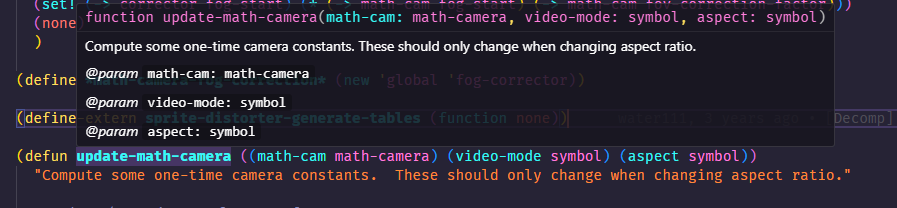  - LSP Status fixed - Type Hierarchy 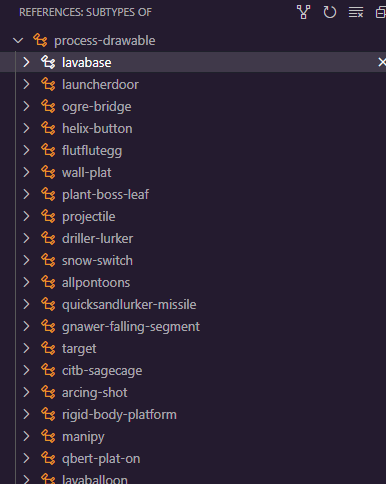 - Document Color 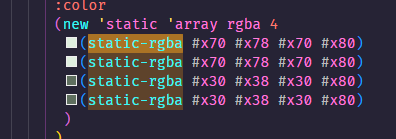 - Document Symbols  - Completions 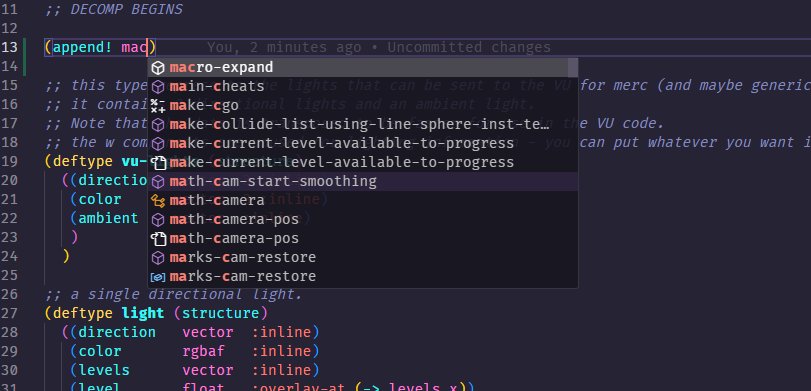 --------- Co-authored-by: Hat Kid <6624576+Hat-Kid@users.noreply.github.com>
2.5 KiB
Vendored
Generated
2.5 KiB
Vendored
Generated
Rust Tree-sitter

Rust bindings to the Tree-sitter parsing library.
Basic Usage
First, create a parser:
use tree_sitter::{Parser, Language};

let mut parser = Parser::new();
Add the cc crate to your Cargo.toml under [build-dependencies]:
[build-dependencies]
cc="*"
Then, add a language as a dependency:
[dependencies]
tree-sitter = "0.21.0"
tree-sitter-rust = "0.20.4"
To then use a language, you assign them to the parser.
parser.set_language(tree_sitter_rust::language()).expect("Error loading Rust grammar");
Now you can parse source code:
let source_code = "fn test() {}";
let tree = parser.parse(source_code, None).unwrap();
let root_node = tree.root_node();

assert_eq!(root_node.kind(), "source_file");
assert_eq!(root_node.start_position().column, 0);
assert_eq!(root_node.end_position().column, 12);
Editing
Once you have a syntax tree, you can update it when your source code changes.
Passing in the previous edited tree makes parse run much more quickly:
let new_source_code = "fn test(a: u32) {}"

tree.edit(&InputEdit {
  start_byte: 8,
  old_end_byte: 8,
  new_end_byte: 14,
  start_position: Point::new(0, 8),
  old_end_position: Point::new(0, 8),
  new_end_position: Point::new(0, 14),
});

let new_tree = parser.parse(new_source_code, Some(&tree));
Text Input
The source code to parse can be provided either as a string, a slice, a vector, or as a function that returns a slice. The text can be encoded as either UTF8 or UTF16:
// Store some source code in an array of lines.
let lines = &[
    "pub fn foo() {",
    "  1",
    "}",
];

// Parse the source code using a custom callback. The callback is called
// with both a byte offset and a row/column offset.
let tree = parser.parse_with(&mut |_byte: u32, position: Point| -> &[u8] {
    let row = position.row as usize;
    let column = position.column as usize;
    if row < lines.len() {
        if column < lines[row].as_bytes().len() {
            &lines[row].as_bytes()[column..]
        } else {
            b"\n"
        }
    } else {
        &[]
    }
}, None).unwrap();

assert_eq!(
  tree.root_node().to_sexp(),
  "(source_file (function_item (visibility_modifier) (identifier) (parameters) (block (number_literal))))"
);