Extend test fixture to verify the targeting.

Includes two "attribute docstrings" which per PEP 257 are not recognized by the Python bytecode compiler or available as runtime object attributes. They are not available for us either at time of writing, but include them for completeness anyway in case they one day are.
If a file doesn't have a `package`, then it must both be in a directory that lacks an `__init__.py`, and a directory that _isn't_ marked as a namespace package.
Closes#2075.
## Summary
The problem: given a (row, column) number (e.g., for a token in the AST), we need to be able to map it to a precise byte index in the source code. A while ago, we moved to `ropey` for this, since it was faster in practice (mostly, I think, because it's able to defer indexing). However, at some threshold of accesses, it becomes faster to index the string in advance, as we're doing here.
## Benchmark
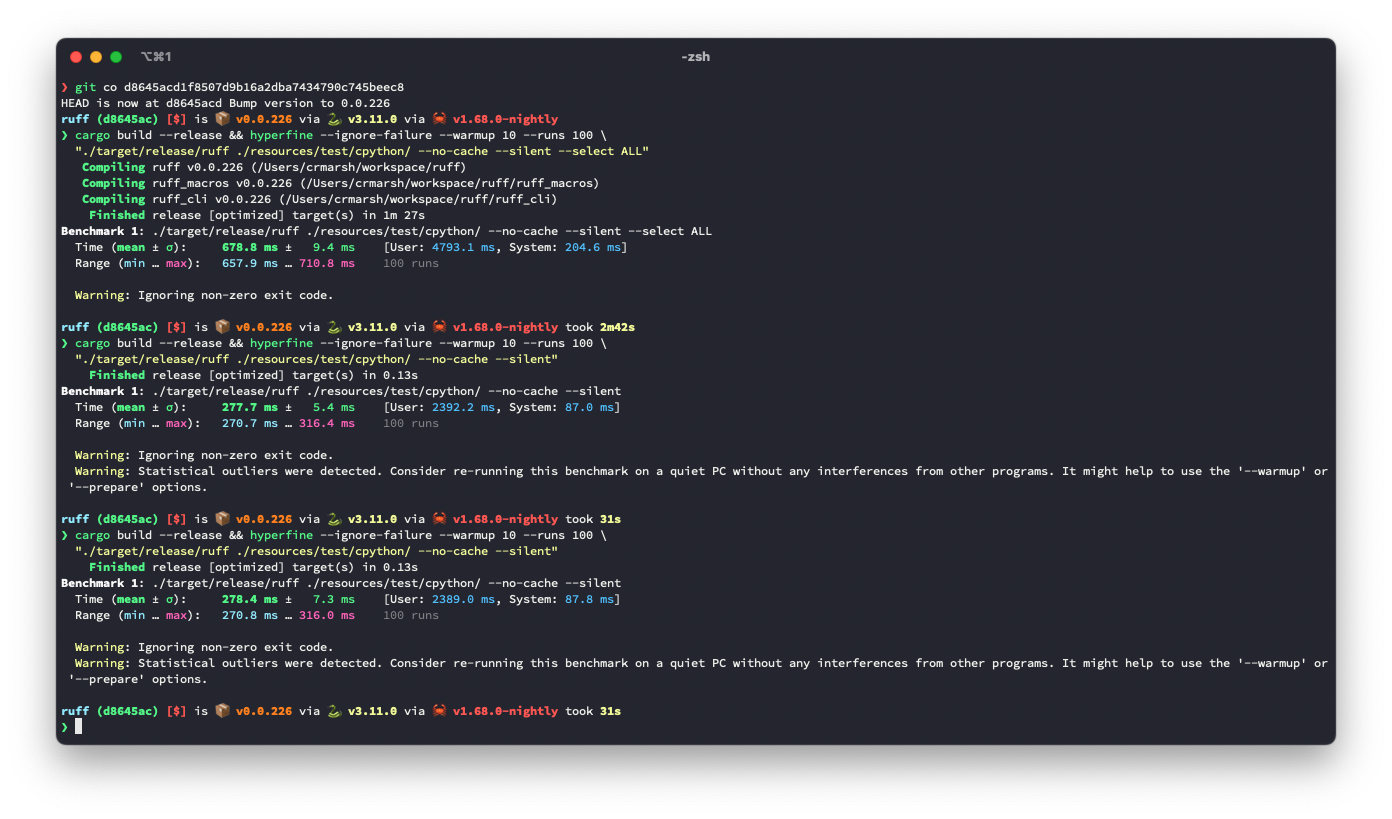
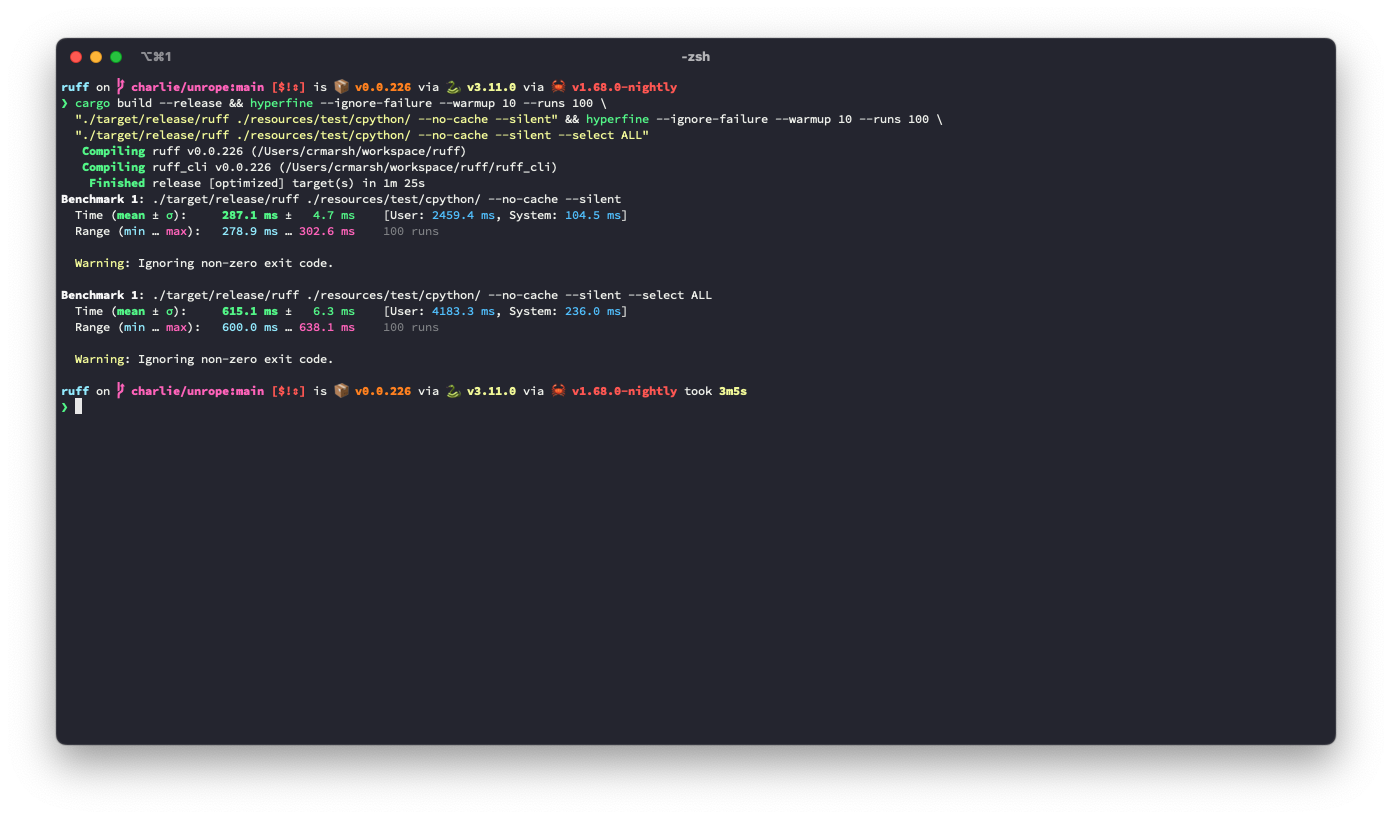
It looks like this is ~3.6% slower for the default rule set, but ~9.3% faster for `--select ALL`.
**I suspect there's a strategy that would be strictly faster in both cases**, based on deferring even more computation (right now, we lazily compute these offsets, but we do it for the entire file at once, even if we only need some slice at the top), or caching the `ropey` lookups in some way.
Before:
After:
## Alternatives
I tried tweaking the `Vec::with_capacity` hints, and even trying `Vec::with_capacity(str_indices::lines_crlf::count_breaks(contents))` to do a quick scan of the number of lines, but that turned out to be slower.
Add tests.

Ensure that these cases are caught by ICN001:
```python
from xml.dom import minidom
from xml.dom.minidom import parseString
```

with config:
```toml
[tool.ruff.flake8-import-conventions.extend-aliases]
"dask.dataframe" = "dd"
"xml.dom.minidom" = "md"
"xml.dom.minidom.parseString" = "pstr"
```
The idea is the same as #1867. Avoids emitting `SIM102` twice for the following code:

```python
if a:
    if b:
        if c:
            d
```

```
resources/test/fixtures/flake8_simplify/SIM102.py:1:1: SIM102 Use a single `if` statement instead of nested `if` statements
resources/test/fixtures/flake8_simplify/SIM102.py:2:5: SIM102 Use a single `if` statement instead of nested `if` statements
```
This PR adds the scaffolding files for `flake8-type-checking`, along with the simplest rule (`empty-type-checking-block`), just as an example to get us started.

See: #1785.
Tracking issue: https://github.com/charliermarsh/ruff/issues/2024

Implementation for EXE003, EXE004 and EXE005 of `flake8-executable`
(shebang should contain "python", not have whitespace before, and should be on the first line)

Please take in mind that this is my first rust contribution.

The remaining EXE-rules are a combination of shebang (`lines.rs`), file permissions (`fs.rs`) and if-conditions (`ast.rs`). I was not able to find other rules that have interactions/dependencies in them. Any advice on how this can be best implemented would be very welcome.

For autofixing `EXE005`, I had in mind to _move_  the shebang line to the top op the file. This could be achieved by a combination of `Fix::insert` and `Fix::delete` (multiple fixes per diagnostic), or by implementing a dedicated `Fix::move`, or perhaps in other ways. For now I've left it out, but keen on hearing what you think would be most consistent with the package, and pointer where to start (if at all).

---
If you care about another testimonial:
`ruff` not only helps staying on top of the many excellent flake8 plugins and other Python code quality tools that are available, it also applies them at baffling speed.
(Planning to implement it soon for github.com/pandas-profiling/pandas-profiling (as largest contributor) and github.com/ing-bank/popmon.)
Rule described here: https://www.flake8rules.com/rules/E101.html

I tried to follow contributing guidelines closely, I've never worked with Rust before. Stumbled across Ruff a few days ago and would like to use it in our project, but we use a bunch of flake8 rules that are not yet implemented in ruff, so I decided to give it a go.
For now, we're just gonna avoid flagging this for `elif` blocks, following the same reasoning as for ternaries. We can handle all of these cases, but we'll knock out the TODOs as a pair, and this avoids broken code.
Closes#2007.
This PR adds a new check that turns expressions such as `[1, 2, 3] + foo` into `[1, 2, 3, *foo]`, since the latter is easier to read and faster:

```
~ $ python3.11 -m timeit -s 'b = [6, 5, 4]' '[1, 2, 3] + b'
5000000 loops, best of 5: 81.4 nsec per loop
~ $ python3.11 -m timeit -s 'b = [6, 5, 4]' '[1, 2, 3, *b]'
5000000 loops, best of 5: 66.2 nsec per loop
```

However there's a couple of gotchas:

* This felt like a `simplify` rule, so I borrowed an unused `SIM` code even if the upstream `flake8-simplify` doesn't do this transform. If it should be assigned some other code, let me know 😄
* **More importantly** this transform could be unsafe if the other operand of the `+` operation has overridden `__add__` to do something else. What's the `ruff` policy around potentially unsafe operations? (I think some of the suggestions other ported rules give could be semantically different from the original code, but I'm not sure.)
* I'm not a very established Rustacean, so there's no doubt my code isn't quite idiomatic. (For instance, is there a neater way to write that four-way `match` statement?)

Thanks for `ruff`, by the way! :)
This is slightly buggy due to Instagram/LibCST#855; it will complain `[ERROR] Failed to fix nested with: Failed to extract CST from source` when trying to fix nested parenthesized `with` statements lacking trailing commas. But presumably people who write parenthesized `with` statements already knew that they don’t need to nest them.

Signed-off-by: Anders Kaseorg <andersk@mit.edu>
If a `try` block has multiple statements, a compound statement, or
control flow, rewriting it with `contextlib.suppress` would obfuscate
the fact that the exception still short-circuits further statements in
the block.
Fixes#1947.
Signed-off-by: Anders Kaseorg <andersk@mit.edu>
Since our binding tracking is somewhat limited, I opted to favor false negatives over false positives. So, e.g., this won't trigger SIM115:
```py
with contextlib.ExitStack():
f = exit_stack.enter_context(open("filename"))
```
(Notice that `exit_stack` is unbound.)
The alternative strategy required us to incorrectly trigger SIM115 on this:
```py
with contextlib.ExitStack() as exit_stack:
exit_stack_ = exit_stack
f = exit_stack_.enter_context(open("filename"))
```
Closes#1945.
 Charlie Marsh
 alm
alm
 Simon Brugman
 Ville Skyttä
 Harutaka Kawamura
 Maksudul Haque
 Zeddicus414
 Colin Delahunty
 Eric Roberts
 Florian Best
 Aarni Koskela
 Anders Kaseorg
 Edgar R. M

