## Summary
The problem: given a (row, column) number (e.g., for a token in the AST), we need to be able to map it to a precise byte index in the source code. A while ago, we moved to `ropey` for this, since it was faster in practice (mostly, I think, because it's able to defer indexing). However, at some threshold of accesses, it becomes faster to index the string in advance, as we're doing here.
## Benchmark
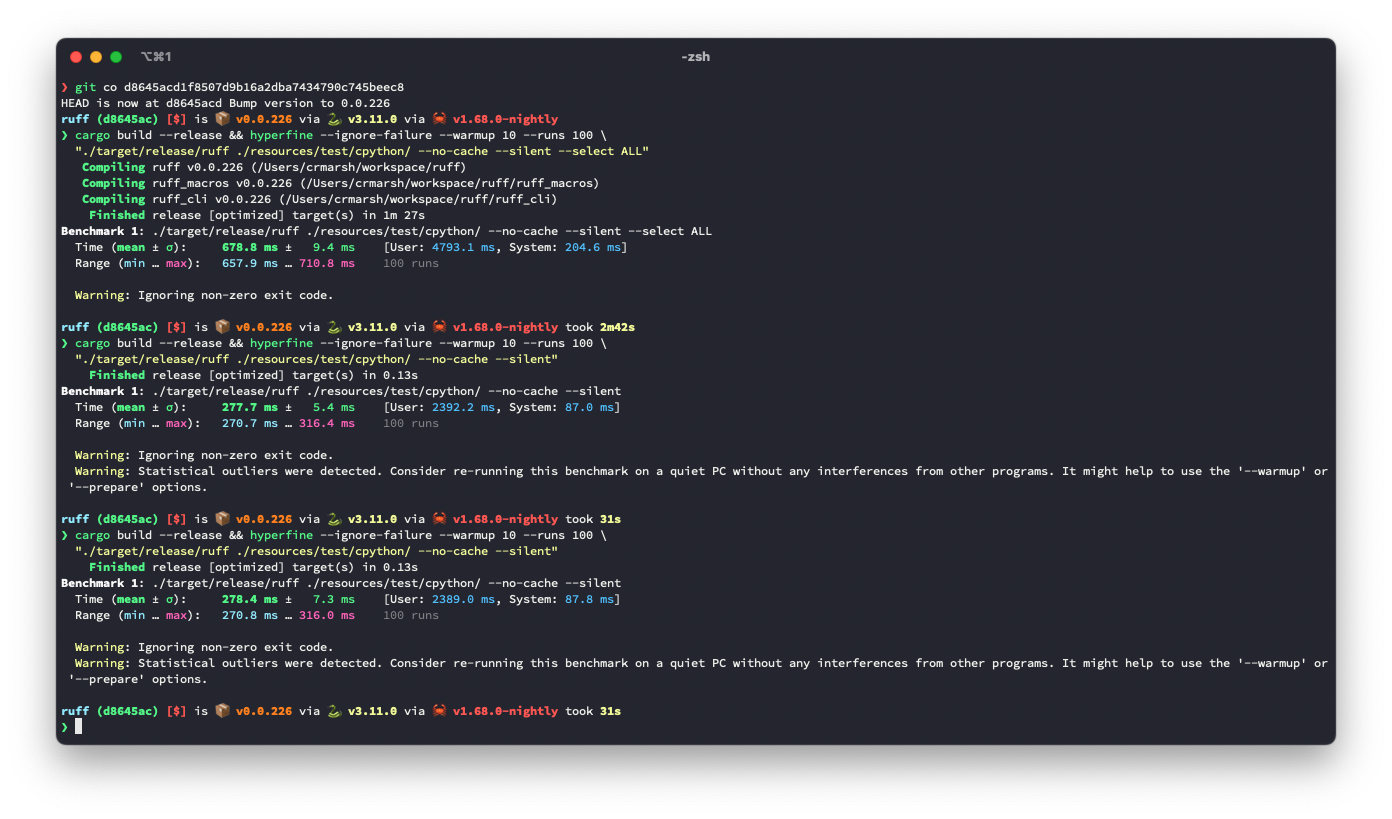
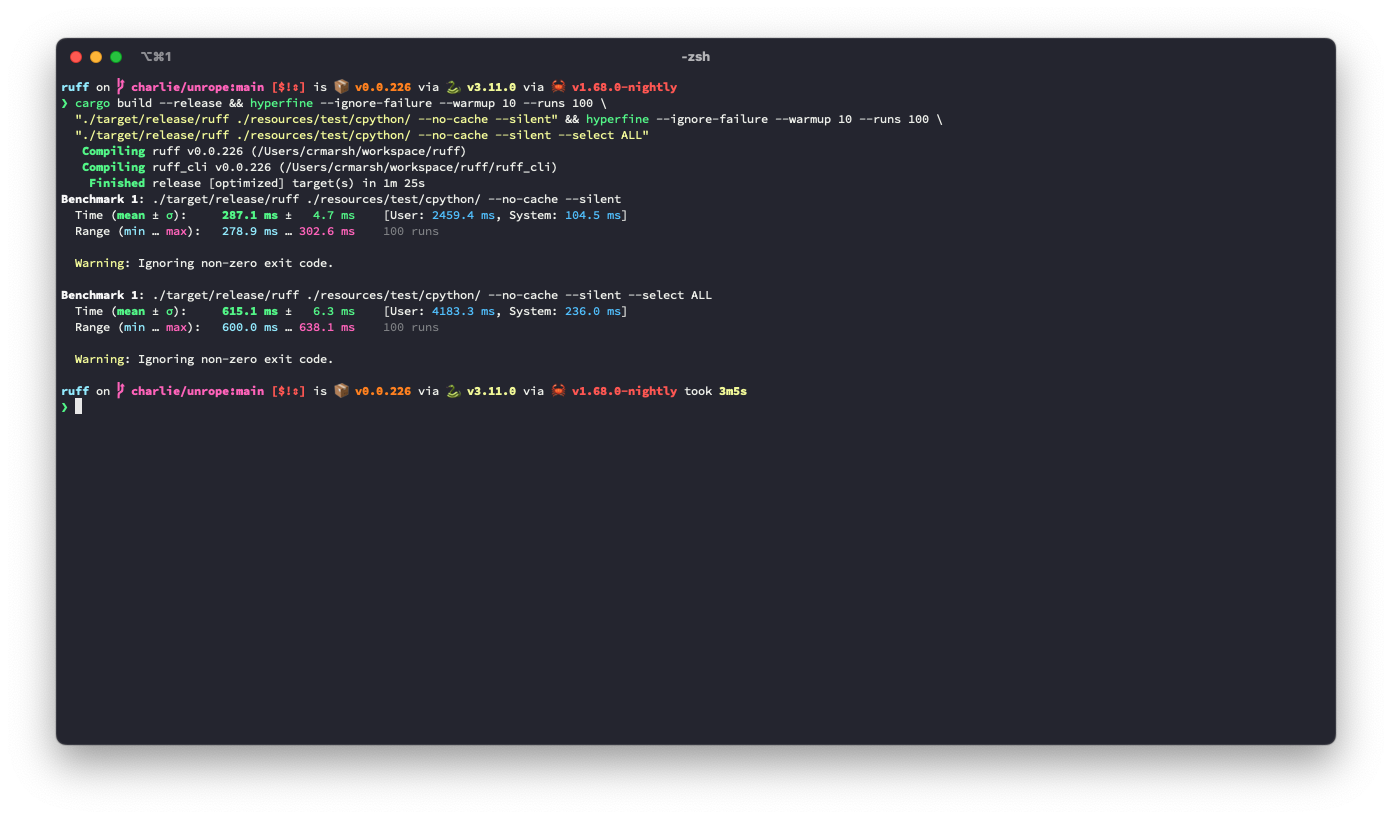
It looks like this is ~3.6% slower for the default rule set, but ~9.3% faster for `--select ALL`.
**I suspect there's a strategy that would be strictly faster in both cases**, based on deferring even more computation (right now, we lazily compute these offsets, but we do it for the entire file at once, even if we only need some slice at the top), or caching the `ropey` lookups in some way.
Before:
After:
## Alternatives
I tried tweaking the `Vec::with_capacity` hints, and even trying `Vec::with_capacity(str_indices::lines_crlf::count_breaks(contents))` to do a quick scan of the number of lines, but that turned out to be slower.
The primary motivation is that we can now robustly detect `\` continuations due to the addition of `Tok::NonLogicalNewline`. This PR generalizes the approach we took to comments (track all lines that contain any comments), and applies it to continuations too.
This PR refactors our import-tracking logic to leverage our existing
logic for tracking bindings. It's both a significant simplification, a
significant improvement (as we can now track reassignments), and closes
out a bunch of subtle bugs.
Though the AST tracks all bindings (e.g., when parsing `import os as
foo`, we bind the name `foo` to a `BindingKind::Importation` that points
to the `os` module), when I went to implement import tracking (e.g., to
ensure that if the user references `List`, it's actually `typing.List`),
I added a parallel system specifically for this use-case.
That was a mistake, for a few reasons:
1. It didn't track reassignments, so if you had `from typing import
List`, but `List` was later overridden, we'd still consider any
reference to `List` to be `typing.List`.
2. It required a bunch of extra logic, include complex logic to try and
optimize the lookups, since it's such a hot codepath.
3. There were a few bugs in the implementation that were just hard to
correct under the existing abstractions (e.g., if you did `from typing
import Optional as Foo`, then we'd treat any reference to `Foo` _or_
`Optional` as `typing.Optional` (even though, in that case, `Optional`
was really unbound).
The new implementation goes through our existing binding tracking: when
we get a reference, we find the appropriate binding given the current
scope stack, and normalize it back to its original target.
Closes#1690.
Closes#1790.
The changes in this commit were generated by running:

for f in $(find src -name '*.rs'); do sed -Ei 's/use crate::registry::.*;/\0use crate::violations;/g' $f; done
for f in $(find src -name '*.rs'); do sed -Ei 's/CheckKind::([A-Z])/violations::\1/g' $f; done
git checkout src/registry.rs src/lib.rs src/lib_wasm.rs src/violations.rs
cargo +nightly fmt



