This lint fires when an `if` negates the condition. The lint
instead suggests that the condition should be un-negated and
the `if` and `else` bodies flipped.

I find this to be a pretty annoying lint, because sometimes
I want to keep the order of the `if` and `else` bodies as-is,
and not make it subject to whether the primary condition is
negated or not. Sometimes it's for linear scanning reasons
(where the `if` block is smaller), and sometimes it's for
"code parallelism" reasons (i.e., this block of code looks like
another block of code intentionally).

Moreover, I don't think the benefits of this lint are very
big. I do agree that sometimes negating a conditional can make
it harder to read (e.g., a double negative), but it's nowhere
near a universal truth enough to ban it outright.
<!--
Thank you for contributing to uv! To help us out with reviewing, please
consider the following:

- Does this pull request include a summary of the change? (See below.)
- Does this pull request include a descriptive title?
- Does this pull request include references to any relevant issues?
-->

## Summary
While working on potential bug fixes with temporary files on Windows (I
think I am currently ecountering the same issue as #2810)
I noticed that sub-workspaces were not all having the same `tempfile`
version. And they were not relying on the cargo root project dependency.
I don't know at all if it was done on purpose or not.
(I also wanted to override the root dependency with a local source but
it was not possible due to sub-workspaces not relying on the same).

The root lockfile already pinned to the `3.14.0`. Some sub-workspaces
were depending on the `3.12.0`, some others on the `3.14.0`. So I
updated the root `Cargo.toml` to the `3.14.0`.

Feel free to decline if it was done on purpose! No worries at all
🙂

Thanks!

<!-- What's the purpose of the change? What does it do, and why? -->

## Test Plan
All units tests are still passing on my side. Let's see with the
pull-request CI 😄
## Summary

A lot of good new lints, and most importantly, error stabilizations. I
tried to find a few usages of the new stabilizations, but I'm sure there
are more.

IIUC, this _does_ require bumping our MSRV.
When building only a single crate in the workspace to run its tests, we
often recompile a lot of other, unrelated crates. Whenever cargo has a
different set of crate features, it needs to recompile. By moving some
features (non-exhaustive for now) to the workspace level, we always
activate them an avoid recompiling.

The cargo docs mismatch the behavior of cargo around default-deps, so I
filed that upstream and left most `default-features` mismatches:
https://github.com/rust-lang/cargo/issues/14841.

Reference script:

```python
import tomllib
from collections import defaultdict
from pathlib import Path

uv = Path("/home/konsti/projects/uv")
skip_list = ["uv-trampoline", "uv-dev", "uv-performance-flate2-backend", "uv-performance-memory-allocator"]

root_feature_map = defaultdict(set)
root_default_features = defaultdict(bool)
cargo_toml = tomllib.loads(uv.joinpath("Cargo.toml").read_text())
for dep, declaration in cargo_toml["workspace"]["dependencies"].items():
    root_default_features[dep] = root_default_features[dep] or declaration.get("default-features", True)
    root_feature_map[dep].update(declaration.get("features", []))

feature_map = defaultdict(set)
default_features = defaultdict(bool)
for crate in uv.joinpath("crates").iterdir():
    if crate.name in skip_list:
        continue
    if not crate.joinpath("Cargo.toml").is_file():
        continue
    cargo_toml = tomllib.loads(crate.joinpath("Cargo.toml").read_text())
    for dep, declaration in cargo_toml.get("dependencies", {}).items():
        # If any item uses default features, they are used everywhere
        default_features[dep] = default_features[dep] or declaration.get("default-features", True)
        feature_map[dep].update(declaration.get("features", []))

for dep, features in sorted(feature_map.items()):
    features = features - root_feature_map.get(dep, set())
    if not features and default_features[dep] == root_default_features[dep]:
        continue
    print(dep, default_features[dep], sorted(features))
```
## Summary

Update the URL to the "tl" crate since the repository has been
transferred to astral-sh/. This is of no real consequence, except it
keeps triggering Gentoo linter that detects permanently redirected URL.

## Test Plan

`cargo test`
When doing a directory traversal for source dist inclusion, we want to
offer the user include and exclude options, and we want to avoid
traversing irrelevant directories. The latter is important for
performance, especially on network file systems, but also with large
data directories, or (not-included) directories with other permissions.
To support this, we introduce `GlobDirFilter`, which uses a DFA from
regex_automata to determine whether any children of a directory can be
included and skips the directory if not.

The globs are based on PEP 639. The syntax is more restricted than glob
or globset, but it's standardized. I chose it over glob or globset
because we're already using this syntax for `project.license-files` a
required by PEP 639, so it makes sense to use the same globs for all
includes (see e.g.
4f52a3bb62/pyproject.toml (L36-L48)
for example with same semantics for include and exclude)

### Semantics

Glob semantics are complex due to mixing directories and files,
expectations around simplicity and our need to exclude most of the tree
in the project from traversal. The current draft uses a syntax that
optimizes for simple default use cases for the start.

#### includes

Glob expressions which files and directories to include in the source
distribution.

Includes are anchored, which means that `pyproject.toml` includes only
`<project root>/pyproject.toml`. Use for example `assets/**/sample.csv`
to include for all
`sample.csv` files in `<project root>/assets` or any child directory. To
recursively include
all files under a directory, use a `/**` suffix, e.g. `src/**`. For
performance and
reproducibility, avoid unanchored matches such as `**/sample.csv`.

The glob syntax is the reduced portable glob from
[PEP 639](https://peps.python.org/pep-0639/#add-license-FILES-key).

#### excludes

Glob expressions which files and directories to exclude from the
previous source
distribution includes.

Excludes are not, which means that `__pycache__` excludes all
directories named
`__pycache__` and it's children anywhere. To anchor a directory, use a
`/` prefix, e.g.,
`/dist` will exclude only `<project root>/dist`.

The glob syntax is the reduced portable glob from
[PEP 639](https://peps.python.org/pep-0639/#add-license-FILES-key).
This adds support for providing conflicting group names in addition to
extra names to `Conflicts`.

This merely makes "room" for it in the types while keeping everything
working. We'll add proper support for it in the next commit.

Note that one interesting trick we do here is depend directly on
`hashbrown` so that we can make use of its `Equivalent` trait. This in
turn lets us use things like `ConflictItemRef` as a lookup key for a
hashset that contains `ConflictItem`. This mirrors using a `&str` as a
lookup key for a hashset that contains `String`, but works for arbitrary
types. `std` doesn't support this, but `hashbrown` does. This trick in
turn lets us simplify some of our data structures.

This also rejiggers some of the serde-interaction with the conflicting
types. We now use a wire type to represent our conflicting items for
more flexibility. i.e., Support `extra` XOR `group` fields.
<!--
Thank you for contributing to uv! To help us out with reviewing, please
consider the following:

- Does this pull request include a summary of the change? (See below.)
- Does this pull request include a descriptive title?
- Does this pull request include references to any relevant issues?
-->

## Summary

This PR builds off of https://github.com/astral-sh/uv/pull/6738 to fix
#6724 (sorry for the new PR @charliermarsh I didn't want to push to your
branch, not even sure if I could). The reason the original PR doesn't
fix the issue described in #6724 is because the fastapi is ran in the
project context (as I assume a lot of use cases are). This PR adds an
extra commit to handle the signals in the project/run.rs file

~It also addresses the comment
[here](https://github.com/astral-sh/uv/pull/6738/files#r1734757548) to
not use the tokio ctrl-c method since we are now handling SIGINT
ourselves~ update, tokio handles SIGINT in a platform agnostic way,
intercepting this ouselves makes the logic more complicated with
windows, decided to leave the tokio ctrl-c handler

~[This
comment](https://github.com/astral-sh/uv/pull/6738/files#r1743510140)
remains unaddressed, however, the Child process does not have any other
methods besides kill() so I don't see how we can "preserve" the
interrupt call :/ I tried looking around but no luck.~ updated, this PR
is reduced to only handling SIGTERM propagation on unix machines, and
the sigterm call to the child is preserved by making use of the nix
package, instead of relying on tokio which only allowed for `kill()` on
a child process

## Test Plan

I tested this by building the docker container locally with these
changes and tagging it "myuv", and then using that as the base image in
uv-docker-example, (and ofc following the rest of the repro issues in
#6724. In my tests I see that ctrl-c in the docker-compose up command
exits the process almost immediately 👍

---------

Co-authored-by: Charlie Marsh <charlie.r.marsh@gmail.com>
Very basic source distribution support. What's included:

- Include and exclude patterns (hard-coded): Currently, we have
globset+walkdir in one part and glob in the other. I'll migrate
everything to globset+walkset and some custom perf optimizations to
avoid traversing irrelevant directories on top. I'll also pick a glob
syntax (or subset), PEP 639 seems like a good candidate since it's
consistent with what we already have to support.
- Add the `PKG-INFO` file with metadata: Thanks to Code Metadata 2.2,
this metadata is reliable and can be read statically by external tools.

Example output:

```
$ tar -ztvf dist/dummy-0.1.0.tar.gz
-rw-r--r-- 0/0             154 1970-01-01 01:00 dummy-0.1.0/PKG-INFO
-rw-rw-r-- 0/0             509 1970-01-01 01:00 dummy-0.1.0/pyproject.toml
drwxrwxr-x 0/0               0 1970-01-01 01:00 dummy-0.1.0/src/dummy
drwxrwxr-x 0/0               0 1970-01-01 01:00 dummy-0.1.0/src/dummy/submodule
-rw-rw-r-- 0/0              30 1970-01-01 01:00 dummy-0.1.0/src/dummy/submodule/impl.py
-rw-rw-r-- 0/0              14 1970-01-01 01:00 dummy-0.1.0/src/dummy/submodule/__init__.py
-rw-rw-r-- 0/0              12 1970-01-01 01:00 dummy-0.1.0/src/dummy/__init__.py
```

No tests since the source distributions don't build valid wheels yet.
## Summary

This PR pulls in https://github.com/astral-sh/uv/pull/8263 and
https://github.com/astral-sh/uv/pull/8463, which were originally merged
into the v0.5 tracking branch but can now be committed separately, as
we've made `.env` loading opt-in.

In summary:

- `.env` loading is now opt-in (`--env-file .env`).
- `.env` remains supported on `uv run`, so it's meant for providing
environment variables to the run command, rather than to uv itself.

---------

Co-authored-by: Eduardo González Vaquero <47718648+edugzlez@users.noreply.github.com>
This still utilizes the RFC 2822 datetime formatter, but utilizes new
methods [added in jiff 0.1.14] to emit timestamps in a format strictly
compatible with RFC 9110.
It seems like most HTTP servers were pretty flexible and supported RFC
2822 datetime formats, but #8747 shows at least one case where that
isn't true. Given that the [MDN docs prescribe RFC 9110], we defer to
them.
Fixes#8747
[added in jiff 0.1.14]: https://github.com/BurntSushi/jiff/pull/154
[MDN docs prescribe RFC 9110]:
https://developer.mozilla.org/en-US/docs/Web/HTTP/Headers/If-Modified-Since
Currently, our trampoline is used to convert `<command> [args]` to
`python <command> [args]` for script entrypoints installed into virtual
environments. For #8458, it'd be nice to convert a shim `python3.12
[args]` to `python [args]`. Here, we modify the trampolines to support
this use-case.

The only change we really need here is to avoid injecting `<command>`
into the child process. We change the "magic number" at the end of the
trampoline executables from `UVUV` to `UVSC` and `UVPY` which define
"script" and "python" variants to the trampoline. We then omit the
`<command>` injection in the latter case. We also omit writing the zip
script payload.

To support construction of the new variant, a new
`uv-trampoline-builder` crate is introduced — this avoids requirements
on `uv-install-wheel` in future work. I also use `uv-trampoline-builder`
to consolidate some of the test setup for `uv-trampoline`.

There should be no backwards compatibility concerns, since trampolines
are fully self-referential.

I rebased to fix the commits at the end, as this took many iterations to
get working via CI. This should roughly be reviewable by commit if you
prefer.
<!--
Thank you for contributing to uv! To help us out with reviewing, please
consider the following:

- Does this pull request include a summary of the change? (See below.)
- Does this pull request include a descriptive title?
- Does this pull request include references to any relevant issues?
-->

## Summary

<!-- What's the purpose of the change? What does it do, and why? -->

Before this PR (and since 651fe6f4e6) `uv`
depends on a git snapshot of `rust-netrc` at
544f3890b6,
with fixes from https://github.com/gribouille/netrc/pull/3 for
https://github.com/astral-sh/uv/issues/8003.

Since `rust-netrc` 0.1.2 was just released, and it includes those fixes
– plus an additional [change to support
`~`-expansion](ca0860c0a0)
– `uv` can go back to depending on published crates from crates.io.

## Test Plan

<!-- How was it tested? -->

```
$ cargo build
$ cargo run python install
$ cargo test
```

I get

```

────────────────────────────────────────────────────────────────────────────────

━━━━━━━━━━━━━━━━━━━━━━━━━━━━━━━━━━━━━━━━━━━━━━━━━━━━━━━━━━━━━━━━━━━━━━━━━━━━━━━━━━━━━━━━━━━━━━━ Snapshot Summary ━━━━━━━━━━━━━━━━━━━━━━━━━━━━━━━━━━━━━━━━━━━━━━━━━━━━━━━━━━━━━━━━━━━━━━━━━━━━━━━━━━━━━━━━━━━━━━━
Snapshot: sha
Source: crates/uv/tests/it/build.rs:1454
────────────────────────────────────────────────────────────────────────────────────────────────────────────────────────────────────────────────────────────────────────────────────────────────────────────────
Expression: snapshot
────────────────────────────────────────────────────────────────────────────────────────────────────────────────────────────────────────────────────────────────────────────────────────────────────────────────
-old snapshot
+new results
────────────┬───────────────────────────────────────────────────────────────────────────────────────────────────────────────────────────────────────────────────────────────────────────────────────────────────
   11    11 │ writing top-level names to src/project.egg-info/top_level.txt
   12    12 │ writing manifest file 'src/project.egg-info/SOURCES.txt'
   13    13 │ reading manifest file 'src/project.egg-info/SOURCES.txt'
   14    14 │ writing manifest file 'src/project.egg-info/SOURCES.txt'
         15 │+[CACHE_DIR]/builds-v0/[TMP]/pkg_resources.html
         16 │+  import pkg_resources
   15    17 │ running sdist
   16    18 │ running egg_info
   17    19 │ writing src/project.egg-info/PKG-INFO
   18    20 │ writing dependency_links to src/project.egg-info/dependency_links.txt
┈┈┈┈┈┈┈┈┈┈┈┈┼┈┈┈┈┈┈┈┈┈┈┈┈┈┈┈┈┈┈┈┈┈┈┈┈┈┈┈┈┈┈┈┈┈┈┈┈┈┈┈┈┈┈┈┈┈┈┈┈┈┈┈┈┈┈┈┈┈┈┈┈┈┈┈┈┈┈┈┈┈┈┈┈┈┈┈┈┈┈┈┈┈┈┈┈┈┈┈┈┈┈┈┈┈┈┈┈┈┈┈┈┈┈┈┈┈┈┈┈┈┈┈┈┈┈┈┈┈┈┈┈┈┈┈┈┈┈┈┈┈┈┈┈┈┈┈┈┈┈┈┈┈┈┈┈┈┈┈┈┈┈┈┈┈┈┈┈┈┈┈┈┈┈┈┈┈┈┈┈┈┈┈┈┈┈┈┈┈┈┈┈┈┈┈┈┈┈┈┈┈┈┈┈┈┈┈
   35    37 │ copying src/project.egg-info/top_level.txt -> project-0.1.0/src/project.egg-info
   36    38 │ Writing project-0.1.0/setup.cfg
   37    39 │ Creating tar archive
   38    40 │ removing 'project-0.1.0' (and everything under it)
         41 │+[CACHE_DIR]/builds-v0/[TMP]/pkg_resources.html
         42 │+  import pkg_resources
   39    43 │ Building wheel from source distribution...
   40    44 │ running egg_info
   41    45 │ writing src/project.egg-info/PKG-INFO
   42    46 │ writing dependency_links to src/project.egg-info/dependency_links.txt
   43    47 │ writing requirements to src/project.egg-info/requires.txt
   44    48 │ writing top-level names to src/project.egg-info/top_level.txt
   45    49 │ reading manifest file 'src/project.egg-info/SOURCES.txt'
   46    50 │ writing manifest file 'src/project.egg-info/SOURCES.txt'
         51 │+[CACHE_DIR]/builds-v0/[TMP]/pkg_resources.html
         52 │+  import pkg_resources
   47    53 │ running bdist_wheel
   48    54 │ running build
   49    55 │ running build_py
   50    56 │ creating build
┈┈┈┈┈┈┈┈┈┈┈┈┼┈┈┈┈┈┈┈┈┈┈┈┈┈┈┈┈┈┈┈┈┈┈┈┈┈┈┈┈┈┈┈┈┈┈┈┈┈┈┈┈┈┈┈┈┈┈┈┈┈┈┈┈┈┈┈┈┈┈┈┈┈┈┈┈┈┈┈┈┈┈┈┈┈┈┈┈┈┈┈┈┈┈┈┈┈┈┈┈┈┈┈┈┈┈┈┈┈┈┈┈┈┈┈┈┈┈┈┈┈┈┈┈┈┈┈┈┈┈┈┈┈┈┈┈┈┈┈┈┈┈┈┈┈┈┈┈┈┈┈┈┈┈┈┈┈┈┈┈┈┈┈┈┈┈┈┈┈┈┈┈┈┈┈┈┈┈┈┈┈┈┈┈┈┈┈┈┈┈┈┈┈┈┈┈┈┈┈┈┈┈┈┈┈┈┈
   73    79 │ adding 'project-0.1.0.dist-info/WHEEL'
   74    80 │ adding 'project-0.1.0.dist-info/top_level.txt'
   75    81 │ adding 'project-0.1.0.dist-info/RECORD'
   76    82 │ removing build/bdist.linux-x86_64/wheel
         83 │+[CACHE_DIR]/builds-v0/[TMP]/pkg_resources.html
         84 │+  import pkg_resources
   77    85 │ Successfully built dist/project-0.1.0.tar.gz and dist/project-0.1.0-py3-none-any.whl
────────────┴───────────────────────────────────────────────────────────────────────────────────────────────────────────────────────────────────────────────────────────────────────────────────────────────────
To update snapshots run `cargo insta review`
Stopped on the first failure. Run `cargo insta test` to run all snapshots.
thread 'build::sha' panicked at /home/ben/.cargo/registry/src/index.crates.io-6f17d22bba15001f/insta-1.40.0/src/runtime.rs:548:9:
snapshot assertion for 'sha' failed in line 1454
note: run with `RUST_BACKTRACE=1` environment variable to display a backtrace


failures:
    build::sha

test result: FAILED. 1299 passed; 1 failed; 4 ignored; 0 measured; 0 filtered out; finished in 101.18s

error: test failed, to rerun pass `-p uv --test it`
```

The sole failure looks unrelated to me, and I can reproduce it on `main`
(currently e8b8daf0fb), so I conclude that
it has nothing to do with this change.
## Summary

This PR declares and documents all environment variables that are used
in one way or another in `uv`, either internally, or externally, or
transitively under a common struct.

I think over time as uv has grown there's been many environment
variables introduced. Its harder to know which ones exists, which ones
are missing, what they're used for, or where are they used across the
code. The docs only documents a handful of them, for others you'd have
to dive into the code and inspect across crates to know which crates
they're used on or where they're relevant.

This PR is a starting attempt to unify them, make it easier to discover
which ones we have, and maybe unlock future posibilities in automating
generating documentation for them.

I think we can split out into multiple structs later to better organize,
but given the high influx of PR's and possibly new environment variables
introduced/re-used, it would be hard to try to organize them all now
into their proper namespaced struct while this is all happening given
merge conflicts and/or keeping up to date.

I don't think this has any impact on performance as they all should
still be inlined, although it may affect local build times on changes to
the environment vars as more crates would likely need a rebuild. Lastly,
some of them are declared but not used in the code, for example those in
`build.rs`. I left them declared because I still think it's useful to at
least have a reference.

Did I miss any? Are their initial docs cohesive?

Note, `uv-static` is a terrible name for a new crate, thoughts? Others
considered `uv-vars`, `uv-consts`.

## Test Plan

Existing tests
## Summary
This was brought up on Twitter recently. `dotenv` hasn't been updated in
years and doesn't build successfully anymore. Users almost always mean
to install `python-dotenv`. I think we can add helpful hints here to
point users in the right direction.
## Test Plan

uv will soon support both a build frontend (`uv build`) and a build
backend (`build-system = "uv"`). To avoid the name clash, I'm renaming
the `uv-build` crate to `uv-build-frontend`. In a follow-up PR, I will
add a `uv-build-backend` crate with the build backend implementation.
Recently, rkyv 0.8 was released. Its API is a fair bit simpler now for
higher level uses (like for us in `uv`) and results in us being able to
delete a fair bit of code. This also removes our last dependency on `syn
1.0`, and thus drops that dependency.
Performance (via testing on the `transformers` example) seems to remain
about the same, which is what was expected:
```
$ hyperfine -w5 -r100 'uv lock' 'uv-ag-rkyv-update lock'
Benchmark 1: uv lock
Time (mean ± σ): 55.6 ms ± 6.4 ms [User: 30.4 ms, System: 35.1 ms]
Range (min … max): 43.0 ms … 73.1 ms 100 runs
Benchmark 2: uv-ag-rkyv-update lock
Time (mean ± σ): 56.5 ms ± 7.2 ms [User: 30.5 ms, System: 36.3 ms]
Range (min … max): 39.1 ms … 71.5 ms 100 runs
Summary
uv lock ran
1.02 ± 0.18 times faster than uv-ag-rkyv-update lock
```
Closes#7415
## Summary

This adds about 50 KB to the binary:

```
❯ du ./target/release/socks
44736	./target/release/socks

❯ du ./target/release/uv
44632	./target/release/uv
```

So need some input on whether it's worth supporting.

Closes https://github.com/astral-sh/uv/issues/7484.
We got user reports where users were confused about why they can't use
`[project.urls]` in `pyproject.toml` (i think that's from poetry?). This
PR adds a hint that (according to PEP 621), you need to set
`project.name` when using any `project` fields. (PEP 621 also requires
`project.version` xor `dynamic = ["version"]`, but we check that later.)
The intermediate parsing layer to tell apart syntax errors from schema
errors doesn't incur a performance penalty according to epage
(https://github.com/toml-rs/toml/issues/778#issuecomment-2310369253).
Closes#6419Closes#6760
## Summary
Replace the unmaintained `tokio-tar` crate with the `krata-tokio-tar`
fork. The latter just merged a fix necessary for the crate to work on
PowerPC, and has better chances of future maintenance.
Fixes#3423
## Test Plan
`cargo test`
This is preparatory work for the upload functionality, which needs to
read the METADATA file and attach its parsed contents to the POST
request: We move finding the `.dist-info` from `install-wheel-rs` and
`uv-client` to a new `uv-metadata` crate, so it can be shared with the
publish crate.

I don't properly know if its the right place since the upload code isn't
ready, but i'm PR-ing it now because it already had merge conflicts.
## Summary

This PR adds a more flexible cache invalidation abstraction for uv, and
uses that new abstraction to improve support for dynamic metadata.

Specifically, instead of relying solely on a timestamp, we now pass
around a `CacheInfo` struct which (as of now) contains
`Option<Timestamp>` and `Option<Commit>`. The `CacheInfo` is saved in
`dist-info` as `uv_cache.json`, so we can test already-installed
distributions for cache validity (along with testing _cached_
distributions for cache validity).

Beyond the defaults (`pyproject.toml`, `setup.py`, and `setup.cfg`
changes), users can also specify additional cache keys, and it's easy
for us to extend support in the future. Right now, cache keys can either
be instructions to include the current commit (for `setuptools_scm` and
similar) or file paths (for `hatch-requirements-txt` and similar):

```toml
[tool.uv]
cache-keys = [{ file = "requirements.txt" }, { git = true }]
```

This change should be fully backwards compatible.

Closes https://github.com/astral-sh/uv/issues/6964.

Closes https://github.com/astral-sh/uv/issues/6255.

Closes https://github.com/astral-sh/uv/issues/6860.
(This is part of #5711)

## Summary

@BurntSushi and I spotted that the `derivative` crate is only used for
one enum in the entire codebase — however, it's a proc macro, and we pay
for the cost of (re)compiling it in many different contexts.

This replaces it with a private `Inner` core which uses the regular std
derive macros — inlining and optimizations should make this equivalent
to the other implementation, and not too hard to maintain hopefully
(versus a manual impl of `PartialEq` and `Hash` which have to be kept in
sync.)

## Test Plan

Trust CI?
Our current strategy of parsing the output of `py --list-paths` to get
the installed python versions on windows is brittle (#6524, missing
`py`, etc.) and it's slow (10ms last time i measured).
Instead, we should behave spec-compliant and read the python versions
from the registry following PEP 514.
It's not fully clear which errors we should ignore and which ones we
need to raise.
We're using the official rust-for-windows crates for accessing the
registry.
Fixes#1521Fixes#6524
## Summary
This PR makes `cargo test | windows` faster in CI.
### Before

### After

## Also
This PR disables the `brotli` feature of `async-compression` since it's
not strictly needed, but this has little to do with the improvements
(it's still less code to build).
This PR introduces additional code in uv tool uninstall to ignore errors
(that only seem to happen on ReFS, ie. on Dev Drives) akin to "the thing
we're trying to delete cannot be deleted because it's already being
deleted".
If `raw_os_error` was stable we could do u32 matching instead of that
`.to_string().contains()` abomination.
As described in #4242, we're currently incorrectly downloading glibc
python-build-standalone on musl target, but we also can't fix this by
using musl python-build-standalone on musl targets since the musl builds
are effectively broken.
We reintroduce the libc detection previously removed in #2381, using it
to detect which libc is the current one before we have a python
interpreter. I changed the strategy a big to support an empty `PATH`
which we use in the tests.
For simplicity, i've decided to just filter out the musl
python-build-standalone archives from the list of available archive,
given this is temporary. This means we show the same error message as if
we don't have a build for the platform. We could also add a dedicated
error message for musl.
Fixes#4242
## Test Plan
Tested manually.
On my ubuntu host, python downloads continue to pass:
```
target/x86_64-unknown-linux-musl/debug/uv python install
```
On alpine, we fail:
```
$ docker run -it --rm -v .:/io alpine /io/target/x86_64-unknown-linux-musl/debug/uv python install
Searching for Python installations
error: No download found for request: cpython-any-linux-x86_64-musl
```
The ADD `MarkerTree` was including the non-deterministic, unstable
`NodeId` in its `Ord` implementation since switching algebraic decision
diagrams. By replacing this with a correct `Ord` implementation, we fix
#6249.

Requires https://github.com/astral-sh/pubgrub/pull/31
This PR moves us to the Linux strategy for our global directories on
macOS. We both feel on the team _and_ have received feedback (in Issues
and Polls) that the `Application Support` directories are more intended
for GUIs, and CLI tools are correct to respect the XDG variables and use
the same directory paths on Linux and macOS.

Namely, we now use:

- `/Users/crmarsh/.local/share/uv/tools` (for tools)
- `/Users/crmarsh/.local/share/uv/python` (for Pythons)
- `/Users/crmarsh/.cache/uv` (for the cache)

The strategy is such that if the `/Users/crmarsh/Library/Application
Support/uv` already exists, we keep using it -- same goes for
`/Users/crmarsh/Library/Caches/uv`, so **it's entirely backwards
compatible**.

If you want to force a migration to the new schema, you can run:

- `uv cache clean`
- `uv tool uninstall --all`
- `uv python uninstall --all`

Which will clean up the macOS-specific directories, paving the way for
the above paths. In other words, once you run those commands, subsequent
`uv` operations will automatically use the `~/.cache` and `~/.local`
variants.

Closes https://github.com/astral-sh/uv/issues/4411.

---------

Co-authored-by: Zanie Blue <contact@zanie.dev>
This PR migrates uv's use of `chrono` to `jiff`.

I did most of this work a while back as one of my tests to ensure Jiff
could actually be used in a real world project. I decided to revive
this because I noticed that `reqwest-retry` dropped its Chrono
dependency,
which is I believe the only other thing requiring Chrono in uv.
(Although, we use a fork of `reqwest-middleware` at present, and that
hasn't been updated to latest upstream yet. I wasn't quite sure of the
process we have for that.)

In course of doing this, I actually made two changes to uv:

First is that the lock file now writes an RFC 3339 timestamp for
`exclude-newer`. Previously, we were using Chrono's `Display`
implementation for this which is a non-standard but "human readable"
format. I think the right thing to do here is an RFC 3339 timestamp.

Second is that, in addition to an RFC 3339 timestamp, `--exclude-newer`
used to accept a "UTC date." But this PR changes it to a "local date."
That is, a date in the user's system configured time zone. I think
this makes more sense than a UTC date, but one alternative is to drop
support for a date and just rely on an RFC 3339 timestamp. The main
motivation here is that automatically assuming UTC is often somewhat
confusing, since just writing an unqualified date like `2024-08-19` is
often assumed to be interpreted relative to the writer's "local" time.
## Summary

This PR rewrites the `MarkerTree` type to use algebraic decision
diagrams (ADD). This has many benefits:
- The diagram is canonical for a given marker function. It is impossible
to create two functionally equivalent marker trees that don't refer to
the same underlying ADD. This also means that any trivially true or
unsatisfiable markers are represented by the same constants.
- The diagram can handle complex operations (conjunction/disjunction) in
polynomial time, as well as constant-time negation.
- The diagram can be converted to a simplified DNF form for user-facing
output.

The new representation gives us a lot more confidence in our marker
operations and simplification, which is proving to be very important
(see https://github.com/astral-sh/uv/pull/5733 and
https://github.com/astral-sh/uv/pull/5163).

Unfortunately, it is not easy to split this PR into multiple commits
because it is a large rewrite of the `marker` module. I'd suggest
reading through the `marker/algebra.rs`, `marker/simplify.rs`, and
`marker/tree.rs` files for the new implementation, as well as the
updated snapshots to verify how the new simplification rules work in
practice. However, a few other things were changed:
- [We now use release-only comparisons for `python_full_version`, where
we previously only did for
`python_version`](https://github.com/astral-sh/uv/blob/ibraheem/canonical-markers/crates/pep508-rs/src/marker/algebra.rs#L522).
I'm unsure how marker operations should work in the presence of
pre-release versions if we decide that this is incorrect.
- [Meaningless marker expressions are now
ignored](https://github.com/astral-sh/uv/blob/ibraheem/canonical-markers/crates/pep508-rs/src/marker/parse.rs#L502).
This means that a marker such as `'x' == 'x'` will always evaluate to
`true` (as if the expression did not exist), whereas we previously
treated this as always `false`. It's negation however, remains `false`.
- [Unsatisfiable markers are written as `python_version <
'0'`](https://github.com/astral-sh/uv/blob/ibraheem/canonical-markers/crates/pep508-rs/src/marker/tree.rs#L1329).
- The `PubGrubSpecifier` type has been moved to the new `uv-pubgrub`
crate, shared by `pep508-rs` and `uv-resolver`. `pep508-rs` also depends
on the `pubgrub` crate for the `Range` type, we probably want to move
`pubgrub::Range` into a separate crate to break this, but I don't think
that should block this PR (cc @konstin).

There is still some remaining work here that I decided to leave for now
for the sake of unblocking some of the related work on the resolver.
- We still use `Option<MarkerTree>` throughout uv, which is unnecessary
now that `MarkerTree::TRUE` is canonical.
- The `MarkerTree` type is now interned globally and can potentially
implement `Copy`. However, it's unclear if we want to add more
information to marker trees that would make it `!Copy`. For example, we
may wish to attach extra and requires-python environment information to
avoid simplifying after construction.
- We don't currently combine `python_full_version` and `python_version`
markers.
- I also have not spent too much time investigating performance and
there is probably some low-hanging fruit. Many of the test cases I did
run actually saw large performance improvements due to the markers being
simplified internally, reducing the stress on the old `normalize`
routine, especially for the extremely large markers seen in
`transformers` and other projects.

Resolves https://github.com/astral-sh/uv/issues/5660,
https://github.com/astral-sh/uv/issues/5179.
This PR tweaks the change made in #5904 so that the `profiling` Cargo
profile does _not_ have LTO enabled. With LTO enabled, compile times
even after just doing a `touch crates/uv/src/bin/uv.rs` are devastating:

    $ cargo b --profile profiling -p uv
       Compiling uv-cli v0.0.1 (/home/andrew/astral/uv/crates/uv-cli)
       Compiling uv v0.2.34 (/home/andrew/astral/uv/crates/uv)
        Finished `profiling` profile [optimized + debuginfo] target(s) in 3m 47s

Even with `lto = "thin"`, compile times are not great, but an
improvement:

    $ cargo b --profile profiling -p uv
       Compiling uv v0.2.34 (/home/andrew/astral/uv/crates/uv)
        Finished `profiling` profile [optimized + debuginfo] target(s) in 53.98s

But our original configuration for `profiling`, prior to #5904, was with
LTO completely disabled:

    $ cargo b --profile profiling -p uv
       Compiling uv v0.2.34 (/home/andrew/astral/uv/crates/uv)
        Finished `profiling` profile [optimized + debuginfo] target(s) in 30.09s

This gives reasonable-ish compile times, although I still want them to
be better.

This setup does risk that we are measuring something in benchmarks that
we are shipping, but in order to make those two the same, we'd either
need to make compile times way worse for development, or take a hit
to binary size and a slight hit to runtime performance in our release
builds. I would weakly prefer that we accept the hit to runtime
performance and binary size in order to bring our measurements in line
with what we ship, but I _strongly_ feel that we should not have compile
times exceeding minutes for development. When doing performance testing,
long compile times, for me anyway, break "flow" state.

A confounding factor here was that #5904 enabled LTO for the `release`
profile, but the `dist` profile (used by `cargo dist`) was still setting
it to `lto = "thin"`. However, because of shenanigans in our release
pipeline, we we actually using the `release` profile for binaries we
ship. This PR does not make any changes here other than to remove `lto =
"thin"` from the `dist` profile to make the fact that they are the same
a bit clearer.

cc @davfsa
## Summary

In the same spirit as #5745, release builds could be a bit slightly more
size efficient by enabling LTO, which removes dead code (either in uv
through fully inlined functions or the libraries it depends on). Also
has the side-effect (more what LTO was created for) of slighly speeding
up uv.

In this case, I have measured a 5MB size decrease!.

Unfortunately, this change also comes with the disadvantage of more than
doubling the build time of a clean build on my machine (see "Test
Plan"). I have opened this pull request to show my findings and suggest
this as an option.

*I have also started looking into what effects optimizing for size
rather than speed could have, but that calls for another pr*

## Test Plan

Comparing the binary size before and after (starting off in just a
simple clone of the repository)

System info:
```
CPU: AMD Ryzen 7 3700X (16) @ 3.600GHz
Memory: 32GB @ 3200 MT/s
Uname: Linux galaxy 6.6.44-1-MANJARO #1 SMP PREEMPT_DYNAMIC Sat Aug  3 10:09:33 UTC 2024 x86_64 GNU/Linux
```

Before:
```
$ cargo build --release
<snip>
Finished `release` profile [optimized] target(s) in 1m 29s

$ du target/release/uv -h
30M	target/release/uv
```

After:
```
$ cargo build --release
<snip>
Finished `release` profile [optimized] target(s) in 3m 43s

$ du target/release/uv -h
25M	target/release/uv
```
<!--
Thank you for contributing to uv! To help us out with reviewing, please
consider the following:

- Does this pull request include a summary of the change? (See below.)
- Does this pull request include a descriptive title?
- Does this pull request include references to any relevant issues?
-->

## Summary

use windows-sys bindings maintained by microsoft devs. winapi didn't has
any updates for more than 3 years

## Test Plan

cargo test. it failed locally because I don't have Python 3.12 installed
## Summary

This is a bit simpler than #5333, but seems to work in my testing on
macOS and Windows. It's based on implementations that I found in
[Pixi](36f1bb297d/src/cli/exec.rs (L99))
and
[Wasmer](49e60af8df/lib/wasix/src/state/builder.rs (L1058)).

Closes https://github.com/astral-sh/uv/issues/5257.

## Test Plan

On both macOS and Windows:

- `cargo run -- tool run --from jupyterlab jupyter-lab` -- hit Ctrl-C;
verify that the process exits and the terminal is left in a good state.
- `cargo run -- run python` -- hit Ctrl-C; verify that the process does
_not_ exit, but does on Ctrl-D.
Search for all `python3.x` minor versions in PATH, skipping those we
already know we can use.
For example, let's say `python` and `python3` are Python 3.10. When a
user requests `>= 3.11`, we still need to find a `python3.12` in PATH.
We do so with a regex matcher.
Fixes#4709
The only pubgrub error that can occur is a `NoSolutionError`, and the
only place it can occur is `unit_propagation`, all other variants if
`PubGrubError` are unreachable. By changing the return type on pubgrub's
side (https://github.com/astral-sh/pubgrub/pull/28), we can remove the
pattern matching and the `unreachable!()` asserts on `PubGrubError`.

Our pubgrub error wrapper used to have a two phased initialization,
first mostly stubs in `solve[_tracked]()` and then adding the actual
context in `resolve()`. When constructing the error in `solve` we
already have all this context, so we can unify this to a regular
constructor and remove the special casing in `resolve()` and `hints()`.
## Summary
Largely based on rustup's implementation (linked in the source).
Closes#5027.
## Test Plan
- Changed the executable directory to `uv/foo`.
- Ran script; verified that I could access executables in `foo`.
## Summary

I'll open follow-up tickets for Windows support.

Closes https://github.com/astral-sh/uv/issues/4953.

## Test Plan

```
❯ cargo run tool install flask
Resolved 7 packages in 353ms
Prepared 7 packages in 392ms
Installed 7 packages in 17ms
 + blinker==1.8.2
 + click==8.1.7
 + flask==3.0.3
 + itsdangerous==2.2.0
 + jinja2==3.1.4
 + markupsafe==2.1.5
 + werkzeug==3.0.3
Installed 1 executable: flask
warning: /Users/crmarsh/.local/bin is not on your PATH. To use installed tools, run:
  export PATH="/Users/crmarsh/.local/bin:$PATH"
```

Then:

```
❯ which flask
flask not found
```

Then:

```
❯ cargo run tool ensurepath
warning: `uv tool ensurepath` is experimental and may change without warning.
Updated configuration file: /Users/crmarsh/workspace/puffin/bar
Restart your shell for the changes to take effect.
```

Then:
```
❯ which flask
/Users/crmarsh/.local/bin/flask
```
## Summary

Move completely off tokio's multi-threaded runtime. We've slowly been
making changes to be smarter about scheduling in various places instead
of depending on tokio's general purpose work-stealing, notably
https://github.com/astral-sh/uv/pull/3627 and
https://github.com/astral-sh/uv/pull/4004. We now no longer benefit from
the multi-threaded runtime, as we run on all I/O on the main thread.
There's one remaining instance of `block_in_place` that can be swapped
for `rayon::spawn`.

This change is a small performance improvement due to removing some
unnecessary overhead of the multi-threaded runtime (e.g. spawning
threads), but nothing major. It also removes some noise from profiles.

## Test Plan

```
Benchmark 1: ./target/profiling/uv (resolve-warm)
  Time (mean ± σ):      14.9 ms ±   0.3 ms    [User: 3.0 ms, System: 17.3 ms]
  Range (min … max):    14.1 ms …  15.8 ms    169 runs

Benchmark 2: ./target/profiling/baseline (resolve-warm)
  Time (mean ± σ):      16.1 ms ±   0.3 ms    [User: 3.9 ms, System: 18.7 ms]
  Range (min … max):    15.1 ms …  17.3 ms    162 runs

Summary
  ./target/profiling/uv (resolve-warm) ran
    1.08 ± 0.03 times faster than ./target/profiling/baseline (resolve-warm)
```
Whew this is a lot.

The user-facing changes are:

- `uv toolchain` to `uv python` e.g. `uv python find`, `uv python
install`, ...
- `UV_TOOLCHAIN_DIR` to` UV_PYTHON_INSTALL_DIR`
- `<UV_STATE_DIR>/toolchains` to `<UV_STATE_DIR>/python` (with
[automatic
migration](https://github.com/astral-sh/uv/pull/4735/files#r1663029330))
- User-facing messages no longer refer to toolchains, instead using
"Python", "Python versions" or "Python installations"

The internal changes are:

- `uv-toolchain` crate to `uv-python`
- `Toolchain` no longer referenced in type names
- Dropped unused `SystemPython` type (previously replaced)
- Clarified the type names for "managed Python installations"
- (more little things)
In #3514 and #2755, users had intermittent network errors, but it was
not always clear whether we had already retried these requests or not.
Building upon https://github.com/TrueLayer/reqwest-middleware/pull/159,
this PR adds the number of retries to the error message, so we can see
at first glance where we're missing retries and where we might need to
change retry settings.

Example error trace:

```
Could not connect, are you offline?
  Caused by: Request failed after 3 retries
  Caused by: error sending request for url (https://pypi.org/simple/uv/)
  Caused by: client error (Connect)
  Caused by: dns error: failed to lookup address information: Name or service not known
  Caused by: failed to lookup address information: Name or service not known
```

This code is ugly since i'm missing a better pattern for attaching
context to reqwest middleware errors in
https://github.com/TrueLayer/reqwest-middleware/pull/159.
## Summary

See: https://github.com/axodotdev/cargo-dist/releases/tag/v0.17.0.

Relevant:

> The only reason you might want to override this setting is if you're
using [dispatch-releases =
true](https://opensource.axo.dev/cargo-dist/book/reference/config.html#dispatch-releases)
and you really want your git tag to be the last operation in your
release process (because creating a GitHub Release necessarily creates
the git tag if it doesn't yet exist, and many organizations really don't
like when you delete/change git tags). In this case setting
github-release = "announce" will accomplish that, but the above race
conditions would then apply.

We _do_ use `dispatch-releases = true`, and we _do_ want the git tag to
be the last operation, so we need to set `github-release = "announce"`
to preserve our current behavior.
This is the minimal "working" implementation. In summary, we:
- Resolve the requested requirements
- Create an environment at `$UV_STATE_DIR/tools/$name`
- Inspect the `dist-info` for the main requirement to determine its
entry points scripts
- Link the entry points from a user-executable directory
(`$XDG_BIN_HOME`) to the environment bin
- Create an entry at `$UV_STATE_DIR/tools/tools.toml` tracking the
user's request
The idea with `tools.toml` is that it allows us to perform upgrades and
syncs, retaining the original user request (similar to declarations in a
`pyproject.toml`). I imagine using a similar schema in the
`pyproject.toml` in the future if/when we add project-levle tools. I'm
also considering exposing `tools.toml` in the standard uv configuration
directory instead of the state directory, but it seems nice to tuck it
away for now while we iterate on it. Installing a tool won't perform a
sync of other tool environments, we'll probably have an explicit `uv
tool sync` command for that?
I've split out todos into follow-up pull requests:
- #4509 (failing on Windows)
- #4501
- #4504Closes#4485
## Summary

This PR moves all the CLI code into its own crate, separate from the
`uv` crate. The `uv` crate is iterated on frequently, and the CLI code
comprises a significant portion of it but rarely changes. Removing the
CLI code reduces the `uv` crate size from 1.4MiB to 1.0MiB.
To support diverging urls, we have to check urls when adding
dependencies (after forking). To prepare for this, i've moved adding
dependencies for the current version to
`SolveState::add_package_version_dependencies` and removed the
duplication when checking for self-dependencies.

This changed is joined with a change in pubgrub
(https://github.com/astral-sh/pubgrub/pull/27) that simplifies the same
code path.
## Summary
In a workspace, we now read configuration from the workspace root.
Previously, we read configuration from the first `pyproject.toml` or
`uv.toml` file in path -- but in a workspace, that would often be the
_project_ rather than the workspace configuration.
We need to read configuration from the workspace root, rather than its
members, because we lock the workspace globally, so all configuration
applies to the workspace globally.
As part of this change, the `uv-workspace` crate has been renamed to
`uv-settings` and its purpose has been narrowed significantly (it no
longer discovers a workspace; instead, it just reads the settings from a
directory).
If a user has a `uv.toml` in their directory or in a parent directory
but is _not_ in a workspace, we will still respect that use-case as
before.
Closes#4249.
Closes https://github.com/astral-sh/uv/issues/3857

Instead of using custom `Arch`, `Os`, and `Libc` types I just use
`target-lexicon`'s which enumerate way more variants and implement
display and parsing. We use a wrapper type to represent a couple special
cases to support the "x86" alias for "i686" and "macos" for "darwin".
Alternatively we could try to use our `platform-tags` types but those
capture more information (like operating system versions) that we don't
have for downloads.

As discussed in https://github.com/astral-sh/uv/pull/4160, this is not
sufficient for proper libc detection but that work is larger and will be
handled separately.
This PR re-adds the `aarch64-unknown-linux-gnu` binary, which will also
add the `manylinux_2_28` wheel for `aarch64` (in addition to the now
dual-tagged `musllinux_1_1` and `manylinux_2_217` wheel for `aarch64`).
We can consider dropping that _wheel_, but in my assessment removing a
release asset should now be treated as a breaking change -- so removing
it in a patch release was incorrect.

Closes https://github.com/astral-sh/uv/issues/4122.
We had previously changed the signature of
`DependencyProvider::get_dependencies` to return an iterator instead of
a hashmap to avoid the conversion cost from our dependencies `Vec` to
the pubgrub's hashmap. These changes are difficult to make in pubgrub
since they complicate the public api. But we don't actually use
`DependencyProvider::get_dependencies`, so we rolled those
customizations back in https://github.com/pubgrub-rs/pubgrub/pull/226
and instead opted to change only the internal
`add_incompatibility_from_dependencies` method that we exposed in our
fork. This aligns us closer with upstream, removes the design questions
about `DependencyProvider` from our concerns and reduces our diff (not
counting the github action) to +36 -12.
Fixes these two warnings on nightly:

```
warning: unexpected `cfg` condition name: `codspeed`
 --> crates/bench/src/lib.rs:5:15
  |
5 |     #[cfg(not(codspeed))]
  |               ^^^^^^^^ help: found config with similar value: `feature = "codspeed"`
  |
  = help: expected names are: `clippy`, `debug_assertions`, `doc`, `docsrs`, `doctest`, `feature`, `miri`, `overflow_checks`, `panic`, `proc_macro`, `relocation_model`, `rustfmt`, `sanitize`, `sanitizer_cfi_generalize_pointers`, `sanitizer_cfi_normalize_integers`, `target_abi`, `target_arch`, `target_endian`, `target_env`, `target_family`, `target_feature`, `target_has_atomic`, `target_has_atomic_equal_alignment`, `target_has_atomic_load_store`, `target_os`, `target_pointer_width`, `target_thread_local`, `target_vendor`, `test`, `ub_checks`, `unix`, and `windows`
  = help: consider using a Cargo feature instead
  = help: or consider adding in `Cargo.toml` the `check-cfg` lint config for the lint:
           [lints.rust]
           unexpected_cfgs = { level = "warn", check-cfg = ['cfg(codspeed)'] }
  = help: or consider adding `println!("cargo::rustc-check-cfg=cfg(codspeed)");` to the top of the `build.rs`
  = note: see <https://doc.rust-lang.org/nightly/rustc/check-cfg/cargo-specifics.html> for more information about checking conditional configuration
  = note: `#[warn(unexpected_cfgs)]` on by default

warning: unexpected `cfg` condition name: `codspeed`
 --> crates/bench/src/lib.rs:8:11
  |
8 |     #[cfg(codspeed)]
  |           ^^^^^^^^ help: found config with similar value: `feature = "codspeed"`
  |
  = help: consider using a Cargo feature instead
  = help: or consider adding in `Cargo.toml` the `check-cfg` lint config for the lint:
           [lints.rust]
           unexpected_cfgs = { level = "warn", check-cfg = ['cfg(codspeed)'] }
  = help: or consider adding `println!("cargo::rustc-check-cfg=cfg(codspeed)");` to the top of the `build.rs`
  = note: see <https://doc.rust-lang.org/nightly/rustc/check-cfg/cargo-specifics.html> for more information about checking conditional configuration
```

```
warning: unexpected `cfg` condition value: `unix`
 --> crates/uv-extract/src/tar.rs:6:16
  |
6 | #[cfg_attr(not(target_os = "unix"), allow(dead_code))]
  |                ^^^^^^^^^^^^^^^^^^
  |
  = note: expected values for `target_os` are: `aix`, `android`, `cuda`, `dragonfly`, `emscripten`, `espidf`, `freebsd`, `fuchsia`, `haiku`, `hermit`, `horizon`, `hurd`, `illumos`, `ios`, `l4re`, `linux`, `macos`, `netbsd`, `none`, `nto`, `openbsd`, `psp`, `redox`, `solaris`, `solid_asp3`, `teeos`, `tvos`, `uefi`, `unknown`, `visionos`, `vita`, `vxworks`, `wasi`, `watchos`, and `windows` and 2 more
  = note: see <https://doc.rust-lang.org/nightly/rustc/check-cfg/cargo-specifics.html> for more information about checking conditional configuration
  = note: requested on the command line with `-W unexpected-cfgs`
```

<!--
Thank you for contributing to uv! To help us out with reviewing, please
consider the following:

- Does this pull request include a summary of the change? (See below.)
- Does this pull request include a descriptive title?
- Does this pull request include references to any relevant issues?
-->
## Summary

We currently rely on libgit2 for most git-related functionality.
However, libgit2 has long-standing performance issues, as well as lags
significantly behind git in terms of new features. For these reasons we
now use the git CLI by default for fetching repositories
(https://github.com/astral-sh/uv/pull/1781). This PR completely drops
libgit2 in favor of the git CLI for all git-related functionality, which
should allow us to use features such as partial clones and sparse
checkouts in the future for performance.

There is also a lot of technical debt in the current git code as it's
mostly taken from Cargo. Switching to the git CLI *vastly* simplifies
the `uv-git` codebase.

Eventually we might want to look into switching to
[`gitoxide`](https://github.com/Byron/gitoxide), but it's currently too
immature for our use case.
## Summary

This PR changes the lock-file format to use inline tables for wheels and
source distributions, which currently use separate tables that make the
file harder to follow.

```diff
[[distribution]]
name = "typing-extensions"
version = "4.10.0"
source = "registry+https://pypi.org/simple"

- [distribution.sdist]
- url = "0d26ce356c7c323176620b7b483e44/typing_extensions-4.10.0.tar.gz"
- hash = "sha256:b0abd7c89e8fb96f98db18d86106ff1d90ab692004eb746cf6eda2682f91b3cb"
- size = 77558
-
- [[distribution.wheel]]
- url = "dc04a3ea60b9bc8074b5d6b7ab90bb/typing_extensions-4.10.0-py3-none-any.whl"
- hash = "sha256:69b1a937c3a517342112fb4c6df7e72fc39a38e7891a5730ed4985b5214b5475"
- size = 33926

+ sdist = { url = "0d26ce356c7c323176620b7b483e44/typing_extensions-4.10.0.tar.gz", hash = "sha256:b0abd7c89e8fb96f98db18d86106ff1d90ab692004eb746cf6eda2682f91b3cb", size = 77558 }
+ wheel = [{ url = "dc04a3ea60b9bc8074b5d6b7ab90bb/typing_extensions-4.10.0-py3-none-any.whl", hash = "sha256:69b1a937c3a517342112fb4c6df7e72fc39a38e7891a5730ed4985b5214b5475", size = 33926 }]
```

The downside is that the inline-tables end up quite long and TOML
doesn't support line breaks in inline tables, yet.

Part of https://github.com/astral-sh/uv/issues/3611.
Extends #3726

Moves toolchain storage out of `UV_BOOTSTRAP_DIR` (`./bin`) into the
proper user data directory as defined by #3726.

Replaces `UV_BOOTSTRAP_DIR` with `UV_TOOLCHAIN_DIR` for customization.
Installed toolchains will be discovered without opt-in, but the idea is
still that these are not yet user-facing.
## Summary

I haven't tested on Windows yet, but the idea here is that we should use
a portable representation when printing paths.

I decided to limit the scope here to paths that we write to output
files.

Closes https://github.com/astral-sh/uv/issues/3800.
## Summary

Restore API-compatibility with pre-1.1.0 versions of the `zip` crate,
and pin the dependency to the 0.6 series, due to concerns discussed in
https://github.com/astral-sh/uv/issues/3642.

## Test Plan

```
cargo run -p uv-dev -- fetch-python
cargo test
```
Pubgrub got a new feature where all unavailability is a custom, instead
of the reasonless `UnavailableDependencies` and our custom `String` type
previously (https://github.com/pubgrub-rs/pubgrub/pull/208). This PR
introduces a `UnavailableReason` that tracks either an entire version
being unusable, or a specific version. The error messages now also track
this difference properly.

The pubgrub commit is our main rebased onto the merged
https://github.com/pubgrub-rs/pubgrub/pull/208, i'll push
`konsti/main-rebase-generic-reason` to `main` after checking for rebase
problems.
## Introduction
PEP 621 is limited. Specifically, it lacks
* Relative path support
* Editable support
* Workspace support
* Index pinning or any sort of index specification
The semantics of urls are a custom extension, PEP 440 does not specify
how to use git references or subdirectories, instead pip has a custom
stringly format. We need to somehow support these while still stying
compatible with PEP 621.
## `tool.uv.source`
Drawing inspiration from cargo, poetry and rye, we add `tool.uv.sources`
or (for now stub only) `tool.uv.workspace`:
```toml
[project]
name = "albatross"
version = "0.1.0"
dependencies = [
"tqdm >=4.66.2,<5",
"torch ==2.2.2",
"transformers[torch] >=4.39.3,<5",
"importlib_metadata >=7.1.0,<8; python_version < '3.10'",
"mollymawk ==0.1.0"
]
[tool.uv.sources]
tqdm = { git = "https://github.com/tqdm/tqdm", rev = "cc372d09dcd5a5eabdc6ed4cf365bdb0be004d44" }
importlib_metadata = { url = "https://github.com/python/importlib_metadata/archive/refs/tags/v7.1.0.zip" }
torch = { index = "torch-cu118" }
mollymawk = { workspace = true }
[tool.uv.workspace]
include = [
"packages/mollymawk"
]
[tool.uv.indexes]
torch-cu118 = "https://download.pytorch.org/whl/cu118"
```
See `docs/specifying_dependencies.md` for a detailed explanation of the
format. The basic gist is that `project.dependencies` is what ends up on
pypi, while `tool.uv.sources` are your non-published additions. We do
support the full range or PEP 508, we just hide it in the docs and
prefer the exploded table for easier readability and less confusing with
actual url parts.
This format should eventually be able to subsume requirements.txt's
current use cases. While we will continue to support the legacy `uv pip`
interface, this is a piece of the uv's own top level interface. Together
with `uv run` and a lockfile format, you should only need to write
`pyproject.toml` and do `uv run`, which generates/uses/updates your
lockfile behind the scenes, no more pip-style requirements involved. It
also lays the groundwork for implementing index pinning.
## Changes
This PR implements:
* Reading and lowering `project.dependencies`,
`project.optional-dependencies` and `tool.uv.sources` into a new
requirements format, including:
* Git dependencies
* Url dependencies
* Path dependencies, including relative and editable
* `pip install` integration
* Error reporting for invalid `tool.uv.sources`
* Json schema integration (works in pycharm, see below)
* Draft user-level docs (see `docs/specifying_dependencies.md`)
It does not implement:
* No `pip compile` testing, deprioritizing towards our own lockfile
* Index pinning (stub definitions only)
* Development dependencies
* Workspace support (stub definitions only)
* Overrides in pyproject.toml
* Patching/replacing dependencies
One technically breaking change is that we now require user provided
pyproject.toml to be valid wrt to PEP 621. Included files still fall
back to PEP 517. That means `pip install -r requirements.txt` requires
it to be valid while `pip install -r requirements.txt` with `-e .` as
content falls back to PEP 517 as before.
## Implementation
The `pep508` requirement is replaced by a new `UvRequirement` (name up
for bikeshedding, not particularly attached to the uv prefix). The still
existing `pep508_rs::Requirement` type is a url format copied from pip's
requirements.txt and doesn't appropriately capture all features we
want/need to support. The bulk of the diff is changing the requirement
type throughout the codebase.
We still use `VerbatimUrl` in many places, where we would expect a
parsed/decomposed url type, specifically:
* Reading core metadata except top level pyproject.toml files, we fail a
step later instead if the url isn't supported.
* Allowed `Urls`.
* `PackageId` with a custom `CanonicalUrl` comparison, instead of
canonicalizing urls eagerly.
* `PubGrubPackage`: We eventually convert the `VerbatimUrl` back to a
`Dist` (`Dist::from_url`), instead of remembering the url.
* Source dist types: We use verbatim url even though we know and require
that these are supported urls we can and have parsed.
I tried to make improve the situation be replacing `VerbatimUrl`, but
these changes would require massive invasive changes (see e.g.
https://github.com/astral-sh/uv/pull/3253). A main problem is the ref
`VersionOrUrl` and applying overrides, which assume the same
requirement/url type everywhere. In its current form, this PR increases
this tech debt.
I've tried to split off PRs and commits, but the main refactoring is
still a single monolith commit to make it compile and the tests pass.
## Demo
Adding
d1ae3b85d5/pyproject.json
as json schema (v7) to pycharm for `pyproject.toml`, you can try the IDE
support already:
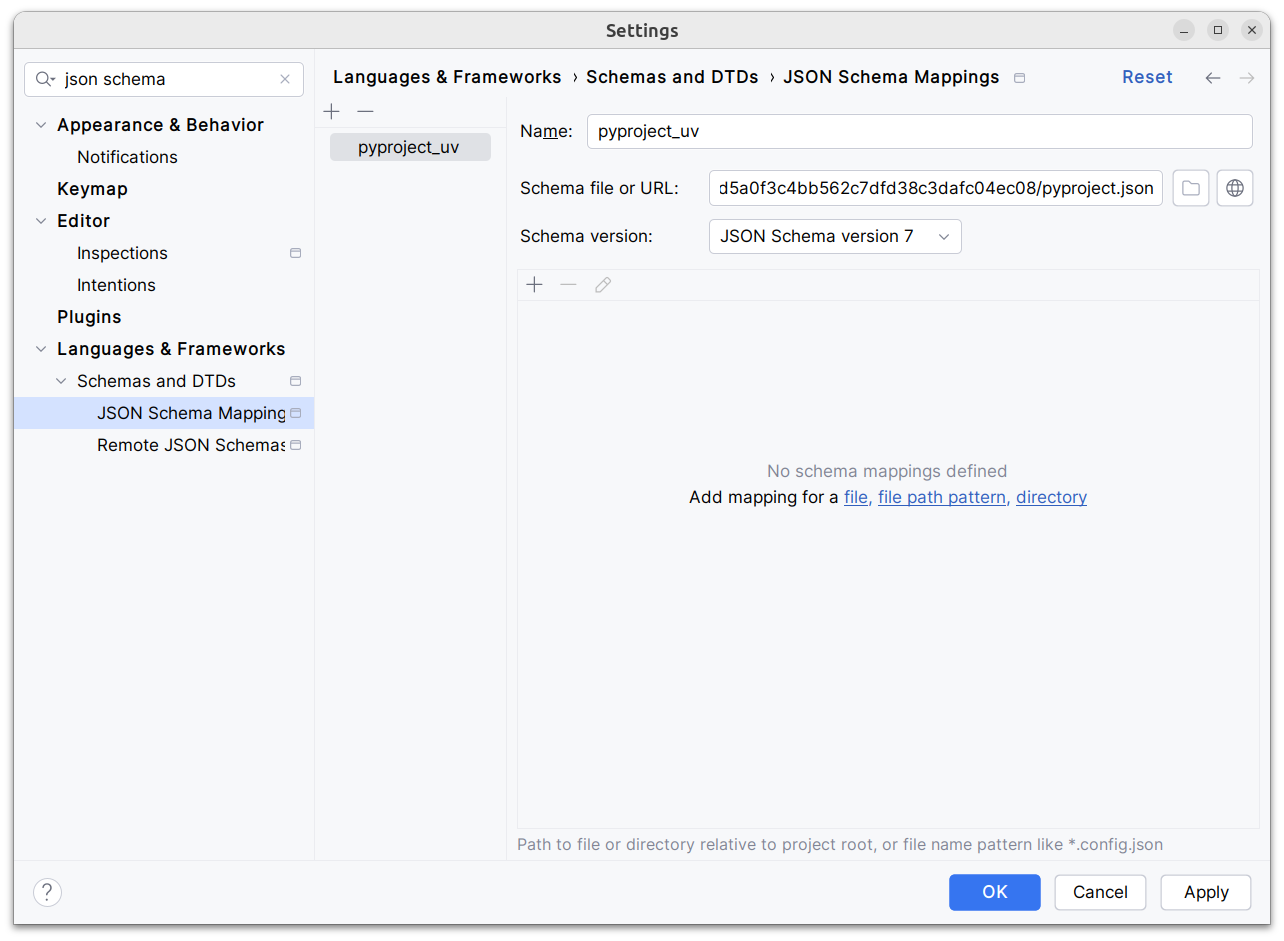
[dove.webm](https://github.com/astral-sh/uv/assets/6826232/c293c272-c80b-459d-8c95-8c46a8d198a1)
Moves all of `uv-toolchain` into `uv-interpreter`. We may split these
out in the future, but the refactoring I want to do for interpreter
discovery is easier if I don't have to deal with entanglement. Includes
some restructuring of `uv-interpreter`.

Part of #2386
Previously, uv-auth would fail to compile due to a missing process
feature. I chose to make all tokio features we use top level features,
so we can share the tokio cache between all test invocations.
 Zanie Blue
 Charlie Marsh
 Andrew Gallant
 Jp
Jp
 konsti
 renovate[bot]
 Michał Górny
 Shane Kennedy
 Pietro Zambelli
 Ben Beasley
 samypr100
 Amos Wenger
 Ibraheem Ahmed
 davfsa
 Maksim Bondarenkov