## Summary

This PR refactors the formatter diff code to reuse the
`SourceKind::diff` logic. This has the benefit that the Notebook diff
now includes the cell numbers which was not present before.

## Test Plan

Update the snapshots and verified the cell numbers.
## Summary

Given:

```python
# comment

class A:
    def foo(self):
        pass
```

We need to insert an additional newline between `# comment` and `class
A`. We were missing this handling for the case in which `# comment` is a
leading comment on `class A`, as opposed to a trailing comment of some
preceding statement.

In practice, I think this only applies to the specific case in which a
class or function is the first statement in a module, and there's a
single empty line between a leading comment and that class or function.
If there are no empty lines, then the comment "sticks" to the
definition; if there are two or more, then `leading_comments` will
truncate appropriately. If the class or function is nested, then we only
need one empty line anyway.

Closes https://github.com/astral-sh/ruff/issues/8215.

## Test Plan

No change in similarity.

Before:

| project | similarity index | total files | changed files |

|----------------|------------------:|------------------:|------------------:|
| cpython | 0.75803 | 1799 | 1647 |
| django | 0.99983 | 2772 | 34 |
| home-assistant | 0.99953 | 10596 | 186 |
| poetry | 0.99891 | 317 | 17 |
| transformers | 0.99966 | 2657 | 330 |
| twine | 1.00000 | 33 | 0 |
| typeshed | 0.99978 | 3669 | 20 |
| warehouse | 0.99977 | 654 | 13 |
| zulip | 0.99970 | 1459 | 22 |

After:

| project | similarity index | total files | changed files |

|----------------|------------------:|------------------:|------------------:|
| cpython | 0.75803 | 1799 | 1648 |
| django | 0.99983 | 2772 | 34 |
| home-assistant | 0.99953 | 10596 | 186 |
| poetry | 0.99891 | 317 | 17 |
| transformers | 0.99966 | 2657 | 330 |
| twine | 1.00000 | 33 | 0 |
| typeshed | 0.99978 | 3669 | 20 |
| warehouse | 0.99977 | 654 | 13 |
| zulip | 0.99970 | 1459 | 22 |
## Summary

This PR removes the `todo!()` around `IpyEscapeCommand` in the
formatter.

The `NeedsParentheses` trait needs to be implemented which always return
`Never`. The reason being that if an escape command is parenthesized,
then that's not parsed as an escape command. IOW, the parentheses
shouldn't be present around an escape command.

In the similar way, the `CanSkipOptionalParenthesesVisitor` will skip
this node.

## Test Plan

Updated the `unformatted.ipynb` fixture with new cells containing
IPython escape commands and the corresponding snapshot was verified.
Also, tested it out in a few open source repositories containing
notebooks (`openai/openai-cookbook`, `huggingface/notebooks`).

#### New cells in `unformatted.ipynb`

**Cell 2**
```markdown
A markdown cell
```

**Cell 3**
```python
def some_function(foo, bar):
    pass
%matplotlib inline
```

**Cell 4**
```python
foo = %pwd
def some_function(foo,bar,):
	foo = %pwd
    print(foo
	)
```

fixes: #8204
## Summary

This PR fixes the bug where if a Notebook contained IPython syntax, then
the format command would fail. This was because the correct mode was not
being used while parsing through the formatter code path.

## Test Plan

This PR isn't the only requirement for Notebook formatting to start
working with IPython escape commands. The following PR in the stack is
required as well.
## Summary

Python 3.12 added the `__buffer__()`/`__release_buffer_()` special
methods, which are incorrectly flagged as invalid dunder methods by
`PLW3201`.

## Test Plan

Added definitions to the test suite, and confirmed they failed without
the fix and are ignored after the fix was done.
## Summary

Related to https://github.com/astral-sh/ruff/issues/8135.

If we're not printing a `--diff`, or a summary of `--check` changes, we
can avoid sorting the list of results. Further, when sorting, we only
need to sort a small subset of the entries, in the common case (i.e., in
general, it's much more likely that a file is formatted than not).

## Test Plan

Local benchmarks suggest a 5-10% speedup on the cached behavior:

```
❯ hyperfine --warmup 3 "./target/release/ruff format ../airflow" "./target/release/sort format ../airflow"
Benchmark 1: ./target/release/ruff format ../airflow
  Time (mean ± σ):      70.3 ms ±   5.2 ms    [User: 52.1 ms, System: 59.0 ms]
  Range (min … max):    68.3 ms … 101.7 ms    42 runs

  Warning: Statistical outliers were detected. Consider re-running this benchmark on a quiet PC without any interferences from other programs. It might help to use the '--warmup' or '--prepare' options.

Benchmark 2: ./target/release/sort format ../airflow
  Time (mean ± σ):      66.0 ms ±   1.4 ms    [User: 48.3 ms, System: 58.4 ms]
  Range (min … max):    64.7 ms …  71.8 ms    44 runs

  Warning: Statistical outliers were detected. Consider re-running this benchmark on a quiet PC without any interferences from other programs. It might help to use the '--warmup' or '--prepare' options.

Summary
  './target/release/sort format ../airflow' ran
    1.07 ± 0.08 times faster than './target/release/ruff format ../airflow'
```
## Summary
This PR renames the `tab-size` configuration option to `indent-width` to
express that the formatter uses the option to determine the indentation
width AND as tab width.
I first preferred naming the option `tab-width` but then decided to go
with `indent-width` because:
* It aligns with the `indent-style` option
* It would allow us to write a lint rule that asserts that each
indentation uses `indent-width` spaces.
Closes#7643
## Test Plan
Added integration test
## Summary
This PR introduces a new `pycodestyl.max-line-length` option that allows overriding the global `line-length` option for `E501` only.
This is useful when using the formatter and `E501` together, where the formatter uses a lower limit and `E501` is only used to catch extra-long lines.
Closes#7644
## Considerations
~~Our fix infrastructure asserts in some places that the fix doesn't exceed the configured `line-width`. With this change, the question is whether it should use the `pycodestyle.max-line-width` or `line-width` option to make that decision.
I opted for the global `line-width` for now, considering that it should be the lower limit. However, this constraint isn't enforced and users not using the formatter may only specify `pycodestyle.max-line-width` because they're unaware of the global option (and it solves their need).~~
~~I'm interested to hear your thoughts on whether we should use `pycodestyle.max-line-width` or `line-width` to decide on whether to emit a fix or not.~~
Edit: The linter users `pycodestyle.max-line-width`. The `line-width` option has been removed from the `LinterSettings`
## Test Plan
Added integration test. Built the documentation and verified that the links are correct.
## Summary

First time contribute to `ruff`, so If there are low-level errors,
please forgive me. 🙇

Introduce auto fix for `E275`, this partially address #8121.

## Test Plan

Already coverd.
<!--
Thank you for contributing to Ruff! To help us out with reviewing,
please consider the following:
- Does this pull request include a summary of the change? (See below.)
- Does this pull request include a descriptive title?
- Does this pull request include references to any relevant issues?
-->
## Summary
<!-- What's the purpose of the change? What does it do, and why? -->
Close#8123
## Test Plan
<!-- How was it tested? -->
New test cases
---------
Signed-off-by: harupy <hkawamura0130@gmail.com>
## Summary

This was just a bug in the parser ranges, probably since it was
initially implemented. Given `match n % 3, n % 5: ...`, the "subject"
(i.e., the tuple of two binary operators) was using the entire range of
the `match` statement.

Closes https://github.com/astral-sh/ruff/issues/8091.

## Test Plan

`cargo test`
## Summary

This PR updates our E721 implementation and semantics to match the
updated `pycodestyle` logic, which I think is an improvement.
Specifically, we now allow `type(obj) is int` for exact type
comparisons, which were previously impossible. So now, we're largely
just linting against code like `type(obj) == int`.

This change is gated to preview mode.

Closes https://github.com/astral-sh/ruff/issues/7904.

## Test Plan

Updated the test fixture and ensured parity with latest Flake8.
## Summary

This PR updates our documentation for the upcoming formatter release.

Broadly, the documentation is now structured as follows:

- Overview
- Tutorial
- Installing Ruff
- The Ruff Linter
    - Overview
    - `ruff check`
    - Rule selection
    - Error suppression
    - Exit codes
- The Ruff Formatter
    - Overview
    - `ruff format`
    - Philosophy
    - Configuration
    - Format suppression
    - Exit codes
    - Black compatibility
        - Known deviations
- Configuring Ruff
    - pyproject.toml
    - File discovery
    - Configuration discovery
    - CLI
    - Shell autocompletion
- Preview
- Rules
- Settings
- Integrations
    - `pre-commit`
    - VS Code
    - LSP
    - PyCharm
    - GitHub Actions
- FAQ
- Contributing

The major changes include:

- Removing the "Usage" section from the docs, and instead folding that
information into "Integrations" and the new Linter and Formatter
sections.
- Breaking up "Configuration" into "Configuring Ruff" (for generic
configuration), and new Linter- and Formatter-specific sections.
- Updating all example configurations to use `[tool.ruff.lint]` and
`[tool.ruff.format]`.

My suggestion is to pull and build the docs locally, and review by
reading them in the browser rather than trying to parse all the code
changes.

Closes https://github.com/astral-sh/ruff/issues/7235.

Closes https://github.com/astral-sh/ruff/issues/7647.
Adds a new `ruff version` sub-command which displays long version
information in the style of `cargo` and `rustc`. We include the number
of commits since the last release tag if its a development build, in the
style of Python's versioneer.

```
❯ ruff version
ruff 0.1.0+14 (947940e91 2023-10-18)
```

```
❯ ruff version --output-format json
{
  "version": "0.1.0",
  "commit_info": {
    "short_commit_hash": "947940e91",
    "commit_hash": "947940e91269f20f6b3f8f8c7c63f8e914680e80",
    "commit_date": "2023-10-18",
    "last_tag": "v0.1.0",
    "commits_since_last_tag": 14
  }
}%
```

```
❯ cargo version
cargo 1.72.1 (103a7ff2e 2023-08-15)
```
## Test plan

I've tested this manually locally, but want to at least add unit tests
for the message formatting. We'd also want to check the next release to
ensure the information is correct.

I checked build behavior with a detached head and branches.

## Future work

We could include rustc and cargo versions from the build, the current
Python version, and other diagnostic information for bug reports.

The `--version` and `-V` output is unchanged. However, we could update
it to display the long ruff version without the rust and cargo versions
(this is what cargo does). We'll need to be careful to ensure this does
not break downstream packages which parse our version string.

```
❯ ruff --version
ruff 0.1.0
```

The LSP should be updated to use `ruff version --output-format json`
instead of parsing `ruff --version`.
This is my first PR and I'm new at rust, so feel free to ask me to
rewrite everything if needed ;)

The rule must be called after deferred lambas have been visited because
of the last check (whether the lambda parameters are used in the body of
the function that's being called). I didn't know where to do it, so I
did what I could to be able to work on the rule itself:

 - added a `ruff_linter::checkers::ast::analyze::lambda` module
 - build a vec of visited lambdas in `visit_deferred_lambdas`
 - call `analyze::lambda` on the vec after they all have been visited

Building that vec of visited lambdas was necessary so that bindings
could be properly resolved in the case of nested lambdas.

Note that there is an open issue in pylint for some false positives, do
we need to fix that before merging the rule?
https://github.com/pylint-dev/pylint/issues/8192

Also, I did not provide any fixes (yet), maybe we want do avoid merging
new rules without fixes?

## Summary

Checks for lambdas whose body is a function call on the same arguments
as the lambda itself.

### Bad

```python
df.apply(lambda x: str(x))
```

### Good

```python
df.apply(str)
```

## Test Plan

Added unit test and snapshot.
Manually compared pylint and ruff output on pylint's test cases.

## References

- [pylint
documentation](https://pylint.readthedocs.io/en/latest/user_guide/messages/warning/unnecessary-lambda.html)
- [pylint
implementation](https://github.com/pylint-dev/pylint/blob/main/pylint/checkers/base/basic_checker.py#L521-L587)
 - https://github.com/astral-sh/ruff/issues/970
## Summary

The lint checks for number of arguments in a function *definition*, but
the message says “function *call*”

## Test Plan

See what breaks and change the tests
Given `print(*a_list_with_elements, sep="\n")`, we can't remove the
separator (unlike in `print(a, sep="\n")`), since we don't know how many
arguments were provided.

Closes https://github.com/astral-sh/ruff/issues/8078.
- Add changelog entry for 0.1.1
- Bump version to 0.1.1
- Require preview for fix added in #7967
- Allow duplicate headings in changelog (markdownlint setting)
<!--
Thank you for contributing to Ruff! To help us out with reviewing,
please consider the following:

- Does this pull request include a summary of the change? (See below.)
- Does this pull request include a descriptive title?
- Does this pull request include references to any relevant issues?
-->

## Summary

Fixes https://github.com/astral-sh/ruff/issues/7448
Fixes https://github.com/astral-sh/ruff/issues/7892

I've removed automatic dangling comment formatting, we're doing manual
dangling comment formatting everywhere anyway (the
assert-all-comments-formatted ensures this) and dangling comments would
break the formatting there.

## Test Plan

New test file.

---------

Co-authored-by: Micha Reiser <micha@reiser.io>
Split out of #8044: In preview style, ellipsis are also collapsed in
non-stub files. This should only affect function/class contexts since
for other statements stub are generally not used. I've updated our tests
to use `pass` instead to reflect this, which makes tracking the preview
style changes much easier.
## Summary

Given an expression like `[x for (x) in y]`, we weren't skipping over
parentheses when searching for the `in` between `(x)` and `y`.

Closes https://github.com/astral-sh/ruff/issues/8053.
## Summary

In #6157 a warning was introduced when users use `ruff: noqa`
suppression in-line instead of at the file-level. I had this trigger
today after forgetting about it, and the warning is an excellent
improvement.

I knew immediately what the issue was because I raised it previously,
but on reading the warning I'm not sure it would be so obvious to all
users. This PR extends the error with a short sentence explaining that
line-level suppression should omit the `ruff:` prefix.

## Test Plan

Not sure it's necessary for such a trivial change :)
**Summary** `ruff format --diff` is similar to `ruff format --check`,
but we don't only error with the list of file that would be formatted,
but also show a diff between the unformatted input and the formatted
output.
```console
$ ruff format --diff scratch.py scratch.pyi scratch.ipynb
warning: `ruff format` is not yet stable, and subject to change in future versions.
--- scratch.ipynb
+++ scratch.ipynb
@@ -1,3 +1,4 @@
import numpy
-maths = (numpy.arange(100)**2).sum()
-stats= numpy.asarray([1,2,3,4]).median()
+
+maths = (numpy.arange(100) ** 2).sum()
+stats = numpy.asarray([1, 2, 3, 4]).median()
--- scratch.py
+++ scratch.py
@@ -1,3 +1,3 @@
x = 1
-y=2
+y = 2
z = 3
2 files would be reformatted, 1 file left unchanged
```
With `--diff`, the summary message gets printed to stderr to allow e.g.
`ruff format --diff . > format.patch`.
At the moment, jupyter notebooks are formatted as code diffs, while
everything else is a real diff that could be applied. This means that
the diffs containing jupyter notebooks are not real diffs and can't be
applied. We could change this to json diffs, but they are hard to read.
We could also split the diff option into a human diff option, where we
deviate from the machine readable diff constraints, and a proper machine
readable, appliable diff output that you can pipe into other tools.
To make the tests work, the results (and errors, if any) are sorted
before printing them. Previously, the print order was random, i.e. two
identical runs could have different output.
Open question: Should this go into the markdown docs? Or will this be
subsumed by the integration of the formatter into `ruff check`?
**Test plan** Fixtures for the change and no change cases, including a
jupyter notebook and for file input and stdin.
Fixes#7231
---------
Co-authored-by: Micha Reiser <micha@reiser.io>
**Summary** Insert a newline after nested function and class
definitions, unless there is a trailing own line comment.

We need to e.g. format
```python
if platform.system() == "Linux":
    if sys.version > (3, 10):
        def f():
            print("old")
    else:
        def f():
            print("new")
    f()
```
as
```python
if platform.system() == "Linux":
    if sys.version > (3, 10):

        def f():
            print("old")

    else:

        def f():
            print("new")

    f()
```
even though `f()` is directly preceded by an if statement, not a
function or class definition. See the comments and fixtures for trailing
own line comment handling.

**Test Plan** I checked that the new content of `newlines.py` matches
black's formatting.

---------

Co-authored-by: Charlie Marsh <charlie.r.marsh@gmail.com>
## Summary

When linting, we store a map from file path to fixes, which we then use
to show a fix summary in the printer.

In the printer, we assume that if the map is non-empty, then we have at
least one fix. But this isn't enforced by the fix struct, since you can
have an entry from (file path) to (empty fix table). In practice, this
only bites us when linting from `stdin`, since when linting across
multiple files, we have an `AddAssign` on `Diagnostics` that avoids
adding empty entries to the map. When linting from `stdin`, we create
the map directly, and so it _is_ possible to have a non-empty map that
doesn't contain any fixes, leading to a panic.

This PR introduces a dedicated struct to make these constraints part of
the formal interface.

Closes https://github.com/astral-sh/ruff/issues/8027.

## Test Plan

`cargo test` (notice two failures are removed)
<!--
Thank you for contributing to Ruff! To help us out with reviewing,
please consider the following:

- Does this pull request include a summary of the change? (See below.)
- Does this pull request include a descriptive title?
- Does this pull request include references to any relevant issues?
-->

## Summary

In https://github.com/astral-sh/ruff/pull/7968, I introduced a
regression whereby we started to treat imports used _only_ in type
annotation bounds (with `__future__` annotations) as unused.

The root of the issue is that I started using `visit_annotation` for
these bounds. So we'd queue up the bound in the list of deferred type
parameters, then when visiting, we'd further queue it up in the list of
deferred type annotations... Which we'd then never visit, since deferred
type annotations are visited _before_ deferred type parameters.

Anyway, the better solution here is to use a dedicated flag for these,
since they have slightly different behavior than type annotations.

I've also fixed what I _think_ is a bug whereby we previously failed to
resolve `Callable` in:

```python
type RecordCallback[R: Record] = Callable[[R], None]

from collections.abc import Callable
```

IIUC, the values in type aliases should be evaluated lazily, like type
parameters.

Closes https://github.com/astral-sh/ruff/issues/8017.

## Test Plan

`cargo test`
## Summary
Rule B005 of flake8-bugbear docs has a typo in one of the examples that
leads to a confusion in the correctness of `.strip()` method

```python
# Wrong output (used in docs)
"text.txt".strip(".txt") # "ex"
# Correct output
"text.txt".strip(".txt") # "e"
```
## Summary

Fix a typo in the docs for quote style.

> a = "a string without any quotes"
> b = "It's monday morning"
> Ruff will change a to use single quotes when using quote-style =
"single". However, a will be unchanged, as converting to single quotes
would require the inner ' to be escaped, which leads to less readable
code: 'It\'s monday morning'.

It should read "However, **b** will be unchanged".

## Test Plan

N/A.
## Summary
### What it does
This rule triggers an error when a bare raise statement is not in an
except or finally block.
### Why is this bad?
If raise statement is not in an except or finally block, there is no
active exception to
re-raise, so it will fail with a `RuntimeError` exception.
### Example
```python
def validate_positive(x):
if x <= 0:
raise
```
Use instead:
```python
def validate_positive(x):
if x <= 0:
raise ValueError(f"{x} is not positive")
```
## Test Plan
Added unit test and snapshot.
Manually compared ruff and pylint outputs on pylint's tests.
## References
- [pylint
documentation](https://pylint.pycqa.org/en/stable/user_guide/messages/error/misplaced-bare-raise.html)
- [pylint
implementation](https://github.com/pylint-dev/pylint/blob/main/pylint/checkers/exceptions.py#L339)
See the provided breaking changes note for details.
Removes support for the deprecated `--format`option in the `ruff check`
CLI, `format` inference as `output-format` in the configuration file,
and the `RUFF_FORMAT` environment variable.
The error message for use of `format` in the configuration file could be
better, but would require some awkward serde wrappers and it seems hard
to present the correct schema to the user still.
## Summary
Given `type RecordOrThings = Record | int | str`, the right-hand side
won't be evaluated at runtime. Same goes for `Record` in `type
RecordCallback[R: Record] = Callable[[R], None]`. This PR modifies the
visitation logic to treat them as typing-only.
Closes https://github.com/astral-sh/ruff/issues/7966.
## Summary
Unlike other filepath-based settings, the `cache-dir` wasn't being
resolved relative to the project root, when specified as an absolute
path.
Closes https://github.com/astral-sh/ruff/issues/7958.
## Summary
This PR adds a new `cell` field to the JSON output format which
indicates the Notebook cell this diagnostic (and fix) belongs to. It
also updates the location for the diagnostic and fixes as per the
`NotebookIndex`. It will be used in the VSCode extension to display the
diagnostic in the correct cell.
The diagnostic and edit start and end source locations are translated
for the notebook as per the `NotebookIndex`. The end source location for
an edit needs some special handling.
### Edit end location
To understand this, the following context is required:
1. Visible lines in Jupyter Notebook vs JSON array strings: The newline
is part of the string in the JSON format. This means that if there are 3
visible lines in a cell where the last line is empty then the JSON would
contain 2 strings in the source array, both ending with a newline:
**JSON format:**
```json
[
"# first line\n",
"# second line\n",
]
```
**Notebook view:**
```python
1 # first line
2 # second line
3
```
2. If an edit needs to remove an entire line including the newline, then
the end location would be the start of the next row.
To remove a statement in the following code:
```python
import os
```
The edit would be:
```
start: row 1, col 1
end: row 2, col 1
```
Now, here's where the problem lies. The notebook index doesn't have any
information for row 2 because it doesn't exists in the actual notebook.
The newline was added by Ruff to concatenate the source code and it's
removed before writing back. But, the edit is computed looking at that
newline.
This means that while translating the end location for an edit belong to
a Notebook, we need to check if both the start and end location belongs
to the same cell. If not, then the end location should be the first
character of the next row and if so, translate that back to the last
character of the previous row. Taking the above example, the translated
location for Notebook would be:
```
start: row 1, col 1
end: row 1, col 10
```
## Test Plan
Add test cases for notebook output in the JSON format and update
existing snapshots.
## Summary
This PR refactors the `NotebookIndex` struct to use `OneIndexed` to make
the
intent of the code clearer.
## Test Plan
Update the existing test case and run `cargo test` to verify the change.
- [x] Verify `--diff` output
- [x] Verify the diagnostics output
- [x] Verify `--show-source` output
**Summary** Handle comment before the default values of function
parameters correctly by inserting a line break instead of space after
the equals sign where required.
```python
def f(
a = # parameter trailing comment; needs line break
1,
b =
# default leading comment; needs line break
2,
c = ( # the default leading can only be end-of-line with parentheses; no line break
3
),
d = (
# own line leading comment with parentheses; no line break
4
)
)
```
Fixes#7603
**Test Plan** Added the different cases and one more complex case as
fixtures.
## Summary
This PR fixes the bug where the rule `E251` was being triggered on a equal token
inside a f-string which was used in the context of debug expressions.
For example, the following was being flagged before the fix:
```python
print(f"{foo = }")
```
But, now it is not. This leads to false negatives such as:
```python
print(f"{foo(a = 1)}")
```
One solution would be to know if the opened parentheses was inside a f-string or
not. If it was then we can continue flagging until it's closed. If not, then we
should not flag it.
## Test Plan
Add new test cases and check that they don't raise any false positives.
fixes: #7882
## Summary
`foo(**{})` was an overlooked edge case for `PIE804` which introduced a
crash within the Fix, introduced in #7884.
I've made it so that `foo(**{})` turns into `foo()` when applied with
`--fix`, but is that desired/expected? 🤔 Should we just ignore instead?
## Test Plan
`cargo test`
Closes https://github.com/astral-sh/ruff/issues/7572
Drops formatting specific rules from the default rule set as they
conflict with formatters in general (and in particular, conflict with
our formatter). Most of these rules are in preview, but the removal of
`line-too-long` and `mixed-spaces-and-tabs` is a change to the stable
rule set.
## Example
The following no longer raises `E501`
```
echo "xxxxxxxxxxxxxxxxxxxxxxxxxxxxxxxxxxxxxxxxxxxxxxxxxxxxxxxxxxxxxxxxxxxxxxxxxxxxxxxxxxxxxxxx = 1" | ruff check -
```
## Summary
Throughout the codebase, we have this pattern:
```rust
let mut diagnostic = ...
if checker.patch(Rule::UnusedVariable) {
// Do the fix.
}
diagnostics.push(diagnostic)
```
This was helpful when we computed fixes lazily; however, we now compute
fixes eagerly, and this is _only_ used to ensure that we don't generate
fixes for rules marked as unfixable.
We often forget to add this, and it leads to bugs in enforcing
`--unfixable`.
This PR instead removes all of these checks, moving the responsibility
of enforcing `--unfixable` up to `check_path`. This is similar to how
@zanieb handled the `--extend-unsafe` logic: we post-process the
diagnostics to remove any fixes that should be ignored.
## Summary
Add autofix for `PLR1714` using tuples.
If added complexity is desired, we can lean into the `set` part by doing
some kind of builtin check on all of the comparator elements for
starters, since we otherwise don't know if something's hashable.
## Test Plan
`cargo test`, and manually.
**Summary** Remove spaces from import statements such as
```python
import tqdm . tqdm
from tqdm . auto import tqdm
```
See also #7760 for a better solution.
**Test Plan** New fixtures
**Summary** Quoting of f-strings can change if they are triple quoted
and only contain single quotes inside.
Fixes#6841
**Test Plan** New fixtures
---------
Co-authored-by: Dhruv Manilawala <dhruvmanila@gmail.com>
<!--
Thank you for contributing to Ruff! To help us out with reviewing,
please consider the following:
- Does this pull request include a summary of the change? (See below.)
- Does this pull request include a descriptive title?
- Does this pull request include references to any relevant issues?
-->
## Summary
<!-- What's the purpose of the change? What does it do, and why? -->
closes https://github.com/astral-sh/ruff/issues/7912
## Test Plan
<!-- How was it tested? -->
Adds two configuration-file only settings `extend-safe-fixes` and
`extend-unsafe-fixes` which can be used to promote and demote the
applicability of fixes for rules.
Fixes with `Never` applicability cannot be promoted.
## Summary
Given:
```python
baz: Annotated[
str,
[qux for qux in foo],
]
```
We treat `baz` as `BindingKind::Annotation`, to ensure that references
to `baz` are marked as unbound. However, we were _also_ treating `qux`
as `BindingKind::Annotation`, which meant that the load in the
comprehension _also_ errored.
Closes https://github.com/astral-sh/ruff/issues/7879.
## Summary
This PR upgrades some rules from "sometimes" to "always" fixes, now that
we're getting ready to ship support in the CLI. The focus here was on
identifying rules for which the diagnostic itself is high-confidence,
and the fix itself is too (assuming that the diagnostic is correct).
This is _unlike_ rules that _may_ be a false positive, like those that
(e.g.) assume an object is a dictionary when you call `.values()` on it.
Specifically, I upgraded:
- A bunch of rules that only apply to `.pyi` files.
- Rules that rewrite deprecated imports or aliases.
- Some other misc. rules, like: `empty-print-string`, `unused-noqa`,
`getattr-with-constant`.
Open to feedback on any of these.
## Summary
Adds autofix to `PYI030`
Closes#7854.
Unsure if the cloning method I chose is the best solution here, feel
free to suggest alternatives!
## Test Plan
`cargo test` as well as manually
## Summary
Restores functionality of #7875 but in the correct place. Closes#7877.
~~I couldn't figure out how to get cargo fmt to work, so hopefully
that's run in CI.~~ Nevermind, figured it out.
## Test Plan
Can see output of json.
## Summary
This PR fixes a bug to disallow f-strings in match pattern literal.
```
literal_pattern ::= signed_number
| signed_number "+" NUMBER
| signed_number "-" NUMBER
| strings
| "None"
| "True"
| "False"
| signed_number: NUMBER | "-" NUMBER
```
Source:
https://docs.python.org/3/reference/compound_stmts.html#grammar-token-python-grammar-literal_pattern
Also,
```console
$ python /tmp/t.py
File "/tmp/t.py", line 4
case "hello " f"{name}":
^^^^^^^^^^^^^^^^^^
SyntaxError: patterns may only match literals and attribute lookups
```
## Test Plan
Update existing test case and accordingly the snapshots. Also, add a new
test case to verify that the parser does raise an error.
## Summary
Fixes#7853.
The old and new source files were reversed in the call to
`TextDiff::from_lines`, so the diff output of the CLI was also reversed.
## Test Plan
Two snapshots were updated in the process, so any reversal should be
caught :)
Closes https://github.com/astral-sh/ruff/issues/7491
Users found it confusing that warnings were displayed when ignoring a
preview rule (which has no effect without `--preview`). While we could
retain the warning with different messaging, I've opted to remove it for
now. With this pull request, we will only warn on `--select` and
`--extend-select` but not `--fixable`, `--unfixable`, `--ignore`, or
`--extend-fixable`.
## Summary
Resolves https://github.com/astral-sh/ruff/issues/7618.
The list of builtin iterator is not exhaustive.
## Test Plan
`cargo test`
``` python
a = [1, 2]
examples = [
enumerate(a),
filter(lambda x: x, a),
map(int, a),
reversed(a),
zip(a),
iter(a),
]
for example in examples:
print(next(example))
```
## Summary
Implement
[`no-single-item-in`](https://github.com/dosisod/refurb/blob/master/refurb/checks/iterable/no_single_item_in.py)
as `single-item-membership-test` (`FURB171`).
Uses the helper function `generate_comparison` from the `pycodestyle`
implementations; this function should probably be moved, but I am not
sure where at the moment.
Update: moved it to `ruff_python_ast::helpers`.
Related to #1348.
## Test Plan
`cargo test`
I noticed that `tracing::instrument` wasn't available with only the
`"std"` feature enabled when trying to run `cargo doc -p
ruff_formatter`.
I could be misunderstanding something, but I couldn't even run the tests
for the crate.
```
ruff on ruff-formatter-tracing [$] is 📦 v0.0.292 via 🦀 v1.72.0
❯ cargo test -p ruff_formatter
Compiling ruff_formatter v0.0.0 (/Users/chrispryer/github/ruff/crates/ruff_formatter)
error[E0433]: failed to resolve: could not find `instrument` in `tracing`
--> crates/ruff_formatter/src/printer/mod.rs:57:16
|
57 | #[tracing::instrument(name = "Printer::print", skip_all)]
| ^^^^^^^^^^ could not find `instrument` in `tracing`
|
note: found an item that was configured out
--> /Users/chrispryer/.cargo/registry/src/index.crates.io-6f17d22bba15001f/tracing-0.1.37/src/lib.rs:959:29
|
959 | pub use tracing_attributes::instrument;
| ^^^^^^^^^^
= note: the item is gated behind the `attributes` feature
For more information about this error, try `rustc --explain E0433`.
error: could not compile `ruff_formatter` (lib) due to previous error
warning: build failed, waiting for other jobs to finish...
error: could not compile `ruff_formatter` (lib test) due to previous error
```
Maybe the idea is to keep this crate minimal, but I figured I'd at least
point this out.
## Summary
Document the performance effects of `itertools.starmap`, including that
it is actually slower than comprehensions in Python 3.12.
Closes#7771.
## Test Plan
`python scripts/check_docs_formatted.py`
After working with the previous change in
https://github.com/astral-sh/ruff/pull/7821 I found the names a bit
unclear and their relationship with the user-facing API muddied. Since
the applicability is exposed to the user directly in our JSON output, I
think it's important that these names align with our configuration
options. I've replaced `Manual` or `Never` with `Display` which captures
our intent for these fixes (only for display). Here, we create room for
future levels, such as `HasPlaceholders`, which wouldn't fit into the
`Always`/`Sometimes`/`Never` levels.
Unlike https://github.com/astral-sh/ruff/pull/7819, this retains the
flat enum structure which is easier to work with.
Previously we just omitted diagnostic summaries when using `--fix` or
`--diff` with a stdin file. Now, we still write the summaries to stderr
instead of the main writer (which is generally stdout but could be
changed by `--output-file`).
Rebase of https://github.com/astral-sh/ruff/pull/5119 authored by
@evanrittenhouse with additional refinements.
## Changes
- Adds `--unsafe-fixes` / `--no-unsafe-fixes` flags to `ruff check`
- Violations with unsafe fixes are not shown as fixable unless opted-in
- Fix applicability is respected now
- `Applicability::Never` fixes are no longer applied
- `Applicability::Sometimes` fixes require opt-in
- `Applicability::Always` fixes are unchanged
- Hints for availability of `--unsafe-fixes` added to `ruff check`
output
## Examples
Check hints at hidden unsafe fixes
```
❯ ruff check example.py --no-cache --select F601,W292
example.py:1:14: F601 Dictionary key literal `'a'` repeated
example.py:2:15: W292 [*] No newline at end of file
Found 2 errors.
[*] 1 fixable with the `--fix` option (1 hidden fix can be enabled with the `--unsafe-fixes` option).
```
We could add an indicator for which violations have hidden fixes in the
future.
Check treats unsafe fixes as applicable with opt-in
```
❯ ruff check example.py --no-cache --select F601,W292 --unsafe-fixes
example.py:1:14: F601 [*] Dictionary key literal `'a'` repeated
example.py:2:15: W292 [*] No newline at end of file
Found 2 errors.
[*] 2 fixable with the --fix option.
```
Also can be enabled in the config file
```
❯ cat ruff.toml
unsafe-fixes = true
```
And opted-out per invocation
```
❯ ruff check example.py --no-cache --select F601,W292 --no-unsafe-fixes
example.py:1:14: F601 Dictionary key literal `'a'` repeated
example.py:2:15: W292 [*] No newline at end of file
Found 2 errors.
[*] 1 fixable with the `--fix` option (1 hidden fix can be enabled with the `--unsafe-fixes` option).
```
Diff does not include unsafe fixes
```
❯ ruff check example.py --no-cache --select F601,W292 --diff
--- example.py
+++ example.py
@@ -1,2 +1,2 @@
x = {'a': 1, 'a': 1}
-print(('foo'))
+print(('foo'))
\ No newline at end of file
Would fix 1 error.
```
Unless there is opt-in
```
❯ ruff check example.py --no-cache --select F601,W292 --diff --unsafe-fixes
--- example.py
+++ example.py
@@ -1,2 +1,2 @@
-x = {'a': 1}
-print(('foo'))
+x = {'a': 1, 'a': 1}
+print(('foo'))
\ No newline at end of file
Would fix 2 errors.
```
https://github.com/astral-sh/ruff/pull/7790 will improve the diff
messages following this pull request
Similarly, `--fix` and `--fix-only` require the `--unsafe-fixes` flag to
apply unsafe fixes.
## Related
Replaces #5119
Closes https://github.com/astral-sh/ruff/issues/4185
Closes https://github.com/astral-sh/ruff/issues/7214
Closes https://github.com/astral-sh/ruff/issues/4845
Closes https://github.com/astral-sh/ruff/issues/3863
Addresses https://github.com/astral-sh/ruff/issues/6835
Addresses https://github.com/astral-sh/ruff/issues/7019
Needs follow-up https://github.com/astral-sh/ruff/issues/6962
Needs follow-up https://github.com/astral-sh/ruff/issues/4845
Needs follow-up https://github.com/astral-sh/ruff/issues/7436
Needs follow-up https://github.com/astral-sh/ruff/issues/7025
Needs follow-up https://github.com/astral-sh/ruff/issues/6434
Follow-up #7790
Follow-up https://github.com/astral-sh/ruff/pull/7792
---------
Co-authored-by: Evan Rittenhouse <evanrittenhouse@gmail.com>
## Summary
This PR updates the parser definition to use the precise location when reporting
an invalid f-string conversion flag error.
Taking the following example code:
```python
f"{foo!x}"
```
On earlier version,
```
Error: f-string: invalid conversion character at byte offset 6
```
Now,
```
Error: f-string: invalid conversion character at byte offset 7
```
This becomes more useful when there's whitespace between `!` and the flag value
although that is not valid but we can't detect that now.
## Test Plan
As mentioned above.
## Summary
This PR resolves an issue raised in
https://github.com/astral-sh/ruff/discussions/7810, whereby we don't fix
an f-string that exceeds the line length _even if_ the resultant code is
_shorter_ than the current code.
As part of this change, I've also refactored and extracted some common
logic we use around "ensuring a fix isn't breaking the line length
rules".
## Test Plan
`cargo test`
## Summary
The implementation here differs from the non-`stdin` version -- this is
now more consistent.
## Test Plan
```
❯ cat Untitled.ipynb | cargo run -p ruff_cli -- check --stdin-filename Untitled.ipynb --diff -n
Finished dev [unoptimized + debuginfo] target(s) in 0.11s
Running `target/debug/ruff check --stdin-filename Untitled.ipynb --diff -n`
--- Untitled.ipynb:cell 2
+++ Untitled.ipynb:cell 2
@@ -1 +0,0 @@
-import os
--- Untitled.ipynb:cell 4
+++ Untitled.ipynb:cell 4
@@ -1 +0,0 @@
-import sys
```
## Summary
This PR fixes the bug where the formatter would panic if a class/function with
decorators had a suppression comment.
The fix is to use to correct start location to find the `async`/`def`/`class`
keyword when decorators are present which is the end of the last
decorator.
## Test Plan
Add test cases for the fix and update the snapshots.
- Only trigger for immediately adjacent isinstance() calls with the same
target
- Preserve order of or conditions
Two existing tests changed:
- One was incorrectly reordering the or conditions, and is now correct.
- Another was combining two non-adjacent isinstance() calls. It's safe
enough in that example,
but this isn't safe to do in general, and it feels low-value to come up
with a heuristic for
when it is safe, so it seems better to not combine the calls in that
case.
Fixes https://github.com/astral-sh/ruff/issues/7797
## Summary
We now list each changed file when running with `--check`.
Closes https://github.com/astral-sh/ruff/issues/7782.
## Test Plan
```
❯ cargo run -p ruff_cli -- format foo.py --check
Compiling ruff_cli v0.0.292 (/Users/crmarsh/workspace/ruff/crates/ruff_cli)
rgo + Finished dev [unoptimized + debuginfo] target(s) in 1.41s
Running `target/debug/ruff format foo.py --check`
warning: `ruff format` is a work-in-progress, subject to change at any time, and intended only for experimentation.
Would reformat: foo.py
1 file would be reformatted
```
## Summary
Check that the sequence type is a list, set, dict, or tuple before
recommending replacing the `enumerate(...)` call with `range(len(...))`.
Document behaviour so users are aware of the type inference limitation
leading to false negatives.
Closes#7656.
## Summary
This PR fixes a bug in the lexer for f-string format spec where it would
consider the `{{` (double curly braces) as an escape pattern.
This is not the case as evident by the
[PEP](https://peps.python.org/pep-0701/#how-to-produce-these-new-tokens)
as well but I missed the part:
> [..]
> * **If in “format specifier mode” (see step 3), an opening brace ({)
or a closing brace (}).**
> * If not in “format specifier mode” (see step 3), an opening brace ({)
or a closing brace (}) that is not immediately followed by another
opening/closing brace.
## Test Plan
Add a test case to verify the fix and update the snapshot.
fixes: #7778
## Summary
Two of the three listed examples were wrong: one was semantically
incorrect, another was _correct_ but not actually within the scope of
the rule.
Good motivation for us to start linting documentation examples :)
Closes https://github.com/astral-sh/ruff/issues/7773.
## Summary
We'll revert back to the crates.io release once it's up-to-date, but
better to get this out now that Python 3.12 is released.
## Test Plan
`cargo test`
## Summary
This PR enables `ruff format` to format Jupyter notebooks.
Most of the work is contained in a new `format_source` method that
formats a generic `SourceKind`, then returns `Some(transformed)` if the
source required formatting, or `None` otherwise.
Closes https://github.com/astral-sh/ruff/issues/7598.
## Test Plan
Ran `cat foo.py | cargo run -p ruff_cli -- format --stdin-filename
Untitled.ipynb`; verified that the console showed a reasonable error:
```console
warning: Failed to read notebook Untitled.ipynb: Expected a Jupyter Notebook, which must be internally stored as JSON, but this file isn't valid JSON: EOF while parsing a value at line 1 column 0
```
Ran `cat Untitled.ipynb | cargo run -p ruff_cli -- format
--stdin-filename Untitled.ipynb`; verified that the JSON output
contained formatted source code.
## Summary
When writing back notebooks via `stdout`, we need to write back the
entire JSON content, not _just_ the fixed source code. Otherwise,
writing the output _back_ to the file will yield an invalid notebook.
Closes https://github.com/astral-sh/ruff/issues/7747
## Test Plan
`cargo test`
## Summary
It turns out that _some_ identifiers can contain newlines --
specifically, dot-delimited import identifiers, like:
```python
import foo\
.bar
```
At present, we print all identifiers verbatim, which causes us to retain
the `\` in the formatted output. This also leads to violating some debug
assertions (see the linked issue, though that's a symptom of this
formatting failure).
This PR adds detection for import identifiers that contain newlines, and
formats them via `text` (slow) rather than `source_code_slice` (fast) in
those cases.
Closes https://github.com/astral-sh/ruff/issues/7734.
## Test Plan
`cargo test`
## Summary
There's no way for users to fix this warning if they're intentionally
using an "invalid" PEP 593 annotation, as is the case in CPython. This
is a symptom of having warnings that aren't themselves diagnostics. If
we want this to be user-facing, we should add a diagnostic for it!
## Test Plan
Ran `cargo run -p ruff_cli -- check foo.py -n` on:
```python
from typing import Annotated
Annotated[int]
```
## Summary
If we have, e.g.:
```python
sum((
factor.dims for factor in bases
), [])
```
We generate three edits: two insertions (for the `operator` and
`functools` imports), and then one replacement (for the `sum` call
itself). We need to ensure that the insertions come before the
replacement; otherwise, the edits will appear overlapping and
out-of-order.
Closes https://github.com/astral-sh/ruff/issues/7718.
## Summary
This PR fixes a bug where if a Windows newline (`\r\n`) character was
escaped, then only the `\r` was consumed and not `\n` leading to an
unterminated string error.
## Test Plan
Add new test cases to check the newline escapes.
fixes: #7632
## Summary
This PR fixes the bug where the value of a string node type includes the
escaped mac/windows newline character.
Note that the token value still includes them, it's only removed when
parsing the string content.
## Test Plan
Add new test cases for the string node type to check that the escapes
aren't being included in the string value.
fixes: #7723
## Summary
This PR modifies the `line-too-long` and `doc-line-too-long` rules to
ignore lines that are too long due to the presence of a pragma comment
(e.g., `# type: ignore` or `# noqa`). That is, if a line only exceeds
the limit due to the pragma comment, it will no longer be flagged as
"too long". This behavior mirrors that of the formatter, thus ensuring
that we don't flag lines under E501 that the formatter would otherwise
avoid wrapping.
As a concrete example, given a line length of 88, the following would
_no longer_ be considered an E501 violation:
```python
# The string literal is 88 characters, including quotes.
"shape:shape:shape:shape:shape:shape:shape:shape:shape:shape:shape:shape:shape:shape:sh" # type: ignore
```
This, however, would:
```python
# The string literal is 89 characters, including quotes.
"shape:shape:shape:shape:shape:shape:shape:shape:shape:shape:shape:shape:shape:shape:sha" # type: ignore
```
In addition to mirroring the formatter, this also means that adding a
pragma comment (like `# noqa`) won't _cause_ additional violations to
appear (namely, E501). It's very common for users to add a `# type:
ignore` or similar to a line, only to find that they then have to add a
suppression comment _after_ it that was required before, as in `# type:
ignore # noqa: E501`.
Closes https://github.com/astral-sh/ruff/issues/7471.
## Test Plan
`cargo test`
## Summary
This PR fixes the bug where the `NotebookIndex` was not being computed
when
using stdin as the input source.
## Test Plan
On `main`, the diagnostic output won't include the cell number when
using stdin
while it'll be included after this fix.
### `main`
```console
$ cat ~/playground/ruff/notebooks/test.ipynb | cargo run --bin ruff -- check --isolated --no-cache - --stdin-filename ~/playground/ruff/notebooks/test.ipynb
/Users/dhruv/playground/ruff/notebooks/test.ipynb:2:8: F401 [*] `math` imported but unused
/Users/dhruv/playground/ruff/notebooks/test.ipynb:7:8: F811 Redefinition of unused `random` from line 1
/Users/dhruv/playground/ruff/notebooks/test.ipynb:8:8: F401 [*] `pprint` imported but unused
/Users/dhruv/playground/ruff/notebooks/test.ipynb:12:4: F632 [*] Use `==` to compare constant literals
/Users/dhruv/playground/ruff/notebooks/test.ipynb:13:38: F632 [*] Use `==` to compare constant literals
Found 5 errors.
[*] 4 potentially fixable with the --fix option.
```
### `dhruv/notebook-index-stdin`
```console
$ cat ~/playground/ruff/notebooks/test.ipynb | cargo run --bin ruff -- check --isolated --no-cache - --stdin-filename ~/playground/ruff/notebooks/test.ipynb
/Users/dhruv/playground/ruff/notebooks/test.ipynb:cell 3:2:8: F401 [*] `math` imported but unused
/Users/dhruv/playground/ruff/notebooks/test.ipynb:cell 5:1:8: F811 Redefinition of unused `random` from line 1
/Users/dhruv/playground/ruff/notebooks/test.ipynb:cell 5:2:8: F401 [*] `pprint` imported but unused
/Users/dhruv/playground/ruff/notebooks/test.ipynb:cell 6:2:4: F632 [*] Use `==` to compare constant literals
/Users/dhruv/playground/ruff/notebooks/test.ipynb:cell 6:3:38: F632 [*] Use `==` to compare constant literals
Found 5 errors.
[*] 4 potentially fixable with the --fix option.
```
## Summary
This PR implements a variety of optimizations to improve performance of
the Eradicate rule, which always shows up in all-rules benchmarks and
bothers me. (These improvements are not hugely important, but it was
kind of a fun Friday thing to spent a bit of time on.)
The improvements include:
- Doing cheaper work first (checking for some explicit substrings
upfront).
- Using `aho-corasick` to speed an exact substring search.
- Merging multiple regular expressions using a `RegexSet`.
- Removing some unnecessary `\s*` and other pieces from the regular
expressions (since we already trim strings before matching on them).
## Test Plan
I benchmarked this function in a standalone crate using a variety of
cases. Criterion reports that this version is up to 80% faster, and
almost every case is at least 50% faster:
```
Eradicate/Detection/# Warn if we are installing over top of an existing installation. This can
time: [101.84 ns 102.32 ns 102.82 ns]
change: [-77.166% -77.062% -76.943%] (p = 0.00 < 0.05)
Performance has improved.
Found 3 outliers among 100 measurements (3.00%)
3 (3.00%) high mild
Eradicate/Detection/#from foo import eradicate
time: [74.872 ns 75.096 ns 75.314 ns]
change: [-84.180% -84.131% -84.079%] (p = 0.00 < 0.05)
Performance has improved.
Found 1 outliers among 100 measurements (1.00%)
1 (1.00%) high mild
Eradicate/Detection/# encoding: utf8
time: [46.522 ns 46.862 ns 47.237 ns]
change: [-29.408% -28.918% -28.471%] (p = 0.00 < 0.05)
Performance has improved.
Found 7 outliers among 100 measurements (7.00%)
6 (6.00%) high mild
1 (1.00%) high severe
Eradicate/Detection/# Issue #999
time: [16.942 ns 16.994 ns 17.058 ns]
change: [-57.243% -57.064% -56.815%] (p = 0.00 < 0.05)
Performance has improved.
Found 3 outliers among 100 measurements (3.00%)
2 (2.00%) high mild
1 (1.00%) high severe
Eradicate/Detection/# type: ignore
time: [43.074 ns 43.163 ns 43.262 ns]
change: [-17.614% -17.390% -17.152%] (p = 0.00 < 0.05)
Performance has improved.
Found 5 outliers among 100 measurements (5.00%)
3 (3.00%) high mild
2 (2.00%) high severe
Eradicate/Detection/# user_content_type, _ = TimelineEvent.objects.using(db_alias).get_or_create(
time: [209.40 ns 209.81 ns 210.23 ns]
change: [-32.806% -32.630% -32.470%] (p = 0.00 < 0.05)
Performance has improved.
Eradicate/Detection/# this is = to that :(
time: [72.659 ns 73.068 ns 73.473 ns]
change: [-68.884% -68.775% -68.655%] (p = 0.00 < 0.05)
Performance has improved.
Found 9 outliers among 100 measurements (9.00%)
7 (7.00%) high mild
2 (2.00%) high severe
Eradicate/Detection/#except Exception:
time: [92.063 ns 92.366 ns 92.691 ns]
change: [-64.204% -64.052% -63.909%] (p = 0.00 < 0.05)
Performance has improved.
Found 4 outliers among 100 measurements (4.00%)
2 (2.00%) high mild
2 (2.00%) high severe
Eradicate/Detection/#print(1)
time: [68.359 ns 68.537 ns 68.725 ns]
change: [-72.424% -72.356% -72.278%] (p = 0.00 < 0.05)
Performance has improved.
Found 2 outliers among 100 measurements (2.00%)
1 (1.00%) low mild
1 (1.00%) high mild
Eradicate/Detection/#'key': 1 + 1,
time: [79.604 ns 79.865 ns 80.135 ns]
change: [-69.787% -69.667% -69.549%] (p = 0.00 < 0.05)
Performance has improved.
```
## Summary
The parser now uses the raw source code as global context and slices
into it to parse debug text. It turns out we were always passing in the
_old_ source code, so when code was fixed, we were making invalid
accesses. This PR modifies the call to use the _fixed_ source code,
which will always be consistent with the tokens.
Closes https://github.com/astral-sh/ruff/issues/7711.
## Test Plan
`cargo test`
## Summary
This wasn't necessary in the past, since we _only_ applied this rule to
bodies that contained two statements, one of which was a `pass`. Now
that it applies to any `pass` in a block with multiple statements, we
can run into situations in which we remove both passes, and so need to
apply the fixes in isolation.
See:
https://github.com/astral-sh/ruff/issues/7455#issuecomment-1741107573.
## Summary
The markdown documentation was present, but in the wrong place, so was
not displaying on the website. I moved it and added some references.
Related to #2646.
## Test Plan
`python scripts/check_docs_formatted.py`
Previously attempted to repair these tests at
https://github.com/astral-sh/ruff/pull/6992 but I don't think we should
prioritize that and instead I would like to remove this dead code.
## Summary
Extend `unnecessary-pass` (`PIE790`) to trigger on all unnecessary
`pass` statements by checking for `pass` statements in any class or
function body with more than one statement.
Closes#7600.
## Test Plan
`cargo test`
Part of #1646.
## Summary
Implement `S505`
([`weak_cryptographic_key`](https://bandit.readthedocs.io/en/latest/plugins/b505_weak_cryptographic_key.html))
rule from `bandit`.
For this rule, `bandit` [reports the issue
with](https://github.com/PyCQA/bandit/blob/1.7.5/bandit/plugins/weak_cryptographic_key.py#L47-L56):
- medium severity for DSA/RSA < 2048 bits and EC < 224 bits
- high severity for DSA/RSA < 1024 bits and EC < 160 bits
Since Ruff does not handle severities for `bandit`-related rules, we
could either report the issue if we have lower values than medium
severity, or lower values than high one. Two reasons led me to choose
the first option:
- a medium severity issue is still a security issue we would want to
report to the user, who can then decide to either handle the issue or
ignore it
- `bandit` [maps the EC key algorithms to their respective key lengths
in
bits](https://github.com/PyCQA/bandit/blob/1.7.5/bandit/plugins/weak_cryptographic_key.py#L112-L133),
but there is no value below 160 bits, so technically `bandit` would
never report medium severity issues for EC keys, only high ones
Another consideration is that as shared just above, for EC key
algorithms, `bandit` has a mapping to map the algorithms to their
respective key lengths. In the implementation in Ruff, I rather went
with an explicit list of EC algorithms known to be vulnerable (which
would thus be reported) rather than implementing a mapping to retrieve
the associated key length and comparing it with the minimum value.
## Test Plan
Snapshot tests from
https://github.com/PyCQA/bandit/blob/1.7.5/examples/weak_cryptographic_key_sizes.py.
## Summary
Extend the `task-tags` checking logic to ignore TODO tags (with or
without parentheses). For example,
```python
# TODO(tjkuson): Rewrite in Rust
```
is no longer flagged as commented-out code.
Closes#7031.
I also updated the documentation to inform users that the rule is prone
to false positives like this!
EDIT: Accidentally linked to the wrong issue when first opening this PR,
now corrected.
## Test Plan
`cargo test`
## Summary
When lexing a number like `0x995DC9BBDF1939FA` that exceeds our small
number representation, we were only storing the portion after the base
(in this case, `995DC9BBDF1939FA`). When using that representation in
code generation, this could lead to invalid syntax, since
`995DC9BBDF1939FA)` on its own is not a valid integer.
This PR modifies the code to store the full span, including the radix
prefix.
See:
https://github.com/astral-sh/ruff/issues/7455#issuecomment-1739802958.
## Test Plan
`cargo test`
Closes#7434
Replaces the `PREVIEW` selector (removed in #7389) with a configuration
option `explicit-preview-rules` which requires selectors to use exact
rule codes for all preview rules. This allows users to enable preview
without opting into all preview rules at once.
## Test plan
Unit tests
## Summary
At present, `quote-style` is used universally. However, [PEP
8](https://peps.python.org/pep-0008/) and [PEP
257](https://peps.python.org/pep-0257/) suggest that while either single
or double quotes are acceptable in general (as long as they're
consistent), docstrings and triple-quoted strings should always use
double quotes. In our research, the vast majority of Ruff users that
enable the `flake8-quotes` rules only enable them for inline strings
(i.e., non-triple-quoted strings).
Additionally, many Black forks (like Blue and Pyink) use double quotes
for docstrings and triple-quoted strings.
Our decision for now is to always prefer double quotes for triple-quoted
strings (which should include docstrings). Based on feedback, we may
consider adding additional options (e.g., a `"preserve"` mode, to avoid
changing quotes; or a `"multiline-quote-style"` to override this).
Closes https://github.com/astral-sh/ruff/issues/7615.
## Test Plan
`cargo test`
## Summary
Extends the pragma comment detection in the formatter to support
case-insensitive `noqa` (as supposed by Ruff), plus a variety of other
pragmas (`isort:`, `nosec`, etc.).
Also extracts the detection out into the trivia crate so that we can
reuse it in the linter (see:
https://github.com/astral-sh/ruff/issues/7471).
## Test Plan
`cargo test`
## Summary
No-op refactor, but we can evaluate early if the first part of
`preserve_parentheses || has_comments` is `true`, and thus avoid looking
up the node comments.
## Test Plan
`cargo test`
## Summary
The formatting for tuple patterns is now intended to match that of `for`
loops:
- Always parenthesize single-element tuples.
- Don't break on the trailing comma in single-element tuples.
- For other tuples, preserve the parentheses, and insert if-breaks.
Closes https://github.com/astral-sh/ruff/issues/7681.
## Test Plan
`cargo test`
## Summary
`PGH002`, which checks for use of deprecated `logging.warn` calls, did
not check for calls made on the attribute `warn` yet. Since
https://github.com/astral-sh/ruff/pull/7521 we check both cases for
similar rules wherever possible. To be consistent this PR expands PGH002
to do the same.
## Test Plan
Expanded existing fixtures with `logger.warn()` calls
## Issue links
Fixes final inconsistency mentioned in
https://github.com/astral-sh/ruff/issues/7502
## Summary
As we bind the `ast::ExprCall` in the big `match expr` in
`expression.rs`
```rust
Expr::Call(
call @ ast::ExprCall {
...
```
There is no need for additional `let/if let` checks on `ExprCall` in
downstream rules. Found a few older rules which still did this while
working on something else. This PR removes the redundant check from
these rules.
## Test Plan
`cargo test`
## Summary
It's common practice to name derive macros the same as the trait that they implement (`Debug`, `Display`, `Eq`, `Serialize`, ...).
This PR renames the `ConfigurationOptions` derive macro to `OptionsMetadata` to match the trait name.
## Test Plan
`cargo build`
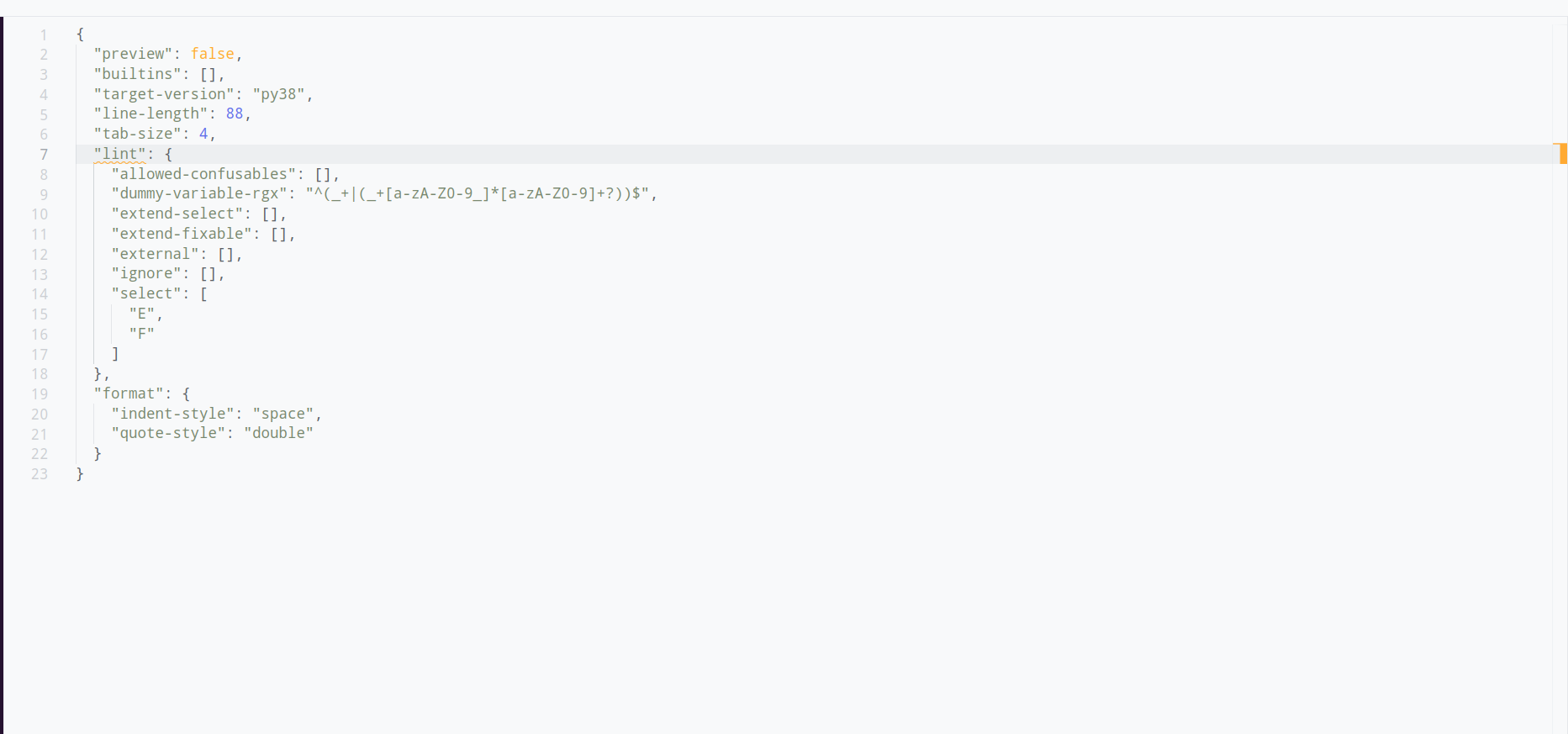
## Summary
This PR adds a new `lint` section to the configuration that groups all linter-specific settings. The existing top-level configurations continue to work without any warning because the `lint.*` settings are experimental.
The configuration merges the top level and `lint.*` settings where the settings in `lint` have higher precedence (override the top-level settings). The reasoning behind this is that the settings in `lint.` are more specific and more specific settings should override less specific settings.
I decided against showing the new `lint.*` options on our website because it would make the page extremely long (it's technically easy to do, just attribute `lint` with `[option_group`]). We may want to explore adding an `alias` field to the `option` attribute and show the alias on the website along with its regular name.
## Test Plan
* I added new integration tests
* I verified that the generated `options.md` is identical
* Verified the default settings in the playground
## Summary
This PR adds support for named expressions when analyzing `__all__`
assignments, as per https://github.com/astral-sh/ruff/issues/7672. It
also loosens the enforcement around assignments like: `__all__ =
list(some_other_expression)`. We shouldn't flag these as invalid, even
though we can't analyze the members, since we _know_ they evaluate to a
`list`.
Closes https://github.com/astral-sh/ruff/issues/7672.
## Test Plan
`cargo test`
## Summary
Fixes#7616 by ensuring that
[B006](https://docs.astral.sh/ruff/rules/mutable-argument-default/#mutable-argument-default-b006)
fixes are inserted after module imports.
I have created a new test file, `B006_5.py`. This is mainly because I
have been working on this on and off, and the merge conflicts were
easier to handle in a separate file. If needed, I can move it into
another file.
## Test Plan
`cargo test`
## Summary
Expands several rules to also check for `Expr::Name` values. As they
would previously not consider:
```python
from logging import error
error("foo")
```
as potential violations
```python
import logging
logging.error("foo")
```
as potential violations leading to inconsistent behaviour.
The rules impacted are:
- `BLE001`
- `TRY400`
- `TRY401`
- `PLE1205`
- `PLE1206`
- `LOG007`
- `G001`-`G004`
- `G101`
- `G201`
- `G202`
## Test Plan
Fixtures for all impacted rules expanded.
## Issue Link
Refers: https://github.com/astral-sh/ruff/issues/7502
<!--
Thank you for contributing to Ruff! To help us out with reviewing,
please consider the following:
- Does this pull request include a summary of the change? (See below.)
- Does this pull request include a descriptive title?
- Does this pull request include references to any relevant issues?
-->
## Summary
<!-- What's the purpose of the change? What does it do, and why? -->
The note about rules being in preview was not being displayed for legacy
nursery rules.
Adds a link to the new preview documentation as well.
## Test Plan
<!-- How was it tested? -->
Built locally and checked a nursery rule e.g.
http://127.0.0.1:8000/ruff/rules/no-indented-block-comment/
## Summary
Pass around a `Settings` struct instead of individual members to
simplify function signatures and to make it easier to add new settings.
This PR was suggested in [this
comment](https://github.com/astral-sh/ruff/issues/1567#issuecomment-1734182803).
## Note on the choices
I chose which functions to modify based on which seem most likely to use
new settings, but suggestions on my choices are welcome!
## Summary
This PR fixes the bug where the cell indices displayed in the `--diff` output
and the ones in the normal output were different. This was due to the fact that
the `--diff` output was using the `enumerate` function to iterate over
the cells which starts at 0.
## Test Plan
Ran the following command with and without the `--diff` flag:
```console
cargo run --bin ruff -- check --no-cache --isolated ~/playground/ruff/notebooks/test.ipynb
```
### `main`
<details><summary>Diagnostics output:</summary>
<p>
```console
$ cargo run --bin ruff -- check --no-cache --isolated ~/playground/ruff/notebooks/test.ipynb
/Users/dhruv/playground/ruff/notebooks/test.ipynb:cell 3:2:8: F401 [*] `math` imported but unused
/Users/dhruv/playground/ruff/notebooks/test.ipynb:cell 5:1:8: F811 Redefinition of unused `random` from line 1
/Users/dhruv/playground/ruff/notebooks/test.ipynb:cell 5:2:8: F401 [*] `pprint` imported but unused
/Users/dhruv/playground/ruff/notebooks/test.ipynb:cell 6:2:4: F632 [*] Use `==` to compare constant literals
/Users/dhruv/playground/ruff/notebooks/test.ipynb:cell 6:3:38: F632 [*] Use `==` to compare constant literals
Found 5 errors.
[*] 4 potentially fixable with the --fix option.
```
</p>
</details>
<details><summary>Diff output:</summary>
<p>
```console
$ cargo run --bin ruff -- check --no-cache --isolated ~/playground/ruff/notebooks/test.ipynb --diff
--- /Users/dhruv/playground/ruff/notebooks/test.ipynb:cell 2
+++ /Users/dhruv/playground/ruff/notebooks/test.ipynb:cell 2
@@ -1,2 +1 @@
-import random
-import math
+import random
--- /Users/dhruv/playground/ruff/notebooks/test.ipynb:cell 4
+++ /Users/dhruv/playground/ruff/notebooks/test.ipynb:cell 4
@@ -1,4 +1,3 @@
import random
-import pprint
random.randint(10, 20)
--- /Users/dhruv/playground/ruff/notebooks/test.ipynb:cell 5
+++ /Users/dhruv/playground/ruff/notebooks/test.ipynb:cell 5
@@ -1,3 +1,3 @@
foo = 1
-if foo is 2:
- raise ValueError(f"Invalid foo: {foo is 1}")
+if foo == 2:
+ raise ValueError(f"Invalid foo: {foo == 1}")
Would fix 4 errors.
```
</p>
</details>
### `dhruv/consistent-cell-indices`
<details><summary>Diagnostic output:</summary>
<p>
```console
$ cargo run --bin ruff -- check --no-cache --isolated ~/playground/ruff/notebooks/test.ipynb
/Users/dhruv/playground/ruff/notebooks/test.ipynb:cell 3:2:8: F401 [*] `math` imported but unused
/Users/dhruv/playground/ruff/notebooks/test.ipynb:cell 5:1:8: F811 Redefinition of unused `random` from line 1
/Users/dhruv/playground/ruff/notebooks/test.ipynb:cell 5:2:8: F401 [*] `pprint` imported but unused
/Users/dhruv/playground/ruff/notebooks/test.ipynb:cell 6:2:4: F632 [*] Use `==` to compare constant literals
/Users/dhruv/playground/ruff/notebooks/test.ipynb:cell 6:3:38: F632 [*] Use `==` to compare constant literals
Found 5 errors.
[*] 4 potentially fixable with the --fix option.
```
</p>
</details>
<details><summary>Diff output:</summary>
<p>
```console
$ cargo run --bin ruff -- check --no-cache --isolated ~/playground/ruff/notebooks/test.ipynb --diff
--- /Users/dhruv/playground/ruff/notebooks/test.ipynb:cell 3
+++ /Users/dhruv/playground/ruff/notebooks/test.ipynb:cell 3
@@ -1,2 +1 @@
-import random
-import math
+import random
--- /Users/dhruv/playground/ruff/notebooks/test.ipynb:cell 5
+++ /Users/dhruv/playground/ruff/notebooks/test.ipynb:cell 5
@@ -1,4 +1,3 @@
import random
-import pprint
random.randint(10, 20)
--- /Users/dhruv/playground/ruff/notebooks/test.ipynb:cell 6
+++ /Users/dhruv/playground/ruff/notebooks/test.ipynb:cell 6
@@ -1,3 +1,3 @@
foo = 1
-if foo is 2:
- raise ValueError(f"Invalid foo: {foo is 1}")
+if foo == 2:
+ raise ValueError(f"Invalid foo: {foo == 1}")
Would fix 4 errors.
```
</p>
</details>
fixes: #6673
I got confused and refactored a bit, now the naming should be more
consistent. This is the basis for the range formatting work.
Chages:
* `format_module` -> `format_module_source` (format a string)
* `format_node` -> `format_module_ast` (format a program parsed into an
AST)
* Added `parse_ok_tokens` that takes `Token` instead of `Result<Token>`
* Call the source code `source` consistently
* Added a `tokens_and_ranges` helper
* `python_ast` -> `module` (because that's the type)
**Summary** Check that `closefd` and `opener` aren't being used with
`builtin.open()` before suggesting `Path.open()` because pathlib doesn't
support these arguments.
Closes#7620
**Test Plan** New cases in the fixture.
## Summary
This is a follow-up to #7469 that attempts to achieve similar gains, but
without introducing malachite. Instead, this PR removes the `BigInt`
type altogether, instead opting for a simple enum that allows us to
store small integers directly and only allocate for values greater than
`i64`:
```rust
/// A Python integer literal. Represents both small (fits in an `i64`) and large integers.
#[derive(Clone, PartialEq, Eq, Hash)]
pub struct Int(Number);
#[derive(Debug, Clone, PartialEq, Eq, Hash)]
pub enum Number {
/// A "small" number that can be represented as an `i64`.
Small(i64),
/// A "large" number that cannot be represented as an `i64`.
Big(Box<str>),
}
impl std::fmt::Display for Number {
fn fmt(&self, f: &mut std::fmt::Formatter<'_>) -> std::fmt::Result {
match self {
Number::Small(value) => write!(f, "{value}"),
Number::Big(value) => write!(f, "{value}"),
}
}
}
```
We typically don't care about numbers greater than `isize` -- our only
uses are comparisons against small constants (like `1`, `2`, `3`, etc.),
so there's no real loss of information, except in one or two rules where
we're now a little more conservative (with the worst-case being that we
don't flag, e.g., an `itertools.pairwise` that uses an extremely large
value for the slice start constant). For simplicity, a few diagnostics
now show a dedicated message when they see integers that are out of the
supported range (e.g., `outdated-version-block`).
An additional benefit here is that we get to remove a few dependencies,
especially `num-bigint`.
## Test Plan
`cargo test`
## Summary
This is whitespace as per `is_python_whitespace`, and right now it tends
to lead to panics in the formatter. Seems reasonable to treat it as
whitespace in the `SimpleTokenizer` too.
Closes .https://github.com/astral-sh/ruff/issues/7624.
## Summary
Given:
```python
if True:
if True:
pass
else:
pass
# a
# b
# c
else:
pass
```
We want to preserve the newline after the `# c` (before the `else`).
However, the `last_node` ends at the `pass`, and the comments are
trailing comments on the `pass`, not trailing comments on the
`last_node` (the `if`). As such, when counting the trailing newlines on
the outer `if`, we abort as soon as we see the comment (`# a`).
This PR changes the logic to skip _all_ comments (even those with
newlines between them). This is safe as we know that there are no
"leading" comments on the `else`, so there's no risk of skipping those
accidentally.
Closes https://github.com/astral-sh/ruff/issues/7602.
## Test Plan
No change in compatibility.
Before:
| project | similarity index | total files | changed files |
|--------------|------------------:|------------------:|------------------:|
| cpython | 0.76083 | 1789 | 1631 |
| django | 0.99983 | 2760 | 36 |
| transformers | 0.99963 | 2587 | 319 |
| twine | 1.00000 | 33 | 0 |
| typeshed | 0.99979 | 3496 | 22 |
| warehouse | 0.99967 | 648 | 15 |
| zulip | 0.99972 | 1437 | 21 |
After:
| project | similarity index | total files | changed files |
|--------------|------------------:|------------------:|------------------:|
| cpython | 0.76083 | 1789 | 1631 |
| django | 0.99983 | 2760 | 36 |
| transformers | 0.99963 | 2587 | 319 |
| twine | 1.00000 | 33 | 0 |
| typeshed | 0.99983 | 3496 | 18 |
| warehouse | 0.99967 | 648 | 15 |
| zulip | 0.99972 | 1437 | 21 |
## Summary
This PR fixes the autofix behavior for `PT022` to create an additional
edit for the return type if it's present. The edit will update the
return type from `Generator[T, ...]` to `T`. As per the [official
documentation](https://docs.python.org/3/library/typing.html?highlight=typing%20generator#typing.Generator),
the first position is the yield type, so we can ignore other positions.
```python
typing.Generator[YieldType, SendType, ReturnType]
```
## Test Plan
Add new test cases, `cargo test` and review the snapshots.
fixes: #7610
## Summary
Implement
[`simplify-print`](https://github.com/dosisod/refurb/blob/master/refurb/checks/builtin/print.py)
as `print-empty-string` (`FURB105`).
Extends the original rule in that it also checks for multiple empty
string positional arguments with an empty string separator.
Related to #1348.
## Test Plan
`cargo test`
Similar to tuples, a generator _can_ be parenthesized or
unparenthesized. Only search for bracketed comments if it contains its
own parentheses.
Closes https://github.com/astral-sh/ruff/issues/7623.
## Summary
Given:
```python
if True:
if True:
if True:
pass
#a
#b
#c
else:
pass
```
When determining the placement of the various comments, we compute the
indentation depth of each comment, and then compare it to the depth of
the previous statement. It turns out this can lead to reordering
comments, e.g., above, `#b` is assigned as a trailing comment of `pass`,
and so gets reordered above `#a`.
This PR modifies the logic such that when we compute the indentation
depth of `#b`, we limit it to at most the indentation depth of `#a`. In
other words, when analyzing comments at the end of branches, we don't
let successive comments go any _deeper_ than their preceding comments.
Closes https://github.com/astral-sh/ruff/issues/7602.
## Test Plan
`cargo test`
No change in similarity.
Before:
| project | similarity index | total files | changed files |
|--------------|------------------:|------------------:|------------------:|
| cpython | 0.76083 | 1789 | 1631 |
| django | 0.99983 | 2760 | 36 |
| transformers | 0.99963 | 2587 | 319 |
| twine | 1.00000 | 33 | 0 |
| typeshed | 0.99979 | 3496 | 22 |
| warehouse | 0.99967 | 648 | 15 |
| zulip | 0.99972 | 1437 | 21 |
After:
| project | similarity index | total files | changed files |
|--------------|------------------:|------------------:|------------------:|
| cpython | 0.76083 | 1789 | 1631 |
| django | 0.99983 | 2760 | 36 |
| transformers | 0.99963 | 2587 | 319 |
| twine | 1.00000 | 33 | 0 |
| typeshed | 0.99979 | 3496 | 22 |
| warehouse | 0.99967 | 648 | 15 |
| zulip | 0.99972 | 1437 | 21 |
## Summary
Given:
```python
# -*- coding: utf-8 -*-
import random
# Defaults for arguments are defined here
# args.threshold = None;
logger = logging.getLogger("FastProject")
```
We want to count the number of newlines after `import random`, to ensure
that there's _at least one_, but up to two.
Previously, we used the end range of the statement (then skipped
trivia); instead, we need to use the end of the _last comment_. This is
similar to #7556.
Closes https://github.com/astral-sh/ruff/issues/7604.
## Summary
B005 only flags `.strip()` calls for which the argument includes
duplicate characters. This is consistent with bugbear, but isn't
explained in the documentation.
## Summary
Currently, this happens
```sh
$ echo "print()" | ruff format -
#Notice that nothing went to stdout
```
Which does not match `ruff check --fix - ` behavior and deletes my code
every time I format it (more or less 5 times per minute 😄).
I just checked that my example works as the change was very
straightforward.
It is apparently possible to add files to the git index, even if they
are part of the gitignore (see e.g.
https://stackoverflow.com/questions/45400361/why-is-gitignore-not-ignoring-my-files,
even though it's strange that the gitignore entries existed before the
files were added, i wouldn't know how to get them added in that case). I
ran
```
git rm -r --cached .
```
then change the gitignore not actually ignore those files with the
exception of
`crates/ruff_cli/resources/test/fixtures/cache_mutable/source.py`, which
is actually a generated file.
## Summary
This is only used for the `level` field in relative imports (e.g., `from
..foo import bar`). It seems unnecessary to use a wrapper here, so this
PR changes to a `u32` directly.
## Summary
When we format the trailing comments on a clause body, we check if there
are any newlines after the last statement; if not, we insert one.
This logic didn't take into account that the last statement could itself
have trailing comments, as in:
```python
if True:
pass
# comment
else:
pass
```
We were thus inserting a newline after the comment, like:
```python
if True:
pass
# comment
else:
pass
```
In the context of function definitions, this led to an instability,
since we insert a newline _after_ a function, which would in turn lead
to the bug above appearing in the second formatting pass.
Closes https://github.com/astral-sh/ruff/issues/7465.
## Test Plan
`cargo test`
Small improvement in `transformers`, but no regressions.
Before:
| project | similarity index | total files | changed files |
|--------------|------------------:|------------------:|------------------:|
| cpython | 0.76083 | 1789 | 1631 |
| django | 0.99983 | 2760 | 36 |
| transformers | 0.99956 | 2587 | 404 |
| twine | 1.00000 | 33 | 0 |
| typeshed | 0.99983 | 3496 | 18 |
| warehouse | 0.99967 | 648 | 15 |
| zulip | 0.99972 | 1437 | 21 |
After:
| project | similarity index | total files | changed files |
|--------------|------------------:|------------------:|------------------:|
| cpython | 0.76083 | 1789 | 1631 |
| django | 0.99983 | 2760 | 36 |
| **transformers** | **0.99957** | **2587** | **402** |
| twine | 1.00000 | 33 | 0 |
| typeshed | 0.99983 | 3496 | 18 |
| warehouse | 0.99967 | 648 | 15 |
| zulip | 0.99972 | 1437 | 21 |
## Summary
If a function has no parameters (and no comments within the parameters'
`()`), we're supposed to wrap the return annotation _whenever_ it
breaks. However, our `empty_parameters` test didn't properly account for
the case in which the parameters include a newline (but no other
content), like:
```python
def get_dashboards_hierarchy(
) -> Dict[Type['BaseDashboard'], List[Type['BaseDashboard']]]:
"""Get hierarchy of dashboards classes.
Returns:
Dict of dashboards classes.
"""
dashboards_hierarchy = {}
```
This PR fixes that detection. Instead of lexing, it now checks if the
parameters itself is empty (or if it contains comments).
Closes https://github.com/astral-sh/ruff/issues/7457.
## Summary
## Stack Summary
This stack splits `Settings` into `FormatterSettings` and `LinterSettings` and moves it into `ruff_workspace`. This change is necessary to add the `FormatterSettings` to `Settings` without adding `ruff_python_formatter` as a dependency to `ruff_linter` (and the linter should not contain the formatter settings).
A quick overview of our settings struct at play:
* `Options`: 1:1 representation of the options in the `pyproject.toml` or `ruff.toml`. Used for deserialization.
* `Configuration`: Resolved `Options`, potentially merged from multiple configurations (when using `extend`). The representation is very close if not identical to the `Options`.
* `Settings`: The resolved configuration that uses a data format optimized for reading. Optional fields are initialized with their default values. Initialized by `Configuration::into_settings` .
The goal of this stack is to split `Settings` into tool-specific resolved `Settings` that are independent of each other. This comes at the advantage that the individual crates don't need to know anything about the other tools. The downside is that information gets duplicated between `Settings`. Right now the duplication is minimal (`line-length`, `tab-width`) but we may need to come up with a solution if more expensive data needs sharing.
This stack focuses on `Settings`. Splitting `Configuration` into some smaller structs is something I'll follow up on later.
## PR Summary
This PR moves the `ResolverSettings` and `Settings` struct to `ruff_workspace`. `LinterSettings` remains in `ruff_linter` because it gets passed to lint rules, the `Checker` etc.
## Test Plan
`cargo test`
## Stack Summary
This stack splits `Settings` into `FormatterSettings` and `LinterSettings` and moves it into `ruff_workspace`. This change is necessary to add the `FormatterSettings` to `Settings` without adding `ruff_python_formatter` as a dependency to `ruff_linter` (and the linter should not contain the formatter settings).
A quick overview of our settings struct at play:
* `Options`: 1:1 representation of the options in the `pyproject.toml` or `ruff.toml`. Used for deserialization.
* `Configuration`: Resolved `Options`, potentially merged from multiple configurations (when using `extend`). The representation is very close if not identical to the `Options`.
* `Settings`: The resolved configuration that uses a data format optimized for reading. Optional fields are initialized with their default values. Initialized by `Configuration::into_settings` .
The goal of this stack is to split `Settings` into tool-specific resolved `Settings` that are independent of each other. This comes at the advantage that the individual crates don't need to know anything about the other tools. The downside is that information gets duplicated between `Settings`. Right now the duplication is minimal (`line-length`, `tab-width`) but we may need to come up with a solution if more expensive data needs sharing.
This stack focuses on `Settings`. Splitting `Configuration` into some smaller structs is something I'll follow up on later.
## PR Summary
This PR extracts the linter-specific settings into a new `LinterSettings` struct and adds it as a `linter` field to the `Settings` struct. This is in preparation for moving `Settings` from `ruff_linter` to `ruff_workspace`
## Test Plan
`cargo test`
## Stack Summary
This stack splits `Settings` into `FormatterSettings` and `LinterSettings` and moves it into `ruff_workspace`. This change is necessary to add the `FormatterSettings` to `Settings` without adding `ruff_python_formatter` as a dependency to `ruff_linter` (and the linter should not contain the formatter settings).
A quick overview of our settings struct at play:
* `Options`: 1:1 representation of the options in the `pyproject.toml` or `ruff.toml`. Used for deserialization.
* `Configuration`: Resolved `Options`, potentially merged from multiple configurations (when using `extend`). The representation is very close if not identical to the `Options`.
* `Settings`: The resolved configuration that uses a data format optimized for reading. Optional fields are initialized with their default values. Initialized by `Configuration::into_settings` .
The goal of this stack is to split `Settings` into tool-specific resolved `Settings` that are independent of each other. This comes at the advantage that the individual crates don't need to know anything about the other tools. The downside is that information gets duplicated between `Settings`. Right now the duplication is minimal (`line-length`, `tab-width`) but we may need to come up with a solution if more expensive data needs sharing.
This stack focuses on `Settings`. Splitting `Configuration` into some smaller structs is something I'll follow up on later.
## PR Summary
This PR extracts a `ResolverSettings` struct that holds all the resolver-relevant fields (uninteresting for the `Formatter` or `Linter`). This will allow us to move the `ResolverSettings` out of `ruff_linter` further up in the stack.
## Test Plan
`cargo test`
(I'll to more extensive testing at the top of this stack)
## Summary
This PR fixes the way NoQA range is inserted to the `NoqaMapping`.
Previously, the way the mapping insertion logic worked was as follows:
1. If the range which is to be inserted _touched_ the previous range, meaning
that the end of the previous range was the same as the start of the new
range, then the new range was added in addition to the previous range.
2. Else, if the new range intersected the previous range, then the previous
range was replaced with the new _intersection_ of the two ranges.
The problem with this logic is that it does not work for the following case:
```python
assert foo, \
"""multi-line
string"""
```
Now, the comments cannot be added to the same line which ends with a continuation
character. So, the `NoQA` directive has to be added to the next line. But, the
next line is also a triple-quoted string, so the `NoQA` directive for that line
needs to be added to the next line. This creates a **union** pattern instead of an
**intersection** pattern.
But, only union doesn't suffice because (1) means that for the edge case where
the range touch only at the end, the union won't take place.
### Solution
1. Replace '<=' with '<' to have a _strict_ insertion case
2. Use union instead of intersection
## Test Plan
Add a new test case. Run the test suite to ensure that nothing is broken.
### Integration
1. Make a `test.py` file with the following contents:
```python
assert foo, \
"""multi-line
string"""
```
2. Run the following command:
```console
$ cargo run --bin ruff -- check --isolated --no-cache --select=F821 test.py
/Users/dhruv/playground/ruff/fstring.py:1:8: F821 Undefined name `foo`
Found 1 error.
```
3. Use `--add-noqa`:
```console
$ cargo run --bin ruff -- check --isolated --no-cache --select=F821 --add-noqa test.py
Added 1 noqa directive.
```
4. Check that the NoQA directive was added in the correct position:
```python
assert foo, \
"""multi-line
string""" # noqa: F821
```
5. Run the `check` command to ensure that the NoQA directive is respected:
```console
$ cargo run --bin ruff -- check --isolated --no-cache --select=F821 test.py
```
fixes: #7530
## Summary
Implement
[`no-ignored-enumerate-items`](https://github.com/dosisod/refurb/blob/master/refurb/checks/builtin/no_ignored_enumerate.py)
as `unnecessary-enumerate` (`FURB148`).
The auto-fix considers if a `start` argument is passed to the
`enumerate()` function. If only the index is used, then the suggested
fix is to pass the `start` value to the `range()` function. So,
```python
for i, _ in enumerate(xs, 1):
...
```
becomes
```python
for i in range(1, len(xs)):
...
```
If the index is ignored and only the value is ignored, and if a start
value greater than zero is passed to `enumerate()`, the rule doesn't
produce a suggestion. I couldn't find a unanimously accepted best way to
iterate over a collection whilst skipping the first n elements. The rule
still triggers, however.
Related to #1348.
## Test Plan
`cargo test`
---------
Co-authored-by: Dhruv Manilawala <dhruvmanila@gmail.com>
Co-authored-by: Charlie Marsh <charlie.r.marsh@gmail.com>
**Summary** Instead of emitting a bogus token per char, we now only emit
on single last bogus token. This leads to much more concise output.
**Test Plan** Updated fixtures
Closes#5497
Needs MkDocs 1.5 to be released.
- [x] https://github.com/mkdocs/mkdocs/milestone/15
## Summary
Uses MkDocs' `not_in_nav` config to hide spam about files in
`docs/rules/` not being in nav.
Close#7479
The `@override` was already implemented
## Test Plan
Tested the code in the issue. After removing all the noqa's, only one
occurrence of `BadName()` raised a violation.
Added a fixture
## Summary
This PR implements a new rule for `flake8-logging` plugin that checks
for uses of `logging.exception()` with `exc_info` set to `False` or a
falsy value. It suggests using `logging.error` in these cases instead.
I am unsure about the name. Open to suggestions there, went with the
most explicit name I could think of in the meantime.
Refer https://github.com/astral-sh/ruff/issues/7248
## Test Plan
Added a new fixture cases and ran `cargo test`
## Summary
This PR updates the `W191` (`tab-indentation`) rule from a line-based to
a token-based rule.
Earlier, the rule used the `triple_quoted_string_ranges` from the
indexer to skip over any lines _inside_ a triple-quoted string. This was the only
use of the ranges. These ranges were extracted through the tokens, so instead
we can directly use the newline tokens to perform the check.
This would also mean that we can remove the `triple_quoted_string_ranges` from
the indexer but I'll hold that off until we have a better idea on #7326
but I don't think it would be a problem to remove it.
This will also fix#7379 once PEP 701 changes are merged.
## Test Plan
`cargo test`
## Summary
This PR implements a new rule for `flake8-logging` plugin that checks
for
`logging.getLogger` calls with either `__file__` or `__cached__` as the
first
argument and generates a suggested fix to use `__name__` instead.
Refer: #7248
## Test Plan
Add test cases and `cargo test`
## Summary
The tokenizer was split into a forward and a backwards tokenizer. The
backwards tokenizer uses the same names as the forwards ones (e.g.
`next_token`). The backwards tokenizer gets the comment ranges that we
already built to skip comments.
---------
Co-authored-by: Micha Reiser <micha@reiser.io>
## Summary
We're planning to move the documentation from
[https://beta.ruff.rs/docs](https://beta.ruff.rs/docs) to
[https://docs.astral.sh/ruff](https://docs.astral.sh/ruff), for a few
reasons:
1. We want to remove the `beta` from the domain, as Ruff is no longer
considered beta software.
2. We want to migrate to a structure that could accommodate multiple
future tools living under one domain.
The docs are actually already live at
[https://docs.astral.sh/ruff](https://docs.astral.sh/ruff), but later
today, I'll add a permanent redirect from the previous to the new
domain. **All existing links will continue to work, now and in
perpetuity.**
This PR contains the code changes necessary for the updated
documentation. As part of this effort, I moved the playground and
documentation from my personal Cloudflare account to our team Cloudflare
account (hence the new `--project-name` references). After merging, I'll
also update the secrets on this repo.
## Summary
Given a trailing operator comment in a unary expression, like:
```python
if (
not # comment
a):
...
```
We were attaching these to the operand (`a`), but formatting them in the
unary operator via special handling. Parents shouldn't format the
comments of their children, so this instead attaches them as dangling
comments on the unary expression. (No intended change in formatting.)
<!--
Thank you for contributing to Ruff! To help us out with reviewing,
please consider the following:
- Does this pull request include a summary of the change? (See below.)
- Does this pull request include a descriptive title?
- Does this pull request include references to any relevant issues?
-->
## Summary
<!-- What's the purpose of the change? What does it do, and why? -->
Adds the maximum of 320 for the line-length setting to the JSON schema
for better integration with IDEs.
Related https://github.com/astral-sh/ruff/pull/6873
## Test Plan
<!-- How was it tested? -->
<!--
Thank you for contributing to Ruff! To help us out with reviewing,
please consider the following:
- Does this pull request include a summary of the change? (See below.)
- Does this pull request include a descriptive title?
- Does this pull request include references to any relevant issues?
-->
## Summary
The previous reference was “CWE-78: Improper Neutralization of Special
Elements used in an OS Command ('OS Command Injection')”, which
describes another issue. The new reference is “CWE-426: Untrusted Search
Path”, which describes exactly the problem that this rule should warn
about.
## Test Plan
The change was not tested, as it only changes two numbers in the
documentation.
## Summary
Adds `LOG009` from
[flake8-logging](https://github.com/adamchainz/flake8-logging). Also
adds the boilerplate for a new plugin
Checks for usages of undocumented `logging.WARN` constant and suggests
replacement with `logging.WARNING`.
## Test Plan
`cargo test` with fresh fixture
## Issue links
Refers: https://github.com/astral-sh/ruff/issues/7248
## Summary
Extends UP040 to support moving type variables with
bounds/constraints/variance that are used in type aliases to use PEP-695
syntax.
Part of #4617.
## Test Plan
The existing tests added by #6314 already cover the relevant cases.
Rules like D209 and D205 are only intended to apply to multi-line
docstrings. If a docstring is single-quoted, but extends via a
continuation, it should be excluded (it'll be flagged by another rule
anyway). Closes https://github.com/astral-sh/ruff/issues/7058.
## Summary
At some point, we removed these so that they wouldn't be autocompleted
for users, since we wanted to discourage usage of `ALL`. But given that
they're valid values, I think that was a bad idea -- it leads to an even
more confusing experience whereby JSON Schema validators tell you that
you have an error, when you don't.
Closes https://github.com/astral-sh/ruff/issues/7261.
The rule selector is not useful because `--select PREVIEW` only targets
Ruff developers and `--ignore PREVIEW` has no effect due to its low
specificity. We may restore it later if useful.
`ComparableExpr` includes the `ExprContext` field on an expression, so,
e.g., the two tuples in `(a, b) = (a, b)` won't be considered equal.
Similarly, the tuples in `[(a, b) for (a, b) in c]` _also_ wouldn't be
considered equal. I find this behavior surprising, since
`ComparableExpr` is intended to allow you to compare two ASTs, but
`ExprContext` is really encoding information about the broader context
for the expression.
Bumps [shlex](https://github.com/comex/rust-shlex) from 1.1.0 to 1.2.0.
<details>
<summary>Changelog</summary>
<p><em>Sourced from <a
href="https://github.com/comex/rust-shlex/blob/master/CHANGELOG.md">shlex's
changelog</a>.</em></p>
<blockquote>
<h1>1.2.0</h1>
<ul>
<li>Adds <code>bytes</code> module to support operating directly on byte
strings.</li>
</ul>
</blockquote>
</details>
<details>
<summary>Commits</summary>
<ul>
<li>See full diff in <a
href="https://github.com/comex/rust-shlex/commits">compare view</a></li>
</ul>
</details>
<br />
[](https://docs.github.com/en/github/managing-security-vulnerabilities/about-dependabot-security-updates#about-compatibility-scores)
Dependabot will resolve any conflicts with this PR as long as you don't
alter it yourself. You can also trigger a rebase manually by commenting
`@dependabot rebase`.
[//]: # (dependabot-automerge-start)
[//]: # (dependabot-automerge-end)
---
<details>
<summary>Dependabot commands and options</summary>
<br />
You can trigger Dependabot actions by commenting on this PR:
- `@dependabot rebase` will rebase this PR
- `@dependabot recreate` will recreate this PR, overwriting any edits
that have been made to it
- `@dependabot merge` will merge this PR after your CI passes on it
- `@dependabot squash and merge` will squash and merge this PR after
your CI passes on it
- `@dependabot cancel merge` will cancel a previously requested merge
and block automerging
- `@dependabot reopen` will reopen this PR if it is closed
- `@dependabot close` will close this PR and stop Dependabot recreating
it. You can achieve the same result by closing it manually
- `@dependabot show <dependency name> ignore conditions` will show all
of the ignore conditions of the specified dependency
- `@dependabot ignore this major version` will close this PR and stop
Dependabot creating any more for this major version (unless you reopen
the PR or upgrade to it yourself)
- `@dependabot ignore this minor version` will close this PR and stop
Dependabot creating any more for this minor version (unless you reopen
the PR or upgrade to it yourself)
- `@dependabot ignore this dependency` will close this PR and stop
Dependabot creating any more for this dependency (unless you reopen the
PR or upgrade to it yourself)
</details>
Signed-off-by: dependabot[bot] <support@github.com>
Co-authored-by: dependabot[bot] <49699333+dependabot[bot]@users.noreply.github.com>
Co-authored-by: Micha Reiser <micha@reiser.io>
## Summary
Given a statement like:
```python
result = (
f(111111111111111111111111111111111111111111111111111111111111111111111111111111111)
+ 1
)()
```
When we go to parenthesize the target of the assignment, we use
`maybe_parenthesize_expression` with `Parenthesize::IfBreaks`. This then
checks if the call on the right-hand side needs to be parenthesized, the
implementation of which looks like:
```rust
impl NeedsParentheses for ExprCall {
fn needs_parentheses(
&self,
_parent: AnyNodeRef,
context: &PyFormatContext,
) -> OptionalParentheses {
if CallChainLayout::from_expression(self.into(), context.source())
== CallChainLayout::Fluent
{
OptionalParentheses::Multiline
} else if context.comments().has_dangling(self) {
OptionalParentheses::Always
} else {
self.func.needs_parentheses(self.into(), context)
}
}
}
```
Checking for `self.func.needs_parentheses(self.into(), context)` is
problematic, since, as in the example above, `self.func` may _already_
be parenthesized -- in which case, we _don't_ want to parenthesize the
entire expression. If we do, we end up with this non-ideal formatting:
```python
result = (
(
f(
111111111111111111111111111111111111111111111111111111111111111111111111111111111
)
+ 1
)()
)
```
This PR modifies the `NeedsParentheses` implementations for call chain
expressions to return `Never` if the inner expression has its own
parentheses, in which case, the formatting implementations for those
expressions will preserve them anyway.
Closes https://github.com/astral-sh/ruff/issues/7370.
## Test Plan
Zulip improves a bit, everything else is unchanged.
Before:
| project | similarity index | total files | changed files |
|--------------|------------------:|------------------:|------------------:|
| cpython | 0.76083 | 1789 | 1632 |
| django | 0.99981 | 2760 | 40 |
| transformers | 0.99944 | 2587 | 413 |
| twine | 1.00000 | 33 | 0 |
| typeshed | 0.99983 | 3496 | 18 |
| warehouse | 0.99834 | 648 | 20 |
| zulip | 0.99956 | 1437 | 23 |
After:
| project | similarity index | total files | changed files |
|--------------|------------------:|------------------:|------------------:|
| cpython | 0.76083 | 1789 | 1632 |
| django | 0.99981 | 2760 | 40 |
| transformers | 0.99944 | 2587 | 413 |
| twine | 1.00000 | 33 | 0 |
| typeshed | 0.99983 | 3496 | 18 |
| warehouse | 0.99834 | 648 | 20 |
| **zulip** | **0.99962** | **1437** | **22** |
## Summary
When fixing `reversed(sorted(x, reverse=False))`, we rewrite as
`sorted(x, reverse=True)`. However, if the `reverse` argument isn't
`True` or `False`, we leave it as-is, which is incorrect.
Now, given `reversed(sorted(x, reverse=y))`, we rewrite as `sorted(x,
reverse=not y)`.
## Summary
Adds warnings for cases where:
- A selector does not include any rules because preview is disabled
- A nursery rule is selected without the preview flag
## Test plan
Add integration tests
Moves the new rule from nursery to preview for the upcoming release.
Adds new test coverage for selection of a single preview rule and fixes
a bug where preview rules were incorrectly selectable with exact codes.
## Summary
This PR bumps the pyproject-toml crate to 0.7.0. The only difference is that it now depends on indexmap 2. I reviewed the indexmap 2 changes and they don't seem relevant to us.
I used this opportunity to remove the default features from `serde_with` which removes our indexmap 1 dependency (and some other unused dependencies)
## Test Plan
`cargo test`
## Motivation
The `ast::Arguments` for call argument are split into positional
arguments (args) and keywords arguments (keywords). We currently assume
that call consists of first args and then keywords, which is generally
the case, but not always:
```python
f(*args, a=2, *args2, **kwargs)
class A(*args, a=2, *args2, **kwargs):
pass
```
The consequence is accidentally reordering arguments
(https://github.com/astral-sh/ruff/pull/7268).
## Summary
`Arguments::args_and_keywords` returns an iterator of an `ArgOrKeyword`
enum that yields args and keywords in the correct order. I've fixed the
obvious `args` and `keywords` usages, but there might be some cases with
wrong assumptions remaining.
## Test Plan
The generator got new test cases, otherwise the stacked PR
(https://github.com/astral-sh/ruff/pull/7268) which uncovered this.
## Summary
This PR updates the `FileCache` to include an optional `NotebookIndex`
to support caching for Jupyter Notebooks.
We only require the index to compute the diagnostics and thus we don't
really need to store the entire `Notebook` on the `Diagnostics` struct.
This means we only need the index to be stored in the cache to
reconstruct the `Diagnostics`.
## Test Plan
Update an existing test case to run over the fixtures under
`ruff_notebook` crate where there are multiple Jupyter Notebook.
Locally, the following commands were run in order:
1. Remove the cache: `rm -rf .ruff_cache`
2. Run without cache: `cargo run --bin ruff -- check --isolated
crates/ruff_notebook/resources/test/fixtures/jupyter/unused_variable.ipynb
--no-cache`
3. Run with cache: `cargo run --bin ruff -- check --isolated
crates/ruff_notebook/resources/test/fixtures/jupyter/unused_variable.ipynb`
4. Check whether the `.ruff_cache` directory was created or not
5. Run with cache again and verify: `cargo run --bin ruff -- check
--isolated
crates/ruff_notebook/resources/test/fixtures/jupyter/unused_variable.ipynb`
## Benchmarks
https://github.com/astral-sh/ruff/pull/6863#issuecomment-1715675186fixes: #6671
## Summary
Closes#6958.
If a method has the `override` decorator, there is nothing you can do
about incorrect dunder methods, so they should be ignored.
## Test Plan
Overridden incorrect dunder method was added to the tests to verify ruff
doesn't catch it when evaluating the file. Snapshot changes are all just
line number changes
## Summary
This PR updates the lexer test snapshots to include the range value as
well. This is mainly a mechanical refactor.
### Motivation
The main motivation is so that we can verify that the ranges are valid
and do not overlap.
## Test Plan
`cargo test`
## Summary
This PR updates the remaining lexer test cases to use the snapshots.
This is mainly a mechanical refactor.
## Motivation
The main motivation is so that when we add the token range values to the
test case output, it's easier to update the test cases.
The reason they were not using the snapshots before was because of the usage of
`test_case` macro. The macros is mainly used for different EOL test cases. If we
just generate the snapshots directly, then the snapshot name would be suffixed
with `-1`, `-2`, etc. as the test function is still the same. So, we'll create
the snapshot ourselves with the platform name for the respective EOL
test cases.
## Test Plan
`cargo test`
## Summary
<!-- What's the purpose of the change? What does it do, and why? -->
Extends work in #7046 (some relevant discussion there)
Changes:
- All nursery rules are now referred to as preview rules
- Documentation for the nursery is updated to describe preview
- Adds a "PREVIEW" selector for preview rules
- This is primarily to allow `--preview --ignore PREVIEW --extend-select
FOO001,BAR200`
- Using `--preview` enables preview rules that match selectors
Notable decisions:
- Preview rules are not selectable by their rule code without enabling
preview
- Retains the "NURSERY" selector for backwards compatibility
- Nursery rules are selectable by their rule code for backwards
compatiblity
Additional work:
- Selection of preview rules without the "--preview" flag should display
a warning
- Use of deprecated nursery selection behavior should display a warning
- Nursery selection should be removed after some time
## Test Plan
<!-- How was it tested? -->
Manual confirmation (i.e. we don't have an preview rules yet just
nursery rules so I added a preview rule for manual testing)
New unit tests
---------
Co-authored-by: Charlie Marsh <charlie.r.marsh@gmail.com>
## Summary
Another statement on the same line as the docstring would previous make
the D204 (newline after docstring) fix fail:
```python
class StatementOnSameLineAsDocstring:
"After this docstring there's another statement on the same line separated by a semicolon." ;priorities=1
def sort_services(self):
pass
```
The fix handles this case manually:
```python
class StatementOnSameLineAsDocstring:
"After this docstring there's another statement on the same line separated by a semicolon."
priorities=1
def sort_services(self):
pass
```
Fixes#7088
## Test Plan
Added a new `D` test case
## Summary
Fix all but one empty line differences with the black preview style in
typeshed. The remaining differences are breaking with type comments and
trailing commas in function definitions.
I compared the empty line differences with the preview mode of black
since stable has some oddities that would have been hard to replicate
(https://github.com/psf/black/issues/3861). Additionally, it assumes the
style proposed in https://github.com/psf/black/issues/3862.
An edge case that also surfaced with typeshed are newline before
trailing module comments.
**main**
| project | similarity index | total files | changed files |
|--------------|------------------:|------------------:|------------------:|
| cpython | 0.76083 | 1789 | 1632 |
| django | 0.99966 | 2760 | 58 |
| transformers | 0.99930 | 2587 | 447 |
| twine | 1.00000 | 33 | 0 |
| **typeshed** | 0.99978 | 3496 | **2173** |
| warehouse | 0.99825 | 648 | 22 |
| zulip | 0.99950 | 1437 | 27 |
**PR**
| project | similarity index | total files | changed files |
|--------------|------------------:|------------------:|------------------:|
| cpython | 0.76083 | 1789 | 1632 |
| django | 0.99966 | 2760 | 58 |
| transformers | 0.99930 | 2587 | 447 |
| twine | 1.00000 | 33 | 0 |
| **typeshed** | 0.99983 | 3496 | **18** |
| warehouse | 0.99825 | 648 | 22 |
| zulip | 0.99950 | 1437 | 27 |
Closes#6723
## Test Plan
The main driver was the typeshed diff. I added new test cases for all
kinds of possible empty line combinations in stub files, test cases for
newlines before trailing module comments.
---------
Co-authored-by: Micha Reiser <micha@reiser.io>
## Summary
This PR adds the `--preview` and `--no-preview` options to the `format` command (hidden) and passes it through to the formatte.
## Test Plan
I added the `dbg(f.options().preview())` statement in `FormatNodeRule::fmt` and verified that the option gets correctly passed to the formatter.
Show header for formatter comment decoration info
**Summary** Show a header in the formatter comment decoration debug
output that shows which node is preceding/following/enclosing
(https://github.com/astral-sh/ruff/pull/6813#issuecomment-1708119550). I
kept this intentionally condensed to make it easy to use this is a small
sidebar without vertical scrolling.
```console
$ cargo run --bin ruff_python_formatter -- --emit stdout --print-comments scratch.py
# Comment decoration: Range, Preceding, Following, Enclosing, Comment
17..20, Some((ParameterWithDefault, 6..10)), None, (Parameters, 5..22), "# a"
44..47, Some((StmtExpr, 28..39)), Some((StmtExpr, 52..60)), (StmtFunctionDef, 0..60), "# b"
77..80, None, None, (ExprList, 71..82), "# c"
{
Node {
kind: ParameterWithDefault,
range: 6..10,
source: `x=[]`,
}: {
...
```
**Test Plan** It's debug output.
**Summary** The comment visitor used to rebuild the locator for every
comment. Instead, we now keep the locator on the builder. Follow-up to
#6813.
**Test Plan** No formatting changes.
## Summary
Add a configuration option to extend the list of names that can be
accessed without triggering SLF001.
Fixes issue #7018
## Test Plan
Manually tested by creating a python file (`test.py`):
```python
def foo(obj):
obj._meta
```
and a `ruff.toml` file:
```toml
select = ["SLF"]
[flake8-self]
extend-ignore-names = ["_meta"]
```
Then running `cargo run -p ruff_cli -- check test.py --no-cache` (once
with the `extend-ignore-names` line comment out) to see if the
configuration option works.
---------
Co-authored-by: Charlie Marsh <charlie.r.marsh@gmail.com>
## Summary
This PR updates the revision of `LibCST` dependency to 9c263aa897
inorder to fix https://github.com/astral-sh/ruff/issues/4899
## Test Plan
The test case including the carriage return (`\r`) character was added for
`F504` and then `cargo test`.
fixes: #4899
If a user has `import collections, functools, operator`, and we try to
import from `functools` and `operator`, we end up adding two identical
synthetic edits to preserve that import statement. We need to dedupe
them.
Closes https://github.com/astral-sh/ruff/issues/7059.
## Summary
This PR moves `ruff/jupyter` into its own `ruff_notebook` crate. Beyond
the move itself, there were a few challenges:
1. `ruff_notebook` relies on the source map abstraction. I've moved the
source map into `ruff_diagnostics`, since it doesn't have any
dependencies on its own and is used alongside diagnostics.
2. `ruff_notebook` has a couple tests for end-to-end linting and
autofixing. I had to leave these tests in `ruff` itself.
3. We had code in `ruff/jupyter` that relied on Python lexing, in order
to provide a more targeted error message in the event that a user saves
a `.py` file with a `.ipynb` extension. I removed this in order to avoid
a dependency on the parser, it felt like it wasn't worth retaining just
for that dependency.
## Test Plan
`cargo test`
## Summary
I think the fallthrough here for some branches is a little confusing.
Now each branch either runs a command that returns `Result<ExitStatus>`,
or runs a command that returns `Result<()>` and then explicitly returns
`Ok(ExitStatus::SUCCESS)`.
## Summary
This PR refactors the error-handling cases around Jupyter notebooks to
use errors rather than `Box<Diagnostics>`, which creates some oddities
in the downstream handling. So, instead of formatting errors as
diagnostics _eagerly_ (in the notebook methods), we now return errors
and convert those errors to diagnostics at the last possible moment (in
`diagnostics.rs`). This is more ergonomic, as errors can be composed and
reported-on in different ways, whereas diagnostics require a `Printer`,
etc.
See, e.g.,
https://github.com/astral-sh/ruff/pull/7013#discussion_r1311136301.
## Test Plan
Ran `cargo run` over a Python file labeled with a `.ipynb` suffix, and
saw:
```
foo.ipynb:1:1: E999 SyntaxError: Expected a Jupyter Notebook, which must be internally stored as JSON, but found a Python source file: expected value at line 1 column 1
```
## Summary
This PR modifies our between-statement comment handling such that
comments that are not separated by a statement by any newlines continue
to be treated as leading comments on the statement, but comments that
_are_ separated are instead formatted as trailing comments on the
preceding statement.
See, e.g., the originating snippet:
```python
DEFAULT_TEMPLATE = "flatpages/default.html"
# This view is called from FlatpageFallbackMiddleware.process_response
# when a 404 is raised, which often means CsrfViewMiddleware.process_view
# has not been called even if CsrfViewMiddleware is installed. So we need
# to use @csrf_protect, in case the template needs {% csrf_token %}.
# However, we can't just wrap this view; if no matching flatpage exists,
# or a redirect is required for authentication, the 404 needs to be returned
# without any CSRF checks. Therefore, we only
# CSRF protect the internal implementation.
def flatpage(request, url):
pass
```
Here, we need to ensure that the `def flatpage` is precede by two empty
lines. However, we want those two empty lines to be enforced from the
_end_ of the comment block, _unless_ the comments are directly atop the
`def flatpage`.
I played with this a bit, and I think the simplest conceptual model and
implementation is to instead treat those as trailing comments on the
preceding node. The main difficulty with this approach is that, in order
to be fully compatible with Black, we'd sometimes need to insert
newlines _between_ the preceding node and its trailing comments. See,
e.g.:
```python
def func():
...
# comment
x = 1
```
In this case, we'd need to insert two blank lines between `def func():
...` and `# comment`, but `# comment` is trailing comment on `def
func(): ...`. So, we'd need to take this case into account in the
various nodes that _require_ newlines after them: functions, classes,
and imports. After some discussion, we've opted _not_ to support this,
and just treat these as trailing comments -- so we won't insert newlines
there. This means our handling is still identical to Black's on
Black-formatted code, but avoids moving such trailing comments on
unformatted code.
I dislike that the empty handling is so complex, and that it's split
between so many different nodes, but this is really tricky. Continuing
to treat these as leading comments is very difficult too, since we'd
need to do similar tricks for the leading comment handling in those
nodes, and influencing leading comments is even harder, since they're
all formatted _before_ the node itself.
Closes https://github.com/astral-sh/ruff/issues/6761.
## Test Plan
`cargo test`
Surprisingly, it doesn't change the similarity at all (apart from a
0.00001 change in CPython), but I manually confirmed that it did fix the
originating issue in Django.
Before:
| project | similarity index |
|--------------|------------------|
| cpython | 0.76082 |
| django | 0.99921 |
| transformers | 0.99854 |
| twine | 0.99982 |
| typeshed | 0.99953 |
| warehouse | 0.99648 |
| zulip | 0.99928 |
After:
| project | similarity index |
|--------------|------------------|
| cpython | 0.76081 |
| django | 0.99921 |
| transformers | 0.99854 |
| twine | 0.99982 |
| typeshed | 0.99953 |
| warehouse | 0.99648 |
| zulip | 0.99928 |
## Summary
This PR modifies a few of our rules related to which statements (and how
many) are allowed in function bodies within `.pyi` files, to improve
compatibility with flake8-pyi and improve the interplay dynamics between
them. Each change fixes a deviation from flake8-pyi:
- We now always trigger the multi-statement rule (PYI048) regardless of
whether one of the statements is a docstring.
- We no longer trigger the `...` rule (PYI010) if the single statement
is a docstring or a `pass` (since those are covered by other rules).
- We no longer trigger the `...` rule (PYI010) if the function body
contains multiple statements (since that's covered by PYI048).
Closes https://github.com/astral-sh/ruff/issues/7021.
## Test Plan
`cargo test`
## Summary
This PR attempts to address a problem in the parser related to the
range's of `WithItem` nodes in certain contexts -- specifically,
`WithItem` nodes in parentheses that do not have an `as` token after
them.
For example,
[here](https://play.ruff.rs/71be2d0b-2a04-4c7e-9082-e72bff152679):
```python
with (a, b):
pass
```
The range of the `WithItem` `a` is set to the range of `(a, b)`, as is
the range of the `WithItem` `b`. In other words, when we have this kind
of sequence, we use the range of the entire parenthesized context,
rather than the ranges of the items themselves.
Note that this also applies to cases
[like](https://play.ruff.rs/c551e8e9-c3db-4b74-8cc6-7c4e3bf3713a):
```python
with (a, b, c as d):
pass
```
You can see the issue in the parser here:
```rust
#[inline]
WithItemsNoAs: Vec<ast::WithItem> = {
<location:@L> <all:OneOrMore<Test<"all">>> <end_location:@R> => {
all.into_iter().map(|context_expr| ast::WithItem { context_expr, optional_vars: None, range: (location..end_location).into() }).collect()
},
}
```
Fixing this issue is... very tricky. The naive approach is to use the
range of the `context_expr` as the range for the `WithItem`, but that
range will be incorrect when the `context_expr` is itself parenthesized.
For example, _that_ solution would fail here, since the range of the
first `WithItem` would be that of `a`, rather than `(a)`:
```python
with ((a), b):
pass
```
The `with` parsing in general is highly precarious due to ambiguities in
the grammar. Changing it in _any_ way seems to lead to an ambiguous
grammar that LALRPOP fails to translate. Consensus seems to be that we
don't really understand _why_ the current grammar works (i.e., _how_ it
avoids these ambiguities as-is).
The solution implemented here is to avoid changing the grammar itself,
and instead change the shape of the nodes returned by various rules in
the grammar. Specifically, everywhere that we return `Expr`, we instead
return `ParenthesizedExpr`, which includes a parenthesized range and the
underlying `Expr` itself. (If an `Expr` isn't parenthesized, the ranges
will be equivalent.) In `WithItemsNoAs`, we can then use the
parenthesized range as the range for the `WithItem`.
Per discussion at https://github.com/astral-sh/ruff/discussions/6998
<!--
Thank you for contributing to Ruff! To help us out with reviewing,
please consider the following:
- Does this pull request include a summary of the change? (See below.)
- Does this pull request include a descriptive title?
- Does this pull request include references to any relevant issues?
-->
## Summary
<!-- What's the purpose of the change? What does it do, and why? -->
Adds a `--preview` and `--no-preview` option to the CLI for `ruff check`
and corresponding settings. The CLI options are hidden for now.
Available in the settings as `preview = true` or `preview = false`.
Does not include environment variable configuration, although we may add
it in the future.
## Test Plan
<!-- How was it tested? -->
`cargo build`
Future work will build on this setting, such as toggling the mode during
a test.
## Summary
This PR adds comment handling for comments between the `=` and the
`value` for keywords, as in the following cases:
```python
func(
x # dangling
= # dangling
# dangling
1,
** # dangling
y
)
```
(Comments after the `**` were already handled in some cases, but I've
unified the handling with the `=` handling.)
Note that, previously, comments between the `**` and its value were
rendered as trailing comments on the value (so they'd appear after `y`).
This struck me as odd since it effectively re-ordered the comment with
respect to its closest AST node (the value). I've made them leading
comments, though I don't know that that's a significant improvement. I
could also imagine us leaving them where they are.
## Summary
Attempt at a small improvement to two `perflint` rules using the new
type inference capabilities to only flag `PERF401` and `PERF402` for
values we infer to be lists. This makes the rule more conservative, as
it only flags values that we _know_ to be lists, but it's overall a
desirable change, as it favors false negatives over false positives for
a "nice-to-have" rule.
Closes https://github.com/astral-sh/ruff/issues/6995.
## Test Plan
Add non-list value cases and make sure all old cases are still caught.
<!--
Thank you for contributing to Ruff! To help us out with reviewing,
please consider the following:
- Does this pull request include a summary of the change? (See below.)
- Does this pull request include a descriptive title?
- Does this pull request include references to any relevant issues?
-->
## Summary
Rewriting the `if`-comparison to focus on the meaning of rule ` assert
S101`.
Fixes#6984
## Test Plan
<!-- How was it tested? -->
---------
Co-authored-by: Zanie Blue <contact@zanie.dev>
## Summary
Ensures that we use the same error types and messages. Also renames
those struct to `FormatCommand*` for consistency, and removes the
`FormatCommandResult::Skipped` variant in favor of skipping in the
iterator directly.
## Summary
Returns an exit code of 1 if any files would be reformatted:
```
ruff on charlie/format-check:main [$?⇡] is 📦 v0.0.286 via 🐍 v3.11.2 via 🦀 v1.72.0
❯ cargo run -p ruff_cli -- format foo.py --check
Compiling ruff_cli v0.0.286 (/Users/crmarsh/workspace/ruff/crates/ruff_cli)
Finished dev [unoptimized + debuginfo] target(s) in 1.69s
Running `target/debug/ruff format foo.py --check`
warning: `ruff format` is a work-in-progress, subject to change at any time, and intended only for experimentation.
1 file would be reformatted
ruff on charlie/format-check:main [$?⇡] is 📦 v0.0.286 via 🐍 v3.11.2 via 🦀 v1.72.0 took 2s
❯ echo $?
1
```
Closes#6966.
## Summary
This is similar to `commands::check` vs. `commands::check_stdin`, and
gets the logic out of the parent file (`lib.rs`). It also ensures that
we avoid formatting files that should be excluded when `--force-exclude`
is provided.
## Summary
This PR adds a new helper method on the `Cursor` called `eat_char2`
which is similar to `eat_char` but accepts 2 characters instead of 1. It'll
`bump` the cursor twice if both characters are found on lookahead.
## Test Plan
`cargo test`
- Use `Option` instead of `Result` everywhere.
- Use `field` instead of `property` (to match the nomenclature of
`NamedTuple` and `TypedDict`).
- Put the violation function at the top of the file, rather than the
bottom.
## Summary
The `typename` argument to `NamedTuple` and `TypedDict` is a required
positional argument. We assumed as much, but panicked if it was provided
as a keyword argument or otherwise omitted. This PR handles the case
gracefully.
Closes https://github.com/astral-sh/ruff/issues/6953.
## Summary
As a small quality-of-life improvement, the locator can now slice like
`locator.slice(stmt)` instead of requiring
`locator.slice(stmt.range())`.
## Test Plan
`cargo test`
## Summary
This PR adds a higher-level enum (`SourceType`) around `PySourceType` to
allow us to use the same detection path to handle TOML files. Right now,
we have ad hoc `is_pyproject_toml` checks littered around, and some
codepaths are omitting that logic altogether (like `add_noqa`). Instead,
we should always be required to check the source type and handle TOML
files as appropriate.
This PR will also help with our pre-commit capabilities. If we add
`toml` to pre-commit (to support `pyproject.toml`), pre-commit will
start to pass _other_ files to Ruff (along with `poetry.lock` and
`Pipfile` -- see
[identify](b59996304f/identify/extensions.py (L355))).
By detecting those files and handling those cases, we avoid attempting
to parse them as Python files, which would lead to pre-commit errors.
(We tried to add `toml` to pre-commit here
(https://github.com/astral-sh/ruff-pre-commit/pull/44), but had to
revert here (https://github.com/astral-sh/ruff-pre-commit/pull/45) as it
led to the pre-commit hook attempting to parse `poetry.lock` files as
Python files.)
## Summary
This PR fixes a bug which sends the lexer into infinite loop for an invalid input.
The code in question is `[1` where the nesting is never finished. This means
that the lexer will keep emitting the `Err` token forever.
## Test Plan
Add a test case which collects all the tokens from the lexer. This just
makes sure that it doesn't go into infinite loop.
## Summary
Just making the formatter CLI more consistent with the linter -- e.g.,
we now use stdin on invocations like `cat foo.py | cargo run -p ruff_cli
-- format -- --stdin-filename=foo.py`, instead of _only_ relying on the
`-` file (and use the same helper as the linter to facilitate this).
**Summary** Add recursive formatting based on `ruff check` file
discovery for `ruff format`, as a prototype for the formatter alpha.
This allows e.g. `format ../projects/django/`. It's still lacking
support for any settings except line length.
Note just like the existing `ruff format` this will become part of the
production build, i.e. you'll be able to use it - hidden by default and
with a prominent warning - with `ruff format .` after the next release.
Error handling works in my manual tests (the colors do also work):
```
$ target/debug/ruff format scripts/
warning: `ruff format` is a work-in-progress, subject to change at any time, and intended for internal use only.
```
(the above changes `add_rule.py` where we have the wrong bin op
breaking)
```
$ target/debug/ruff format ../projects/django/
warning: `ruff format` is a work-in-progress, subject to change at any time, and intended for internal use only.
Failed to format /home/konsti/projects/django/tests/test_runner_apps/tagged/tests_syntax_error.py: source contains syntax errors: ParseError { error: UnrecognizedToken(Name { name: "syntax_error" }, None), offset: 131, source_path: "<filename>" }
```
```
$ target/debug/ruff format a
warning: `ruff format` is a work-in-progress, subject to change at any time, and intended for internal use only.
Failed to read /home/konsti/ruff/a/d.py: Permission denied (os error 13)
```
**Test Plan** Missing! I'm not sure if it's worth building tests at this
stage or how they should look like.
## Summary
The motivation here is that this enables us to implement `Ranged` in
crates that don't depend on `ruff_python_ast`.
Largely a mechanical refactor with a lot of regex, Clippy help, and
manual fixups.
## Test Plan
`cargo test`
## Summary
The range of the usage from `Globals` should be the range of the
identifier, not the range of the full `global pandas` statement.
Closes https://github.com/astral-sh/ruff/issues/6914.
## Summary
This PR introduces two new AST nodes to improve the representation of
`PatternMatchClass`. As a reminder, `PatternMatchClass` looks like this:
```python
case Point2D(0, 0, x=1, y=2):
...
```
Historically, this was represented as a vector of patterns (for the `0,
0` portion) and parallel vectors of keyword names (for `x` and `y`) and
values (for `1` and `2`). This introduces a bunch of challenges for the
formatter, but importantly, it's also really different from how we
represent similar nodes, like arguments (`func(0, 0, x=1, y=2)`) or
parameters (`def func(x, y)`).
So, firstly, we now use a single node (`PatternArguments`) for the
entire parenthesized region, making it much more consistent with our
other nodes. So, above, `PatternArguments` would be `(0, 0, x=1, y=2)`.
Secondly, we now have a `PatternKeyword` node for `x=1` and `y=2`. This
is much more similar to the how `Keyword` is represented within
`Arguments` for call expressions.
Closes https://github.com/astral-sh/ruff/issues/6866.
Closes https://github.com/astral-sh/ruff/issues/6880.
Closes#6767
Replaces https://github.com/astral-sh/ruff/pull/6773 (this cherry-picks
some parts from there)
Alternative to the approach introduced in #6616 which added support for
placeholders in format specifications while retaining parsing of other
format specification parts.
The idea is that if there are placeholders in a format specification we
will not attempt to glean semantic meaning from the other parts of the
format specification we'll just extract all of the placeholders ignoring
other characters. The dynamic content of placeholders can drastically
change the meaning of the format specification in ways unknowable by
static analysis. This change prevents false analysis and will ensure
safety if we build other rules on top of this at the cost of missing
detection of some bad specifications.
Minor note: I've use "replacements" and "placeholders" interchangeably
but am trying to go with "placeholder" as I think it's a better term for
the static analysis concept here
Closes https://github.com/astral-sh/ruff/issues/6821
ERA100 was not raising on commented parts of dictionaries if it included
another comment (such as a noqa clause). In cases where this comment was
a noqa clause, RUF100 to be emitted since the noqa would have no effect.
Here, we update ERA100 to raise even when there are trailing comments.
This resolves the linked issue _and_ increases the scope of ERA100. We
could narrow the regular expression to only apply to noqa comments if we
do not want to expand ERA100 however I think this change is within the
spirit of the rule.
<!--
Thank you for contributing to Ruff! To help us out with reviewing,
please consider the following:
- Does this pull request include a summary of the change? (See below.)
- Does this pull request include a descriptive title?
- Does this pull request include references to any relevant issues?
-->
## Summary
Adds support for `PatternMatchMapping` -- i.e., cases like:
```python
match foo:
case {"a": 1, "b": 2, **rest}:
pass
```
Unfortunately, this node has _three_ kinds of dangling comments:
```python
{ # "open parenthesis comment"
key: pattern,
** # end-of-line "double star comment"
# own-line "double star comment"
rest # end-of-line "after rest comment"
# own-line "after rest comment"
}
```
Some of the complexity comes from the fact that in `**rest`, `rest` is
an _identifier_, not a node, so we have to handle comments _after_ it as
dangling on the enclosing node, rather than trailing on `**rest`. (We
could change the AST to use `PatternMatchAs` there, which would be more
permissive than the grammar but not totally crazy -- `PatternMatchAs` is
used elsewhere to mean "a single identifier".)
Closes https://github.com/astral-sh/ruff/issues/6644.
## Test Plan
`cargo test`
## Summary
This PR ensures that if an expression has an own-line leading comment
_before_ its open parentheses, we render it as such.
For example, given:
```python
[ # foo
# bar
( # baz
1
)
]
```
On `main`, we format as:
```python
[ # foo
(
# bar
# baz
1
)
]
```
As of this PR, we format as:
```python
[ # foo
# bar
( # baz
1
)
]
```
## Test Plan
`cargo test`
## Summary
This PR ensures that we handle bracketed comments on sequences, like `#
comment` here:
```python
match x:
case [ # comment
1, 2
]:
pass
```
The handling is very similar to other, similar nodes, except that we do
need some special logic to determine whether the sequence is
parenthesized, similar to our logic for tuples.
## Test Plan
`cargo test`
## Summary
This PR modifies our formatting of comments around the `.` in an
attribute. Specifically, the goal here is to avoid _reordering_
comments, and the net effect is that we generally leave comments
where-they-are when dealing with comments between around the dot (which
you can also think of as comments between attributes).
All comments around the dot are now treated as dangling and formatted
manually, with the exception of end-of-line or parenthesized comments on
the value, like those marked as trailing here, which remain trailing:
```python
(
(
a # trailing end-of-line
# trailing own-line
) # dangling before dot end-of-line
.b # trailing end-of-line
)
```
Closes https://github.com/astral-sh/ruff/issues/6823.
## Test Plan
`cargo test`
Before:
| project | similarity index |
|--------------|------------------|
| cpython | 0.76050 |
| django | 0.99820 |
| transformers | 0.99800 |
| twine | 0.99876 |
| typeshed | 0.99953 |
| warehouse | 0.99615 |
| zulip | 0.99729 |
After:
| project | similarity index |
|--------------|------------------|
| cpython | 0.76050 |
| django | 0.99820 |
| transformers | 0.99800 |
| twine | 0.99876 |
| typeshed | 0.99953 |
| warehouse | 0.99615 |
| zulip | 0.99729 |
## Summary
This PR fixes the duplicate-parenthesis problem that's visible in the
tests from https://github.com/astral-sh/ruff/pull/6799. The issue is
that we might have parentheses around the entire match-case pattern,
like in `(1)` here:
```python
match foo:
case (1):
y = 0
```
In this case, the inner expression (`1`) will _think_ it's
parenthesized, but we'll _also_ detect the parentheses at the case level
-- so they get rendered by the case, then again by the expression.
Instead, if we detect parentheses at the case level, we can force-off
the parentheses for the pattern using a design similar to the way we
handle parentheses on expressions.
Closes https://github.com/astral-sh/ruff/issues/6753.
## Test Plan
`cargo test`
## Summary
Our first-party import detection uses a heuristic that doesn't exist in
isort: if an import appears to be from within the same package as the
containing file, we mark it as first-party. For example, if you have a
directory `./foo/__init__.py`, and you import `from foo import bar` in
`./foo/baz.py`, we'll mark that as first-party. (See:
https://github.com/astral-sh/ruff/pull/1266.)
This is often unnecessary, and arguably should be removed (though it
does have some important use-cases that are otherwise unserved -- I
believe Dagster uses it to ensure that all packages mark imports from
within the same package as first-party, but not imports _across_
different first-party packages)... but it does exist, and it does help
in cases in which the `src` field is not properly configured.
This PR adds an option to turn off this behavior:
```toml
[tool.ruff.isort]
detect-same-package = false
```
This is being introduced to help codebases migrating over from isort
that may want more consistent behavior with their current sorting.
## Test Plan
`cargo test`
Extends #6781
Part of https://github.com/astral-sh/ruff/issues/3762
<!--
Thank you for contributing to Ruff! To help us out with reviewing,
please consider the following:
- Does this pull request include a summary of the change? (See below.)
- Does this pull request include a descriptive title?
- Does this pull request include references to any relevant issues?
-->
## Summary
<!-- What's the purpose of the change? What does it do, and why? -->
Allows calls in argument defaults if the argument is annotated as an
immutable type to avoid false positives.
## Test Plan
<!-- How was it tested? -->
Snapshots
<!--
Thank you for contributing to Ruff! To help us out with reviewing,
please consider the following:
- Does this pull request include a summary of the change? (See below.)
- Does this pull request include a descriptive title?
- Does this pull request include references to any relevant issues?
-->
## Summary
<!-- What's the purpose of the change? What does it do, and why? -->
Fix#6834
## Test Plan
<!-- How was it tested? -->
Need tests?
---------
Co-authored-by: Dhruv Manilawala <dhruvmanila@gmail.com>
The docs were out of date, and the new version incorporates some
feedback.
I tried to keep the language concise and the information ordered by how
early you need it, so people can get the relevant information quickly
before jumping into the code.
I did some minor format_dev changes for consistency in the docs.
---------
Co-authored-by: Micha Reiser <micha@reiser.io>
Closes https://github.com/astral-sh/ruff/issues/6788 by special casing
integer literals with attribute access — either retaining parenthesis
for literals with values (e.g. `int(7).denominator` to
`(7).denominator)` or leaving calls without values (e.g.
`int().denominator`) unchanged.
## Summary
Another drive-by change to remove unnecessary custom lexing. We just
need to know the parenthesized range, so we can use...
`parenthesized_range`. I've also updated `parenthesized_range` to
support nested parentheses.
## Test Plan
`cargo test`
## Summary
This is effectively #6608, but with additional tests.
We aren't properly handling parenthesized patterns, but that needs to be
dealt with separately as it's somewhat involved.
Closes#6555
## Summary
Follows up on
https://github.com/astral-sh/ruff/pull/6652#discussion_r1300871033 with
some modifications to the `PatternMatchAs` comment handling.
Specifically, any comments between the `as` and the end are now
formatted as dangling, and we now insert some newlines in the
appropriate places.
## Test Plan
`cargo test`
## Summary
Ensures that we retain the open-parenthesis comment in cases like:
```python
match pattern_comments:
case ( # leading
only_leading
):
...
```
Previously, this was treated as a leading comment on `only_leading`.
## Test Plan
`cargo test`
## Summary
This PR fixes the bug where the decorator parentheses weren't being considered
when computing the autofix for `ANN204`. The existing logic would only look
for balanced parentheses and not multiple pairs of parentheses.
The solution is to remove the logic to generate the autofix and use the
`Parameters` end range directly which includes the parentheses as well.
## Test Plan
Add test case for `ANN204` with decorator being called
fixes: #6790
## Summary
Given:
```python
def end_of_file():
if False:
return 1
x = 2 \
```
Then when searching for the end of the `x = 2` statement, we'd reach a
panic as we'd hit the last line (`\\`) and abort, since the universal
iterator doesn't return trailing newlines. Instead, we should just use
the end of the file as the fallback.
Closes https://github.com/astral-sh/ruff/issues/6787.
## Test Plan
`cargo test`
## Summary
Avoid `C417` for `lambda` with default and variadic parameters.
## Test Plan
`cargo test` and checking if it generates any autofix errors as test
cases
for `lambda` with default parameters already exists.
fixes: #6715
## Summary
This PR updates the lexer tests to use the snapshot testing framework.
It also
makes the following changes:
* Remove the use of macros in the lexer tests
* Use `test_case` for EOL tests
## Test Plan
```
cargo test --package ruff_python_parser --lib --all-features -- lexer::tests --no-capture
```
<!--
Thank you for contributing to Ruff! To help us out with reviewing,
please consider the following:
- Does this pull request include a summary of the change? (See below.)
- Does this pull request include a descriptive title?
- Does this pull request include references to any relevant issues?
-->
## Summary
This PR adds a utility for transforming expressions via LibCST that
automatically wraps the expression in parentheses, applies a
user-provided transformation, then strips the parentheses from the
generated code. LibCST can't parse arbitrary expression ranges, since
some expressions may require parenthesization in order to be parsed
properly. For example:
```python
option = (
'{name}={value}'
.format(nam=name, value=value)
)
```
In this case, the expression range is:
```python
'{name}={value}'
.format(nam=name, value=value)
```
Which isn't valid on its own. So, instead, we add "fake" parentheses
around the expression.
We were already doing this in a few places, so this is mostly
formalizing and DRYing up that pattern.
Closes https://github.com/astral-sh/ruff/issues/6720.
## Summary
For imports, we enforce that there's _at least_ one empty line after an
import (assuming the next statement is _not_ an import), but allow up to
two at the module level.
Closes https://github.com/astral-sh/ruff/issues/6760.
## Test Plan
`cargo test`
## Summary
The isolation group for unused imports was relying on
`checker.semantic().current_statement()`, which isn't valid for that
rule, since it runs over the _scope_, not the statement. Instead, we
need to lookup the isolation group based on the `NodeId` of the
statement.
Our tests didn't catch this, because we mostly have cases that look like
this:
```python
if TYPE_CHECKING:
import shelve
import importlib
```
In this case, the two fixes to remove the two unused imports are
considered overlapping (since we delete the _full_ line, and the two
_full_ lines touch, and we consider exactly-adjacent fixes to be
overlapping), and so they don't run in a single pass due to the
non-overlapping-fixes requirement. That is: the isolation groups aren't
required for this case. They are, however, required for cases like:
```python
if TYPE_CHECKING:
import shelve
import importlib
```
...where the fixes don't overlap.
Closes https://github.com/astral-sh/ruff/issues/6758.
## Test Plan
`cargo test`
`IOError` is special, it is not actually a lint but an error before
linting. I'm not entirely sure how to document it since it does not
match the general lint rule pattern (`Checks that the file can be read
in its entirety.` is imho worse).
I added the in my experience two most common reasons for io errors on
unix systems and linked two tutorials on how to fix them.
See https://github.com/astral-sh/ruff/issues/2646
---------
Co-authored-by: Charlie Marsh <charlie.r.marsh@gmail.com>
## Summary
I noticed this in the ecosystem CI check from
https://github.com/astral-sh/ruff/pull/6742. If we include source code
directly in a diagnostic, we need to be careful to avoid rendering
multi-line diagnostics or even excessively long diagnostics.
## Test Plan
`cargo test`
## Summary
This PR is a follow-up to the suggestion in
https://github.com/astral-sh/ruff/pull/6345#discussion_r1285470953 to
use a single stack to store all statements and expressions, rather than
using separate vectors for each, which gives us something closer to a
full-fidelity chain. (We can then generalize this concept to include all
other AST nodes too.)
This is in part made possible by the removal of the hash map from
`&Stmt` to `StatementId` (#6694), which makes it much cheaper to store
these using a single interface (since doing so no longer introduces the
requirement that we hash all expressions).
I'll follow-up with some profiling, but a few notes on how the data
requirements have changed:
- We now store a `BranchId` for every expression, not just every
statement, so that's an extra `u32`.
- We now store a single `NodeId` on every snapshot, rather than separate
`StatementId` and `ExpressionId` IDs, so that's one fewer `u32` for each
snapshot.
- We're probably doing a few more lookups in general, since any calls to
`current_statement()` etc. now have to iterate up the node hierarchy
until they identify the first statement.
## Test Plan
`cargo test`
## Summary
Avoid attempting to rewrite `import matplotlib.pyplot` as `import
matplotlib.pyplot as plt`. We can't support these right now, since we
don't track references at the attribute level (like
`matplotlib.pyplot`).
Closes https://github.com/astral-sh/ruff/issues/6719.
## Summary
Given:
```python
from sys import *
exit(0)
```
We can't add `exit` to `from sys import *`, so we should just ignore it.
Ideally, we'd just resolve `exit` in the first place (since it's
imported from `from sys import *`), but as long as we don't support
wildcard imports, this is more consistent.
Closes https://github.com/astral-sh/ruff/issues/6718.
## Test Plan
`cargo test`
Avoid the nesting in a macro by using the new `WithNodeLevel` to
`PyFormatter` deref. No changes otherwise.
I wanted to follow this up with quickly fixing the typeshed empty line
rules but they turned out a lot more complex than i had anticipated.
**Summary** A common pattern in the code used to be
```rust
if statements.len() != 1 {
return;
}
use_single_entry(statements[0])?;
```
which can be better expressed as
```rust
let [statement] = statements else {
return;
};
use_single_entry(statements)?;
```
Direct indexing can cause panics if you don't manually take care of
checking the length, while matching (such as if-let or let-else) can
never panic.
This isn't a complete refactor, i've just removed some of the obvious
cases. I've specifically looked for `.len() != 1` and fixed those.
**Test Plan** No functional changes
## Summary
We're using LibCST to ensure that we return the full parenthesized range
of an expression, for display purposes. We can just use
`parenthesized_range` which is more efficient and removes one LibCST
dependency.
## Test Plan
`cargo test`
This _probably_ never matters given the set of rules we support and in
fact I'm having trouble thinking of a test-case for it, but it's
definitely incorrect _not_ to pass on the `BranchId` here.
## Summary
We have a few rules that rely on detecting whether two statements are in
different branches -- for example, different arms of an `if`-`else`.
Historically, the way this was implemented is that, given two statement
IDs, we'd find the common parent (by traversing upwards via our
`Statements` abstraction); then identify branches "manually" by matching
the parents against `try`, `if`, and `match`, and returning iterators
over the arms; then check if there's an arm for which one of the
statements is a child, and the other is not.
This has a few drawbacks:
1. First, the code is generally a bit hard to follow (Konsti mentioned
this too when working on the `ElifElseClause` refactor).
2. Second, this is the only place in the codebase where we need to go
from `&Stmt` to `StatementID` -- _everywhere_ else, we only need to go
in the _other_ direction. Supporting these lookups means we need to
maintain a mapping from `&Stmt` to `StatementID` that includes every
`&Stmt` in the program. (We _also_ end up maintaining a `depth` level
for every statement.) I'd like to get rid of these requirements to
improve efficiency, reduce complexity, and enable us to treat AST modes
more generically in the future. (When I looked at adding the `&Expr` to
our existing statement-tracking infrastructure, maintaining a hash map
with all the statements noticeably hurt performance.)
The solution implemented here instead makes branches a first-class
concept in the semantic model. Like with `Statements`, we now have a
`Branches` abstraction, where each branch points to its optional parent.
When we store statements, we store the `BranchID` alongside each
statement. When we need to detect whether two statements are in the same
branch, we just realize each statement's branch path and compare the
two. (Assuming that the two statements are in the same scope, then
they're on the same branch IFF one branch path is a subset of the other,
starting from the top.) We then add some calls to the visitor to push
and pop branches in the appropriate places, for `if`, `try`, and `match`
statements.
Note that a branch is not 1:1 with a statement; instead, each branch is
closer to a suite, but not _every_ suite is a branch. For example, each
arm in an `if`-`elif`-`else` is a branch, but the `else` in a `for` loop
is not considered a branch.
In addition to being much simpler, this should also be more efficient,
since we've shed the entire `&Stmt` hash map, plus the `depth` that we
track on `StatementWithParent` in favor of a single `Option<BranchID>`
on `StatementWithParent` plus a single vector for all branches. The
lookups should be faster too, since instead of doing a bunch of jumps
around with the hash map + repeated recursive calls to find the common
parents, we instead just do a few simple lookups in the `Branches`
vector to realize and compare the branch paths.
## Test Plan
`cargo test` -- we have a lot of coverage for this, which we inherited
from PyFlakes
## Summary
This is much simpler and avoids (1) multiple passes over the entire
function body, (2) requiring the rule to do its own binding tracking (we
can just use the semantic model), and (3) a usage of `StatementKey`.
In general, where we can, we should try to remove these kinds of custom
visitors that track name references, and instead rely on the semantic
model.
## Test Plan
`cargo test`
## Summary
If a lambda doesn't contain any parameters, or any parameter _tokens_
(like `*`), we can use `None` for the parameters. This feels like a
better representation to me, since, e.g., what should the `TextRange` be
for a non-existent set of parameters? It also allows us to remove
several sites where we check if the `Parameters` is empty by seeing if
it contains any arguments, so semantically, we're already trying to
detect and model around this elsewhere.
Changing this also fixes a number of issues with dangling comments in
parameter-less lambdas, since those comments are now automatically
marked as dangling on the lambda. (As-is, we were also doing something
not-great whereby the lambda was responsible for formatting dangling
comments on the parameters, which has been removed.)
Closes https://github.com/astral-sh/ruff/issues/6646.
Closes https://github.com/astral-sh/ruff/issues/6647.
## Test Plan
`cargo test`
## Summary
In working on https://github.com/astral-sh/ruff/pull/6628, I noticed
that we clone the source code contents, potentially multiple times,
prior to linting. The issue is that `SourceKind::Python` takes a
`String`, so we first have to provide it with a `String`. In the stdin
case, that means cloning. However, on top of this, we then have to clone
`source_kind.contents()` because `SourceKind` gets mutated. So for
stdin, we end up cloning twice. For non-stdin, we end up cloning once,
but unnecessarily (since the _contents_ don't get mutated, only the
kind).
This PR removes the `String` from `source_kind`, instead requiring that
we parse it out elsewhere. It reduces the number of clones down to 1 for
Jupyter Notebooks, and zero otherwise.
## Summary
The motivating code here was:
```python
with test as (
# test
foo):
pass
```
Which we were formatting as:
```python
with test as
# test
(foo):
pass
```
`with` statements are oddly difficult. This PR makes a bunch of subtle
modifications and adds a more extensive test suite. For example, we now
only preserve parentheses if there's more than one `WithItem` _or_ a
trailing comma; before, we always preserved.
Our formatting is_not_ the same as Black, but here's a diff of our
formatted code vs. Black's for the `with.py` test suite. The primary
difference is that we tend to break parentheses when they contain
comments rather than move them to the end of the life (this is a
consistent difference that we make across the codebase):
```diff
diff --git a/crates/ruff_python_formatter/foo.py b/crates/ruff_python_formatter/foo.py
index 85e761080..31625c876 100644
--- a/crates/ruff_python_formatter/foo.py
+++ b/crates/ruff_python_formatter/foo.py
@@ -1,6 +1,4 @@
-with (
- aaaaaaaaaaaaaaaaaaaaaaaaaaaaaaaaaaaaaaaaaaaaaaaaaa
-), aaaaaaaaaaaaaaaaaaaaaaaaaaaaaaaaaaaaaaaaaaaaaaaaaa:
+with aaaaaaaaaaaaaaaaaaaaaaaaaaaaaaaaaaaaaaaaaaaaaaaaaa, aaaaaaaaaaaaaaaaaaaaaaaaaaaaaaaaaaaaaaaaaaaaaaaaaa:
...
# trailing
@@ -16,28 +14,33 @@ with (
# trailing
-with a, b: # a # comma # c # colon
+with (
+ a, # a # comma
+ b, # c
+): # colon
...
with (
- a as # a # as
- # own line
- b, # b # comma
+ a as ( # a # as
+ # own line
+ b
+ ), # b # comma
c, # c
): # colon
... # body
# body trailing own
-with (
- a as # a # as
+with a as ( # a # as
# own line
- bbbbbbbbbbbbbbbbbbbbbbbbbbbbbbbbbbbbbbbbbbbbbbbbbbbbbbbbbbbbbbbbb # b
-):
+ bbbbbbbbbbbbbbbbbbbbbbbbbbbbbbbbbbbbbbbbbbbbbbbbbbbbbbbbbbbbbbbbb
+): # b
pass
-with (a,): # magic trailing comma
+with (
+ a,
+): # magic trailing comma
...
@@ -47,6 +50,7 @@ with a: # should remove brackets
with aaaaaaaaaaaaaaaaaaaaaaaaaaaaaaaaaaaaaa + bbbbbbbbbbbbbbbbbbbbbbbbbbbbbbbbbbbbbb as c:
...
+
with (
# leading comment
a
@@ -74,8 +78,7 @@ with (
with (
a # trailing same line comment
# trailing own line comment
- as b
-):
+) as b:
...
with (
@@ -87,7 +90,9 @@ with (
with (
a
# trailing own line comment
-) as b: # trailing as same line comment # trailing b same line comment
+) as ( # trailing as same line comment
+ b
+): # trailing b same line comment
...
with (
@@ -124,18 +129,24 @@ with ( # comment
...
with ( # outer comment
- CtxManager1() as example1, # inner comment
+ ( # inner comment
+ CtxManager1()
+ ) as example1,
CtxManager2() as example2,
CtxManager3() as example3,
):
...
-with CtxManager() as example: # outer comment
+with ( # outer comment
+ CtxManager()
+) as example:
...
with ( # outer comment
CtxManager()
-) as example, CtxManager2() as example2: # inner comment
+) as example, ( # inner comment
+ CtxManager2()
+) as example2:
...
with ( # outer comment
@@ -145,7 +156,9 @@ with ( # outer comment
...
with ( # outer comment
- (CtxManager1()), # inner comment
+ ( # inner comment
+ CtxManager1()
+ ),
CtxManager2(),
) as example:
...
@@ -179,7 +192,9 @@ with (
):
pass
-with a as (b): # foo
+with a as ( # foo
+ b
+):
pass
with f(
@@ -209,17 +224,13 @@ with f(
) as b, c as d:
pass
-with (
- aaaaaaaaaaaaaaaaaaaaaaaaaaaaaa + bbbbbbbbbbbbbbbbbbbbbbbbbbbbbbbbbbbbbbbbbbbbbbb
-) as b:
+with aaaaaaaaaaaaaaaaaaaaaaaaaaaaaa + bbbbbbbbbbbbbbbbbbbbbbbbbbbbbbbbbbbbbbbbbbbbbbb as b:
pass
with aaaaaaaaaaaaaaaaaaaaaaaaaaaaaa + bbbbbbbbbbbbbbbbbbbbbbbbbbbbbbbbbbbbbbbbbbbbbbb as b:
pass
-with (
- aaaaaaaaaaaaaaaaaaaaaaaaaaaaaa + bbbbbbbbbbbbbbbbbbbbbbbbbbbbbbbbbbbbbbbbbbbbbbb
-) as b, c as d:
+with aaaaaaaaaaaaaaaaaaaaaaaaaaaaaa + bbbbbbbbbbbbbbbbbbbbbbbbbbbbbbbbbbbbbbbbbbbbbbb as b, c as d:
pass
with (
@@ -230,6 +241,8 @@ with (
pass
with (
- aaaaaaaaaaaaaaaaaaaaaaaaaaaaaa + bbbbbbbbbbbbbbbbbbbbbbbbbbbbbbbbbbbbbbbbbbbbbbb
-) as b, c as d:
+ aaaaaaaaaaaaaaaaaaaaaaaaaaaaaa
+ + bbbbbbbbbbbbbbbbbbbbbbbbbbbbbbbbbbbbbbbbbbbbbbb as b,
+ c as d,
+):
pass
```
Closes https://github.com/astral-sh/ruff/issues/6600.
## Test Plan
Before:
| project | similarity index |
|--------------|------------------|
| cpython | 0.75473 |
| django | 0.99804 |
| transformers | 0.99618 |
| twine | 0.99876 |
| typeshed | 0.74292 |
| warehouse | 0.99601 |
| zulip | 0.99727 |
After:
| project | similarity index |
|--------------|------------------|
| cpython | 0.75473 |
| django | 0.99804 |
| transformers | 0.99618 |
| twine | 0.99876 |
| typeshed | 0.74292 |
| warehouse | 0.99601 |
| zulip | 0.99727 |
`cargo test`
## Summary
Attaches comments around the `:=` operator in a named expression as
dangling, and formats them manually in the `named_expr.rs` formatter.
Closes https://github.com/astral-sh/ruff/issues/5695.
## Test Plan
`cargo test`
## Summary
This PR exposes our `is_expression_parenthesized` logic such that we can
use it to expand expressions when autofixing to include their
parenthesized ranges.
This solution has a few drawbacks: (1) we need to compute parenthesized
ranges in more places, which also relies on backwards lexing; and (2) we
need to make use of this in any relevant fixes.
However, I still think it's worth pursuing. On (1), the implementation
is very contained, so IMO we can easily swap this out for a more
performant solution in the future if needed. On (2), this improves
correctness and fixes some bad syntax errors detected by fuzzing, which
means it has value even if it's not as robust as an _actual_
`ParenthesizedExpression` node in the AST itself.
Closes https://github.com/astral-sh/ruff/issues/4925.
## Test Plan
`cargo test` with new cases that previously failed the fuzzer.
## Summary
I noticed some inconsistencies around uses of `.range.start()`, structs
that have a `TextRange` field but don't implement `Ranged`, etc.
## Test Plan
`cargo test`
## Summary
Given:
```python
if (
x
:=
( # 4
y # 5
) # 6
):
pass
```
It turns out the parser ended the range of the `NamedExpr` at the end of
`y`, rather than the end of the parenthesis that encloses `y`. This just
seems like a bug -- the range should be from the start of the name on
the left, to the end of the parenthesized node on the right.
## Test Plan
`cargo test`
Closes https://github.com/astral-sh/ruff/issues/6442
Python string formatting like `"hello {place}".format(place="world")`
supports format specifications for replaced content such as `"hello
{place:>10}".format(place="world")` which will align the text to the
right in a container filled up to ten characters.
Ruff parses formatted strings into `FormatPart`s each of which is either
a `Field` (content in `{...}`) or a `Literal` (the normal content).
Fields are parsed into name and format specifier sections (we'll ignore
conversion specifiers for now).
There are a myriad of specifiers that can be used in a `FormatSpec`.
Unfortunately for linters, the specifier values can be dynamically set.
For example, `"hello {place:{align}{width}}".format(place="world",
align=">", width=10)` and `"hello {place:{fmt}}".format(place="world",
fmt=">10")` will yield the same string as before but variables can be
used to determine the formatting. In this case, when parsing the format
specifier we can't know what _kind_ of specifier is being used as their
meaning is determined by both position and value.
Ruff does not support nested replacements and our current data model
does not support the concept. Here the data model is updated to support
this concept, although linting of specifications with replacements will
be inherently limited. We could split format specifications into two
types, one without any replacements that we can perform lints with and
one with replacements that we cannot inspect. However, it seems
excessive to drop all parsing of format specifiers due to the presence
of a replacement. Instead, I've opted to parse replacements eagerly and
ignore their possible effect on other format specifiers. This will allow
us to retain a simple interface for `FormatSpec` and most syntax checks.
We may need to add some handling to relax errors if a replacement was
seen previously.
It's worth noting that the nested replacement _can_ also include a
format specification although it may fail at runtime if you produce an
invalid outer format specification. For example, `"hello
{place:{fmt:<2}}".format(place="world", fmt=">10")` is valid so we need
to represent each nested replacement as a full `FormatPart`.
## Test plan
Adding unit tests for `FormatSpec` parsing and snapshots for PLE1300
## Summary
<!-- What's the purpose of the change? What does it do, and why? -->
Support glob patterns for `raises_require_match_for` and
`raises_require_match_for`. Resolve#6473
## Test Plan
New tests + existing tests
 Micha Reiser
 Dhruv Manilawala
 Charlie Marsh
 Spencer Brown
 Zanie Blue
 Weijie Guo
 Harutaka Kawamura
 gouzil
 dependabot[bot]
 Claudio Jolowicz
 Flowrey
 Steve C
 Clément Schreiner
 Valeriy Savchenko
 Philipp A
 konsti
 Tony Lykke
 Ahmed Ashraf
 Eiko Wagenknecht
 Sven Hager
 Victor Hugo Gomes
 Jake Park
 T-256
T-256
 Henry Schreiner
 Alex Waygood
 bluthej
 Simon Høxbro Hansen
 Tom Kuson
 Chris Pryer
 Timo Brembeck
 Cosmo
Cosmo
 Jelle Zijlstra
 Colton Berry
 jan Apisu
 Daniel Parizher
 Mathieu Kniewallner
 qdegraaf
 Chammika Mannakkara
 Leiser Fernández Gallo
 Micael Jarniac
 Jonathan Plasse
 Jaap Roes
 Manuel Jacob
 Nathan Whitaker
 Jelle van der Waa
 Tom Kuson
 Brendon Happ
 Ely Ronnen
 Greger
 Jaap Roes
 Nicholas Grisafi
 Justin Prieto
 Sergey Chudov
 magic-akari
 Anselm Hahn
 David Szotten
 Luc Khai Hai
 Konrad Listwan-Ciesielski
 Shantanu
 Evan Rittenhouse