## Summary
Closes#1567.
Add both `length-sort` and `length-sort-straight` settings for isort.
Here are a few notable points:
- The length is determined using the
[`unicode_width`](https://crates.io/crates/unicode-width) crate, i.e. we
are talking about displayed length (this is explicitly mentioned in the
description of the setting)
- The dots are taken into account in the length to be compatible with
the original isort
- I had to reorder a few fields of the module key struct for it all to
make sense (notably the `force_to_top` field is now the first one)
## Test Plan
I added tests for the following cases:
- Basic tests for length-sort with ASCII characters only
- Tests with non-ASCII characters
- Tests with relative imports
- Tests for length-sort-straight
closes#8732
I noticed that the reference to the setting in the rule docs doesn't
work, but there seem to be something wrong with pylint settings in
general in the docs - the "For related settings, see ...." is also
missing there.
# Summary
This setting behaves similarly to the ``from_first`` setting in isort
upstream, and sorts "from X import Y" type imports before straight
imports.
Like the other PR I added, happy to refactor if this is better in
another form.
Fixes#8662
# Test plan
I've added a unit test, and ran this on a large codebase that relies on
this setting in isort to verify it doesn't have unexpected side effects.
<!--
Thank you for contributing to Ruff! To help us out with reviewing,
please consider the following:

- Does this pull request include a summary of the change? (See below.)
- Does this pull request include a descriptive title?
- Does this pull request include references to any relevant issues?
-->

## Summary

Adds the Pylint rule E1132 to check for repeated keyword arguments in a
function call.

## Test Plan

Tested via the included unit tests and manual spot checking.
## Summary

Implements
[FURB136](https://github.com/dosisod/refurb/blob/master/docs/checks.md#furb136-use-min-max)
that checks for `if` expressions that can be replaced with `min()` or
`max()` calls. See issue #1348 for more information.

This implementation diverges from Refurb's original implementation by
retaining the order of equal values. For example, Refurb suggest that
the following expressions:

```python
highest_score1 = score1 if score1 > score2 else score2
highest_score2 = score1 if score1 >= score2 else score2
```

should be to rewritten as:

```python
highest_score1 = max(score1, score2)
highest_score2 = max(score1, score2)
```

whereas this implementation provides more correct alternatives:

```python
highest_score1 = max(score2, score1)
highest_score2 = max(score1, score2)
```

## Test Plan

Unit test checks all eight possibilities.
## Summary
This adds a ``no-sections`` option for isort in the linter, similar to
the ``no_sections`` option that exists in upstream isort
(https://pycqa.github.io/isort/docs/configuration/options.html#no-sections)
This option puts all imports except for ``__future__`` into the same
section, and is mostly used by monorepos.
I've taken a bit of a leap in assuming that ruff wants to support the
exact same option; more than happy to refactor if you'd prefer a
different way of setting this up.
Fixes#8653
## Test Plan
I've added a test and have run it on a large Python codebase that uses
isort with --no-sections. The option is disabled by default.
When using the autofixer for `Q000` it does not remove the backslashes
from quotes that no longer need escaping.
This new rule checks for such backslashes (regardless whether they come
from the autofixer or not) and can remove them.
fixes#8617
## Summary
This fixes#2606 by moving where we apply the convention ignores --
instead of applying that at the very end, e track, we now track which
rules have been specifically enabled (via `Specificity::Rule`). If they
have, then we do *not* apply the docstring overrides at the end.
## Test Plan
Added unit tests to `ruff_workspace` and an integration test to
`ruff_cli`
## Summary
This brings ruff's behavior in line with what `pep8-naming` already does
and thus closes#8397.
I had initially implemented this to look at the last segment of a dotted
path only when the entry in the `*-decorators` setting started with a
`.`, but in the end I thought it's better to remain consistent w/
`pep8-naming` and doing a match against the last segment of the
decorator name in any case.
If you prefer to diverge from this in favor of less ambiguity in the
configuration let me know and I'll change it so you would need to put
e.g. `.expression` in the `classmethod-decorators` list.
## Test Plan
Tested against the file in the issue linked below, plus the new testcase
added in this PR.
## Summary

Implement
[`no-is-type-none`](https://github.com/dosisod/refurb/blob/master/refurb/checks/builtin/no_is_type_none.py)
as `type-none-comparison` (`FURB169`).

Auto-fixes comparisons that use `type` to compare the type of an object
to `type(None)` to a `None` identity check. For example,

```python
type(foo) is type(None)
```

becomes

```python
foo is None
```

Related to #1348.

## Test Plan

`cargo test`
## Summary

Adds `TRIO105` from the [flake8-trio
plugin](https://github.com/Zac-HD/flake8-trio). The `MethodName` logic
mirrors that of `TRIO100` to stay consistent within the plugin.

It is at 95% parity with the exception of upstream also checking for a
slightly more complex scenario where a call to `start()` on a
`trio.Nursery` context should also be immediately awaited. Upstream
plugin appears to just check for anything named `nursery` judging from
[the relevant issue](https://github.com/Zac-HD/flake8-trio/issues/56).

Unsure if we want to do so something similar or, alternatively, if there
is some capability in ruff to check for calls made on this context some
other way

## Test Plan

Added a new fixture, based on [the one from upstream
plugin](https://github.com/Zac-HD/flake8-trio/blob/main/tests/eval_files/trio105.py)

## Issue link

Refers: https://github.com/astral-sh/ruff/issues/8451
## Summary

<!-- What's the purpose of the change? What does it do, and why? -->

Hi! Currently NumPy Python API is undergoing a cleanup process that will
be delivered in NumPy 2.0 (release is planned for the end of the year).
Most changes are rather simple (renaming, removing or moving a member of
the main namespace to a new place), and they could be flagged/fixed by
an additional ruff rule for numpy (e.g. changing occurrences of
`np.float_` to `np.float64`).

Would you accept such rule?

I named it `NPY201` in the existing group, so people will receive a
heads-up for changes arriving in 2.0 before actually migrating to it.

~~This is still a draft PR.~~ I'm not an expert in rust so if any part
of code can be done better please share!

NumPy 2.0 migration guide:
https://numpy.org/devdocs/numpy_2_0_migration_guide.html
NEP 52: https://numpy.org/neps/nep-0052-python-api-cleanup.html
NumPy cleanup tracking issue:
https://github.com/numpy/numpy/issues/23999


## Test Plan

A unit test is provided that checks all rule's fix cases.
## Summary

Implements pylint C0415 (import-outside-toplevel) — imports should be at
the top level of a file.

The great debate I had on this implementation is whether "top-level" is
one word or two (`toplevel` or `top_level`). I opted for 2 because that
seemed to be how it is used in the codebase but the rule string itself
uses one-word "toplevel." 🤷 I'd be happy to change it as desired.

I suppose this could be auto-fixed by moving the import to the
top-level, but it seems likely that the author's intent was to actually
import this dynamically, so I view the main point of this rule is to
force some sort of explanation, and auto-fixing might be annoying.

For reference, this is what "pylint" reports:
```
> pylint crates/ruff/resources/test/fixtures/pylint/import_outside_top_level.py
************* Module import_outside_top_level
...
crates/ruff/resources/test/fixtures/pylint/import_outside_top_level.py:4:4: C0415: Import outside toplevel (string) (import-outside-toplevel)
```

ruff would now report:

```
import_outside_top_level.py:4:5: PLC0415 `import` should be used only at the top level of a file
  |
3 | def import_outside_top_level():
4 |     import string # [import-outside-toplevel]
  |     ^^^^^^^^^^^^^ PLC0415
  |
```

Contributes to https://github.com/astral-sh/ruff/issues/970.

## Test Plan

Snapshot test.
## Summary

Implement
[`no-isinstance-type-none`](https://github.com/dosisod/refurb/blob/master/refurb/checks/builtin/no_isinstance_type_none.py)
as `isinstance-type-none` (`FURB168`).

Auto-fixes calls to `isinstance` to check if an object is `None` to a
`None` identity check. For example,

```python
isinstance(foo, type(None))
```

becomes

```python
foo is None
```

Related to #1348.

## Test Plan

`cargo test`

---------

Co-authored-by: Charlie Marsh <charlie.r.marsh@gmail.com>
## Summary

Remove wrong note on `tool.ruff.format` `exclude` option from
documentation which is referencing `extend-exclude` even if it's not
relevant for the formatter options (`exclude` is additive). See #8301

## Test Plan

N/A (Docs change)
## Summary

Avoid warning about incompatible rules except if their configuration
directly conflicts with the formatter. This should reduce the noise and
potentially the need for https://github.com/astral-sh/ruff/issues/8175
and https://github.com/astral-sh/ruff/issues/8185

I also extended the rule and option documentation to mention any
potential formatter incompatibilities or whether they're redundant when
using the formatter.

* `LineTooLong`: This is a use case we explicitly want to support. Don't
warn about it
* `TabIndentation`, `IndentWithSpaces`: Only warn if
`indent-style="tab"`
* `IndentationWithInvalidMultiple`,
`IndentationWithInvalidMultipleComment`: Only warn if `indent-width !=
4`
* `OverIndented`: Don't warn, but mention that the rule is redundant
* `BadQuotesInlineString`: Warn if quote setting is different from
`format.quote-style`
* `BadQuotesMultilineString`, `BadQuotesDocstring`: Warn if `quote !=
"double"`

## Test Plan

I added a new integration test for the default configuration with `ALL`.
`ruff format` now only shows two incompatible rules, which feels more
reasonable.
## Summary
This PR renames the `tab-size` configuration option to `indent-width` to
express that the formatter uses the option to determine the indentation
width AND as tab width.
I first preferred naming the option `tab-width` but then decided to go
with `indent-width` because:
* It aligns with the `indent-style` option
* It would allow us to write a lint rule that asserts that each
indentation uses `indent-width` spaces.
Closes#7643
## Test Plan
Added integration test
## Summary
This PR introduces a new `pycodestyl.max-line-length` option that allows overriding the global `line-length` option for `E501` only.
This is useful when using the formatter and `E501` together, where the formatter uses a lower limit and `E501` is only used to catch extra-long lines.
Closes#7644
## Considerations
~~Our fix infrastructure asserts in some places that the fix doesn't exceed the configured `line-width`. With this change, the question is whether it should use the `pycodestyle.max-line-width` or `line-width` option to make that decision.
I opted for the global `line-width` for now, considering that it should be the lower limit. However, this constraint isn't enforced and users not using the formatter may only specify `pycodestyle.max-line-width` because they're unaware of the global option (and it solves their need).~~
~~I'm interested to hear your thoughts on whether we should use `pycodestyle.max-line-width` or `line-width` to decide on whether to emit a fix or not.~~
Edit: The linter users `pycodestyle.max-line-width`. The `line-width` option has been removed from the `LinterSettings`
## Test Plan
Added integration test. Built the documentation and verified that the links are correct.
This is my first PR and I'm new at rust, so feel free to ask me to
rewrite everything if needed ;)

The rule must be called after deferred lambas have been visited because
of the last check (whether the lambda parameters are used in the body of
the function that's being called). I didn't know where to do it, so I
did what I could to be able to work on the rule itself:

 - added a `ruff_linter::checkers::ast::analyze::lambda` module
 - build a vec of visited lambdas in `visit_deferred_lambdas`
 - call `analyze::lambda` on the vec after they all have been visited

Building that vec of visited lambdas was necessary so that bindings
could be properly resolved in the case of nested lambdas.

Note that there is an open issue in pylint for some false positives, do
we need to fix that before merging the rule?
https://github.com/pylint-dev/pylint/issues/8192

Also, I did not provide any fixes (yet), maybe we want do avoid merging
new rules without fixes?

## Summary

Checks for lambdas whose body is a function call on the same arguments
as the lambda itself.

### Bad

```python
df.apply(lambda x: str(x))
```

### Good

```python
df.apply(str)
```

## Test Plan

Added unit test and snapshot.
Manually compared pylint and ruff output on pylint's test cases.

## References

- [pylint
documentation](https://pylint.readthedocs.io/en/latest/user_guide/messages/warning/unnecessary-lambda.html)
- [pylint
implementation](https://github.com/pylint-dev/pylint/blob/main/pylint/checkers/base/basic_checker.py#L521-L587)
 - https://github.com/astral-sh/ruff/issues/970
## Summary

Fix a typo in the docs for quote style.

> a = "a string without any quotes"
> b = "It's monday morning"
> Ruff will change a to use single quotes when using quote-style =
"single". However, a will be unchanged, as converting to single quotes
would require the inner ' to be escaped, which leads to less readable
code: 'It\'s monday morning'.

It should read "However, **b** will be unchanged".

## Test Plan

N/A.
## Summary

### What it does
This rule triggers an error when a bare raise statement is not in an
except or finally block.
### Why is this bad?
If raise statement is not in an except or finally block, there is no
active exception to
re-raise, so it will fail with a `RuntimeError` exception.
### Example
```python
def validate_positive(x):
   if x <= 0:
       raise
```
Use instead:
```python
def validate_positive(x):
   if x <= 0:
       raise ValueError(f"{x} is not positive")
```

## Test Plan

Added unit test and snapshot.
Manually compared ruff and pylint outputs on pylint's tests.

## References

- [pylint
documentation](https://pylint.pycqa.org/en/stable/user_guide/messages/error/misplaced-bare-raise.html)
- [pylint
implementation](https://github.com/pylint-dev/pylint/blob/main/pylint/checkers/exceptions.py#L339)
See the provided breaking changes note for details.

Removes support for the deprecated `--format`option in the `ruff check`
CLI, `format` inference as `output-format` in the configuration file,
and the `RUFF_FORMAT` environment variable.

The error message for use of `format` in the configuration file could be
better, but would require some awkward serde wrappers and it seems hard
to present the correct schema to the user still.
Adds two configuration-file only settings `extend-safe-fixes` and
`extend-unsafe-fixes` which can be used to promote and demote the
applicability of fixes for rules.

Fixes with `Never` applicability cannot be promoted.
## Summary
Restores functionality of #7875 but in the correct place. Closes#7877.
~~I couldn't figure out how to get cargo fmt to work, so hopefully
that's run in CI.~~ Nevermind, figured it out.
## Test Plan
Can see output of json.
## Summary

Implement
[`no-single-item-in`](https://github.com/dosisod/refurb/blob/master/refurb/checks/iterable/no_single_item_in.py)
as `single-item-membership-test` (`FURB171`).

Uses the helper function `generate_comparison` from the `pycodestyle`
implementations; this function should probably be moved, but I am not
sure where at the moment.

Update: moved it to `ruff_python_ast::helpers`.

Related to #1348.

## Test Plan

`cargo test`
Rebase of https://github.com/astral-sh/ruff/pull/5119 authored by
@evanrittenhouse with additional refinements.

## Changes

- Adds `--unsafe-fixes` / `--no-unsafe-fixes` flags to `ruff check`
- Violations with unsafe fixes are not shown as fixable unless opted-in
- Fix applicability is respected now
    - `Applicability::Never` fixes are no longer applied
    - `Applicability::Sometimes` fixes require opt-in
    - `Applicability::Always` fixes are unchanged
- Hints for availability of `--unsafe-fixes` added to `ruff check`
output

## Examples

Check hints at hidden unsafe fixes
```
❯ ruff check example.py --no-cache --select F601,W292
example.py:1:14: F601 Dictionary key literal `'a'` repeated
example.py:2:15: W292 [*] No newline at end of file
Found 2 errors.
[*] 1 fixable with the `--fix` option (1 hidden fix can be enabled with the `--unsafe-fixes` option).
```

We could add an indicator for which violations have hidden fixes in the
future.

Check treats unsafe fixes as applicable with opt-in
```
❯ ruff check example.py --no-cache --select F601,W292 --unsafe-fixes
example.py:1:14: F601 [*] Dictionary key literal `'a'` repeated
example.py:2:15: W292 [*] No newline at end of file
Found 2 errors.
[*] 2 fixable with the --fix option.
```

Also can be enabled in the config file

```
❯ cat ruff.toml
unsafe-fixes = true
```

And opted-out per invocation

```
❯ ruff check example.py --no-cache --select F601,W292 --no-unsafe-fixes
example.py:1:14: F601 Dictionary key literal `'a'` repeated
example.py:2:15: W292 [*] No newline at end of file
Found 2 errors.
[*] 1 fixable with the `--fix` option (1 hidden fix can be enabled with the `--unsafe-fixes` option).
```

Diff does not include unsafe fixes
```
❯ ruff check example.py --no-cache --select F601,W292 --diff
--- example.py
+++ example.py
@@ -1,2 +1,2 @@
 x = {'a': 1, 'a': 1}
-print(('foo'))
+print(('foo'))
\ No newline at end of file

Would fix 1 error.
```

Unless there is opt-in
```
❯ ruff check example.py --no-cache --select F601,W292 --diff --unsafe-fixes
--- example.py
+++ example.py
@@ -1,2 +1,2 @@
-x = {'a': 1}
-print(('foo'))
+x = {'a': 1, 'a': 1}
+print(('foo'))
\ No newline at end of file

Would fix 2 errors.
```

https://github.com/astral-sh/ruff/pull/7790 will improve the diff
messages following this pull request

Similarly, `--fix` and `--fix-only` require the `--unsafe-fixes` flag to
apply unsafe fixes.

## Related

Replaces #5119
Closes https://github.com/astral-sh/ruff/issues/4185
Closes https://github.com/astral-sh/ruff/issues/7214
Closes https://github.com/astral-sh/ruff/issues/4845
Closes https://github.com/astral-sh/ruff/issues/3863
Addresses https://github.com/astral-sh/ruff/issues/6835
Addresses https://github.com/astral-sh/ruff/issues/7019
Needs follow-up https://github.com/astral-sh/ruff/issues/6962
Needs follow-up https://github.com/astral-sh/ruff/issues/4845
Needs follow-up https://github.com/astral-sh/ruff/issues/7436
Needs follow-up https://github.com/astral-sh/ruff/issues/7025
Needs follow-up https://github.com/astral-sh/ruff/issues/6434
Follow-up #7790
Follow-up https://github.com/astral-sh/ruff/pull/7792

---------

Co-authored-by: Evan Rittenhouse <evanrittenhouse@gmail.com>
Part of #1646.

## Summary

Implement `S505`
([`weak_cryptographic_key`](https://bandit.readthedocs.io/en/latest/plugins/b505_weak_cryptographic_key.html))
rule from `bandit`.

For this rule, `bandit` [reports the issue
with](https://github.com/PyCQA/bandit/blob/1.7.5/bandit/plugins/weak_cryptographic_key.py#L47-L56):
- medium severity for DSA/RSA < 2048 bits and EC < 224 bits
- high severity for DSA/RSA < 1024 bits and EC < 160 bits

Since Ruff does not handle severities for `bandit`-related rules, we
could either report the issue if we have lower values than medium
severity, or lower values than high one. Two reasons led me to choose
the first option:
- a medium severity issue is still a security issue we would want to
report to the user, who can then decide to either handle the issue or
ignore it
- `bandit` [maps the EC key algorithms to their respective key lengths
in
bits](https://github.com/PyCQA/bandit/blob/1.7.5/bandit/plugins/weak_cryptographic_key.py#L112-L133),
but there is no value below 160 bits, so technically `bandit` would
never report medium severity issues for EC keys, only high ones

Another consideration is that as shared just above, for EC key
algorithms, `bandit` has a mapping to map the algorithms to their
respective key lengths. In the implementation in Ruff, I rather went
with an explicit list of EC algorithms known to be vulnerable (which
would thus be reported) rather than implementing a mapping to retrieve
the associated key length and comparing it with the minimum value.

## Test Plan

Snapshot tests from
https://github.com/PyCQA/bandit/blob/1.7.5/examples/weak_cryptographic_key_sizes.py.
Closes#7434
Replaces the `PREVIEW` selector (removed in #7389) with a configuration
option `explicit-preview-rules` which requires selectors to use exact
rule codes for all preview rules. This allows users to enable preview
without opting into all preview rules at once.
## Test plan
Unit tests
## Summary

At present, `quote-style` is used universally. However, [PEP
8](https://peps.python.org/pep-0008/) and [PEP
257](https://peps.python.org/pep-0257/) suggest that while either single
or double quotes are acceptable in general (as long as they're
consistent), docstrings and triple-quoted strings should always use
double quotes. In our research, the vast majority of Ruff users that
enable the `flake8-quotes` rules only enable them for inline strings
(i.e., non-triple-quoted strings).

Additionally, many Black forks (like Blue and Pyink) use double quotes
for docstrings and triple-quoted strings.

Our decision for now is to always prefer double quotes for triple-quoted
strings (which should include docstrings). Based on feedback, we may
consider adding additional options (e.g., a `"preserve"` mode, to avoid
changing quotes; or a `"multiline-quote-style"` to override this).

Closes https://github.com/astral-sh/ruff/issues/7615.

## Test Plan

`cargo test`
## Summary
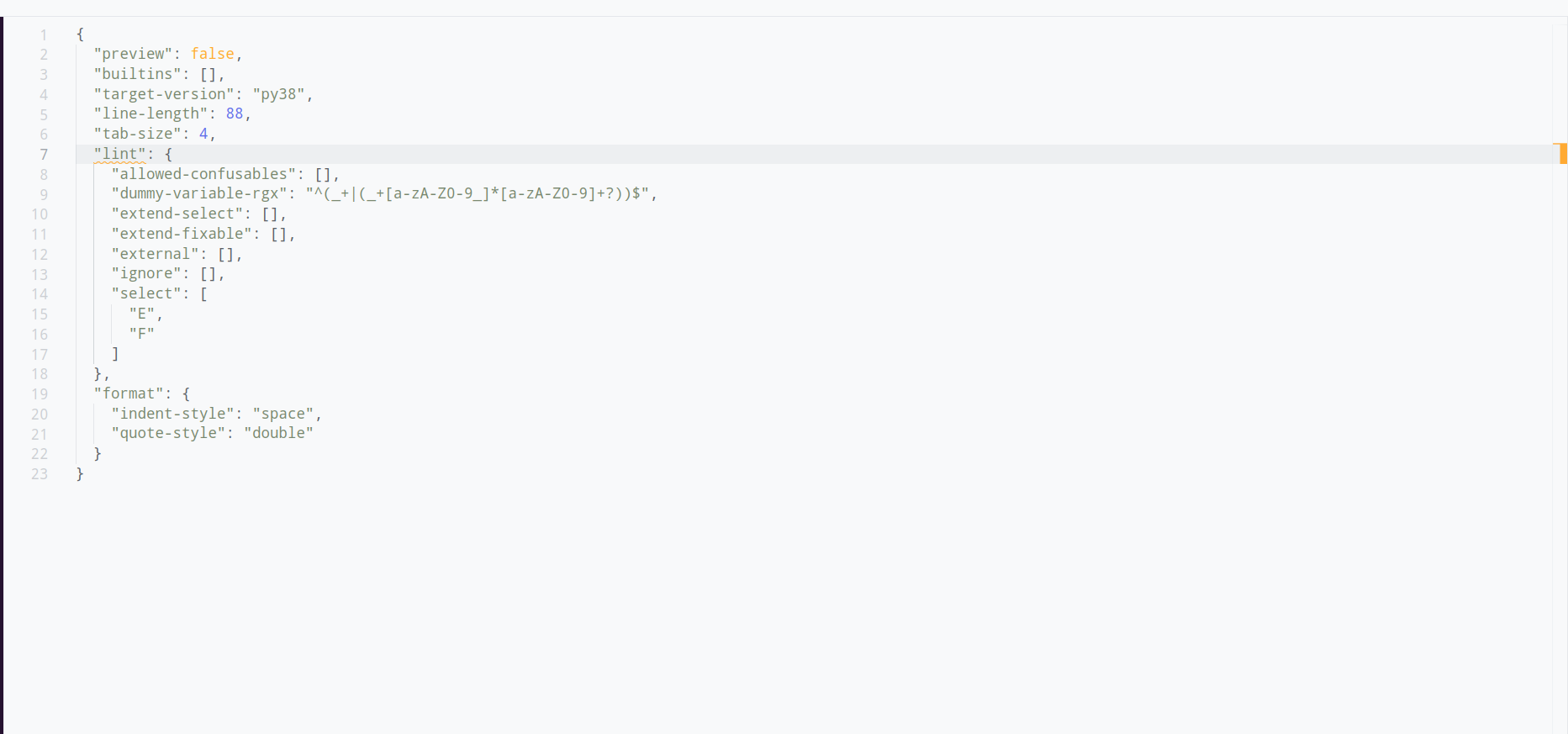
This PR adds a new `lint` section to the configuration that groups all linter-specific settings. The existing top-level configurations continue to work without any warning because the `lint.*` settings are experimental.
The configuration merges the top level and `lint.*` settings where the settings in `lint` have higher precedence (override the top-level settings). The reasoning behind this is that the settings in `lint.` are more specific and more specific settings should override less specific settings.
I decided against showing the new `lint.*` options on our website because it would make the page extremely long (it's technically easy to do, just attribute `lint` with `[option_group`]). We may want to explore adding an `alias` field to the `option` attribute and show the alias on the website along with its regular name.
## Test Plan
* I added new integration tests
* I verified that the generated `options.md` is identical
* Verified the default settings in the playground
## Summary

Implement
[`simplify-print`](https://github.com/dosisod/refurb/blob/master/refurb/checks/builtin/print.py)
as `print-empty-string` (`FURB105`).

Extends the original rule in that it also checks for multiple empty
string positional arguments with an empty string separator.

Related to #1348.

## Test Plan

`cargo test`
## Summary

Implement
[`no-ignored-enumerate-items`](https://github.com/dosisod/refurb/blob/master/refurb/checks/builtin/no_ignored_enumerate.py)
as `unnecessary-enumerate` (`FURB148`).

The auto-fix considers if a `start` argument is passed to the
`enumerate()` function. If only the index is used, then the suggested
fix is to pass the `start` value to the `range()` function. So,

```python
for i, _ in enumerate(xs, 1):
    ...
```

becomes

```python
for i in range(1, len(xs)):
    ...
```

If the index is ignored and only the value is ignored, and if a start
value greater than zero is passed to `enumerate()`, the rule doesn't
produce a suggestion. I couldn't find a unanimously accepted best way to
iterate over a collection whilst skipping the first n elements. The rule
still triggers, however.

Related to #1348.

## Test Plan

`cargo test`

---------

Co-authored-by: Dhruv Manilawala <dhruvmanila@gmail.com>
Co-authored-by: Charlie Marsh <charlie.r.marsh@gmail.com>
## Summary

This PR implements a new rule for `flake8-logging` plugin that checks
for uses of `logging.exception()` with `exc_info` set to `False` or a
falsy value. It suggests using `logging.error` in these cases instead.

I am unsure about the name. Open to suggestions there, went with the
most explicit name I could think of in the meantime.

Refer https://github.com/astral-sh/ruff/issues/7248

## Test Plan

Added a new fixture cases and ran `cargo test`
## Summary

This PR implements a new rule for `flake8-logging` plugin that checks
for
`logging.getLogger` calls with either `__file__` or `__cached__` as the
first
argument and generates a suggested fix to use `__name__` instead.

Refer: #7248

## Test Plan

Add test cases and `cargo test`
## Summary

We're planning to move the documentation from
[https://beta.ruff.rs/docs](https://beta.ruff.rs/docs) to
[https://docs.astral.sh/ruff](https://docs.astral.sh/ruff), for a few
reasons:

1. We want to remove the `beta` from the domain, as Ruff is no longer
considered beta software.
2. We want to migrate to a structure that could accommodate multiple
future tools living under one domain.

The docs are actually already live at
[https://docs.astral.sh/ruff](https://docs.astral.sh/ruff), but later
today, I'll add a permanent redirect from the previous to the new
domain. **All existing links will continue to work, now and in
perpetuity.**

This PR contains the code changes necessary for the updated
documentation. As part of this effort, I moved the playground and
documentation from my personal Cloudflare account to our team Cloudflare
account (hence the new `--project-name` references). After merging, I'll
also update the secrets on this repo.
<!--
Thank you for contributing to Ruff! To help us out with reviewing,
please consider the following:

- Does this pull request include a summary of the change? (See below.)
- Does this pull request include a descriptive title?
- Does this pull request include references to any relevant issues?
-->

## Summary

<!-- What's the purpose of the change? What does it do, and why? -->
Adds the maximum of 320 for the line-length setting to the JSON schema
for better integration with IDEs.

Related https://github.com/astral-sh/ruff/pull/6873

## Test Plan

<!-- How was it tested? -->
## Summary

Adds `LOG009` from
[flake8-logging](https://github.com/adamchainz/flake8-logging). Also
adds the boilerplate for a new plugin

Checks for usages of undocumented `logging.WARN` constant and suggests
replacement with `logging.WARNING`.

## Test Plan

`cargo test` with fresh fixture

## Issue links

Refers: https://github.com/astral-sh/ruff/issues/7248
## Summary

At some point, we removed these so that they wouldn't be autocompleted
for users, since we wanted to discourage usage of `ALL`. But given that
they're valid values, I think that was a bad idea -- it leads to an even
more confusing experience whereby JSON Schema validators tell you that
you have an error, when you don't.

Closes https://github.com/astral-sh/ruff/issues/7261.
## Summary

<!-- What's the purpose of the change? What does it do, and why? -->

Extends work in #7046 (some relevant discussion there)

Changes:

- All nursery rules are now referred to as preview rules
- Documentation for the nursery is updated to describe preview
- Adds a "PREVIEW" selector for preview rules
- This is primarily to allow `--preview --ignore PREVIEW --extend-select
FOO001,BAR200`
- Using `--preview` enables preview rules that match selectors

Notable decisions:

- Preview rules are not selectable by their rule code without enabling
preview
- Retains the "NURSERY" selector for backwards compatibility
- Nursery rules are selectable by their rule code for backwards
compatiblity

Additional work:

- Selection of preview rules without the "--preview" flag should display
a warning
- Use of deprecated nursery selection behavior should display a warning
- Nursery selection should be removed after some time

## Test Plan

<!-- How was it tested? -->

Manual confirmation (i.e. we don't have an preview rules yet just
nursery rules so I added a preview rule for manual testing)

New unit tests

---------

Co-authored-by: Charlie Marsh <charlie.r.marsh@gmail.com>
## Summary

Add a configuration option to extend the list of names that can be
accessed without triggering SLF001.

Fixes issue #7018

## Test Plan

Manually tested by creating a python file (`test.py`):

```python
def foo(obj):
    obj._meta
```

and a `ruff.toml` file:

```toml
select = ["SLF"]

[flake8-self]
extend-ignore-names = ["_meta"]
```

Then running `cargo run -p ruff_cli -- check test.py --no-cache` (once
with the `extend-ignore-names` line comment out) to see if the
configuration option works.

---------

Co-authored-by: Charlie Marsh <charlie.r.marsh@gmail.com>
Per discussion at https://github.com/astral-sh/ruff/discussions/6998

<!--
Thank you for contributing to Ruff! To help us out with reviewing,
please consider the following:

- Does this pull request include a summary of the change? (See below.)
- Does this pull request include a descriptive title?
- Does this pull request include references to any relevant issues?
-->

## Summary

<!-- What's the purpose of the change? What does it do, and why? -->

Adds a `--preview` and `--no-preview` option to the CLI for `ruff check`
and corresponding settings. The CLI options are hidden for now.

Available in the settings as `preview = true` or `preview = false`.

Does not include environment variable configuration, although we may add
it in the future.

## Test Plan

<!-- How was it tested? -->

`cargo build`

Future work will build on this setting, such as toggling the mode during
a test.
 Steve C
 Joffrey Bluthé
 Tom Kuson
 Chaojie
 Adrian
 Jelmer Vernooij
 Alex Bieg
 Tuomas Siipola
 Tuomas Siipola
 Jelmer Vernooij
 Charlie Marsh
 Jake Park
 Alan Du
 Kar Petrosyan
 konsti
 qdegraaf
 Hugo van Kemenade
 Mateusz Sokół
 Andrew Shannon Brown
 Harutaka Kawamura
 Mathieu Kniewallner
 Giulio Mazzanti
 Micha Reiser
 Zanie Blue
 Clément Schreiner
 Valeriy Savchenko
 Dhruv Manilawala
 Eiko Wagenknecht
 Sven Hager
 Henry Schreiner
 Daniel Parizher
 Jelle van der Waa
 Tom Kuson
 Jaap Roes