This PR does two main things:
1. Work through the main low-hanging fruit issues in the formatter
keeping it from feeling mature and usable
2. Iterate and prove that point by formatting all of the Jak 1 code
base. **This has removed around 100K lines in total.**
- The decompiler will now format it's results for jak 1 to keep things
from drifting back to where they were. This is controlled by a new
config flag `format_code`.
How am I confident this hasn't broken anything?:
- I compiled the entire project and stored it's `out/jak1/obj` files
separately
- I then recompiled the project after formatting and wrote a script that
md5's each file and compares it (`compare-compilation-outputs.py`
- The results (eventually) were the same:

> This proves that the only difference before and after is non-critical
whitespace for all code/macros that is actually in use.
I'm still aware of improvements that could be made to the formatter, as
well as general optimization of it's performance. But in general these
are for rare or non-critical situations in my opinion and I'll work
through them before doing Jak 2. The vast majority looks great and is
working properly at this point. Those known issues are the following if
you are curious:

Relates to #1353

This adds no new functionality or overhead to the compiler, yet. This is
the preliminary work that has:
- added code to the compiler in several spots to flag when something is
used without being properly required/imported/whatever (disabled by
default)
- that was used to generate project wide file dependencies (some
circulars were manually fixed)
- then that graph underwent a transitive reduction and the result was
written to all `jak1` source files.

The next step will be making this actually produce and use a dependency
graph. Some of the reasons why I'm working on this:
- eliminates more `game.gp` boilerplate. This includes the `.gd` files
to some extent (`*-ag` files and `tpage` files will still need to be
handled) this is the point of the new `bundles` form. This should make
it even easier to add a new file into the source tree.
- a build order that is actually informed from something real and
compiler warnings that tell you when you are using something that won't
be available at build time.
- narrows the search space for doing LSP actions -- like searching for
references. Since it would be way too much work to store in the compiler
every location where every symbol/function/etc is used, I have to do
ad-hoc searches. By having a dependency graph i can significantly reduce
that search space.
- opens the doors for common shared code with a legitimate pattern.
Right now jak 2 shares code from the jak 1 folder. This is basically a
hack -- but by having an explicit require syntax, it would be possible
to reference arbitrary file paths, such as a `common` folder.

Some stats:
- Jak 1 has about 2500 edges between files, including transitives
- With transitives reduced at the source code level, each file seems to
have a modest amount of explicit requirements.

Known issues:
- Tracking the location for where `defmacro`s and virtual state
definitions were defined (and therefore the file) is still problematic.
Because those forms are in a macro environment, the reader does not
track them. I'm wondering if a workaround could be to search the
reader's text_db by not just the `goos::Object` but by the text
position. But for the purposes of finishing this work, I just statically
analyzed and searched the code with throwaway python code.
Reverse engineer the skinning matrix calculation and port to GOAL. This
is about 3x faster than the MIPS2c version.

As usual, there is a `*use-new-bones*` flag to go back to the old
version.

Fix for a bug in the compiler's `.div.vf` implementation (only happens
if src/dst are the same), and fix for a typo in the register allocator
that would sometimes cause it not to consider xmm8-xmm15.
Major change to how `deftype` shows up in our code:
- the decompiler will no longer emit the `offset-assert`,
`method-count-assert`, `size-assert` and `flag-assert` parameters. There
are extremely few cases where having this in the decompiled code is
helpful, as the types there come from `all-types` which already has
those parameters. This also doesn't break type consistency because:
- the asserts aren't compared.
- the first step of the test uses `all-types`, which has the asserts,
which will throw an error if they're bad.
- the decompiler won't emit the `heap-base` parameter unless necessary
now.
- the decompiler will try its hardest to turn a fixed-offset field into
an `overlay-at` field. It falls back to the old offset if all else
fails.
- `overlay-at` now supports field "dereferencing" to specify the offset
that's within a field that's a structure, e.g.:
```lisp
(deftype foobar (structure)
((vec vector :inline)
(flags int32 :overlay-at (-> vec w))
)
)
```
in this structure, the offset of `flags` will be 12 because that is the
final offset of `vec`'s `w` field within this structure.
- **removed ID from all method declarations.** IDs are only ever
automatically assigned now. Fixes#3068.
- added an `:overlay` parameter to method declarations, in order to
declare a new method that goes on top of a previously-defined method.
Syntax is `:overlay <method-name>`. Please do not ever use this.
- added `state-methods` list parameter. This lets you quickly specify a
list of states to be put in the method table. Same syntax as the
`states` list parameter. The decompiler will try to put as many states
in this as it can without messing with the method ID order.
Also changes `defmethod` to make the first type definition (before the
arguments) optional. The type can now be inferred from the first
argument. Fixes#3093.
---------
Co-authored-by: Hat Kid <6624576+Hat-Kid@users.noreply.github.com>
This renames the method object in `defmethod`s to `this` and adds
detection for the `set-time!` and `time-elapsed?` macros.

Definitely my biggest PR yet...
Removes a leftover case for falling to back to generic-merc in jak 1.
This should fix the bug where daxter's face wasn't animated in the intro
after floating-point blerc was added.
This moves the blerc math from mips2c to the Merc2 renderer, and uses
floats instead.

We could potentially do this on the GPU, which would be even faster, but
this isn't that slow in the first place.
- better handling of the `disable-fog` settings for merc, should fix the
spotlights. There's a setting in the merc effect, and also a runtime
flag for the draw-control. I'm not actually sure what reads these, but
the draw-control one is definitely used to disable fog on the
spotlights.
- increase merc draw limit to try to fix the issue about partially drawn
citizens in the city
- remove useless debug prints (it's okay to die in init, and the medium
load buffer size mode is understood now)
Three main changes:

- Adds support for the texture scrolling effect used on conveyor belts,
and turn it on for jak 2.
- Use merc instead of generic in jak 1 for ripple/water/texscroll stuff
(non-ocean water, lava, dark eco, etc). This is a pretty big speedup in
a lot of places.
- Fix a really old bug with blending mode used to draw environment maps.
The effect is that envmaps were half as bright as they should have been.

As usual, there's a flag to go back to the old behavior on jak 1. Set
these to `#t` to use generic like we used to.
```
*texscroll-force-generic*
*ripple-force-generic*
```

The format has changed, and everything must be rebuilt (C++, FR3's, GOAL
code)
Support rendering eyes with merc for both jak 1 and jak 2.

For jak 1, everything should look the same, but merc will be used to
draw eyes. This means that jak is now fully drawn with merc!

For jak 2, eyes should draw, but there are still a few issues:
- the tbp/clut ptr trick is used a lot for these eye textures, so
there's a lot that use the wrong texture
- I had to enable a bunch more "texture uploads" (basically emulating
the ps2 texture system) in order to get the eyes to upload. It would be
much better if the eye renderer could somehow grab the texture from the
merc model info, skipping the vram addressing stuff entirely. I plan to
return to this.
- I disabled some sky draws in `sky-tng`. After turning on pris2
uploads, the sky flashed in a really annoying way.
Moves PC-specific entity and debug menu things to `entity-debug.gc` and
`default-menu-pc.gc` respectively and makes `(declare-file (debug))`
work as it should (no need to wrap the entire file in `(when
*debug-segment*` now!).
Also changes the DGO descriptor format so that it's less verbose. It
might break custom levels, but the format change is very simple so it
should not be difficult for anyone to update to the new format. Sadly,
you lose the completely useless ability to use DGO object names that
don't match the source file name. The horror!
I've also gone ahead and expanded the force envmap option to also force
the ripple effect to be active. I did not notice any performance or
visual drawbacks from this. Gets rid of some distracting LOD and some
water pools appearing super flat (and pitch back for dark eco).
Fixes#1424
This PR adds a feature to merc2 to update vertices. This will be needed
to efficient do effects like blerc/ripple/texture scroll. It's enabled
for blerc in jak 1 and jak 2, but with a few disclaimers:
- currently we still use the mips2c blerc implementation, which is slow
and has some "jittering" because of integer precision. When porting to
PC, there was an additional synchronization problem because blerc
overwrites the merc data as its being read by the renderers. I _think_
this wasn't an issue on PS2 because the blerc dma is higher priority
than the VIF1 DMA, but I'm not certain. Either way, I had to add a mutex
for this on PC to avoid very slight flickering/gaps. This isn't ideal
for performance, but still beats generic by a significant amount in
every place I tested. If you see merc taking 2ms to draw, it is likely
because it is stuck waiting on blerc to finish. This will go away once
blerc itself is ported to C++.
- in jak 1, we end up using generic in some cases where we could use
merc. In particular maia in village3 hut. This will be fixed later once
we can use merc in more places. I don't want to mess with the
merc/generic selection logic when we're hopefully going to get rid of it
soon.
- There is no support for ripple or texture scroll. These use generic on
jak 1, and remain broken on jak 2.
- Like with `emerc`, jak 1 has a toggle to go back to the old behavior
`*blerc-hack*`.
- In most cases, toggling this causes no visual differences. One
exception is Gol's teeth. I believe this is caused by texture coordinate
rounding issues, where generic has an additional float -> int -> float
compared to PC merc. It is very hard to notice so I'm not going to worry
about it.
This adds environment mapping support to `Merc2`, and turns it on for
Jak 1 and Jak 2.
- The performance is much better
- Jak 1 can be toggled back to the old behavior with `(set! *emerc-hack*
#f)`. The new environment mapping is identical to the old one everywhere
I checked.
- Jak 1 still falls back to generic for ripple/texscroll/blerc/eyes -
there's still no dynamic texture or vertex updating support. The eye
detection stuff will sometimes flag stuff as eyes which is not eyes,
which is fine, but means that generic will be used in some places where
emerc could be used. For example, the shiny plates on jak's arm will be
drawn with generic because jak has eyes.
- Jak 2 hasn't been checked super carefully against PCSX2 yet.
- Jak 2 still isn't technically using emerc, but instead putting emerc
models in the merc bucket.
- The interface to merc is a lot different now and totally custom
OpenGOAL DMA code. The original merc drawing asm doesn't run anymore.
- The FR3 format changed
- Something funky going on with foreground lighting in escape, but
doesn't seem to be related to this change?
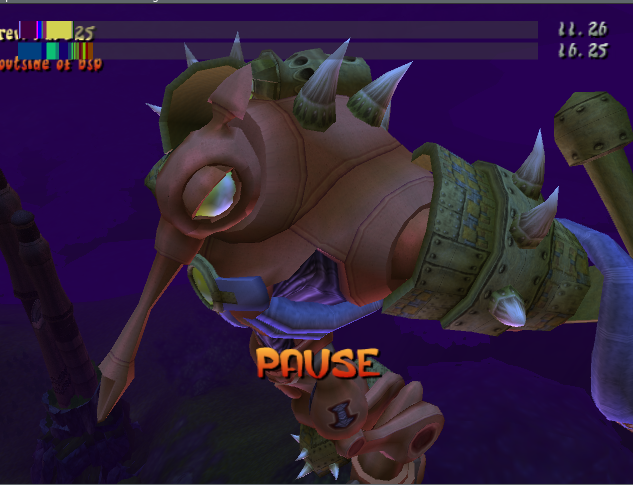
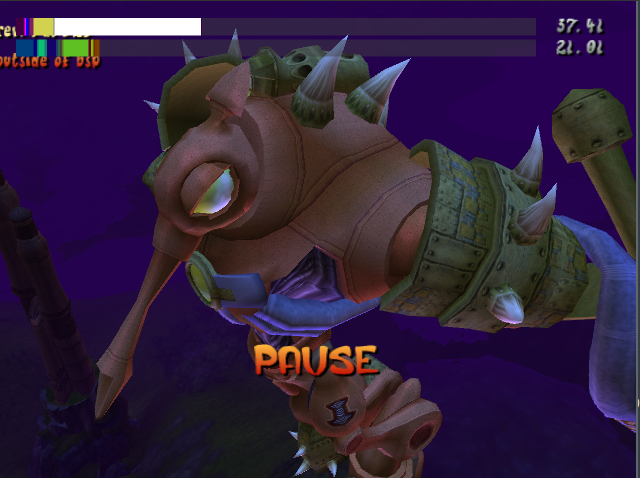
Performance comparison, jak 1, in likely the most generic-merc heavy
spot:
* raise particles cap to 10x

* change a text line

* allow sound bank load during vag

* fix default settings and fps setting

* keep "auto save disabled" option in menu

* cheats menu!

* Update game_text_ja.gs

* fix battle hud crash

* add cheats menu to title

* update settings version

* Update all-types.gc

* disable envmap fade out with hires actor lod setting

* disable merc fadeout if not using ps2 actor lods

* dont update aspect ratio if game size is bad

* set vsync later

* increase memory for generic, sprite and dma.

* fix issues with aspect ratio not saving

* split forcing envmap to a separate toggle

* too slow, dont expose to users yet
 Tyler Wilding


